Cathode Ray Tubes and Instruments for 3rd Generation Information Display Systems
As is well known, the head-up displays (HUDs) included in the IPP-2-53, SEI-31, and Narcissus systems utilize the Kunitsa projection CRT. This PELT is also known to have a number of drawbacks, the main ones being the "screen effect"—the presence of a residual screen glow at night and the formation of halos around image elements when brightness is increased, which reduces contrast. The causes of these drawbacks in the Kunitsa PELT and methods for mitigating them have been discussed above. Therefore, during the development of the KAI-1, the need to create a new, improved PELT with higher brightness and resolution and devoid of these drawbacks became urgent. The Platan Research Institute began developing a similar PELT in the early 1980s. This PELT, called "Latex," was a tube with a ceramic envelope using leucosapphire as the screen, which has higher thermal conductivity than glass. With an anode voltage of 18 kV and mixed (magnetic and electrostatic) focusing, the "Lateks" PELT, according to the developers, was expected to provide high brightness, greater resolution, and significantly longer life than existing PELTs. Considering that the claimed characteristics of the "Lateks" PELT significantly exceeded those of the "Kunitsa" PELT, a new tube was incorporated into the KAI-1 design. However, during testing of the KAI-1, the claimed characteristics of the "Lateks" PELT were not confirmed. This was due to the PELT developers' miscalculation of the phosphor capabilities and the reliability of the bonding technology between the ceramic envelope and the leucosapphire. The point is that as the brightness was increased, the phosphor saturated, and the expected proportional increase in brightness did not occur. Instead, critical heating of the screen occurred due to localized concentration of radiant energy. It was this latter factor that necessitated the use of leucosapphire. Furthermore, during bench and flight tests, including factory tests of the MIG-29M aircraft, frequent failures of the Latex PELT occurred due to leaks, leading to complete failure of the KAI. Almost all Lateks PELTs manufactured by the Platan Research Institute failed within a relatively short period of time. Only a small reserve of these tubes and a well-organized repair service at NIO-2 allowed flight tests of the aircraft to continue for some time. Another significant drawback of the Lateks PELT is the hard X-ray radiation it generates, especially in the direction of the tube axis. The tube's screen, made of leucosapphire, unlike the glass in conventional CRTs, does not block radiation levels several times higher than the permissible limit. Since the preliminary adjustment of the PELT control unit is performed without the optical head attached, adjusters could be exposed to strong radiation when turning it on. These objective facts were established by specialists from the V. G. Khlopin Institute, who conducted corresponding measurements at workstations within the Association. At the Institute's recommendation, the necessary radiation protection measures were implemented at these workstations. Finally, regarding the "Lateks" PELTs, it should be noted that these PELTs are extremely expensive: in 1986 prices, it was 2,500 rubles per sample.
In 1987, On the initiative of M. Z. Lvovsky and V. A. Sysoev, supported by the Association's General Director, K. K. Filippov, and in accordance with the Technical Specifications approved by him, the plant (MELZ) began developing an alternative PELT based on the Moscow "Kunitsa" PELT bulb, dubbed "Koma." The development of the new PELT received the support of the Ministry of Defense, which instructed the relevant services to continuously monitor the development process. The development of the "Koma" PELT utilized the latest advances in electron optics and incorporated a modern technology based on laser processing of the focusing elements of the PELT's electron optics. The use of an improved phosphor, combined with a successful optical design, made it possible to achieve very high performance at an anode voltage of 15 kV and a focusing electrode voltage of 2 kV. The brightness of the Koma PELT (in a compressed raster) is twice that of the Kunitsa PELT, reaching 12,000–14,000 cd/m², and the resolution is increased by 30 (line width 0.08–0.1 mm). The "screen effect" and halo formation when boosting brightness are virtually eliminated. The working tube diameter is 55 mm, the neck diameter is 22 mm, the flare angle is 55°, and the tube length is 220–230 mm.
The cost of the Koma PELT was 200 rubles in 1987–1988 prices, or 12.5 times lower than the cost of the Lateks PELT, with identical characteristics. The development of the Koma PELT made it possible to promptly resolve the crisis that arose as a result of the failure of the Lateks tube. In a short time, the KAI-1 design was developed based on the Koma PELT (Lead Designer F. D. Zharzhavsky), and all previously manufactured indicators were modified. In 1988, state testing of the Koma PELT was completed, and it received certification for use in military equipment.
Monochromatic CRT for ELI cathode-ray indicators.
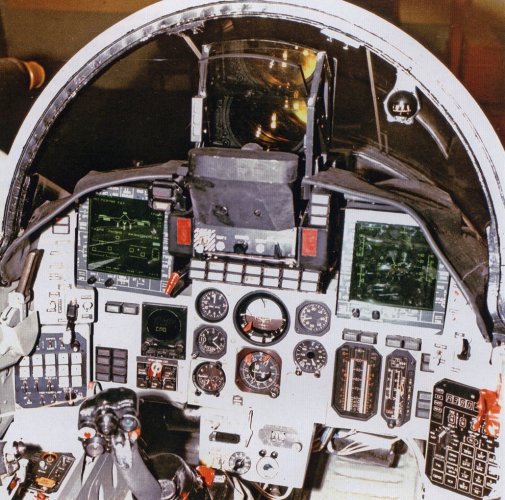
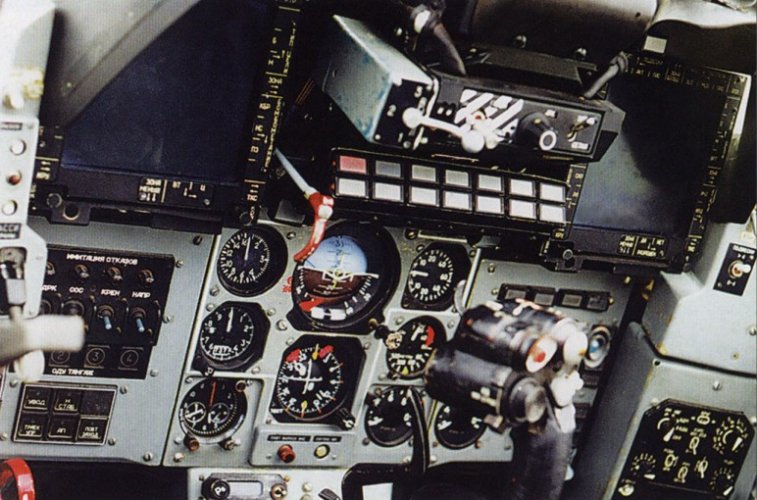
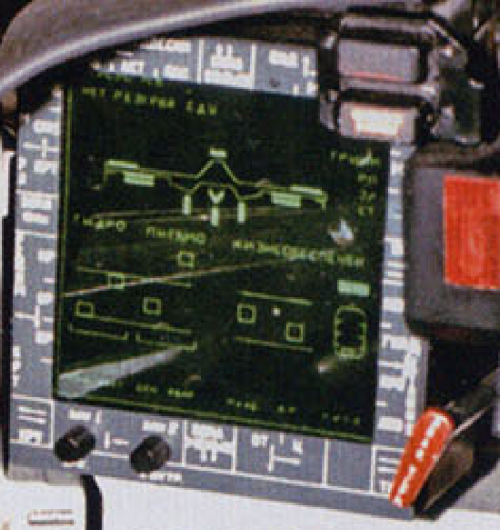
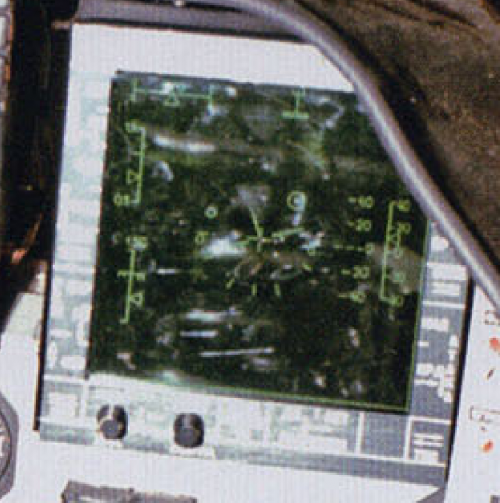
While developing the concept for building third-generation information display systems, which include the KROKUS and EDELWEISS systems, the Association studied the state of development in the field of direct-view cathode-ray tubes and their future development prospects. The research results revealed that the Soviet electronics industry lagged significantly behind the global market in this area. This was especially true for color (mask) CRTs suitable for use onboard cannon-armed fighters. Moreover, there was no reason to expect any changes in this area in the coming years, which subsequently proved to be true. Given these and other circumstances, the decision was made to design ELI based on a monochromatic CRT. This decision was not uncommon in international practice. An example of a similar approach is the information display system on the F-18 fighter, which was recognized as meeting the requirements for integrated display systems for aircraft of this type. Monochromatic CRTs in direct-view displays like the ELI are square, with a working screen size of 127 mm x 127 mm. The developers of this system assumed that the high brightness of the CRT would ensure, through luminance contrast, the reliable perception of all graphic image elements, even when they differ in shape and location, based on the fundamental principles of engineering psychology.
At an extended meeting of the Council of Chief Designers at the Mikoyan Moscow Machine Building Plant, attended by representatives of the MAP research institutes, the Association's viewpoint on the design principles of the KROKUS information display system was presented by the author, Deputy Head of NIO-2, at the request of the Association's General Director, K. K. Filippov. Despite the compelling arguments presented in support of the Association's proposals, representatives of the leading MAP institutes (LII, NIIAS) categorically opposed the Association's concept, insisting on the use of penetrons in the ELI. This was despite the fact that the futility of this type of CRT was already obvious at the time, having even been abandoned by its French creators. Toshiba and Intel revolutionized this field by creating a high-brightness color liquid crystal display panel with an internal backlight and an integrated control system. Within a short time, electronic display systems were developed based on these panels, which were installed on production Boeing 757 and 767 aircraft. Unfortunately, the domestic electronics industry did not have such capabilities. Therefore, the KROKUS developers had no alternative but to use a monochromatic tube similar to the F-18.
Mikoyan Machine Building Plant Deputy Chief Designer Yu. A. Yanyshev soon recognized the Association's position as the only viable one. Thanks to him, the Ministry of Electronics Industry coordinated all technical and organizational issues related to the development of a new monochromatic CRT for electronic devices, featuring high brightness and high resolution, as well as the selection of a developer. This was the Platan Research Institute, with which the technical specifications for the CRT development and the development program were agreed upon. For the first time in the Ministry of Electronics Industry, Platan Research Institute implemented a comprehensive approach to CRT development, taking into account real-world operating conditions at the facility and factors ensuring the achievement of the best CRT performance. The institute's electron beam device, dubbed "Litva," includes the CRT itself, a focusing and deflecting system (FDS), and an electromagnetic shield with device mounting elements in the display. The "Litva" EBT is manufactured using modern technology and has flexible leads, including high-voltage leads. The space between the CRT bulb and the electromagnetic shield is filled with a special compound, ensuring the rigidity of the CRT structure.
The "Litva" CRT is equipped with an anti-glare filter with an anti-reflective coating on the first surface. The filter's absorption coefficient is 90%. To protect the coating from damage, the CRT is supplied with a special soft cap. The high-quality filter allows for the viewing of not only symbolic information generated by the functional method, but also raster, multi-gradient images with 67 gradations at a maximum ambient illumination of 100,000 lux. The flare angle of the CRT bulb is less than 50°, reducing power consumption by 40° compared to the "Malyshka" CRT. The main characteristics of the "Litva" ELP: screen size 130mm x 130mm, dimensions 145mm x 145mm x 350mm, anode voltage of 16kV, line width of 0.20-22mm, service life of 1000 hours. The "Litva" ELP has successfully passed state tests for compliance with the requirements for military aircraft components.
The acceptance by the Mikoyan Machine Building Plant of the concept for constructing the KROKUS information display system for the MiG-29M aircraft, proposed by the Association, and the real assistance in organizing the work related to the creation of new electronic components, in particular the "Litva" electronic control system, allowed the Association to begin developing and manufacturing prototypes of the KROKUS system. It is worth noting the positive role of F. D. Zharzhavsky, KROKUS 's lead designer, in the creation of the "Litva" electronic control system. His rational proposals for the external contours of the tube and its mounting method were taken into account during its development.
The development of the KROKUS system was carried out in accordance with the technical specifications agreed upon with the Mikoyan Machine Building Plant and the Air Force. Prototypes of the KROKUS system were manufactured in late 1988. Following laboratory debugging, two prototypes of this system were sent to the Institute of Space and Aviation Medicine for testing on a simulator created based on the actual cockpit of a MIG-29M aircraft and to the Integrated Department of the Association for bench testing as part of the Scientific and Production Complex. The third prototype of the KROKUS system was subjected to bench testing for compliance with the requirements of the Technical Specifications. The tests revealed that the prototype of the KROKUS information display system, in terms of its accuracy, optical, and lighting characteristics, fully complied with the requirements of the Technical Specifications and outperformed all previously developed systems for a similar purpose. In 1987–1988, to support flight tests of the MIG-29M aircraft, an intermediate version of the information display system was created, consisting of KAI-1 and ELI indicators and SEI-31 units: TsVM20–6, GS-31, BP. Corresponding software was developed for this system. It was during the factory testing process that the defects of the Lateks CRT, which were mentioned above, were discovered.