
You are using an out of date browser. It may not display this or other websites correctly.
You should upgrade or use an alternative browser.
You should upgrade or use an alternative browser.
M1 Abrams Developments and News
- Thread starter Forest Green
- Start date

Grey Havoc
ACCESS: USAP
- Joined
- 9 October 2009
- Messages
- 24,500
- Reaction score
- 18,175
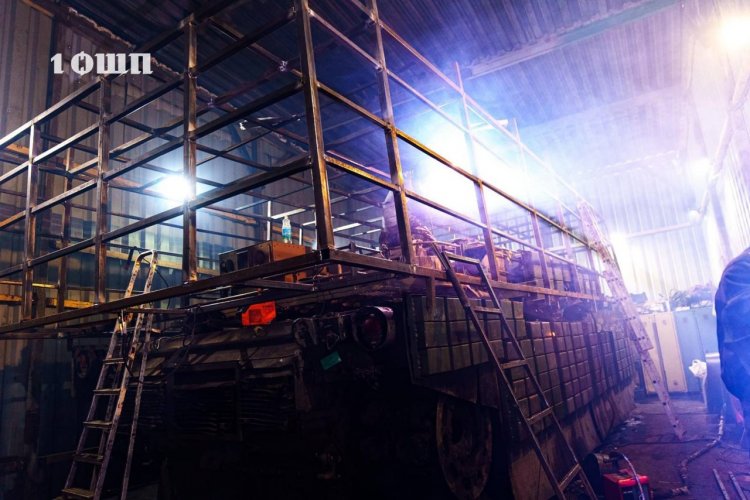
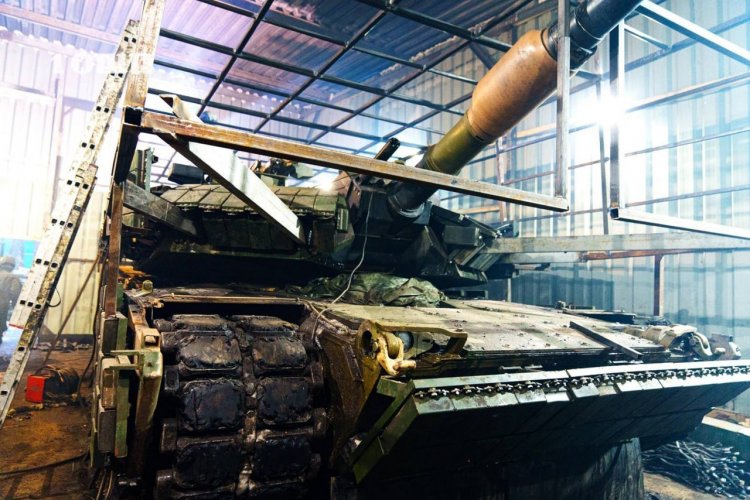
Looks like its been turned into an ad hoc assault gun. That is a desperation move.They're using this tank for indirect fire only, I assume. That turret can no longer traverse.

Winchester
ACCESS: Confidential
- Joined
- 26 May 2008
- Messages
- 90
- Reaction score
- 209
C13D commercial units tap out at 690hp , so to get to 1100hp or something they would need to be forcing the heck out of it . Besides there are commercial truck engines with 16liter and V shape around 800hp of the shelf , but i reckon one of the reasons for looking at caterpillar its in its core a very simple engine with minimal ancillary gear and the other thing it has multiple power take off points where you could connect generators or hydraulics
Top truck engines at the moment Chinese Shacman , Scania D16 and Volvo
Scania D16 makes 750hp for truck , but without all the emission controls and tuned up it was built into T72 tanks for poland with 1150hp , marine variant also produce over 1100hp.
View attachment 799910
Keep in mind that truck engines are designed to be run for at least eight hours a day for years on end. I wouldn't be surprised if your average commercial line-haul truck puts on more miles in a month than a tank does in a year.
Also, maintenance on tanks is part of the training cycle, so any tank that's actually being driven is going to have its engine out for inspection and repair at least once per year just for the training opportunity.
Under those circumstances? I would not be surprised if the tank version of the same engine provides twice the power of the civilian one.
yeetmahboi
ACCESS: Top Secret
- Joined
- 6 April 2022
- Messages
- 1,025
- Reaction score
- 1,435
They can still use neutral steering, and overhead drone surveillance can give a fair warning.They're using this tank for indirect fire only, I assume. That turret can no longer traverse.
A lot of mechanized attacks use tanks like this because they are assaulting run down towns defended by a lot or two of fireteams supported by a disproportionately large drone strike force, so defense is placed over other qualities.
A lot of other militaries should be learning, shall they not fall prey to arrogance.

EmoBirb
ACCESS: Top Secret
- Joined
- 18 January 2025
- Messages
- 2,712
- Reaction score
- 6,955
The turtlefication of the M1 is setting in, better late than never.Abrams finally getting boss level FPV protection in addition to all the explosive reactive armor
M1A1 AIM (AFU) in process of installation of “mangal” anti FPV protective structure
View attachment 807250
View attachment 807251

Kat Tsun
eeeeeeeeeeeeeee
- Joined
- 16 June 2013
- Messages
- 1,887
- Reaction score
- 2,669
They're using this tank for indirect fire only, I assume. That turret can no longer traverse.
All tanks are indirect fire now. They haven't been used in main assaults for years, unless you're backwards like Rusich, honestly.

Colonial-Marine
UAVs are now friend, drones are the real enemy.
- Joined
- 5 October 2009
- Messages
- 1,718
- Reaction score
- 1,832
There is nothing to be learned from crippling your main battle tank's ability to rapidly engage targets, it's an improvisation brought about by desperation. What needs to be learned is the need for appropriate vehicle support to neutralize enemy drones, and the need for a new generation of APS.They can still use neutral steering, and overhead drone surveillance can give a fair warning.
A lot of mechanized attacks use tanks like this because they are assaulting run down towns defended by a lot or two of fireteams supported by a disproportionately large drone strike force, so defense is placed over other qualities.
A lot of other militaries should be learning, shall they not fall prey to arrogance.
Well ,in practical use Mangal and Hedgehogs take most punishment to disable or destroy. We also see in lebanon APS is not intercepting any FPVs . So till there is working defense system for FPV , and such that it does not run on empty after first attack .these cages will be built
yeetmahboi
ACCESS: Top Secret
- Joined
- 6 April 2022
- Messages
- 1,025
- Reaction score
- 1,435
I don't have a real ball in the bet but I'd advise the next generation of tankers anywhere on the world to look at where real large scale 21st century mechanized combat is happening, the lessons the participants are drawing and how your commandants learn from those. To sign out ASAP if the mud is strong.
Colonial-Marine
UAVs are now friend, drones are the real enemy.
- Joined
- 5 October 2009
- Messages
- 1,718
- Reaction score
- 1,832
I don't know if the present conditions that conflict has devolved into can still qualify as large scale mechanized combat anymore. Most actions involving AFVs now are small scale at best. What is clear however is the need for new systems to counter the constant barrage and surveillance of drones, else those tankers will be stuck serving as little more than live decoy targets for the enemy to expend drones on.I don't have a real ball in the bet but I'd advise the next generation of tankers anywhere on the world to look at where real large scale 21st century mechanized combat is happening, the lessons the participants are drawing and how your commandants learn from those. To sign out ASAP if the mud is strong.
The improvisations deemed necessary in Ukraine doesn't mean the rest of the world should start welding things to their tanks until they've compromised their ability to rapidly engage targets. They need to be looking for ways to avoid having to do that.

Forest Green
ACCESS: USAP
- Joined
- 11 June 2019
- Messages
- 14,581
- Reaction score
- 31,688
Scott Kenny
ACCESS: USAP
- Joined
- 15 May 2023
- Messages
- 19,651
- Reaction score
- 28,129
I'm struggling to find info on the Rook APS. Anyone got a link?
Forest Green
ACCESS: USAP
- Joined
- 11 June 2019
- Messages
- 14,581
- Reaction score
- 31,688
There's a little bit in link on the tweet.I'm struggling to find info on the Rook APS. Anyone got a link?
https://www.baesystems.com/en-us/ar...rotection-system-for-u-s-army-combat-vehicles
BAE Systems has been awarded the Soft Kill Active Protection System (APS) program of record by the U.S. Army, equipping ground vehicles with advanced electronic warfare capabilities. The program leverages BAE Systems’ Rapid Optical Observation and Kill (ROOK) system to disrupt and defeat incoming threats, including unmanned aerial systems (UAS) and anti-tank guided missiles, enhancing crew and vehicle survivability and mission effectiveness.
ROOK is a leading soft-kill countermeasure system, providing improved situational awareness and threat response in complex battlefield conditions. The system’s electronic countermeasures defeat threats before they reach the vehicle by confusing or jamming their guidance systems. This renders the threats ineffective while preserving the limited magazine depth of hard-kill kinetic countermeasures.
Some useful comparisons of different APS employed by US Army here too:
https://thedefensepost.com/2026/05/28/bae-systems-rook-us-army/
Scott Kenny
ACCESS: USAP
- Joined
- 15 May 2023
- Messages
- 19,651
- Reaction score
- 28,129
Thank you!There's a little bit in link on the tweet.
So, it's more or less an aircraft DIRCM/MAWS system, and it sounds like it includes an active laser dazzler. It also automatically slews the turret to face the incoming. Automatic sagger drill.
Still think we need one of those 50-100kw lasers at the back of the turret as an AA laser with enough power to shoot down incoming.
Seems like ROOK will be ineffective against FPVs using fiber for guidance.Thank you!
So, it's more or less an aircraft DIRCM/MAWS system, and it sounds like it includes an active laser dazzler. It also automatically slews the turret to face the incoming. Automatic sagger drill.
Still think we need one of those 50-100kw lasers at the back of the turret as an AA laser with enough power to shoot down incoming.
Unclear what frequencies are involved, but likely it is designed to use lasers to interfere with EO sensors. Even laser pointers can cause glare, and with long, steady exposure, even damaging. A military system with much higher output could pretty easily blind cheaper commercial electronics. Certainly glare is quite easily accomplished. The trick is detecting the UAV in the first place and accurately engaging it with a steady beam.
Scott Kenny
ACCESS: USAP
- Joined
- 15 May 2023
- Messages
- 19,651
- Reaction score
- 28,129
Not when the DIRCM is shining a laser right into the FPV cameras.Seems like ROOK will be ineffective against FPVs using fiber for guidance.
Forest Green
ACCESS: USAP
- Joined
- 11 June 2019
- Messages
- 14,581
- Reaction score
- 31,688
Problem is you need above 300kWe for a military 100kW laser, which likely means 1MWt or 1341hp, which would mean using almost all engine power and a pretty sizeable generator. Basically the tank would need to tow a caravan. Although for self-defence purposes you may only need about 10% of those power levels, since it only really has to work inside ~100m against FPVs.Still think we need one of those 50-100kw lasers at the back of the turret as an AA laser with enough power to shoot down incoming.
Scott Kenny
ACCESS: USAP
- Joined
- 15 May 2023
- Messages
- 19,651
- Reaction score
- 28,129
Batteries, capacitors, or flywheels. You don't need that power all the time. So maybe you keep that 1500hp tank engine and use 500hp to charge up the laser batteries, in addition to charging the batteries for motive power.Problem is you need above 300kWe for a military 100kW laser, which likely means 1MWt or 1341hp, which would mean using almost all engine power and a pretty sizeable generator. Basically the tank would need to tow a caravan. Although for self-defence purposes you may only need about 10% of those power levels, since it only really has to work inside ~100m against FPVs.
Or maybe you have a pair of ~600hp engines, one for moving the tank and one for charging the laser. Or 800/400 or whatever.
CastleBravo
ACCESS: Confidential
- Joined
- 21 January 2026
- Messages
- 197
- Reaction score
- 184
Problem is you need above 300kWe for a military 100kW laser, which likely means 1MWt or 1341hp, which would mean using almost all engine power and a pretty sizeable generator. Basically the tank would need to tow a caravan. Although for self-defence purposes you may only need about 10% of those power levels, since it only really has to work inside ~100m against FPVs.
The engine puts out ~1MW net power, not ~1MWt.
RC LCO batteries can run at 100C or higher. Keep the battery on the laser mount outside the turret so it doesn't do anything bad to the crew and/or ammo if it ignites. SMC for instance makes a 14.8V 9500mAh 150C pack that can supply bursts of ~20kw and it only weighs ~1kg. Fifteen of them on the top of the turret would be able to supply ~300kw in bursts.
Scott Kenny
ACCESS: USAP
- Joined
- 15 May 2023
- Messages
- 19,651
- Reaction score
- 28,129
The trick with that would be battery recharge time.The engine puts out ~1MW net power, not ~1MWt.
RC LCO batteries can run at 100C or higher. Keep the battery on the laser mount outside the turret so it doesn't do anything bad to the crew and/or ammo if it ignites. SMC for instance makes a 14.8V 9500mAh 150C pack that can supply bursts of ~20kw and it only weighs ~1kg. Fifteen of them on the top of the turret would be able to supply ~300kw in bursts.
Forest Green
ACCESS: USAP
- Joined
- 11 June 2019
- Messages
- 14,581
- Reaction score
- 31,688
Got to convert to electrical though.The engine puts out ~1MW net power, not ~1MWt.
CastleBravo
ACCESS: Confidential
- Joined
- 21 January 2026
- Messages
- 197
- Reaction score
- 184
Got to convert to electrical though.
Yes, at ~90% efficiency, not 30% like you stated.
Forest Green
ACCESS: USAP
- Joined
- 11 June 2019
- Messages
- 14,581
- Reaction score
- 31,688
Yeah you're right, I overlooked that, it's kinetic to electrical not thermal to electrical.Yes, at ~90% efficiency, not 30% like you stated.
Some of the cope cages seem to be attached to the turret so that it can still function.The improvisations deemed necessary in Ukraine doesn't mean the rest of the world should start welding things to their tanks until they've compromised their ability to rapidly engage targets. They need to be looking for ways to avoid having to do that.
If the tank is electric drive with the engine essentially as a gen set or range extender, there should be enough battery to power the occasional laser burst.Problem is you need above 300kWe for a military 100kW laser
Similar threads
-

-
Armed UAV search and wipe out the portable anti-tank missile shooter
- Started by li zhuo peng
- Replies: 0
-
 Army Wants 'Air Droppable' Light Tank & Ultra-Light Vehicles
- Started by bobbymike
- Replies: 750
-
 Т-64A and object 287, object 775 ERA, 1968 design
- Started by Andrei_bt
- Replies: 7
-