RavenOne
ACCESS: Top Secret
- Joined
- 18 June 2008
- Messages
- 1,134
- Reaction score
- 3,466
NaVAIR designates the EC-130J TACAMO as the E-130J

cheers
cheers


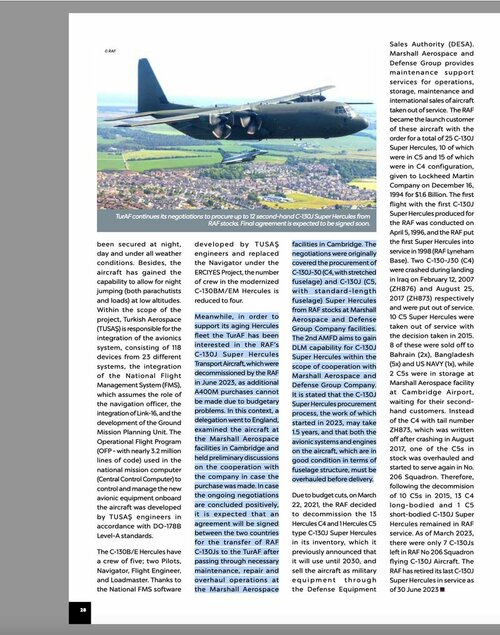
Türkiye will buy twelve ex-RAF Super Hercules'
Already rumoured back in July, Türkiye will buy twelve of the fifteen Royal Air Force Super Hercules transport aircraft that have been stored at Cambridge since their withdrawal from use, starting in June 2022.
The aircraft stored consist of two types: the Hercules C4 and Hercules C5. Scramble assesses that the Türk Hava Kuvvetleri Komutanlığı (Turkish Air Force Command) will acquire twelve “stretched fuselage” C-130J-30s, designated by the RAF as Hercules C4. The acquisition of the C-130J-30 makes sense, since the Turkish Air Force already operates the C-130B and C-130E models it is familiar with the aircraft and its logistics. These stretched versions will provide additional tactical transport capacity, their maintenance and logistics costs are relatively low and the total time of flight hours on the airframes is low. Some sources state that one Hercules C5 (C-130J) is part of the deal.
It remains to be seen what the acquisition means for the existing 222 Filo operated fleet of Hercules’ that underwent the locally developed ERCIYES modernisation programme. Under the programme, the avionics modernisation of thirteen C-130Es and six C-130Bs was scheduled by 2nci HIBM.K (2nd Hava İkmal Bakim Merkezi Komutanlığı or Air Supply Maintenance Center Command) at Kayseri-Erkilet. One airframe (former Saudi Air Force 451, serial 65-0451) is stored at Kayseri pending the upgrade, and with this acquisition in mind, it is likely that it will not receive the upgrade and will be cannibalised for spare parts.
Currently stored at Cambrige are the following fifteen Hercules’, twelve of them are now sold to Türkiye:
Hercules C4
ZH865, 382-5408, ex N130JA
ZH866, 382-5414, ex N130JE
ZH867, 382-5416, ex N130JJ
ZH868, 382-5443, ex N130JN
ZH869, 382-5444, ex N130JV
ZH870, 382-5445, ex N73235
ZH871, 382-5446, ex N73238
ZH872, 382-5456, ex N4249Y
ZH874, 382-5458, ex N41030
ZH875, 382-5459, ex N4099R
ZH877, 382-5461, ex N4081M
ZH878, 382-5462, ex N73232
ZH879, 382-5463, ex N4080M
Hercules C5
ZH888, 382-5496, ex N4187
ZH889, 382-5500, ex N4099R
since the Turkish Air Force already operates the C-130B and C-130E models
It seems TurAF can't reach a consensus...
That sounds about right for equipment that has been sitting in storage for ~20 years.It seems TurAF can't reach a consensus...
Nice article from the Aviationist:


 www.facebook.com

Royal Australian Air Force - you can just see the black titling on the perspex section.What about the flag identity in the fin. Is that the 1928-1994 South African flag?
 www.facebook.com
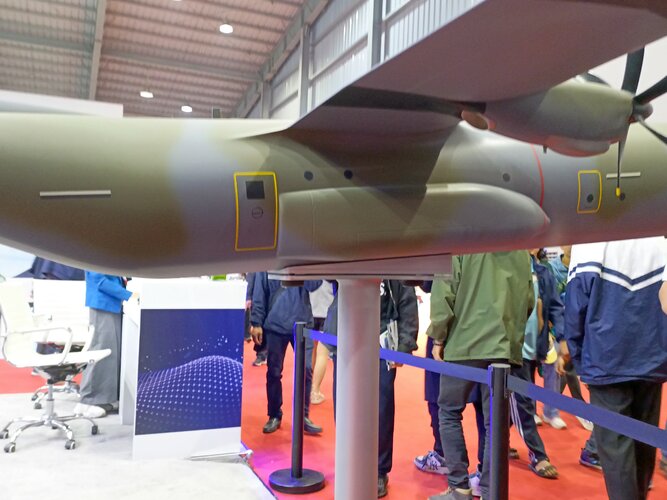
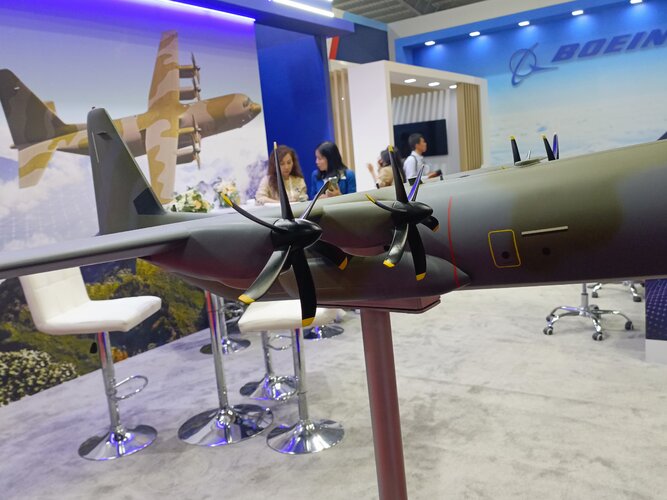
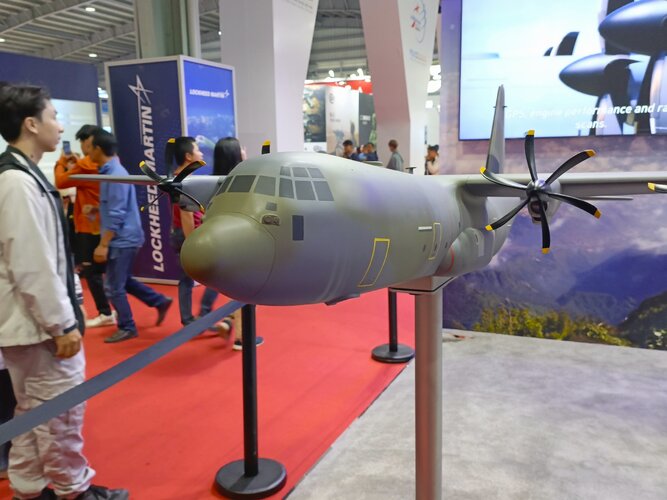
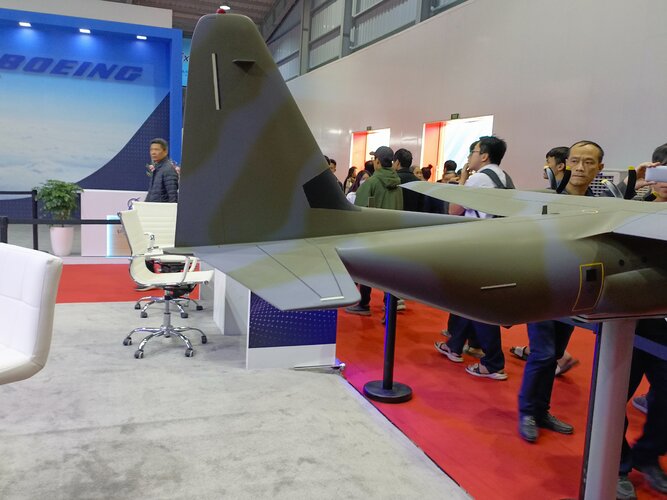
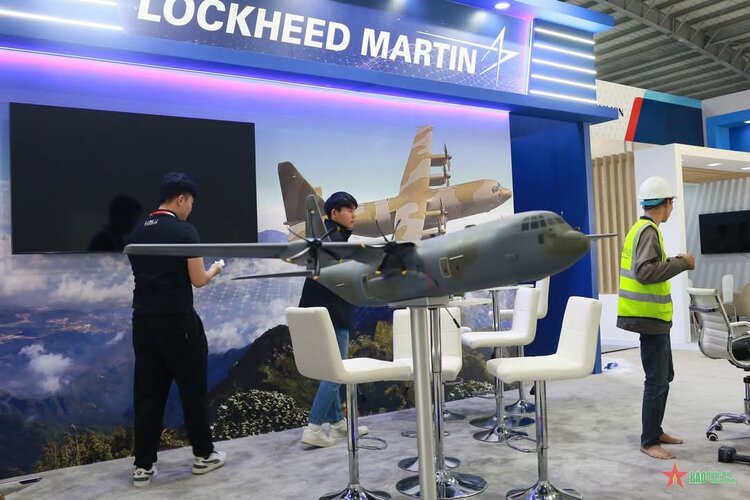
Lockheed Martin's booth at the upcoming Vietnam Defence Expo 2024 features a huge C-130J model. Noticeably, this camo seems quite unfamiliar to the C-130 family's gallery, meanwhile, from the patterns to the shades of colors, the model's appearance seems virtually the same as the camouflage livery that Vietnam People's Air Force (VPAF) has applied for its CASA/Airbus C-212 and C-295M, and only lacks the identification marking. Besides this camo, the USAF delegates have also flown a whole USAF C-130J alongside a pair of A-10s to Vietnam for exhibition, marking an unprecedented American engagement in Vietnamese defense affairs.
In fact, we approached enough documentation to confidently confirm that Vietnam is buying 3 C-130J from the United States which will eventually become a historic deal between the two former enemies. VPAF is not exactly a new user of the C-130, since it once operated a small number of ex-South Vietnamese C-130A in the 70s-80s, but this time, the Vietnamese Air Force is buying the series of aircraft that it once fought to, freshly from the enemy that it once dealt with. Inarguably, this is a historic milestone for the two nations. Early information states that the delivery would take place from ~2027, and there are already Vietnamese personnel being deployed abroad for training and preparations required for the upcoming C-130J commission.
Back to the appearance of the exhibited model, it lacks Vietnamese identification marking simply because the deal has not been disclosed yet. However, the camouflage that it sports is already a big enough spoiler that LM is showing to us.
Once again we will definitely see the legendary C-130s flying under a Vietnamese banner, but this time they will fly under a whole new positive context, representing the motivations of peace, harmony, reconciliation, and fair cooperation between the Socialist Republic of Vietnam and the United States of America.
-wonyo-


 www.twz.com
 www.navalnews.com

 www.airandspaceforces.com
 www.twz.com
View: https://x.com/GarethJennings3/status/1928414659779977634"Speaking on condition of anonymity, three sources with knowledge of the matter, but without authorisation for official comment, said in late May that the airlifters would soon be arriving in the country, with two noting that this would happen “in early 2026”. Janes understands they were referring to 12 surplus UK aircraft, which were retired from Royal Air Force (RAF) service in June 2023."


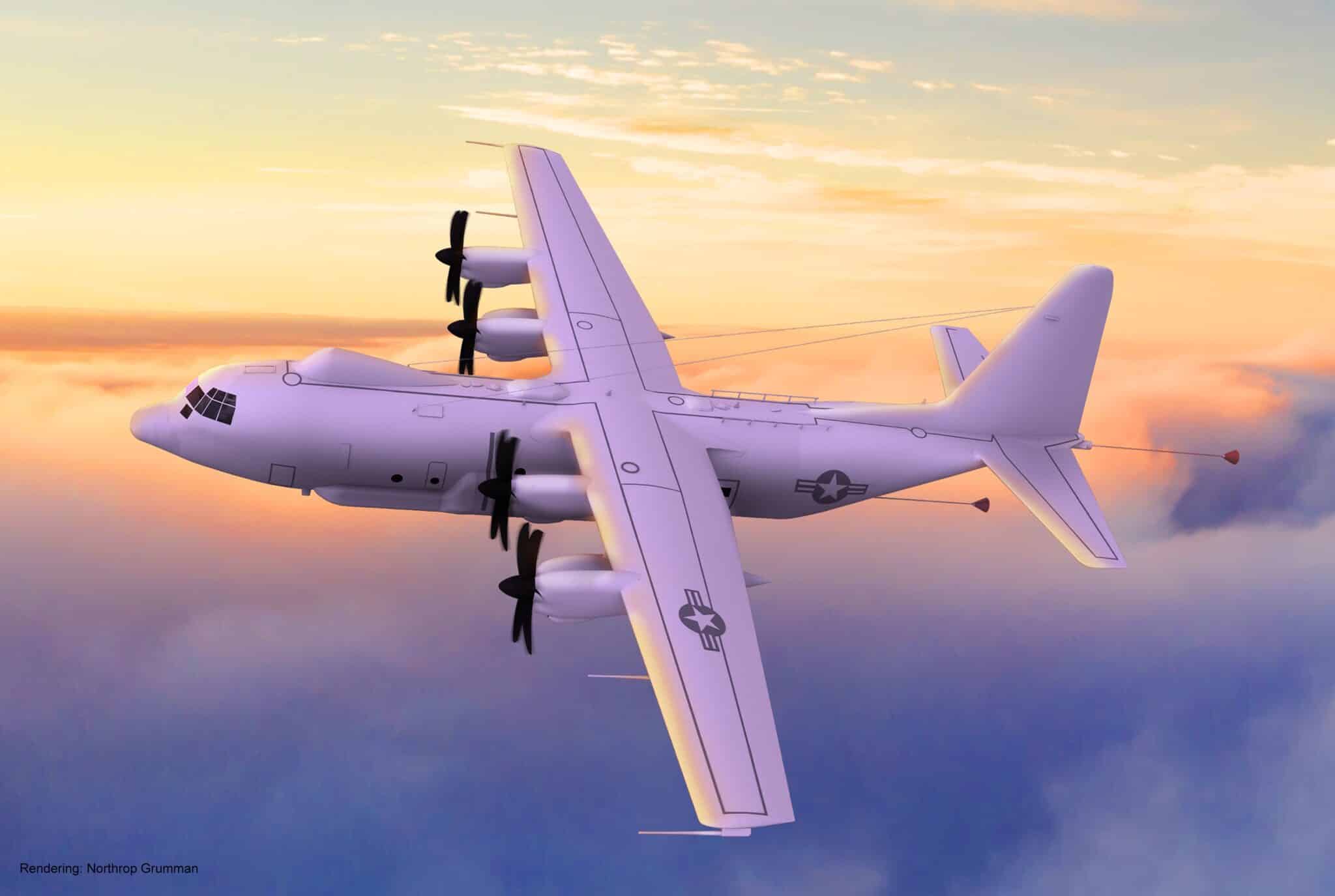
The US Navy has designated its new TACAMO aircraft as the E-130J Phoenix II.NaVAIR designates the EC-130J TACAMO as the E-130J
[...]


 theaviationist.com


GE Aerospace picks Merlin for AI co-pilot, with eyes on KC-135 CCR upgrade [EXCLUSIVE] - Breaking Defense
In the near term, the "Merlin Pilot" could replace one of the two crew currently required to fly the KC-135 tanker and C-130J transport — but the ultimate aim is for the AI to fly complex missions on its own.breakingdefense.com
AFA 2025 — Venerable aviation supplier GE Aerospace teamed with seven-year-old Merlin Labs to add AI to GE avionics used on a wide range of military and civilian aircraft, the companies told Breaking Defense ahead of an announcement at the Air Force Association annual conference here.
The firms’ first target is likely to be the Air Force’s planned cockpit overhaul for the aging KC-135 tanker, the Center Console Refresh (CCR), for which the formal competition could kick off as early as this fall, executives told Breaking Defense. But in the slightly longer term, they envision their combined product assisting human pilots on multiple aircraft, allowing the human crew of, for example, the C-130J transport to be cut from two to one — and even, ultimately, to zero.
The current plan is to have a human pilot “in the loop” to oversee, and if necessary, override the AI, GE general manager for “connected aircraft” Jeremy Barbour told Breaking Defense. But as Merlin’s technology matures, he said, “I’m excited about where the relationship could grow over time, so we’ll see how that evolves.”
While GE Aerospace is best known for its jet engines, it also builds sophisticated Flight Management Systems (FMS) installed on over 14,000 large, multi-engine aircraft, both military and civilian, from the Boeing 737 (and its Navy derivative, the P-8 Poseidon) to the C-130J transport and the KC-46 tanker. Pilots can program their FMS with their flight plan — including military-specific complications like where to air-drop supplies or to orbit waiting for fighters to refuel — which the FMS then turns into detailed instructions for the autopilot, which then flies the plane. But the current state-of-the-art FMS isn’t particularly adaptable to changing circumstances, so a human has to manually enter updated instructions from Air Traffic Control or any other adjustments to the plan.
Meanwhile, Merlin is developing what it calls an “aircraft-agnostic” AI, which it’s tested on five different types of plane since its 2019 first flight. Last year Merlin won both a $105 million from Special Operations Command to integrate the “Merlin Pilot” on the C-130J and another contract (value undisclosed) with the Air Force to test the AI on the KC-135. The Merlin Pilot is designed to plug into an aircraft’s existing control system — preferably, a full-featured FMS like GE’s product, although it can work with more primitive controls if suitably modified — and make it more user-friendly and flexible. For instance, the AI has natural language processing capabilities that let it listen to air traffic control instructions and automatically turn them into detailed instructions the FMS can execute, without a human having to manually enter each one.
In the current scheme, once the AI has generated such a revision to the flight plan, the human pilot would need to review and approve it. But ultimately Merlin aims for the AI to fly the plane by itself, without needing a human pilot either in the cockpit or at a remote-control station on the ground, as is required today for many unmanned aircraft. In the company’s flight tests, starting in 2019, the AI has been able handle every aspect of piloting “from takeoff to touchdown,” Merlin exec Matt George told Breaking Defense.
“What we focus on is true onboard autonomy, meaning it does not need any link to the ground,” George said. “All the software lives on board the airplane [and] makes its own decisions based off sensors … on the airplane.” It doesn’t even need a GPS signal to find its way, he said, although he couldn’t disclose the details of the alternative navigation systems employed.
In the short term, the two companies need to work out the details of plugging the Merlin Pilot into the GE Aerospace Flight Management System. (The main unanswered question is which of several possible Application Programming Interfaces, or APIs, to use).
They’re also eager for Air Force feedback on how to refine the tech: “That’s why we’re making the announcement at the Air Force Association meeting,” Barbour said.
 www.twz.com
 www.twz.com
Funds Shifted To Develop New LC-130J “Ski Bird” Polar Airlifters
Funds Shifted To Develop New LC-130J “Ski Bird” Polar Airlifters
The unique ski-equipped LC-130Hs of the New York Air National Guard badly need replacements, with their mission growing in importance. The unique LC-130H “Ski Birds” of the New York Air National Guard badly need replacement, with their mission growing in importance.
Is that all -J or just the -J-30?C-130J has pretty poor short-field performance.
 www.twz.com
C-130H Eight-Bladed NP2000 Prop Upgrade Plans Cut Short By USAF
C-130H Eight-Bladed NP2000 Prop Upgrade Plans Cut Short By USAF
Refitting C-130Hs with NP2000 propellers offers performance and maintenance benefits, but the USAF is fully focused on buying newer C-130Js.
Bureaucratic shenanigans (along with more than a bit of lobbing in back rooms by Lockheed Martin) in play, methinks.
Lockheed Martin would never stand for it.Well the USAF could have the C-130Hs refurbished and refitted with the NP2000 propellors and offer them second-hand to foreign customers.