SBLs are a bit too heavy.
Well, currently US have two super-heavy boosters running (Falcon Heavy and New Glenn), the third in development (Starship-Superheavy). And despire Chinese best efforts, that gap would took them a lot of time to bridge. So... it basically make all sence for USA to move as much of its military standoff with China to the area, where USA have - and would have for foreseeable future - significant logistic advantage.
 
I can't find any information on the dimensions of the PGRV. Are you aware of any?
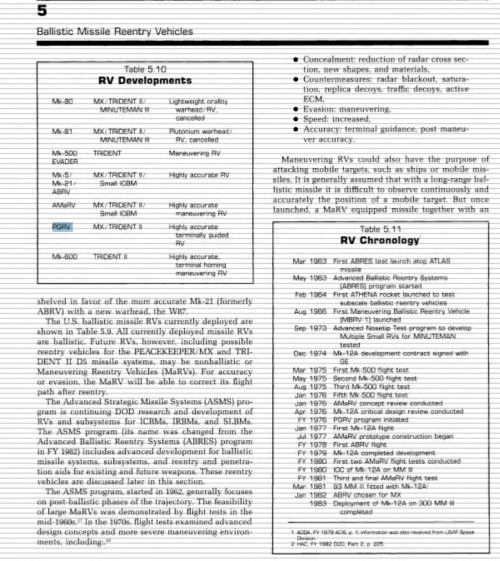
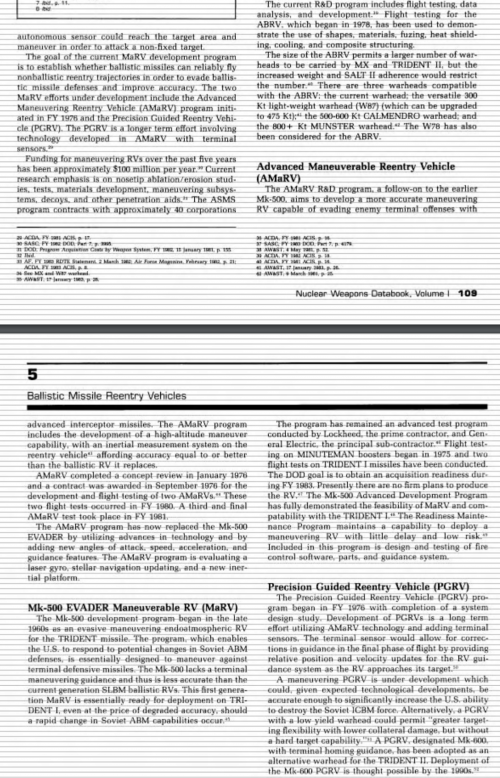
PGRV was to go on a Mk-600 RV and was due to be a development for the D5.


1770214267398.png 1770214209927.png

I can't find any sources supporting your claim that $175 billion has already been allocated? The only money actually allocated so far for the golden dome program appears to be $24.4 billion for FY25 (virtually none of which appears to have actually been spent yet), and a further $13 billion for FY26.
In the link:
WASHINGTON, May 20 (Reuters) - President Donald Trump said on Tuesday he had selected a design for the $175-billion Golden Dome missile defense shield and named a Space Force general to head the ambitious program aimed at blocking threats from China and Russia.
 
PGRV was to go on a Mk-600 RV and was due to be a development for the D5.


View attachment 800934View attachment 800933
Those older FAS NWD publications weren't always 100% accurate.

You can see them claiming that the AMaRV was to be deployed aboard the Trident II in Table 5.10, yet we know from the published info on the dimensions of the Trident II missile and the published info on the dimensions of the AMaRV that the AMaRV's physical dimensions significantly exceeded the available space within the annulus under the shroud of the Trident II.

I suspect that the Mark 600 variant of the PGRV was likely similar to the E2 concept, in that it was a W76 warhead with a backpack extension containing an IMU, a GPS receiver (which is not the best idea given the likely suppression of GPS during nuclear exchanges – I suppose its possible that the initial concept did not include one and that this was only added later on for the E2 concept?), and flaps for maneuvering.

It is interesting that they imply there were at least two major variants of the PGRV, and that only one was being developed for use on Trident. Presumably the other variant would have been closer to the AMaRV in size and capabilities.

The oddest part is the terminal homing claim. True radar based terminal homing is an extremely bulky and heavy technology. I seriously doubt that they were considering including this on all PGRV variants, as doing so would make it impossible to fit it inside the Trident annulus, and extremely challenging to fit it inside other missiles.

I wonder if perhaps they actually meant terminal homing through an ultra-high-accuracy IMU? That is a far more plausible technology, and while it may or may not fit within an envelope capable of being stuffed onto a Trident II (you could probably only fit a downsized version with limited accuracy inside of it), it could definitely fit within an envelope capable of being stuffed onto other missile platforms.

It would be exorbitantly expensive to do this, but the upside is that it would be completely immune to radar jamming (which can severely impair the accuracy of radar based terminal homing) and GNSS satellite constellation jamming/disruption (which can severely impair the accuracy of GPS-assisted terminal homing).

Either way, the only thing you've shown through these documents is that there was a special variant of the PGRV called the Mk-600 that was intended to be used on the Trident II, but this was not the same as the baseline version of the PGRV.

In the link:
Like I said, this does not demonstrate that $175 billion has been allocated.

The only thing it demonstrates is that President Trump claims that he believes his wish list for Golden Dome should cost an estimated total of $175 billion dollars to implement.

President Trump's claim is not the same thing as Congress allocating that quantity of money!

Additionally, many people have argued that his $175 billion estimate is wildly inaccurate given the capabilities he is claiming Golden Dome will have.

The Congressional Budget Office (CBO) released an analysis on the cost of Golden Dome, which concluded that it will cost $831 billion dollars to implement.

The American Enterprise Institute conducted their own analysis, which concluded that it will cost $3.6 trillion dollars to implement.

So far, the only money actually allocated by Congress for the purposes of implementing Golden Dome amounts to a total of $37.4 billion dollars. This is a tiny fraction of the total cost of the system. There is no guarantee that Congress will continue to release further funding for the system (let alone well over $100 billion worth of further funding), especially so given that most of the money they have already released doesn't even seem to have been spent yet.

Remember, Trump can claim whatever he wants, but he does not control the purse strings. Congress does. And until Congress explicitly passes legislation authorizing spending, Trump does not get a dime towards his project. They have generously passed legislation authorizing $37.4 billion towards his pet project. There is no guarantee that they will authorize further funding, and if they do, there is no guarantee that they will authorize further funding in the amounts needed to fulfill President Trump's vision for the Golden Dome system.

 
I remember reading somewhere that LORAL were supposed to develop a RADAC for the AMARV.

Wrt $175bn, I assumed that money is allocated when cost is estimated. That's probably too sensible though. ;)
 
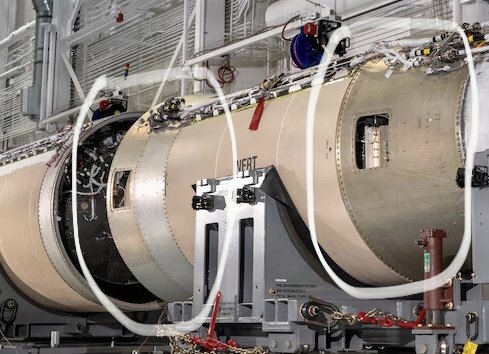
No, if you click on the photograph to get an enlarged image you can see that the second third stages have a slightly smaller diameter than the first-stage and both interstage are slightly conical.
?
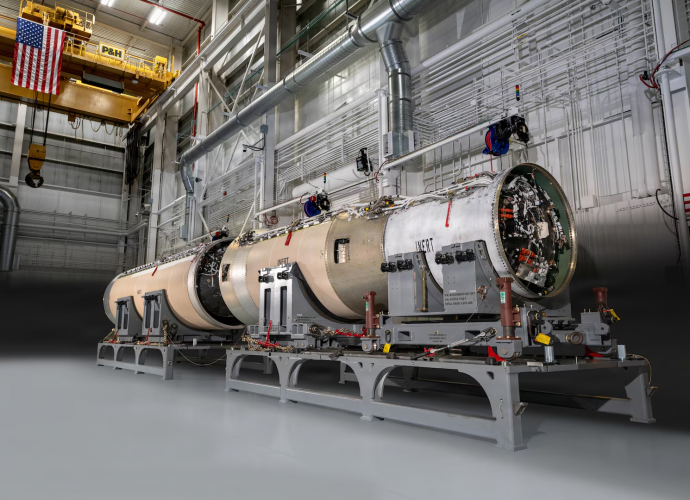
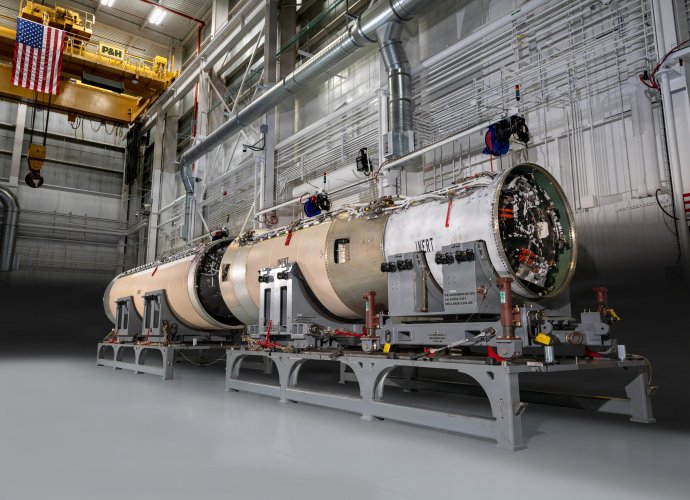
An undated photo of an LGM-35A Sentinel test booster, including stages-one, -two and -three solid rocket motors and both interstage mechanisms, is assembled. The booster will be integrated with the missile’s forward section to create the first fully assembled ground Sentinel test missile. This pathfinder test missile is essential for verifying the weapon system's design and preparing for the first Sentinel flight test, ensuring the future of our nation's strategic deterrence. (U.S. Air Force courtesy photo)
1771422029885.png
 
Looks slightly tapered
Yes, I see it now, it took me a while from that angle. Dying to know the stage diameters.

Sentinel rebaseline expected by end of year​

 
Last edited:
That is one nice looking booster stack. You can clearly see that it's a true clean sheet design, with correctly optimized booster stage sizing.

Unfortunately there's not enough detail to tell with confidence certain details, but it looks like my suspicions that they'd switch to all-gimbaled partially buried single nozzles for all stages were likely correct. Not quite clear if they ended up using ENECs, but I'd guess probably not given the clearances between stages. Given the amount of space available, there's probably no need for them.

I am dying to know stage dimensions, stage propellant mass, stage dead/dry mass, stage thrust/Isp figures, payload/throw weight, range, MIRV capabilities (especially if they managed to improve to 3-1 MIRV or not), countermeasure capabilities (did they bother to implement any this time? if so, is it similar to MM III (15 shots of chaff), or is it different?), CEP (did they manage MX-class accuracy (<100 m), or is it closer to Trident-class accuracy (>150 m)?), INS design details (what number and types of instruments were used this time?), etc...

Sadly, I don't think any of that info will be released for quite a long time, and some of it might not even get released within my lifetime.
 
Extendible/Extendable Nozzle Exit Cone (ENEC), also called Extendible/Extendable Exit Cone (EEC). Both terms can be used interchangeably, but specific projects tend to use different terms. With regards to the use of "Extendible" vs "Extendable", unfortunately usage is very mixed for the ENEC (both forms are widely used), although the EEC at least leans heavily towards the former over the later.

ENECs were developed for and used on the second and third stages of the Peacekeeper (MX) missile.

EECs were developed for use on the second and third stages of the Trident I C4. However, the final version of the C4 design ended up omitting the EECs in favor of deeply buried/submerged motor nozzles.

Some of the sources I've read have implied that EECs were likely used on the Trident II D5, but I have been unable to find any good evidence to firmly support or disprove this assertion, so it is unclear if they ended up getting used on the Trident II D5 or not. I personally suspect that they probably aren't in use on the D5, as there's enough room to use partially buried/submerged motor nozzles.
 
The first inert stack. If you look closely, you can see that the first stage is on a separate carriage and slightly separated from the second and third stages. I’m surprised that they showed as much of the infrastructure on the third stage forward dome as they did. There is also a significant amount of detail shown on the raceway/system tunnel contents.
Extendible/Extendable Nozzle Exit Cone (ENEC), also called Extendible/Extendable Exit Cone (EEC). Both terms can be used interchangeably, but specific projects tend to use different terms. With regards to the use of "Extendible" vs "Extendable", unfortunately usage is very mixed for the ENEC (both forms are widely used), although the EEC at least leans heavily towards the former over the later.

ENECs were developed for and used on the second and third stages of the Peacekeeper (MX) missile.

EECs were developed for use on the second and third stages of the Trident I C4. However, the final version of the C4 design ended up omitting the EECs in favor of deeply buried/submerged motor nozzles.

Some of the sources I've read have implied that EECs were likely used on the Trident II D5, but I have been unable to find any good evidence to firmly support or disprove this assertion, so it is unclear if they ended up getting used on the Trident II D5 or not. I personally suspect that they probably aren't in use on the D5, as there's enough room to use partially buried/submerged motor nozzles.
Actually an ENEC was used on Peacekeeper stage 3. PK stage 3 used double nested cone for the extensible designs. I have heard reports that a single cone ENEC was used on PK stage 2, but I haven’t been able to verify that one. Trident used/uses standard exit cones for all three stages of both C4 and D5. All three used submerged nozzles to minimize overall stage length.
 
Yes, I see it now, it took me a while from that angle. Dying to know the stage diameters.

Sentinel rebaseline expected by end of year​

I would be surprised if it's not as small or smaller than MM3.
 
Actually an ENEC was used on Peacekeeper stage 3. PK stage 3 used double nested cone for the extensible designs.

The third stage used a three-piece exit cone. You can clearly see this in photos of the third stage on Flickr. I guess you're correct in that there are two nested extensions on top of the base nozzle segment, but double nested sounds like they were only two nozzle segments, not three.

I have heard reports that a single cone ENEC was used on PK stage 2, but I haven’t been able to verify that one.

I have found a number of otherwise highly reliable references claiming that the second stage used an ENEC, but the photographic evidence is mixed.

The few photos of the second stage exit cone on Flickr do appear to show evidence of a secondary segment on the exit cone that would have no need to exist if it wasn't an ENEC, but the museum exhibits do not appear to show the assembly hardware, and none appear to show it in its collapsed state.

However I have also seen a number of photos indicating that the museum exhibits weren't always set up exactly the same same way as production missiles were.

Based on the slew of high-reliability references (including multiple refs from after the end of the PK program refering to retired ex-PK boosters) which all uniformly claim the second stage used an ENEC, I am inclined to believe that this is accurate and it indeed used an ENEC.

Trident used/uses standard exit cones for all three stages of both C4 and D5. All three used submerged nozzles to minimize overall stage length.
The C4 nozzles are much more deeply submerged than the D5 nozzles though, which reduced propellant loading (and possibly also nozzle efficiency) on the C4 to some degree.

To be fair, the EEC hardware would have added some extra weight, but presumably not enough to offset the increase in range from greater propellant loadings within the same total volume (and possibly also from better nozzle effficiency as well).

I suppose in the end the predicted reliability hit must have been too high to justify using them. Either that or the EEC hardware turned out to be much heavier and/or much less volume efficient than expected.
 
I would be surprised if it's not as small or smaller than MM3.
As a bare minimum I would hope they've designed it to hold at least 3 Mk21As. Anything less would be a sad joke.

It might be the perspective and the angles but MMIII was 66” (a short man) diameter and this first stage diameter looks more than double the 1/2 a person we see on the second stage. So unless he’s really short it appears larger than 66”. But again it’s tough to gauge.
What person? The first stage is definitey wider, probably 2-2.1m, the question is how much each stage necks it.
 
Last edited:
As a bare minimum I would hope they've designed it to hold at least 3 Mk21As. Anything less would be a sad joke.


What person? The first stage is definitey wider, probably 2-2.1m, the question is how much each stage necks it.
Deleted my post. Was fiddling around with this and other images but it didn’t really work.
 
I would be surprised if it's not as small or smaller than MM3.
Highly doubt it.

I expect it's slightly larger in diameter than MM3, to allow for reaching the deep targets with a full load of 3 RVs. Composite rocket motor cases to reduce weight (Trident/MX tech), and a larger diameter bus stage able to hold 3x W87s/Mk21 RVs.
 
There is no need to be able to carry 8 RVs when we dont have RVs for them to carry.

The extra RVs would be hard-decoys ballasted to match the ballistic characteristics of the actual MIRVs, also having capacity for eight MIRVs means that in the future if and when extra MIRVs become available the capacity is already there.
 
Who has an ABM system with enough capacity to justify that?
Given the fact that this thing is supposed to be in service until 2075, there could be a lot by then. With the pace the Chinese can build missiles, I wouldn't be surprised if they have effective anti-ICBM defenses around major metropolitan areas and military sites within 20 years, and that's saying nothing of any space-based or directed-energy weapons. Additionally, the big missile fields the Chinese are building will absorb a lot of warhead capacity, so that would already limit targeting options for other targets and make them easier to defend without an increase in warhead count. If an ABM system forces you to double or triple targets to make sure they get hit, it's already done its job before the first missiles are launched.
 

Similar threads

Back
Top Bottom