
You are using an out of date browser. It may not display this or other websites correctly.
You should upgrade or use an alternative browser.
You should upgrade or use an alternative browser.
Kuznetsov Engine Projects
- Thread starter Vasily41
- Start date
TV-2, NK-4 and NK-6 are covered in this series of articles on the history of Kuznetsov:
The NK-15 designation ended up with a rocket engine (the predecessor of the legendary NK-33), are you sure it was used for a turboprop?
The NK-15 designation ended up with a rocket engine (the predecessor of the legendary NK-33), are you sure it was used for a turboprop?

Vasily41
ACCESS: Confidential
- Joined
- 5 August 2019
- Messages
- 90
- Reaction score
- 115
Positive it was a turboprop. Tony Butler lists the Beriev Be-26 amphibian's power plant as a NK-15 with 12,000+ shp.TV-2, NK-4 and NK-6 are covered in this series of articles on the history of Kuznetsov:
The NK-15 designation ended up with a rocket engine (the predecessor of the legendary NK-33), are you sure it was used for a turboprop?
Edit: a data sheet of the Be-26 reveals it had the NK-12MV. Maybe Tony accidentally typed the wrong number.

- Joined
- 12 July 2006
- Messages
- 975
- Reaction score
- 950
Kuznetsov P-8
Development: Project in context of the order "Strategic supersonic bomber" 07/1954, no connection to the turboprop project NK-8, certainly also none to the turbofan NK-8.
Use: Planned on Tupolev 108 (as alternative)
Type: Turbo jet screw engine ("RVD": differed from the normal "TVD" by the large proportion of the thrust of the gases from the jet nozzle in the total thrust)
Source: РИГМАНТ, В.: Под знаками „АНТ“ и „Ту“. Авиация и Космонавтика 1999, 3, p33 - 43.
Thanks to H. B. (1941 - 2018)
Development: Project in context of the order "Strategic supersonic bomber" 07/1954, no connection to the turboprop project NK-8, certainly also none to the turbofan NK-8.
Use: Planned on Tupolev 108 (as alternative)
Type: Turbo jet screw engine ("RVD": differed from the normal "TVD" by the large proportion of the thrust of the gases from the jet nozzle in the total thrust)
Source: РИГМАНТ, В.: Под знаками „АНТ“ и „Ту“. Авиация и Космонавтика 1999, 3, p33 - 43.
Thanks to H. B. (1941 - 2018)

- Joined
- 6 September 2006
- Messages
- 5,198
- Reaction score
- 11,112
The NK-10 was a low-bypass 2-spool turbofan developed from the NK-6. Reheated thrust 235.3kN, fuel consumption 1.4-1.6kg/kgf/hr, project from 1958 proposed for the Bartini SBR, Myasishchev M-70 and the Tu-106.
A related project was the very similar NK-10B proposed for the Myasischhev M-56.
A related project was the very similar NK-10B proposed for the Myasischhev M-56.
Vasily41
ACCESS: Confidential
- Joined
- 5 August 2019
- Messages
- 90
- Reaction score
- 115
Boxkite,
regarding the description of the Kuznetsov P-8 in your posting #4 - what does "turbo jet screw engine" mean? Is it a turboprop configuration?
It’s just a translation error. Screw is another (far less used) name for a propeller and turbo jet is turbojet. A flawless translation would most likely read turbo-propeller engine.
So the Tu 108 would have been a supersonic bomber powered by turboprops? This is unique in the history of aviation.
Is it this project?
Is it this project?
Vasily41
ACCESS: Confidential
- Joined
- 5 August 2019
- Messages
- 90
- Reaction score
- 115
So the Tu 108 would have been a supersonic bomber powered by turboprops? This is unique in the history of aviation.
Is it this project?
Yes, but those are P-4 (NK-4?) turboprops. And it’s not really a bomber, but more of a composite bomber mated with Tupolev ‘Aircraft 100’. There was a bomber version of ‘Aircraft 108’, but it had turbofans instead.
Do you have any any performance parameters for the NK-4 and P-8 turboprops? The Tupolev 'Aircraft 108' is mentioned in the book about soviet secret bombers (by Buttler / Gordon) but there is no detailed information about the turboprop variant which shows a typical transsonic / supersonic layout with its delta wing, area ruling and Kuechemann carrots. It is amazing Tupolev investigated a supersonic design using turboprop engines. For sure it would have needed supersonic propeller profiles.
Bottleship
ACCESS: Top Secret
- Joined
- 30 June 2019
- Messages
- 565
- Reaction score
- 1,552
NK-4
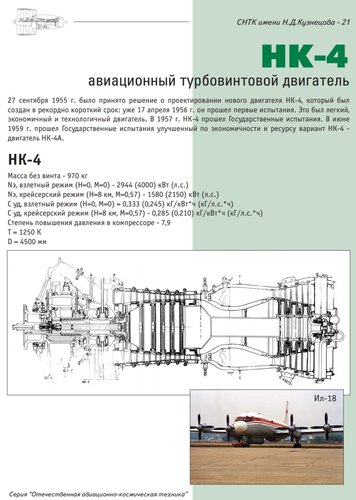
Weight without propeller 970 kg, power - standart 2150 HP, maximum 4000 HP, temperature 1250 K.

- Joined
- 27 December 2005
- Messages
- 18,720
- Reaction score
- 33,098
The P-8 isn't the NK-4. The P-8 was a Kuznetsov study for more fuel efficient engines. The P-8 'RVD' is probably better translated as a "propjet", it was hybrid between a turbojet and a turboprop with more emphasis on the jet thrust component than a standard turboprop. Its not a million miles from an unducted fan engine. There was also a turbofan version of this engine. Other engines explored included Mikulin AM-17, Dobrynin VD-5M and VD-7M, and Klimov VK-9F.
The entire 108/100 system was a hybrid bomber, and the 108 was the carrier for the 100. Two mission profiles were envisaged, a strategic one where the host aircraft flies at 900-1000 km/h and a supersonic one at 1500-1800km/h. I would imagine the 'propjet" was optimised for efficiency at the 900-1000km/h profile.
As part of these studies, engine cycles and layout were optimised and later versions had NK-6 engines and a low swept wing.
The entire 108/100 system was a hybrid bomber, and the 108 was the carrier for the 100. Two mission profiles were envisaged, a strategic one where the host aircraft flies at 900-1000 km/h and a supersonic one at 1500-1800km/h. I would imagine the 'propjet" was optimised for efficiency at the 900-1000km/h profile.
As part of these studies, engine cycles and layout were optimised and later versions had NK-6 engines and a low swept wing.
Last edited:
Thx for clarification. The P-8 RVD would have been an interesting engine.
In comparison with western turboprop engines with their lower flight speed spectrum the Kuznetsov NK-12 of the Tu-95 Bear also has a higher exhaust thrust proportion.
In comparison with western turboprop engines with their lower flight speed spectrum the Kuznetsov NK-12 of the Tu-95 Bear also has a higher exhaust thrust proportion.
- Joined
- 27 December 2005
- Messages
- 18,720
- Reaction score
- 33,098
At the beginning of the journey
Nikolai Dmitrievich Kuznetsov was born on June 23, 1911 in Aktyubinsk into a working-class family. The childhood years of the future general designer were spent in the Turkestan region but already in 1923, after a serious injury received by his father, the family moved to the Moscow region where relatives lived. Nikolai's grandfather, a hereditary blacksmith, said that the family surname was different half a century ago, but it was a profession associated with processing hot metal, did its job - in the village of Semenovskoye the whole family became steel call them Kuznetsovs.
At the age of 14, Nikolai entered a tractor driving course, and in 1930, an engine building course department of the Moscow Aviation College. Later he began working as a mechanic at the engine plant № 24 named after. M.V. Frunze, continuing his evening studies technical school department. Kuznetsov’s active participation in the promotion of technical innovations in the village, on instructions from the Komsomol organization of the plant, it attracted the attention of management RKSM and, in particular, the first secretary of the Komsomol A.V. Kosareva. On recommendation the latter, in 1932, Nikolai entered the Air Force Academy. N.E. Zhukovsky to the Faculty of Air Engineering. The composition of academy applicants was very heterogeneous. So, among the students who studied in the same group with Kuznetsov, there was one girl and... brigade commander A.M. Shapochkin (adjutant for special assignments of the People's Commissar of Defense K.E.Voroshilov).
The Academy at that time provided not only a first-class education, but also provided extensive opportunities for self-improvement in a variety of areas. Nikolai I tried myself in ski jumping, mountaineering (climbing Elbrus), parachuting... Here he began to engage in technical creativity: he came up with a device significantly facilitated the process of filling engines with hot water in winter. The mechanics of the training team stationed at the Central Airfield manufactured according to Kuznetsov’s drawings, these are "water heaters" for all serviced aircraft. IN THE at the academy's training camp near Serpukhov, Kuznetsov learned to pilot the U-2.
In the fall of 1938, having brilliantly defended his diploma project, Nikolai was like an excellent student upon release, I immediately received the captain's sleeper in the buttonhole. Moreover, he was abandoned in the academy's adjunct. It is curious that the scientific supervisor is a famous scientist corresponding Member of the USSR Academy of Sciences L.S. Leibenzon - Kuznetsov chose himself. That one with a certain one a dose of doubt listened to the young adjunct and warned that his chosen topic was related to the structural strength of aircraft engines, it is extremely complex. But Kuznetsov’s determination did its job, and Leibenzon agreed to become the leader. He didn't have to regret it.
As a result of three years of hard work, Kuznetsov managed to create an original one method for calculating elastic deformations of the crankshaft in supports (bearings) and even confirm it experimentally. Leibenzon was so pleased with the dissertation candidate that he invited the most prominent strongmen - professors I.I. - as opponents. Trapezina from MAI and A.A. Ilyushin from Moscow State University. At the defense, which took place on April 4, 1941 g, the results of Nikolai Dmitrievich’s work were highly appreciated. Moreover, the Leibenzon given, as he put it, the "outstanding contribution to science" made by Kuznetsov, suggested "approving the dissertation not as a candidate’s thesis, but as a doctorate!" The proposal was supported by both opponents and known for their contributions to engine building professor T.M. Melkumov and V.V. Uvarov.
However, other members of the Academic Council expressed doubts about the advisability of appropriation immediately a doctoral degree to such a young (twenty-nine year old) applicant. Leibenzon was beside himself, but could not change anything. Jumping out to the podium after voting, according to the results of which the council unanimously awarded Kuznetsov a degree candidate of Technical Sciences, he passionately announced that he would take Nikolai Dmitrievich to his doctoral studies and that in a year he will defend his doctoral dissertation "here, in this very place.". In the meantime, Leibenzon considered it necessary urgently no later than the autumn of 1941, publish the results of the research in the form of a monograph. However, the outbreak of war instantly destroyed all plans.
At the front and in the rear
Kuznetsov submitted his first report with a request to send him to the front to the next one the day after the German attack. He was immediately refused. Deployed at the academy urgent retraining courses for reservists, including aviation technicians. Soon classes lasting 12-15 hours began in the camp near Naro-Fominsk per day. In just a week and a half, another stream of listeners learned the device rules for the operation and repair of one of the modern aircraft engines of that time. The courses operated until September, when the enemy came close to Moscow. Only On October 15, the day before the notorious Moscow "panic," Kuznetsov was together I went with my family to Sverdlovsk, where I was evacuated back in July-August academy.
In April 1942, after the sixth report, Kuznetsov managed to obtain a transfer to the active army. He was appointed senior engineer of the 239th Fighter air Divisions of the North-Western Front Air Force. The division had three "motley" units air Regiment: one was armed with Yakas, another with LaGG-3, and the third with English ones Hurricanes. If the first two types of fighters were equipped with well-known ones for technical personnel with domestic M-105 engines, it was installed on the latter the Rolls-Royce "Merlin" XX engine, and the instructions for it were written in language Shakespeare and Byron, little known to aviation technicians. Fortunately, over the years of study at the academy and in the adjunct school, Kuznetsov mastered English quite well, so soon in the Hurricane Regimentvery qualified translations of all instructions have appeared.
Directing the technical operation of the division's fighters, Nikolai Dmitrievich he often used his personal U-2 aircraft, on which he often flew from one airfield to another. Gradually with his deep technical knowledge with his ability to lead people, Kuznetsov earned high authority among his subordinates. From the division commander, Colonel G. Ivanov, he borrowed the catchphrase: "S with the beginning of the war in the Russian language, the word "cannot" was replaced by the word "must". In time nikolai Dmitrievich got used to both a difficult life and to life at the front to war, to luck and losses, he became friends with his comrades in arms. Especially unexpected and his summons to the Central Committee of the All-Union Communist Party (Bolsheviks), which arrived at the division headquarters in October, was surprising 1942 Dejected at the prospect of losing a knowledgeable, capable senior engineerthe division commander directly asked Kuznetsov if he had written any letters or statements "up". Nikolai Dmitrievich himself, quite amazed by what was happening, answered negatively. It is unknown from whom the initiative to recall Kuznetsov from the front came.
In Moscow, Major Kuznetsov was received by the Secretary of the Central Committee of the All-Union Communist Party (Bolsheviks) G.M. Malenkov, in years wars oversaw the aviation industry. Here a lot became clear: it was solved send the party organizer of the Central Committee to the design bureau of V.Ya. Klimova. Evacuated to Ufa from Rybinsk at the end of 1941, in the fall of 1942 the design bureau experienced significant difficulties with fine-tuning of the new M-106 and M-107 engines intended for modernized ones yakovlev fighters and Petlyakov bombers. Lack of progress with engines liquid cooling put our aviation in a difficult position, because the Germans that same fall, 1942, the Bf 109G-2 fighter appeared with a new DB 605A engine developing a maximum power of 1650 hp. The Soviet Air Force was urgently needed adequate response to enemy novelty.
Having become a party organizer of the Central Committee, Kuznetsov managed to delve into the technical in a short time and the "humanitarian" problems that have accumulated in the Klimovsky Design Bureau. During one of the technical nikolai Dmitrievich met unexpectedly for many participants who did not expect it the "political worker" indicated an error in the calculations and he suggested a way to eliminate it. Then another similar incident followed another: V.Ya. Klimov, who headed the design bureau, constantly maintained a distance between himself and his subordinates, but at the same time he was in dire need of a highly qualified one to the assistant. Soon he turned to the Central Committee of the All-Union Communist Party (Bolsheviks) with a request to reappoint Kuznetsov his deputy. Klimov was taken into account "at the top"; I.V. knew him well. Stalin, and soon Nikolai Dmitrievich became deputy chief designer.
Resolution of the State Defense Committee № 2346 of September 25, 1942 obliged Ufa engine builders by mid-November of this year, complete 50-hour tests of the M-107A engine, as well by the end of the year, increase its resource to 100 hours. This engine option is significant it differed from the pre-war "one hundred and seventh". The designers have developed a new drive centrifugal supercharger with rotary blades V.I. Polikovsky. The engine was boosted by supercharging, which increased its take-off power to 1600 hp, and nominal - up to 1500 hp. at an altitude of 4500 m. The data obtained was set to M-107A on a par with the best foreign models. If the M-105PF had a power density of 34.5 hp/l, then M-107A - already 42.7 hp./l.
Soon the engine was installed on a Yakovlev fighter and a test pilot P.YA. Fedrovy reached a maximum speed of 590 km/h at the ground and on a Yak-7 M-107A 680 km/h at an altitude of 5800 m. He made a proposal to urgently produce 10-15 of these fighters for military testing. However, on February 23, 1943, an experimental vehicle was lost in an accident. At the end of the flight, when performing a platform at low altitude suddenly the engine shook and smoke began to appear. Pilot P.M. Stefanovsky was forced to commit landing before reaching the border of the Naberezhnaya airfield. As a result, the plane it was completely destroyed, and the pilot was wounded. Investigation into the causes of the accident showed: oil released from the engine broke the thermal insulation, causing a burn external manifold and ignition wires.
The Klimovsk Design Bureau and the Ufa Plant № 26 worked hard to eliminate the defects M-107A, but success still did not come. At the end of April 1943, the People's Commissariat of Aviation Industry sent an authoritative commission to Ufa, headed by the head of the 8th State Institution NKAP (po concurrently - Director of CIAM) V.I. Polikovsky. The conclusions were disappointing: the commission did not rule out "the possibility of long delays and unforeseen difficulties in fine-tuning the M-107A and introduction into widespread flight operation.". Klimov's explanations no one listened to the objective reasons for the delay. May 12, 1943 came out unusual GKO № 3358 ruling: "Due to the fact that Klimov did not comply on time, the decision of the State Defense Committee to create the M-107A engine, which is currently exceptional meaning, ... send a doctor of technical sciences to help. Shvetsova and Doctor of Technical Sciences. Mikulin and provide successful completion of the state test with the M-107A engine is the shortest term". The arrival of the "Varangians" hurt the authority of the Chief, but also the situation didn't fix it.
Only by August 1943 was it possible to equip the "one hundred and seventh" with several fighters Yak. During tests at LII NKAP, seven engines worked in just over 84 hours. Five of these had to be removed from the planes for various reasons, the sixth burned down along with a fighter. Only one engine worked safely on the plane for 34 hours. Leakage was cited among the main reasons preventing aircraft from operating water from cylinder seals, destruction of connecting rods, burnout of pistons, and shaking power plant.
Finally, after many years of effort, the hard work of the entire team gave its fruits: on December 27, 1943, the State Defense Committee approved conclusions based on the results of the 100-hour period testing the M-107A engine and adopted the engine into service with the Red Army Air Force. Klimov received the rank of Major General of ITS, Kuznetsov was awarded the Order of the Red Stars. However, the problems of the M-107A (soon renamed VK-107A) are on this it's not over. His painful fine-tuning continued after the end of the war. Parallelly with the "one hundred and seventh" from 1943, even more powerful VK-108 and VK-109 were developed.
M-105PF VK-107A VK-108 RD-10
The advent of the jet era forced the domestic engine industry to resort again to borrow foreign experience. In 1946 at the Ufa plant under the RD-10 brand production of German Jumo 004 engines with a thrust of 900 kgf was launched. They are intended for Yak-15 jet fighters, developed on the basis of the famous one Yak-3. The next step was the acquisition of engine production licenses in England "Nin" and "Derwent" with a thrust of 1600 and 2200 kgf, respectively. Soviet delegation the negotiations were headed by V.Ya. Klimov. Soon after his return, he managed to achieve a government decree providing for the return of his design bureau in Leningrad. By the same decree, 35-year-old engineer-lieutenant colonel Kuznetsov appointed chief designer of the Ufa plant № 26.
Take-off power, hp. Cruising power, hp. Specific consumption, kg/hp-h Degree of compressor pressure increase Temperature of gases in front of the turbine, K Number of compressor stages Number of turbine stages Shaft speed, rpm Engine weight, kg
Introduction into production of a completely new jet technology from the point of view the RD-10 engine took up most of Kuznetsov’s time. At the same time, by force the remaining designers at the plant (a significant part of them together with Klimov) left for St. Petersburg) he began designing the RD-12, his own version of the thrust turbojet 3000 kgf. Unlike the Germans, they decided to make the compressor centrifugal. However, the use of German experience was given great importance, and it was not for nothing that it worked at the Ufa design bureau, the German engineer F. Brandner received a fantastic one for those times salary - 4000 rubles (for comparison, the commander of a fighter regiment received at that time, about half that amount).
Turboprop engines, or German influence
During testing of the RD-12, an accident occurred due to a broken compressor blade, Kuznetsov and one of the testers was injured. The trouble delayed the work as per this engine, and the less powerful, but more "real" RD-14, intended for a twin-engine fighter. Fate did not allow time to fine-tune these motors. At the end of 1948, by order of the Minister of Aviation Industry of the Plant Design Bureau № 26 were disbanded, and Kuznetsov was virtually out of work. And at the beginning of May 1949 g. Nikolai Dmitrievich was appointed chief designer of the pilot plant № 2, staffed primarily by German specialists.
This plant was organized in October 1946. Its employees were the main ones thus, the forcibly deported German engine designers previously worked in the Soviet occupation zone of Germany. "By five o'clock in the morning, trucks with machine gunners arrived at the houses where German specialists lived and our specialists who called introduced themselves and explained the purpose of the evacuation they guaranteed the preservation of life and work in their specialty, recalled E.M. Semenov. - Soldiers helped load things. No documents were drawn up: In passenger rooms specialists with their families were placed in the carriages, and their belongings were placed in the luggage compartments. Project documentation they were also loaded into the train. During an overload in Brest, a safe was discovered missing with the following drawings:"
Among the arriving specialists, workers were considered the most valuable "prey" junkers, led by Dr. A. Scheibe, and BMW, led by an engineer K. Prestel - only about 250 people. About a hundred more Germans were engaged in design various types of units, instruments and equipment. To accommodate German arrivals there were families in the village of Upravlenchesky near Kuibyshev (now Samara again) the corresponding living space was freed up (the Russians were "compacted") and more was built hundreds of "Finnish" houses. Among the deportees there were many high-quality ones they tried to interest them financially by appointing 56 employees salary from 4000 rubles and above. An eight-year school was organized for children by teachers in which the wives of deportees worked.
At first, the most important task for the Germans was considered to be the creation of forced ones variants Jumo 004 and BMW 003, but with the development of basic Soviet designs engine factories gradually concentrated their attention on more late projects of German engines such as the BMW 018 with a thrust of 3400 kgf and Jumo 012 thrust 3000 kgf.
Having become familiar with the state of affairs at the plant, Kuznetsov reorganized the structure design bureau, ensuring a closer relationship between the work of employees former German engine-building companies, which were previously carried out in a closed manner even with elements of unhealthy competition between BMW and Jumo representatives. Then Nikolai Dmitrievich organized technical training. Thus, Dr. R. Scheinost read lectures on strength calculations, and Dr. G. Heinrich on thermodynamics. Classes they were conducted in German, the study of which was given to Soviet specialists of great importance: those who passed the language exam were entitled to a 20 percent increase to the salary. Kuznetsov’s third important decision was his widespread involvement in the design bureau young graduates of the Kuibyshev Aviation Institute. Soon it was time and more "tough" onesevents: at the end of summer, Nikolai Dmitrievich gave the order stop fine-tuning all engines being developed, with the exception of the project a powerful turboprop engine.
In November 1950, the TV-022 engine, created with the direct participation of the Germans specialists based on the Jumo 022 project, passed State tests. He it had a fourteen-stage compressor, a ring-type combustion chamber and a three-stage one a turbine. The engine drove two coaxial counter-rotating propellers (AV-41) gearbox driven. A modified version of the engine, which received the name TV-2 was tested at the Tu-4 Flight Test Flying Laboratory institute in May-October 1951. On the 27th flight, the Tu-4 aircraft head. № 225402 suffered accident due to fire in the right engine. Despite this trouble, work according to the improvements, TV-2 was continued.
The fact is that the turboprop engines, the creation of which was carried out by the Kuznetsov Design Bureau, urgently needed to solve the most important state task: the creation of an intercontinental one bomber. Conducted at OKB A.N. Tupolev's calculations showed that this is the case the machine will have a weight of about 200 tons. To provide the required range the flight was to be equipped with four turboprop engines (TRD "not they passed" due to low efficiency, which was confirmed by the experience of creating another version of an intercontinental bomber at the V.M. Design Bureau. Myasishcheva) power at 12,000:15,000 hp. As a temporary measure after Tupolev’s negotiations with Kuznetsov decided to create a twin 2TV-2F engine. He represented two side-by-side boosted TV-2F engines running on general gearbox.At the same time, the development of a new TV-12 engine, equal to, began in terms of power, the pair is 2TV-2F.
Flight tests of the first experimental aircraft Tu-95 ("95-1") with 2TV-2F engines they began on November 12, 1952. At first they were successful, but on the 17th flight held on May 11, 1953, the plane crashed due to an engine fire. Four crew members were killed, including the famous test pilot A.D. Flight. A serious flight accident is certainly followed by a stage of searching for those responsible, and they naturally, they were found. After the disaster, all materials were urgently delivered to Moscow factory bench tests of engines, from which it turned out that during fine-tuning 2TV-2F showed serious defects associated with the destruction of the gear gearboxes after 30:40 hours of operation. The "debriefing" promised Kuznetsov huge troubleshowever, at a meeting of the commission to investigate the causes of the disaster, it was unexpected for him A.N. stood up. Tupolev, who stated: "Behead the design team, removing the leader means ruining this most powerful engine in the world, and at the same time and the Tu-95 plane. This cannot be done. Our decisions must be aimed at support for the 2TV-2F engine and its other variants. And to achieve this goal the chief designer of the engine should be helped, not jailed:" Subsequently, the cause of the disaster was associated with a violation of manufacturing technology gears, the specific culprit was found and convicted, and a fragment of that same gear became an exhibit of the factory museum...
Nevertheless, work on the creation of 2TV-2F was stopped, and the attention of the Kuznetsov Design Bureau focused on TV-12 (the number 12 meant power in thousands of horsepower). Here, too, there were problems that called into question its very existence design team. According to Kuznetsov, "Tupolev was nervous and he sent his deputies to Kuibyshev - K.V. Minkera, G.A. Ozerov and others. Those, probably, at the request of A.N. Tupolev, compiled reports that included: "in an engine it’s bad, both are bad, and the other is no better: "It’s come to that." what is V.A. Malyshev, deputy chairman of the Soviet Council of Ministers, said: Well, since nothing it turns out, let's close it [development of TV-12 - N.A.]". But here tupolev himself intervened again, disavowing all the reports of his deputies. In a conversation with Malyshev, he took the blame upon himself and offered to give Kuznetsov more "two or three months," especially since the 25-hour discussion ended successfully on the day TV-12 tests. Soon the experimental engines were installed in three flying laboratories Tu-4LL for accelerated development in the air. At the end of December 1954 the engine was successful passed 100-hour state tests, and in February 1955 completed the first flight aircraft "95-2" - the second experimental Tu-95, equipped with four TV-12s, soon renamed NK-12. During the development process, at the request of the aircraftmen, the maximum engine power was increased to 15,000 hp.
Aircraft type Tu-95 Tu-116 Tu-114 Tu-95K-20 IL-18 An-10
The NK-12MV engine modification was intended for strategic bombers Tu-95, Tu-114 passenger aircraft, Tu-126 AWACS aircraft and anti-submarine aircraft tu-142 cars. A version was developed specifically for the An-22 Antey transport aircraft NK-12MA with screws of increased diameter AV-90 (used on Tupolev vehicles) AV-60 propellers), and for Orlyonok-type ekranoplanes, the NK-12MK variant was different the use of corrosion-resistant materials and special coatings. For creation NK-12, which today remains the most powerful theater of operations in the world, N.D. Kuznetsov was awarded the title of Hero of Socialist Labor, he became a laureate of the Lenin Prize and the General Prize designer. In the early eighties, the strategic was adopted tu-95ms missile carrier armed with long-range cruise missiles.This one the version of the vehicle, like the modified Tu-142M, was equipped with NK-12MP engines increased efficiency.
Engine type NK-12, NK-12M NK-12MV TV-2T NK-4, NK-4A
In 1955, after recognizing success with the "twelve thousandth", Nikolai Dmitrievich received the task of designing a smaller engine intended for for passenger airliners Il-18 and An-10, as well as for military transport aircraft An-12. At the same time, designer A.G. received the same task. Ivchenko. Having for having the experience of creating NK-12, Kuznetsov considered the task received as relative light, "white bread," as he put it. And indeed, not even seven months have passed from the moment the technical specifications were drawn up, the NK-4 engine was ready. He it turned out to be light, economical, and easy to produce. For the first time in a 6-speed supersonic stages were used for the compressor. In 1957 the engine passed state tests, it began to be mass-produced by the plant № 24 named after. M.V. Frunze.The An-10 and Il-18 aircraft of the first series were equipped with NK-4 engines and their modified ones variant NK-4A.
One day, on an Il-18 passenger plane, the gearbox shaft collapsed and was rotating the propeller flew away at great speed, fortunately without hitting either the fuselage or the neighboring one motorcycle nacelle. But these were just flowers. In 1958 as a result of engine failure an Il-18 plane crashed with a group of high-ranking officials on board military. The commission that investigated the causes of the severe flight accident determined the engine shutdown resulted in a powerful turning moment that could not be compensated by the pilots due to the lack of a feathering device screw. The quickly designed and implemented "auto vane" did not save the day: NK-4 turned out to be compromised. Attempts by N.D. Kuznetsov to prove that they were entered the changes fixed the problem and were unsuccessful:into mass production the AI-20 of the Zaporozhye plant was launched, and the NK-4 was removed from production. To accept this the decisions were also influenced by subjective aspects: since the An-10 and An-12 aircraft were being built in Ukraine, then, they say, the engine for them should be "Ukrainian". Arguments Kuznetsov and V.Ya., who supported him. Klimova about a higher technological level and the best efficiency of the NK-4 was not taken into account. At the end of 1958, after the production of 222 engines, production of NK-4 was discontinued.Klimova about a higher technological level and the best efficiency of the NK-4 was not taken into account. At the end of 1958, after the production of 222 engines, production of NK-4 was discontinued.Klimova about a higher technological level and the best efficiency of the NK-4 was not taken into account. At the end of 1958, after the production of 222 engines, production of NK-4 was discontinued.
Engines for supersonic speeds
At the end of July 1954, by resolution of the USSR Council of Ministers № 1605-726 design Bureau A.N. Tupolev received a design task a new long-range bomber in two versions: Tu-105 with two turbofan engines VD-7 designed by V.A. Dobrynin and Tu-106 with two Kuznetsov turbofan engines NK-6. Two years were allocated for the design and construction of the first machine, and for the second is three. For the first time in the practice of domestic aircraft manufacturing, long-range the bomber was supposed to fly at supersonic speed, although for now only at the stage of breaking through the enemy’s air defense system. For an aircraft weighing 80...90 this meant that the required total thrust of the two "engines" should have been be at least 30 000 kgf; thus, themore than one and a half times was required growth from the then most powerful domestic AM-3 engine.
The uniqueness of the situation should be emphasized. Bomber The Tu-16 has just begun to enter service with Long-Range Aviation. On January 1st In 1955, the latter had only two incompletely staffed ones air divisions of such vehicles; the remaining ten divisions were in service hopelessly outdated Tu-4 with piston engines. And so, without really having time "tune the Tu-sixteenths", designers and industry are being given a new one the task is to urgently make a long-range supersonic bomber with an unprecedented one at a speed of 1800 km/h! Has the Air Force Commander-in-Chief, Air Chief Marshal, overworked himself P.F. Zhigarev? No, I'm not overtired. Just domestic "knights of the cloak and the dagger' got hold of information that since 1953.the Americans turned around full-scale program for creating a supersonic medium strategic a bomber that later became known as the B-58 Hustler. This one the car, according to Soviet intelligence officers, was supposed to have a speed of 1800...2200 km/h, a range of about 10,000 km and carry four nuclear bombs. At fear, as they say, the eyes are big... Oh, and then the Convair company got tired of it with its own a brainchild, and, as if mirroring, the Tupolevites also gave it away this time not candy at all...the range is about 10,000 km and carry four nuclear bombs. At fear, as they say, the eyes are big... Oh, and then the Convair company got tired of it with its own a brainchild, and, as if mirroring, the Tupolevites also gave it away this time not candy at all...the range is about 10,000 km and carry four nuclear bombs. At fear, as they say, the eyes are big... Oh, and then the Convair company got tired of it with its own a brainchild, and, as if mirroring, the Tupolevites also gave it away this time not candy at all...
21 June 1958, with "Hustler" almost a length behind two years, Tu-105 with VD engines?7M made its first flight. The plane was being pursued failures: only a few times in the air, the first experimental machine she was lost in an accident due to the front landing gear not extending. Her the 105A backup crashed on December 21, 1959 on its seventh flight, killing the pilot and the navigator. The trouble didn't end there: the first production car called Tu-22B, it was destroyed during an emergency landing on November 17 1960 after turning off one of the engines due to a drop in pressure oils. "There were a total of 10 accidents involving the aircraft between 1959 and 1964 and disasters: one disaster in Long-Range Aviation, two in Navy Aviation,three disasters and four accidents at MAP," he indicated in his report to the minister defense Commander-in-Chief of the Air Force K.A. Vershinin.
Due to the unavailability of missile weapons (cruise missiles) X-22 and guidance systems) in February 1960, they decided to build the aircraft in a variant reconnaissance aircraft, with reduced flight performance data. As a result, the machine originally intended to replace the Tu-16, it was practically produced "underground", without being officially adopted; existed even the bureaucratic wording for similar cases is "produce aircraft according to the drawings and specifications of the chief designer.". In March 1965 in the troops there were already 105 Tu-22s with VD-7M engines, of which 83 were reconnaissance aircraft, 5 bombers, 6 jammers and 11 training machines.
In addition, somehow the Tupolev OKB-156 did not "dance" and fulfilling the most important requirement of the technical specifications is achieving maximum speed 1800 km/h. In the latter case, part of the blame lay with the Kuznetsov Design Bureau. After all it was to him, in accordance with the resolution of the Council of Ministers of April 17, 1958. it was necessary to create and put into production the NK-6 bypass engine with a thrust of 22,000 kgf (the beginning of engine development dates back to 1955 g.). Revolutionary in design, it had a ten-stage compressor (4) low and 6 - high pressure stages), annular combustion chamber, three-stage turbine (one high and two low pressure stage) and afterburner. In the early 60s, NK-6 was by far the most powerful turbofan engine in the world.On the it was the first to use supersonic high-pressure compressor stages wear inserts above turbine blades, multi-nozzle combustion chamber, system for regulating the degree of fan pressure increase and other new products.
However, it was not possible to bring NK-6 to series. In July 1963 g. all work on it was stopped. This engine is probably too much ahead of its time. Perhaps the reduction in allocations also played a role for manned military aviation, initiated by N.S. Khrushchev. But the accumulated experience was not in vain and was soon used in the design NK-144 engine, intended for the first supersonic passenger engine aircraft Tu-144.
The requirements for maximum afterburner thrust of the NK-144 have been lowered up to 17,500 kgf, but a cruising afterburner flight mode with thrust was introduced 3970 kgf. A two-stage fan was used in the low-pressure circuit and a three-stage compressor; in the high pressure circuit of the compressor there were five steps. The afterburner was common to both circuits (the NK-6 only had a tube-ring type afterburner in the outer one outline).
On the last day of 1968, a Tu-144 equipped with four NK-144, took off for the first time. Serial version of supersonic passenger the aircraft, which began flying on the Moscow - Almaty line in 1973, was produced with NK-144A engines of increased thrust. NK-144A was added to the design third fan stage. Since 1974, an even more powerful NK-144V has been created which also had significantly improved efficiency in cruising mode afterburner (at an altitude of 18 km). However, in 1980 its development was stopped due to the curtailment of interest in the Tu-144 aircraft on the part of the government and the Ministry of Aviation Industry.
Despite this, the efforts of the Kuznetsov Design Bureau to fine-tune the NK-144 they weren't wasted. History with NK?6 was repeated, but now from the "civilian" I had to make a "military" engine. As stated above, the Tu-22 received in NATO, the name Blinder - "blind man" - turned out to be not the most successful work A.N. Tupolev; therefore, in 1967, by resolution of the Council of Ministers of the USSR, OKB-156 received task to design a new long-range bomber. This time the creation of the engine was entrusted only to Kuznetsov’s design team. The basis for the NK-22 was developments on the NK-144, but unlike the latter there were three fan stages from the very beginning. These engines have traction 20,000 kgf was equipped with the Tu-22Munder the name Backfire it has become widespread known in the West in connection with the hype and persistence raised by the Americans attempts to "count" it among the Soviet strategic bombers within the framework of the SALT-1 and SALT-2 treaties.
The degree of proximity of NK-144 and NK-22 is evidenced by the fact that already in 1969, the latter was put into mass production. However, in due to the fact that the Tu-22M was conceived as a multi-mode, capable of carrying out flights both near the ground and at high altitudes were used in its engines new items: ejector-type nozzle with a wide control range, electronic gas temperature limiter in front of the turbine and fuel combustion alarm in the afterburner. In 1976, on the basis of the NK-22, development of its modernized one began NK-23 version, characterized by a four-stage low compressor pressure, as well as some other modifications. However, despite the NK-23 did not become serial with greater thrust (22,000 kgf) and better efficiencysince the development of a new one was already being successfully completed at the Kuznetsov Design Bureau with higher engine specific parameters for aircraft tu-22m family.
The double-circuit three-stage NK-25 with a thrust of 25,000 kgf became at that time, the world's most powerful military aircraft engine. Mounted on the Tu-22M3 long-range bomber, which took off for the first time airborne on 22 June 1977, she provided a new 124-ton modification of the "Backfire" speed corresponding to the number M=2 at high altitude. The Americans did it everything to limit the combat capabilities of the vehicle, insisting on dismantling equipment for in-flight refueling; in addition, the maximum release rate the bomber, by mutual agreement with the United States, was limited to 30 aircraft per year. However, after the collapse of the Soviet Union, the set bar was set much higher than the real possibilities of financing the Tu-22M3 program. Despite to this,it is precisely such cars that are the most popular in Russia today Long-range aviation.
A close relative of the NK-25 is the bypass turbofan three-shaft engine NK-32, developed for a strategic missile carrier Tu-160. With the same thrust during afterburner (25,000 kgf), "thirty-second" in cruising mode it is more powerful than its predecessor - 14,000 kgf. Compressor the engine has a three-stage fan and five medium pressure stages and seven high pressure stages. In high and medium pressure cascades single-stage turbines are used, in the low-pressure cascade - two-stage. The engine nozzle is adjustable, auto-model; control system is electric with hydromechanical duplication.
The first flight of the Tu-160 took place on December 18, 1981, and shortly before this, photographs of the Soviet novelty appeared in the West. I took the photo an overly nimble passenger on a plane landing at the airport Bykovo and flying at low altitude over the Ramenskoye airfield (test LII MAP base). From that moment on, "flounder," as the aviators nicknamed the car behind the bug-eyed cockpit and fuselage, smoothly turning into a wing, for long the years attracted the attention of specialists and various writing fraternity, the first the case drew attention to the "strange" external similarity of the Tu-160 with the American one strategic bombers B-1.
In the mid-eighties there was a kind of superficial view it was quite natural for the "competitors", because the technical characteristics domestic combat aircraft, unlike overseas ones, were a secret behind seven seals. Only after showing "sixty" to the American one the Minister of Defense F. Carlucci was leaked to the press with information that "double B-1" is a third heavier than its opponent and almost 10 m longer than him...
As for the power of the power plant, the American is here too it was not comparable: its "engines" had an afterburner thrust of only 13,700 kgf which, together with unregulated B-1B air intakes, led to maximum speed limit is ridiculous 1470 km/h. Note that the Tu-160 on one of the test flights it reached a maximum speed of 2200 km/h and with a payload of 30 tons, it turned out to be capable of passing through a closed 1000-kilometer one route with an average speed of 1731 km/h. Officially announced maximum the flight range without refueling was 14,000 km - quite enough to fly to the "North American military geographical area" and return. It should be emphasized that it is the N.D. engines.Kuznetsov was provided the car has such outstanding flight characteristics. As regards implementation a production program that included the deployment of 100 bombers (exactly how many B-1Bs the Americans built), but there is clearly no comparison here in favor of the domestic car. The heaviest, the most perfect and probably the last domestic strategic missile carrier barely reached a quarter planned "circulation".the last domestic strategic missile carrier barely reached a quarter planned "circulation".the last domestic strategic missile carrier barely reached a quarter planned "circulation".
Rocket engines
In the late 50s, under pressure from the First Secretary of the CPSU Central Committee N.S. Khrushchev, a significant part of the aviation was reoriented industry on the rocket theme so beloved by Nikita Sergeevich. The logic was very simple: the economic capabilities of the country that failed facing almost the rest of the world, were limited and missile systems, taking into account the cost of their production and operation, required much less funds than the corresponding aviation ones. For example, a division In terms of cost, the Tu-16 was one and a half times inferior to the R-12 missile division and the Tu-95 division is more than doubled - the R-14 missile division. I wonder what neither efficiency criterion, neither reusability of aircraft during combat use they were not taken into account.
In the summer of 1958, the engine-building State Union pilot plant № 276 visited S.P. Korolev, who introduced himself, however, P. Sergeev. He inspected the workshops, design bureau and conferred for a long time with Kuznetsov behind closed office doors. Appears shortly after draft resolution of the Council of Ministers, which proposed to "switch" the plant missile-themed. Only with the help of the Secretary of the CPSU Central Committee for Industry F.R. Kozlov (former second secretary of the Kuibyshev regional committee) Kuznetsov it was possible to change one word in the wording of the resolution and instead of "switch" write "connect". Thanks to this, it was possible to preserve at the plant and in OKB aircraft engine building.
As for the "missile theme," Kuznetsov was at first I tried to combine the design of gas turbine engines and liquid-propellant engines in single divisions but then he abandoned this idea. Chief designer for liquid-reactive the direction became M.A. Kuzmin, the head of a specially organized one OKB-2 - V.N. Orlov, and the organization of the tests was headed by N.A. Dondukov.
The first-born OKB-2 was named NK-9. He consisted of four single engines, united by a common power frame, and was intended for the first stage of the GR-1 intercontinental ballistic missile, which created under the leadership of S.P. Queen. In addition, it was planned apply in the modernized R-9M rocket. NK-9 was the first in the world an oxygen-kerosene engine with a thrust of more than 100 tf, made according to closed circuit - with afterburning of generator gas. For the second stage the GR-1 rocket was developed with the NK-9V engine with a high-altitude nozzle. IN 1963-1964 gg. both engines were mass-produced. In the process of working together S.P. Korolev learned N.D.’s creative abilities well. Kuznetsov and high I appreciated his design talent. But intervention "aviation workers" c rocket propulsion naturally caused understandable jealousy from the side of the "patriarchs" - the creators of liquid-propellant rocket engines. Without being constrained by some with missile "taboos", Kuznetsov and his assistants actually proved their groundlessness some of them. Competitors were forced to admit that the Kuibyshevskys were right engine builders, but at the same time they "held a grudge" against their leader.Competitors were forced to admit that the Kuibyshevskys were right engine builders, but at the same time they "held a grudge" against their leader.Competitors were forced to admit that the Kuibyshevskys were right engine builders, but at the same time they "held a grudge" against their leader.
In 1961, the Kuznetsov Design Bureau began developing engines for the Soviet lunar rocket system N1-L3. The complex consisted of three-stage launch vehicle N1 (carrier 1st) and lunar system L3, included an upper stage (sometimes called the fourth stage). Scale the task at hand was amazing: the take-off weight of the complex exceeded 2700 tons, and the total length of the rocket was 105.3 m.
The first stage of the rocket (Block A) was equipped with 30 engines NK-15, the second (block B) - 8 NK-15V engines with a thrust of 178 tons, and the third - 4 NK-19 engines. Later, in 1968, the development of modifications began specified engines for reusable use (NK-33, NK-31, NK-39 and NK-43). All engines were made in a closed circuit, as the most energetic perfect. In addition, the possibilities of creating even more were explored powerful oxygen-kerosene engines with thrust of 300 and 600 tons. Designed also the experimental oxygen-hydrogen liquid-propellant rocket engine NK-5.
An important feature of the first stage of the N1 rocket was its peculiarity "redundancy" in the number of engines - in the event of a malfunction in one of them, the KORD (engine operation control) system was supposed to produce a command to turn off a failed and symmetrical engine with that to compensate for the yaw moment. Theoretically, it all looked like this convincingly, but in reality the KORD system was unable to save the H1 carrier at the first launch on February 21, 1969. Moreover, it was cable damage Due to a local fire, KORD led to a false shutdown command all rocket engines. The next three launches were also unsuccessful but experts attribute only the second accident to engine failure of the first steps, more preciselywith the failure of its turbopump unit. During the fourth start-up on November 23, 1972, the N1 engines worked 107 seconds without any comments; reason the accident was considered an error in the operating algorithm of the propulsion system because of which there was a "cannon" shutdown of six engines of the first stages at 96 seconds with instantaneous removal of 900 tf load, breakdown pipelines and, as a result, a fire...breakdown pipelines and, as a result, a fire...breakdown pipelines and, as a result, a fire...
Curtailment of the N1-L3 program on the initiative of V.P. Glushko, having headed the Central Clinical Hospital in May 1974, he automatically meant excommunication kuznetsovsky Design Bureau on missile topics. Nikolai Dmitrievich was deeply worried and he even allowed himself the phrase: "I’m also a very proud person, but to such an extent..." Order "from above" on the scrapping of those already manufactured kuznetsov did not complete the engines, but on the contrary, he gave instructions to carefully preserve them them. In 1976, one of the first stage liquid-propellant rocket engines underwent lengthy tests for reliability, working continuously on a stand of 14,000 s instead of the specified ones terms of reference 140 pp. The NK-33 engine produced in 1972 after 23 years of storage and routine maintenance were delivered to the USA, where at the company's stand "Aerojet "(Sacramento) has undergone a set of fire tests. Having worked 411 seconds over 5 starts, the engine confirmed its highest reliability and very decent specific characteristics. These tests were carried out in order to confirm the possibility of using NK-33 and NK-43 engines on American commercial launch vehicles Atlas, Delta and Kistler.
A new project is currently being developed in Samara yamal launch vehicle, which involves the use of NK-33 engines. There are other ideas for using rocket engines from the Kuznetsov Design Bureau.
Engines for passenger liners
In 1961, the design bureau of S.V. Ilyushin began towards the design of the Il-62 aircraft, designed to become the flagship of the Civil aviation. The development of the engine for it was entrusted to the Kuznetsov Design Bureau. Leaning on based on the experience gained during the development of NK-6 and using the latter’s gas generator kuibyshev engine builders managed to create a bypass engine in just three years engine NK-8. Titanium was widely used in the engine design alloys, and in the manufacture of parts - the latest technological processes including chemical milling, electrochemical and electrophysical processing methods. Director of the pilot plant P.M. Markin, firsthand familiar with the numerous problems that arose during the creation of NK-8 he put it very figuratively: "To master titaniumengineers and workers had to do a titanic job'.
In June 1964, the NK-8 successfully passed the State Test and was launched into mass production. Three months earlier I made the first one il-62 flight equipped with four NK-8 (the first experimental "sixty-second") flew with AL-7 engines). Serial Il-62s were produced in 1966-1968. with NK-8 engines of the 3rd series, and then on assembly lines they began to produce NK-8-4, which had more thrust. Serial production of the latter continued until 1979, its overhaul life was increased to 7000 hours, and the assigned one resource - up to 18,000 hours. Especially for a three-engine passenger aircraft Tu-154 in 1965, development of the NK-8-2 modification began. From predecessors it was distinguished by a new thrust reversal mechanism, a drive box for the unitsnew anti-icing system and other units.
NK-8 engine, continuously improving from modification by modification, it has become one of the most popular serial turbofan engines in history domestic aviation. The total "circulation" is only NK-8-2U, produced at Kazan Engine Plant, amounted to more than 2,500 units. Recognition merits of N.D. Kuznetsov in the field of aircraft engine manufacturing was his election corresponding member of the USSR Academy of Sciences and assignment of military status to him in 1968 rank of lieutenant general. Nikolai Dmitrievich also loved military uniforms for work time, as a rule, wore a general's uniform. That's what they respectfully called him behind your back in your native design bureau, at serial factories and even in the Ministry of Aviation Industry - General.
In 1974, the Minister for the Aeronautical Industry, P.V. Dementyev instructed N.D. Kuznetsov development of an engine for the first domestic one wide-body passenger aircraft-airbus Il-86. The deadlines have been set very tough, and the OKB was intensively engaged in improving the military "engines" intended for the Tu-22M. The active part has not yet ended "space epic", during which significant forces of the OKB were sent for the development of liquid propellant engines. Therefore, Kuznetsov decided not to create a new turbofan engine "from scratch list," and try to "force" NK-8, at the same time somewhat improving the others characteristics. However, from the very beginning, the chief designer warned minister, which is the "engine" being created in terms of efficiencyNK-86 will certainly happen lag behind modern foreign engines. This was explained by low gas temperature values in front of the turbine (Tg) and degree of pressure increase (pc), due to the technologies used in manufacturing. Together at the same time, promising new products were used in the NK-86 design: sound-absorbing perforated plates, analog electronic control system, as well compressor blade break protection system.sound-absorbing perforated plates, analog electronic control system, as well compressor blade break protection system.sound-absorbing perforated plates, analog electronic control system, as well compressor blade break protection system.
An interesting incident occurred during the preparation of the first flight airplane Il-86. When the machine's engines were already running, one of the technicians the Ilyushinsky Design Bureau, underestimating the power of the sucked air flow, is too much approached the air intake of the external engine. He was torn from his head the cap and, to the horror of those present, was instantly sucked into the compressor. Turned pale the lead engineer reported to N.D. who was present. Kuznetsov about the incident. He quickly asked if there were any hard objects in the hat. Having received a negative the answer was, smiled and loud, so that others, mainly the "airplanes," could hear he stated: "Well, well... Let Novozhilov now buy this equipment a new hat.". And he allowed us to continue preparing for takeoff.Soon the Il-86 broke away from the factory one runway and flew safely to the LII airfield. About fate petty the chopped and “well-done" hat and its owner subsequently walked around various aviation tales.
The "headdress eater" himself was constantly improving. In 1987, single-crystal workers were introduced into the NK-86A modification blades of the first stage of the turbine, which made it possible to increase the temperature of the gases in front of the turbine up to 1280K, and take-off thrust up to 13,300 kgf. Eight engines modifications of NK-87 (with corrosion and heat resistant coatings providing reliable operation in offshore conditions) were used as part of the force installations of the world's first combat ekranoplan-missile carrier "Lun".
As expected, after 2010, as stocks are exhausted oil, the increasing use of natural oil will begin throughout the world gas (in the longer term - liquefied hydrogen) as motor fuel. N.D. Kuznetsov turned out to be one of the first domestic ones general designers who realized the importance of "gasification" of aviation. It was in his design bureau based on the NK-8-2U that the country's first turbofan engines were developed used as fuel liquid hydrogen (NK-88, 1980) and liquefied natural gas (NK-89, 1989) On 15 April 1988, it made its first flight flying laboratory Tu-155 (Tu-154, which had it in the right engine nacelle) NK-88 was installed, and in January 1989 a Tu-156 with NK-89 flew.In the future (for obvious reasons), the pace of development of "cryogenic" aircraft and the power plants for them have dropped sharply, but the design bureau continues to fine-tune NK-89.
In 1979, work began on the creation of the Kuznetsov Design Bureau promising NK-56 and NK-64. The first of these was for airbus Il-96, and the second - for Tu-204 and Il-96-300. It should be recalled that that the Il-96 aircraft was originally conceived as a 350-seat aircraft, and the NK-56 engine the thrust of 18,000 kgf fully corresponded to this option. Three-shaft NK-56 had a fifteen-stage compressor and a multi-nozzle combustion chamber and a five-stage turbine. The resource before the overhaul was 7,500 h, and the appointed one is 15,000 hours. However, the Minister of Aviation Industry I.S. Silaev considered it is irrational to produce several engines of similar power and he chose the Perm turbofan engine PS-90 with a thrust of 16,000 kgf. For this the Il-96 engine turned out to be too big.And then the general designer of the aviation complex them. S.V. Ilyushina G.V. Novozhilov decided to shorten the fuselage, limiting it passenger capacity 300 seats.
After the ministry abandoned the "eighteen-ton" building, c may 1983, the Kuznetsov Design Bureau focused on the NK-64. But here too kuibyshev engine builders faced failure: based on test results in the thermal pressure chamber in March 1985, the choice was again made in favor of the PS-90. The latter was recommended for use on the Tu-204 and Il-96-300, "pushing out" promising NK engines from the list of serial Russian aircraft engines intended for civil airliners.
It took three years of hard work to formulate the concept of the company's new "trump ace". It became NK-93 - propfan ultra-high bypass ratio engine. Double row propfan with rotating blades, it is driven by a three-stage turbine moreover, 40% of the power transmitted through the gearbox to the propfan accounts for the eight-bladed stage, and 60% for the ten-bladed stage. Shoulder blades and the disks of the seven-stage low-pressure compressor are made of titanium as are the first five stages of an eight-stage high-pressure compressor. Multi-nozzle ring-type combustion chamber, compressor turbines low and high pressure single-stage.Engine control diagram - duplicated electronic with hydromechanical backup.
The engine complies with ICAO pollutant emission standards substances and noise levels. It is supposed to be installed on large aircraft passenger capacity Il-96-500, Tu-204-200, Tu-214, Tu-304, etc. Design NK-93 is the base for the 8000 take-off thrust engine family...23 000 kgf.
One of the latest developments of OJSC "SNTK named after N.D. Kuznetsova" there is a project for a 40-ton NK-44 engine for the Tu-304 aircraft and its cryogenic one modifications of NK-46 for the Tu-306 aircraft.
Ground-based engines
The first domestic gas turbine engine converted for use as part of a gas pumping unit, NK-12ST became. He it was created in 1964 on the basis of the most powerful and reliable theater of operations NK-12. Gas pumping GPA-Ts-3 stations with NK-12ST have been in operation since 1974 on 24 gas pipelines domestically; in addition, they were exported to Bulgaria, Poland and Argentina. The total operating time of all power plants of this type exceeds 25 million hours individual engines ran 100 thousand hours without repair. In the nineties based on the NK-12ST, an improved version of the NK-14ST was created, which has high power and k.p.d. Another modification is a gas turbine drive electric generator NK-14E, designed for block-modular power plants Gazprom.
Since 1982, the NK-16ST engine, created, has been mass-produced based on the NK-8, from which 69% of the parts were borrowed. Development of leading engines without major repairs, it exceeded 25 thousand hours. But today K.P.d. installations less than 30% ceased to satisfy gas workers, therefore as basic increasingly advanced engines are being chosen for gas pumping units. Thus, on the basis of the NK-321, a highly efficient NK-36ST engine was created in 1990 (it borrows more than 60% of parts from the basic design). An option NK-36ST, designed to work with an electric generator with a power of 25 MW, is NK-37. It is equipped with an automatic start-up and control system this allows the installation to be used in both "normal" production mode electricity,so it is in the mode of compensation for "peak" and emergency loads. The modular design of the engine allows it to be transported in various types transport, as well as replace elements during operation.
Highly efficient new generation engine NK-38ST, designed to drive the gas pumping unit GPA-16 "Volga", developed on the basis of the aviation NK-93, which in specific gravity and specific fuel consumption corresponds to the best world standards. The blades are the first and the second stages of the turbine with a vortex cooling system are ceramic covering. Modern technologies used in the creation of NK-38ST provided he has a high Ph.D., which fully satisfies the modern requirements of gas workers.
Epilogue
Nikolai Dmitrievich Kuznetsov was one of the most capable and prolific domestic engine designers. In 1957 g. for developing the NK-12 engine, he was awarded the title of Hero of the Socialist Labor, and in 1981 received this award for the second time. According to the existing c in those years, a bronze bust of the Twice Hero was installed in Kuibyshev at the intersection of Pobeda and Novovokzalnaya streets. Among the awards is N.D. Kuznetsova ten orders, including five Orders of Lenin. In 1973 it was unanimously elected a full member of the USSR Academy of Sciences.
As people who knew him closely note, Nikolai Dmitrievich they were distinguished by personal modesty combined with exceptional scientific and design the courage expressed in creating unique engines, in some cases unsurpassed in the most important characteristics until now. He was ready to "engine" from dawn to dusk, eighteen at a time hours a day, that was his whole life. In addition, he was also extraordinary an organizer whose persistence and talent she owes her existence to financial and industrial group "NK Engines". N.D. died. Kuznetsov July 31 1995 in Moscow after a serious illness. Through all the many years of activity he carried the principle left as a legacy to the current leaders: "One one of the strongest means in educating subordinates is your personal example in work and life."
(as of 1965)
- at subsonic speed
Basic data of some turbofan engine designs OKB im. N.D. Kuznetsova
(H=11 km, M=1.7)
(H=18 km, M=2.3)
(H=11 km, M=0.9)
(H=11 km, M=0.94)
Basic data of some liquid-propellant rocket engines of the design design bureau them. N.D. Kuznetsova
Basic data of some turbofan engines of the NK-8 family
Basic data of some NK engines with large bypass ratio
Basic data of NK engines for ground useTg, K Yours, K
Similar threads
-
-
-
 Turbopropeller derivatives of Tupolev Tu-16 and Tu-104
- Started by overscan (PaulMM)
- Replies: 5
-
 Tupolev '108' Composite Bomber & Developments
- Started by Vasily41
- Replies: 36
-
Engines of Combat Aircraft of Russia by Kotelnikov, Khrobystova, Zrelov & Ponomarev
- Started by overscan (PaulMM)
- Replies: 2