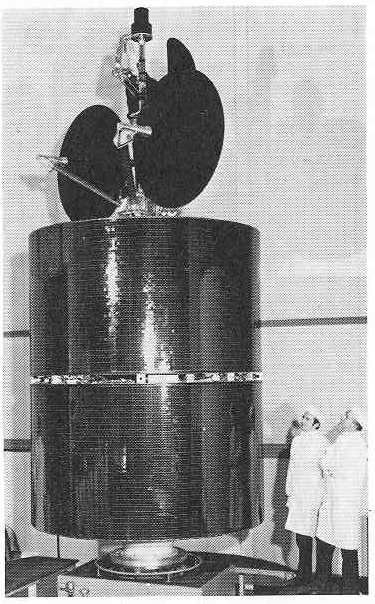
JUMPSEAT (AFP-711) - Now Declassified

Here’s the first part.

https://thespacereview.com/article/4091/1
Big bird, little bird: chasing Soviet anti-ballistic missile radars in the 1960s
by Dwayne A. Day
Monday, December 14, 2020

The second bus-sized HEXAGON photo-reconnaissance satellite roared off its California launch pad in January 1972. Inside of its payload shroud atop the Titan III rocket, the HEXAGON looked somewhat like a train locomotive, and tucked along one of its slab sides was a small rectangular box about the size of a suitcase. After the HEXAGON reached its proper orbit and stabilized itself, circling the Earth over its poles, the box detached, pushed off by springs. It started spinning, and then fired a small rocket motor that boosted its orbit a bit higher than the big bird that had delivered it into space. The small satellite began unfolding like an origami crane spreading out, deploying solar panels and numerous antennas, most of them pointed down at the Earth.

The satellite was named MABELI, and once its antennas were open, MABELI began hunting for radar signals.

MABELI stood for “Main beam TIVOLI.” TIVOLI had been a predecessor satellite, and it stood for “Technical Intelligence Vehicle Orbital Life Indefinite,” which only made a little bit of sense and may have been an inside joke to its designers, who often gave the satellites and their payloads irreverent names, sometimes naming them after movie stars or puns or even their coworkers. Three TIVOLI satellites had flown by 1971, and now MABELI was following on, continuing the mission of listening for signals from Soviet anti-ballistic missile (ABM) radars, a mission that had perplexed American intelligence analysts for much of the 1960s. It had been one part of an often-heated debate over whether the Soviet Union was developing an anti-ballistic missile system, and whether the United States needed one as well.
 
As I don’t do FB I don’t know how to get the accompanying image onto this forum.

NRO Facebook page:

POPPY was the successor to GRAB, the nation's 1st ELINT satellite. Developed by the Naval Research Lab, POPPY was designed to detect land based radar emitters and support ocean surveillance, making great contributions to the nation's security during a perilous era. ️ #tbt
 
Here’s the second part.


https://thespacereview.com/article/4096/1
From TACSAT to JUMPSEAT: Hughes and the top secret Gyrostat satellite gamble
by Dwayne A. Day and Nicholas W. Watkins
Monday, December 21, 2020

Starting in August 1968, the secretive National Reconnaissance Office began launching new intelligence satellites into much higher orbits to accomplish their missions. The first was the CANYON series of communications intelligence satellites, followed in 1970 by the first of the RHYOLITE telemetry interception satellites. In spring 1971, the NRO launched a new and enigmatic satellite named JUMPSEAT, which has remained perhaps the most mysterious of these high-orbit satellites. Each of these satellites pushed the state of the art in terms of payloads, antennas, and satellite design. But JUMPSEAT represented a concerted effort by a civil and commercial satellite designer to break into the top-secret world of satellite intelligence by leveraging a new technology and a military contract to demonstrate that it could perform the mission of both detecting signals from the ground, and spotting missile launches with an infrared telescope.

By the late 1960s, the Space Systems Division of Hughes Aircraft Company was already a dominant force in satellite communications, having developed the first geosynchronous orbit communications satellite, Syncom 2 in 1963, and its commercial successor, Intelsat I, better known as Early Bird, in 1965. In early 1969, another new Hughes technology, the Gyrostat, made its space debut. This time it was on the tactical communications satellite, or TACSAT, one of the first geostationary military comsats. The Gyrostat was a damping system which prevented satellites from inevitably spinning around their longest axis. By allowing “long and thin” satellites, the Gyrostat maximized the use of shroud space on the Titan IIIC launcher, enabling TACSAT to be nearly eight meters long and three meters in diameter. TACSAT was a spinning cylinder with a large antenna “farm” on its top, and at over half a ton in mass, and with over 200 watts of power to the UHF antenna array, it has long been known to be a pioneer and record-breaker among comsats. Newly revealed information is, however, only now showing how TACSAT gave Hughes the knowledge and skills to successfully compete for several other key military and intelligence satellite contracts over the next few years, including the JUMPSEAT signals intelligence (SIGINT) and Satellite Data System (SDS) data-relay satellites. The new information also confirms the long-rumored dual role of JUMPSEAT in carrying both signals intelligence (SIGINT) and infrared missile detection payloads, though some puzzles remain.
 
Well JUMPSEAT just got a limited declassification:

View: https://twitter.com/NRO_gov/status/2016619786885579207


JUMPSEAT, the United States’ first-generation, highly elliptical orbit (HEO) signals-collection satellite, has recently been declassified!

Learn more about its history here: https://nro.gov/news-media-featured...ifying-jumpseat-an-american-pioneer-in-space/

As per NSF see quote below.

It indicates that USA-21 launched on 12 February 1987 on the final Titan-IIIB is actually an 8th JUMPSEAT satellite, not SDS as most sources have assigned to it.

I'm not sure if the fact sheet is the only thing declassified.

https://www.nro.gov/news-media-feat...ifying-jumpseat-an-american-pioneer-in-space/

Declassifying JUMPSEAT: an American pioneer in space

The director of the National Reconnaissance Office (NRO) recently declassified the existence of JUMPSEAT: the United States’ first-generation, highly elliptical orbit (HEO) signals-collection satellite.

Launched from 1971 to 1987 under mission numbers 7701 to 7708, JUMPSEAT was the product of the United States Air Force’s (USAF) program at the NRO. Developed under a program called “Project EARPOP,” JUMPSEAT offered the U.S. a way of collecting intelligence during unprecedented geopolitical change and Cold War tensions that lasted until the early 1990s.

“The historical significance of JUMPSEAT cannot be understated,” said Dr. James Outzen, NRO director of the Center for the Study of National Reconnaissance. “Its orbit provided the U.S. a new vantage point for the collection of unique and critical signals intelligence from space.”

Following the end of World War II, threats of globally-spreading communism and nuclear weapons proliferation fueled Americans’ anxiety of the unknown. Across the world, the U.S. suspected that more American adversaries were building out extensive, topline defense arsenals including long-range missiles and atomic weapons. The success of the Soviet Union’s Sputnik 1 demonstrated an object could be placed on orbit, which could pose a weapons threat from space.

Thankfully, the newly-formed NRO was poised to offer the U.S. some critical answers.

The NRO’s existing electronic surveillance satellites, including GRAB and POPPY, already collected intelligence from their positions in low-earth orbit. The NRO and USAF, collaborating as a part of NRO’s “Program A,” were tasked with developing a foundational HEO signals collection satellite to bolster the U.S. government’s space intelligence portfolio. Named JUMPSEAT, the new satellite would be capable of operating in a HEO, or Molniya, orbit.

The NRO’s USAF members worked quickly to develop the pioneering satellite’s technology. JUMPSEAT’s core mission focus was to monitor adversarial offensive and defensive weapon system development. From its further orbital position, it aimed to collect data that might offer unique insight into existing and emerging threats.

Together, the NRO and the USAF launched the first JUMPSEAT mission in 1971 from Vandenberg Air Force Base (now Vandenberg Space Force Base) in California. Once in orbit, JUMPSEAT successfully collected electronic emissions and signals, communication intelligence, and foreign instrumentation intelligence: invaluable information that was downlinked to ground processing facilities within the U.S. From there, the data was provided to the Department of Defense, the National Security Agency, and other national security elements.

Over the decades, JUMPSEAT satellites continued to prove their worth to signals intelligence, finally operating in transponder mode until they were taken out of service in 2006. The NRO and its mission partners, including national-level decision makers and national command authorities, collaborated in its decommissioning.

The JUMPSEAT declassification recognizes the program’s long and distinguished life in support of our national security, as well as JUMPSEAT’s status as the progenitor of other HEO satellite programs.

The declassification memorandum on JUMPSEAT provides more details on the historic program.

Photos (PDF with links to png version of the pictures): https://www.nro.gov/Portals/135/Documents/foia/JUMPSEAT Records/JUMPSEAT Photos.pdf
 
View: https://twitter.com/planet4589/status/2016663028805087271


Jonathan McDowell
@planet4589

We know JUMPSEAT 1,2,3,4 1971 Mar 21, 1972 Feb 16, 1973 Mar 21, 1975 Mar 10 and JUMPSEAT 8 (1987 Feb 12). But...


Jonathan McDowell
@planet4589
1978 Feb 25 : JS 5 or QUASAR 3
1978 Aug 5: QUASAR 3 or JS5
1980 Dec 13; QUASAR 4 or JS6
1981 Apr 24 : JS 6 or QUASAR 4
1983 Jul 31: JS7 or QUASAR 5
1984 Aug 28: QUASAR 5 or JS7
are still to be resolved.
4:01 PM · Jan 28, 2026
 
I'm glad this was declassified--I mean, what does a spysat look like?
Like a comsat--we know what they look like already--a big garbage can with antennas on top.
What else would it look like?
 
I'm glad this was declassified--I mean, what does a spysat look like?
Like a comsat--we know what they look like already--a big garbage can with antennas on top.
What else would it look like?
Not the the same as a comsat. Different type and size of antennas, plus shorter solar array barrel.
 

Attachments

  • Intelsat-4-4_image.jpg
    Intelsat-4-4_image.jpg
    49.5 KB · Views: 17
I'm glad this was declassified--I mean, what does a spysat look like?
Like a comsat--we know what they look like already--a big garbage can with antennas on top.
What else would it look like?
According to over on NSF we can expect the KH-11 to be declassified sometime this year. I’m guessing that means the early part of the program from the seventies and eighties.

By the way these are early Jumpseat satellites in the released images, apparently later ones looked different to this.
 
Last edited:

Top Secret Spy Satellite Declassified By National Reconnaissance Office​

https://www.twz.com/space/top-secre...eclassified-by-national-reconnaissance-office
The video in that article:

View: https://www.youtube.com/watch?v=sZrPFQ-BTC8

Another article:

https://arstechnica.com/space/2026/...assifies-high-flying-cold-war-listening-post/
Also Blackstar on NSF points this out.

I'm very happy we got the JUMPSEAT information and images. But just to bring everybody down a bit, let's remember that PARCAE got the same kind of declassification in July 2023 and we still don't have any documents or an official history of the program after two and a half years.
 
According to over on NSF we can expect the KH-11 to be declassified sometime this year. I’m guessing that means the early part of the program from the seventies and eighties.

By the way these are early Jumpseat satellites in the released images, apparently later ones looked different to this.

That was me who wrote that. And I'm only guessing based upon the NRO's habit of making declassification events tied to anniversaries. 1976 is when the first SDS satellites were launched and when the first KH-11 was launched. There is some logic to assuming that because it has been 50 years, they'll declassify something on the KH-11 (and maybe the SDS) this year.

But don't hold your breath.
 
As for the anniversaries thing, I believe that GRAB was declassified on an anniversary (1998--40 years after the program was started), and GAMBIT and HEXAGON were declassified for the 50th anniversary of the NRO.

It seemed like there was a plan to declassify the KH-11 on the 60th anniversary of the NRO in 2021, but the pandemic was raging and NRO did not throw a party for themselves. They declassified the electro-optical imaging discussion that led up to KH-11 in (I think) 2021. I think that when they announced that, they indicated that they would have the celebration later. That was a prudent choice, because a lot of the people who showed up for the party would be in their 70s and 80s, and they did not want them all getting covid and dying. My guess is that they would have shown off some photos and a big model or mockup of a KH-11 at that anniversary, but it did not happen.
 
Last edited:
According to over on NSF we can expect the KH-11 to be declassified sometime this year. I’m guessing that means the early part of the program from the seventies and eighties.

By the way these are early Jumpseat satellites in the released images, apparently later ones looked different to this.
That refers to the follow-on systems
 
High Jump: the JUMPSEAT signals intelligence satellite
by Dwayne A. Day
Monday, February 2, 2026

On March 21, 1971, a new and unusual rocket lifted off from Vandenberg Air Force Base on the California coast. It was a night launch and nobody viewing the rocket climb into the cold Pacific sky could tell that it was different than other Titan rockets that had launched from there many times before. But anybody at the base who saw it knew that it was new. Previous Titan rockets had narrow, pointy noses half the diameter of the Titan core stage. But this rocket had a thicker fairing, the same diameter as the core, indicating a new and bigger payload. The fairing was also tall, meaning that something long was packed inside. Once it reached orbit, anybody who had access to the orbital data could tell that rather than a low Earth orbit, it had instead headed into a highly elliptical orbit highly inclined to the Equator, one that took it low and fast over the southern hemisphere and then high and slower over the northern hemisphere, perfect for staring down on the Soviet Union for longer periods of time.

The satellite was named JUMPSEAT, and it was the first of a new kind of signals intelligence collector. It was equipped with two large dish antennas and a small telescope at the base of its “antenna farm.” In orbit, it flew with its spinning bus covered with solar panels up, and its antenna farm pointed down toward the Earth. In December 2025, the National Reconnaissance Office declassified the JUMPSEAT signals intelligence satellite, announcing it on January 28. Eight JUMPSEAT satellites were launched from 1971 to 1987, and the program was finally shut down in 2006—meaning that at least one satellite lasted 19 years or longer in orbit. Although the NRO provided only a limited amount of information on JUMPSEAT, in a press release the office indicated that it would reveal more information in the future. Most notably, the NRO released over a half-dozen photos of the early spacecraft, including models, artwork, and flight hardware.

https://thespacereview.com/article/5151/1
 
According to the article later Jumpseat satellites had the dishes mounded side by side by the time of Desert Storm in 1991.
 

Similar threads

Back
Top Bottom