Further indications that we're close to getting contracts for DDX:

-snip-

Forgot to post it, but Fincantieri's Q1 2026 results mentioned that the DDX contract would be in the next few months (a couple months ago). Most recently this is also reflected the press release from a recent OSN event:

On 26 May 2026, the DDX OSN Matchmaking Event took place in Brussels, an important networking event organized by Agoria - Belgian Security & Defence Industry (BSDI), in collaboration with OCCAR (Organisation for Joint Armament Cooperation), within the framework of the “Industrial Global Balance” activities.

The event was attended by representatives from OCCAR, OSN, and several industries interested in the Programme.

During the event, OCCAR officially presented the DDX programme, which foresees the construction of two next-generation destroyers for the Italian Navy, with contract signing expected in the near future.

OSN, Prime Contractor of the Programme, subsequently delivered a presentation illustrating the company and the ongoing and/or upcoming programmes in which it serves and/or will serve as Whole Warship Design Authority.

Particular interest was generated by the opportunity to hold one-to-one meetings with the various industries interested in cooperating with OSN.

Special thanks to OCCAR and Agoria for organizing this important networking event, aimed at highlighting a programme that will represent a major technological leap forward for the Navy and for the entire industrial sector.

Which also had an interesting slide showing the progress of various programs orchestrated by them:
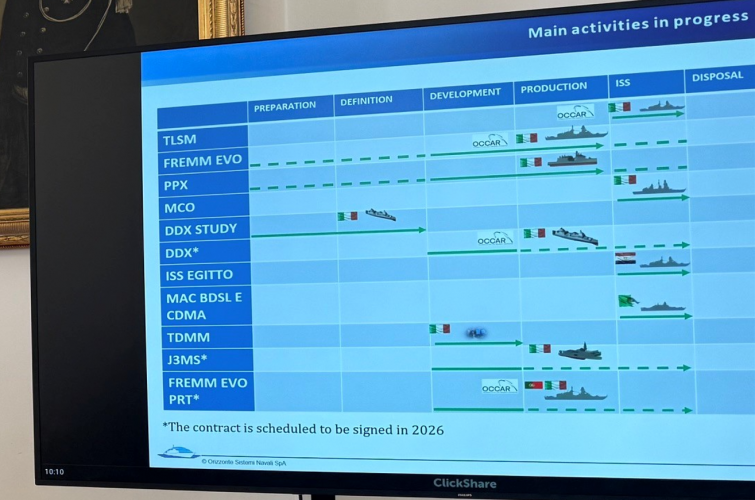
1780775687425.png
 
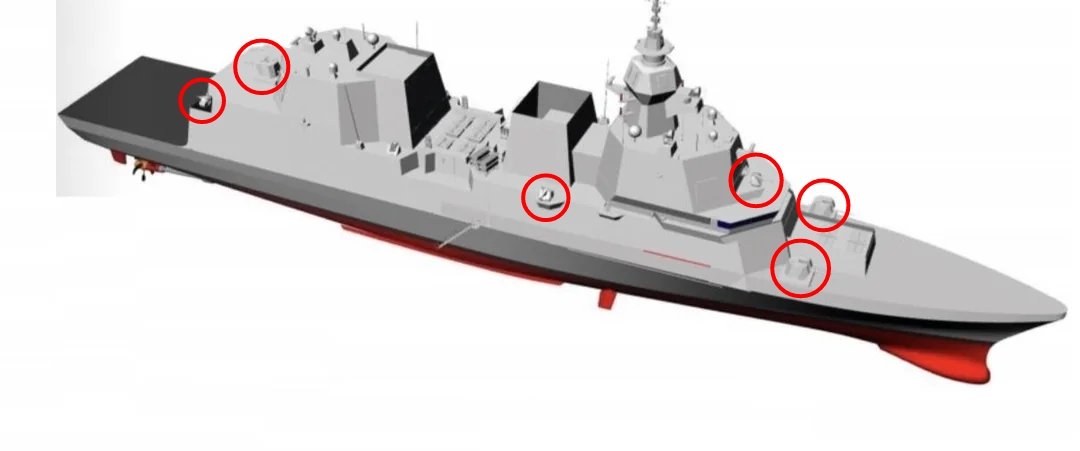
Certainly unpleasant looking, but seeing several medium to small caliber gun armaments across the entire ship to combat unmanned threats is nice.
View attachment 818164

Moreso the 30mm systems (4-5x) than the 76mm (3). Not that the 76mm can't be used to engage drones - but they are somewhat overkill for OWA-UAV threats to the ships themselves and are better left for general-purpose work (though this can still include engaging drones at longer ranges than the 30mm can manage), and anti-missile interception.
 
Moreso the 30mm systems (4-5x) than the 76mm (3). Not that the 76mm can't be used to engage drones - but they are somewhat overkill for OWA-UAV threats to the ships themselves and are better left for general-purpose work (though this can still include engaging drones at longer ranges than the 30mm can manage), and anti-missile interception.
The Italians have long seen the OTO 76mm as a CIWS (replacing the US Phalanx). There's even a version of the 76mm that is non-deck-penetrating and is just as light as a Phalanx as well!
 
The Italians have long seen the OTO 76mm as a CIWS (replacing the US Phalanx). There's even a version of the 76mm that is non-deck-penetrating and is just as light as a Phalanx as well!

Same role as Phalanx, certainly. Though for the Italian experience/intent, it was actually a replacement for the 40mm DARDO, which was their first generation CIWS system that was installed on various ships authorized and built in the 1970s to the mid-1980s. That was then superseded by the 76/62 Super Rapido in the late 1980s, starting with the Durand de la Penne-class destroyers.
 
Simultaneously, the expected timeline for spending across the entire €2.7bn program is now projected to stretch to 2036 rather than 2035 (which was the end date in every DPP since 2021), likely reflecting a general year long delay in the program - if they start production on the first ship in 2026 there is no way they will deliver it in 2029 as previously planned. I would expect the lead ship to be delivered in 2030 or 2031, though if the second starts production soon after (rather than with a two year gap) it may still enter service in 2031, or otherwise 2032?

Could the Sylver NG be first fitted to the DDX ?
https://www.meretmarine.com/fr/defense/la-suede-signe-la-commande-de-quatre-fregates-a-naval-group
... But there should still be a possibility for future FDIs with the Sylver NG, a new versatile vertical launcher (which can carry several types of missiles) on which Naval Group is already working for production in the 2030s. But this project, which is at the preliminary stage, has not yet been commissioned by the State. Unless things accelerate and the Sylver NG is available from the beginning of the 2030s, which would make it possible to integrate it if Stockholm so wishes on the last units of its series, this evolution could only see the light of day on the occasion of a renovation...
 

Truly, I do not know. It is a thought that has crossed my mine several times this year, ever since reading the article that informed this post.

To quote from that post:

It is interesting to note - and I may be reading too far into this - that RID no longer describes the type of VLS (whether A50 or A70) and instead only refers to '80 cells dedicated to air-missile defense and deep strike' (in totale di 80 celle dedicate all'IAMD e al deep strike). The deck-mounted missile armament remains at eight Teseo Mk.2/E.

My assumptions are fairly conservative, and I assume is the split of 48x A50 and 32x A70 that had been previously reported is still what is intended.

But the phrasing certainly leaves things open to interpretation, and given the fact that we have heard nothing about Aquila integration into Sylver A70 (only Mk.41), and the fact that Italian effort to buy MdCN (the only munition actually integrated into Sylver A70) seems to have fallen through... it certainly makes one wonder.
 
My assumptions are fairly conservative, and I assume is the split of 48x A50 and 32x A70 that had been previously reported is still what is intended.

But the phrasing certainly leaves things open to interpretation, and given the fact that we have heard nothing about Aquila integration into Sylver A70 (only Mk.41), and the fact that Italian effort to buy MdCN (the only munition actually integrated into Sylver A70) seems to have fallen through... it certainly makes one wonder.
It does.

I'd be leaning more towards a split install, ~48x A50s and 32x Mk41. Aquila and Tomahawks in the Mk41, everything else in A50s. Because even Aster 30 B1NT fits into an A50.
 
There will be a Sylver variant for HYDIS/Aquila, France won't buy Mk41.
If HYDEF wins then it's another story
 
Certainly unpleasant looking, but seeing several medium to small caliber gun armaments across the entire ship to combat unmanned threats is nice.
View attachment 818164
Definitely not a looker, but it may surprise us by being really pretty in the steel.

Italy is at least giving us something to be excited about. Cant wait to see a DD render.
 
This is bordering blasphemy
Nope. Ironically, more often than not Italian ships were kinda fugly, if you go design by design.
It's general reputation ("Italians can make shit but they can't make ugly") and some bright exceptions that form the picture; but it's mostly the opposite. Their ships are usually very good, but good looking ... oh boy, it depends.
 
my personal opinion, the aesthetics of Italian warship designs were peak in the 2000s and 2010s.
Cavour, Italian FREMM, Orrizante, Comandanti, etc.

I don't dislike the current designs like the Thaon Di Revel or this new DDX, (I think Trieste looks kinda off with its two tall islands), but its not as nice as the previous decade
 
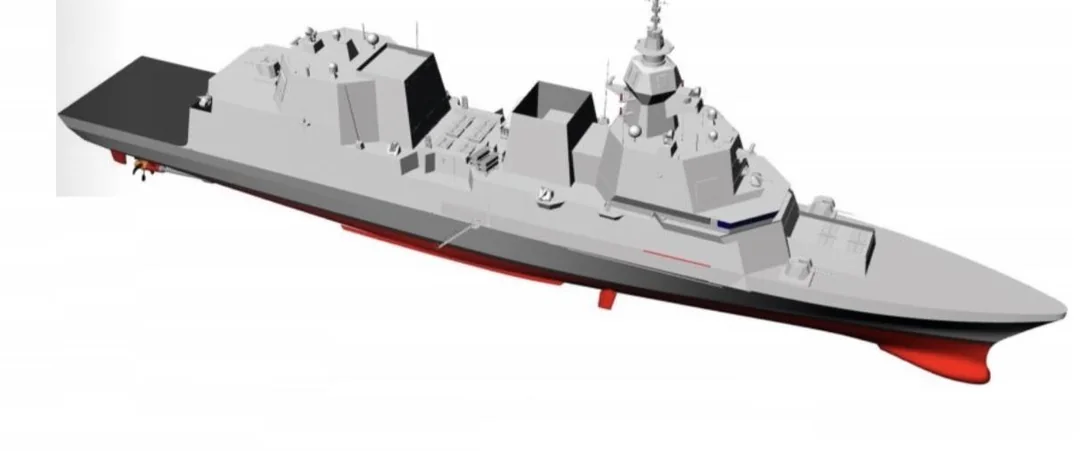
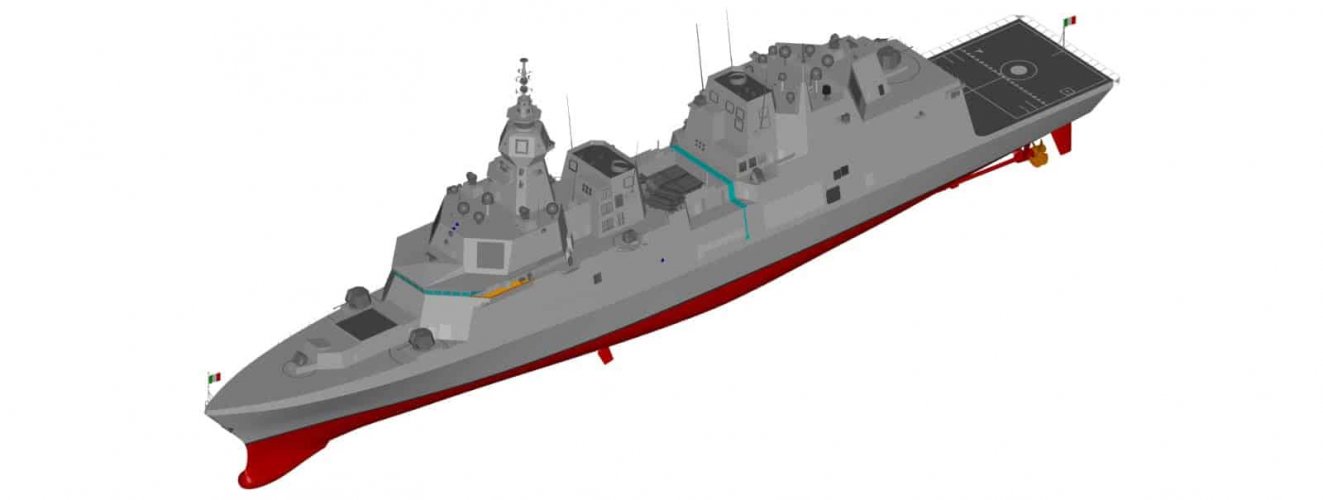
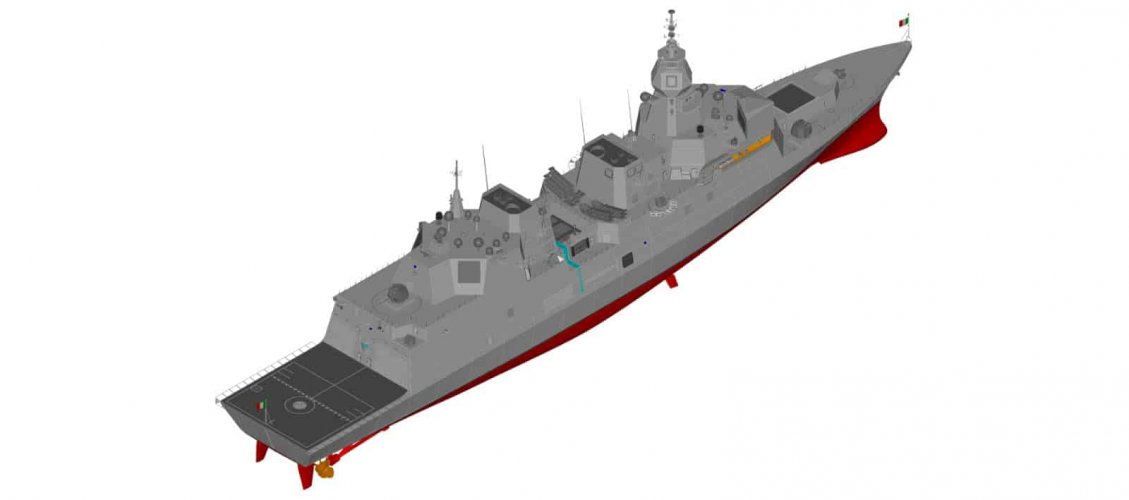
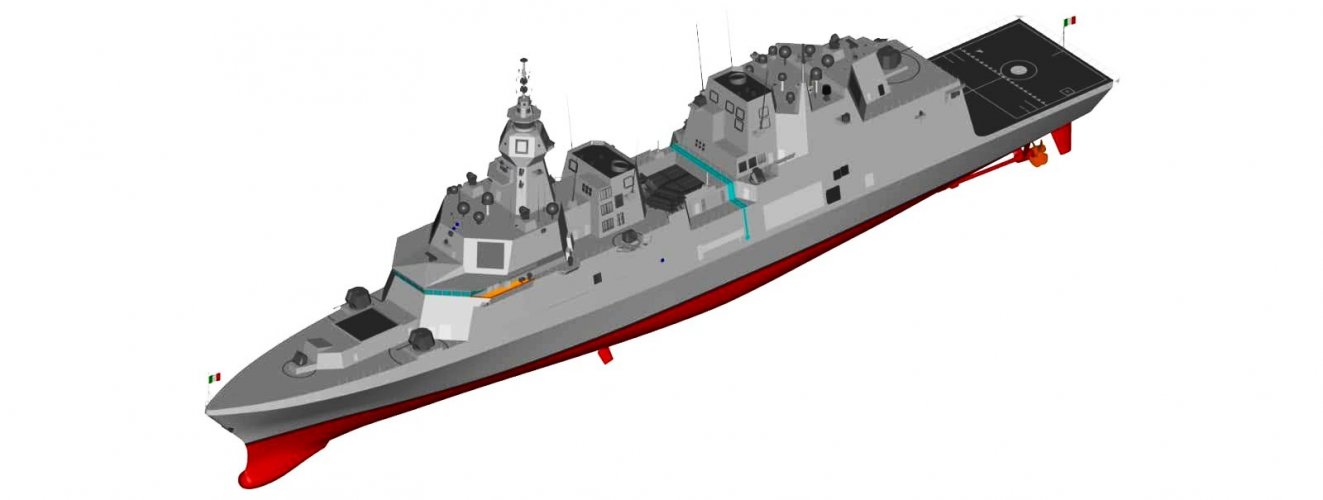
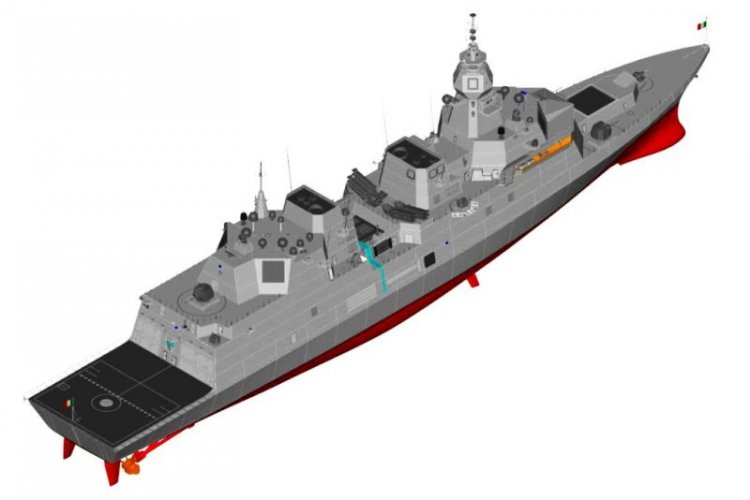
Now that the DDX is on contract [OCCAR Press Release], it seems like a good time to post a round-up of all the additional details that have come with the news releases and renders.

OSN-Italian-Navy-DDG_02.jpg OSN-Italian-Navy-DDG_01-800x534.jpg ​

The DDX procurement, managed by OCCAR on the behalf of the Italian Ministry of Defense, has been formally initiated with the signature of a contract with OSN, the JV between Fincantieri and Leonardo that has, to date, been responsibility for the delivery for the Italian ships of the Horizon and FREMM programs.
The total value of the contract is €3.7bn, with the initial signature activating the first section worth €2.4bn. This will cover related RDT&E costs for the DDX program, as well as the production of the lead ship of the class and initial in-service support. The second ship remains on option, making up the remaining €1.3bn of contract value.

These values are a considerable increase in cost over the previous value given for the entire DDX program (which is a value greater than contract cost to OSN), of €2.7bn. This likely reflects a mix of new technologies incorporated into the design compared to what was previously envisioned (new and novel SMS, CMS, radar suite, etc), design changes, armament increases, and inflation.

Additional details and an updated render are now available since my past review of information on the design, which was posted in this thread in January.

The design grew marginally, now reported at a full 180 meters in length with a full load displacement in excess of 13,500 tonnes. Crew count is now described at 251, which falls neatly between previously reported figures of 200 core crew and accommodations of up to 300.

Curiously, the ship is described as having a range of "4,000 nmi" in press releases, with no speed given. Previous reporting indicated that range would be 6,000 nmi at 18 knots, and there are no major negative changes to the propulsion arrangement, which leaves this figure confusing. It is possible that it is a typo, or reporting a much higher cruising speed in excess of 20 knots?

The press release confirms that the DDX are using a new CMS, SADOC 5, which they describe as a 'C5I' capability - which follows from the reported emphasis on cyber resilience reported by RID earlier this year. It also confirms the use of a DC power subnetwork and previously mentioned ESS (Energy Storage System).

It is interesting to note that the description of the armament follows the vagueness that RID reported on this year, but takes it to a new extreme by saying only that it is equipped with an "MBDA weapon system." Visually, the armament is the same as last reported (80x VLS, 8x Teseo Mk.2/E, 3x 76/62, 4x 30mm Lionfish), though the fore 30mm Lionfish mount had now been shifted from atop the bridge to the bow, ahead of the forward VLS farm. It is interesting to note that there is a considerable amount of deckhouse between the forward cells and the 30mm gun position - possibly FFBNW space for either more VLS, or a HEL?

Delivery for the First-of-Class is set for 2033, while the Follow-On-Ship will now be delivered in 2035. This represents a four year delay from the previous targets of 2029 and 2031, respectively.
 
I"m surprised by the rendering showing obvious blind spots fore and aftwards by design. They can do better.
 
I"m surprised by the rendering showing obvious blind spots fore and aftwards by design. They can do better.
Where, if you mind me asking?
It appears to be best covered modern combatant period.
 
It is interesting to note that the description of the armament follows the vagueness that RID reported on this year, but takes it to a new extreme by saying only that it is equipped with an "MBDA weapon system." Visually, the armament is the same as last reported (80x VLS, 8x Teseo Mk.2/E, 3x 76/62, 4x 30mm Lionfish), though the fore 30mm Lionfish mount had now been shifted from atop the bridge to the bow, ahead of the forward VLS farm. It is interesting to note that there is a considerable amount of deckhouse between the forward cells and the 30mm gun position - possibly FFBNW space for either more VLS, or a HEL?
AM i missing it or is there no CAMM uplink ?
Also how large are the S band radar panels ?
 
Last edited:
Where, if you mind me asking?
It appears to be best covered modern combatant period
The upper mast has the higher frquency panels at right corners from each other. They sit at 45 degree angles to each other. But they also sit on a slope, so the final angle is over 90 degrees in the sea level plane. This is why the Australians CEA systems went with a six panel system, so the side lobe didn't drop off so much between panels. Electronic beam shaping is pretty cool stuff but it still obeys the laws of physics.

The larger, lower frequency panels are toed in towards the laterals. Again, these panels are sloped which strains their power at 45 degree angles from the face. There are obstruction built into the aft section to where there is no uninterupted view rearwards. And the front panels, although less obstruction, is simply relying on lobe data from frontward scanning. That is a mere fraction of the power available from what a front-facing panel would allow. The perpindicular ship view will suffer somehat the same issue which may be why they over emphasized the panel direction towards the side by over ten degrees on each panel. This will alleviate a little bit of the range 90 degrees offboard.
 
Last edited:

Similar threads

Back
Top Bottom