Apparently the experience of modern warfare - multiple 76-mm to swap attacking drone swarms are much more useful than single 127-mm. And 76-mm still retain enough anti-surface and coastal bombardment capability to be viewed seriously as offense weapon.
I would say, no and yes.
Yes to the second part because that is certainly true, and with the availability of extended range ammunition like Vulcano you can somewhat make up for the reduced reach of the 76mm (28 km with BER, 40 km with GLR).
The drone threat, however, is not really a driver for the 76mm guns. Although they have gained much accolade for downing UAVs in the Red Sea, destroyers mounting three 76mm guns for CIWS role has been a consistent feature in Italian DDGs since the late 1980s and the design of the
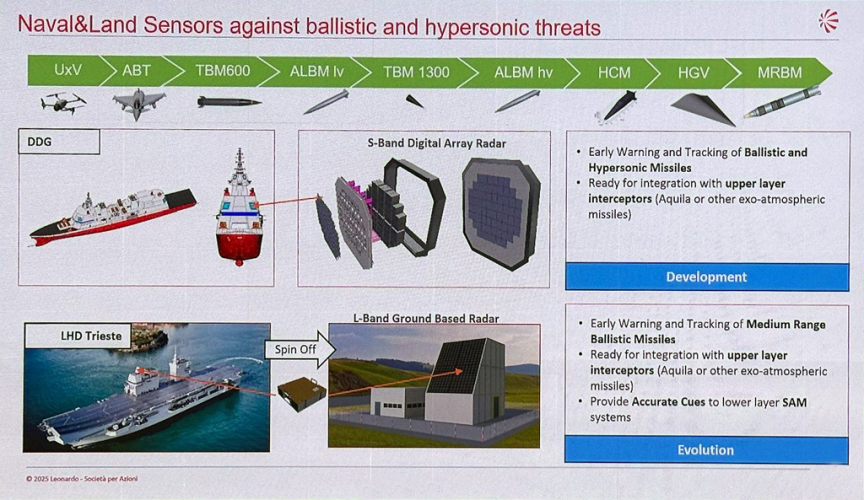
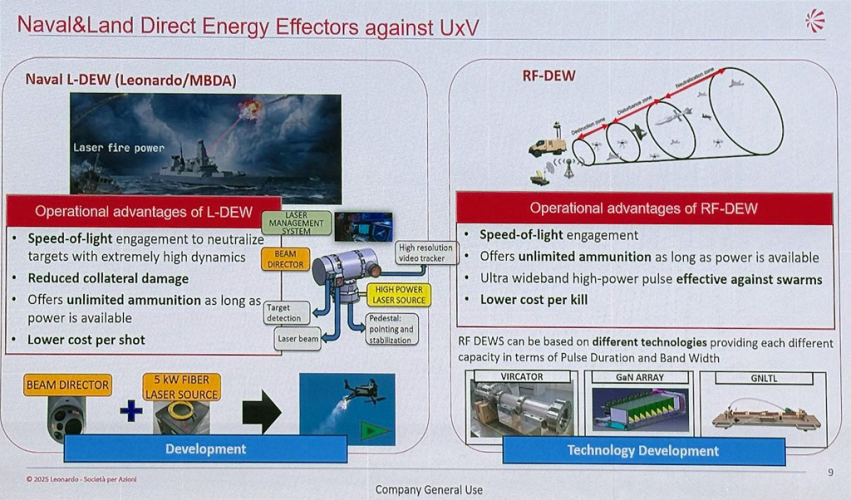
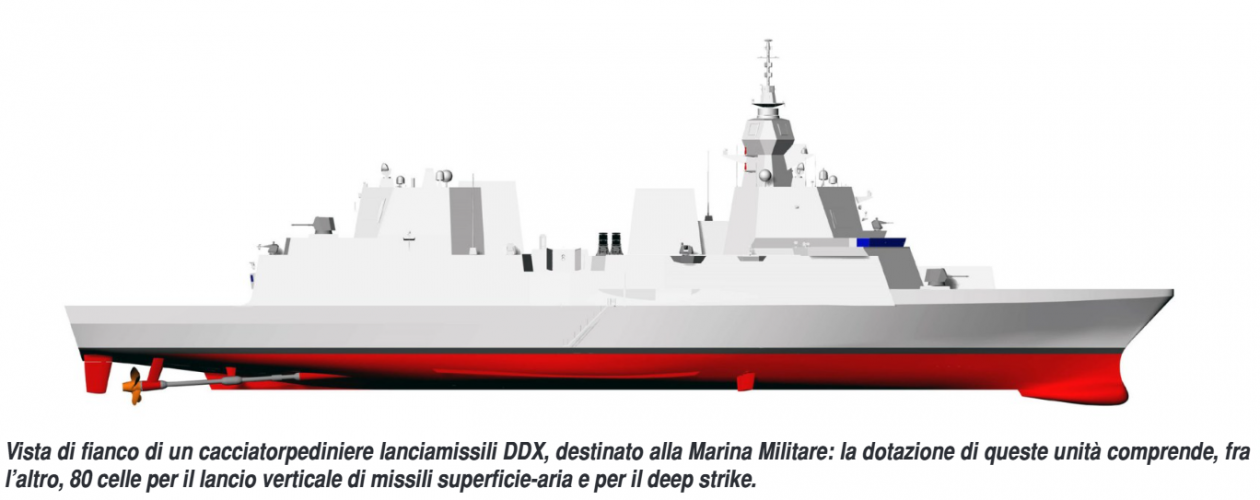
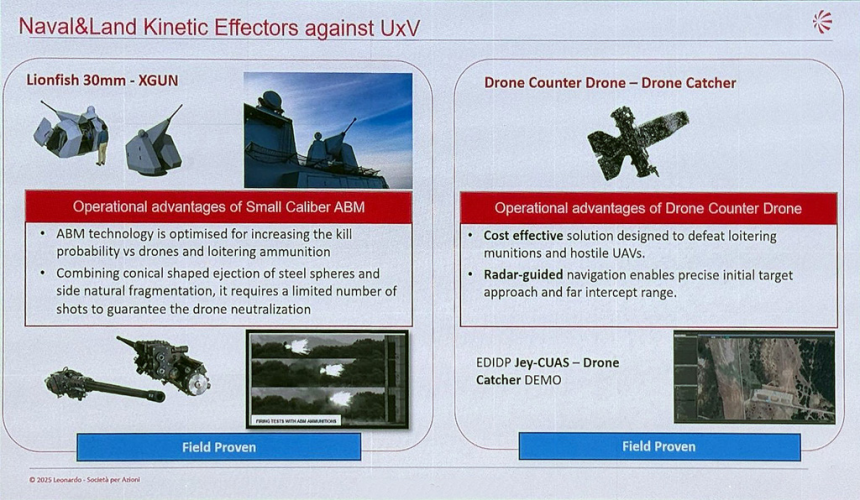
Durand de la Penne-class. Furthermore, the Marina Militare's efforts to improve C-UxV capabilities on ships do not center on the 76mm gun systems. Instead, the hardkill system of choice is the 30mm gun system, which is motivating its replacement of the 25mm KBA system and the fitting of three such systems on the DDX. This is being tied into the dedicated C-UxV system they intend to field on ships going forward, which will integrate the EW suite with the X-band radar and DSS-IRST and a new suite of softkill and hardkill capabilities (30mm guns initially, but also DEW/HPM solutions in the future).
I wouldn't go as far as saying that, given that France has them firmly beat in that regard. But Italy is a very close second, indeed.
France is definitely the only full-spectrum builder in Europe, given their ability construction nuclear-powered submarines and aircraft carriers. Though it is interesting to note that the Italy has actually built more warships (including submarines) than France so far this century, whether you count by number or by tonnage.
Wow. 14 000 tons air defense ships and nuclear carrier : what is happening with the italian navy ? bouts of megalomania ? very impressive.
And it is actually surprising that it took Italy so long to expand their naval capabilities. Although, one has to ask the "why" again. The Mediterranean, which is the hometurf of Italy, is more so characterized by illegal immigration rather than anti-ship ballistic missiles and transoceanic ranges that require a top notch blue water Navy. All of the naval powers in the Mediterranean pose no threat to Italy really. So why the sudden need for such capable vessels?
To respond to both of these at once;
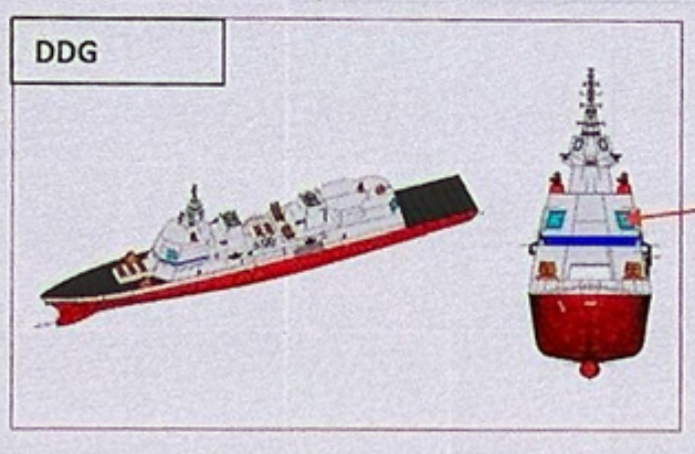
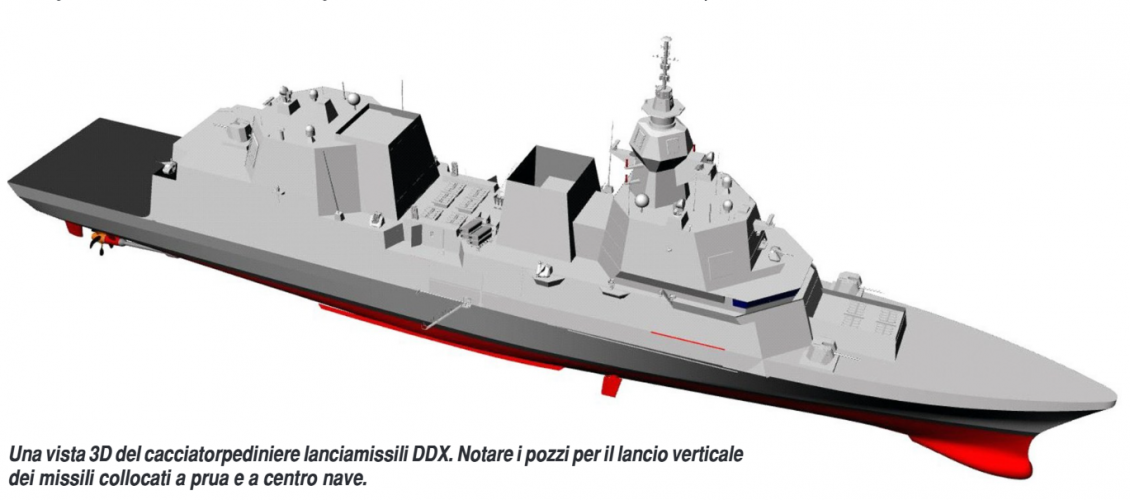
The destroyer's capabilities are fairly easy to explain - this size range (12,000 to 15,000 tonnes) simply is the new standard for destroyers of the present. Type 055 is the first of these larger types to enter service, but whether it is DDX (MM), DDG(X) (USN), DDGX (JMSDF), KDDX, and likely even Type 83, you're looking at this larger size. It's simply what is necessary to fit the kind of power and cooling requirements necessary for the modern high-end sensor suites, along with adequate armament.
DDX specifically has certainly grown with time - it started as 'improved Orizzonte' nearer 9,000-10,000 tonnes before turning into a completely separate 11,000-tonne design (at the time it became a program of record) and then growing since then, as requirements for armament and sensor suite have adapted. But then likewise so have likely threats, and even the Horizon/Orizzonte-class were never as heavily armed as the Marina Militare would have liked (setting aside the gun discussion from earlier, it is actually a 64-cell design and both the French and Italian ships remain FFBNW an additional 16 VLS, like their British cousins).
Fundamentally, the MMI has had an outstanding need for a new pair of destroyers. They have always wanted to have six DDGs, and that was why this was their target during the Horizon program. The cutting of that procurement to just two hulls was as bad for them as it was for France. Even if the MMI has been able to cope with this better due to their FREMM all having the medium-range air warfare capability, that was not meant to be a crutch - it was just a result of the general recognition that even ASW escorts needed to have a more credible air defense capability for both themselves and consort defense. Most most of the last decade, the Marina Militare has been forced to make do with two modern DDGs, as while they still had the two
Durand de la Penne-class destroyers in service, they were not credible air escorts anymore due to the age of their primary AAW system (SM-1MR).
With regards to the Italian navy's size and capabilities... to a significant degree, this is consistent with the same trend they have always been on since the early Cold War. Though they were not a nuclear navy (though they did try to become one in the 50s-60s), they were by far the largest and most capable of the conventional navies in Europe, with only the USN, RN, and MN exceeding them in overall capability given their access to aircraft carriers with jet aircraft and nuclear-powered submarines. Even in spite of this, the Marina Militare maintained a guided missile escort force that was on par with that of the Marine Nationale during the mid-Cold War, and then fielded an objectively larger and more capable guided missile force from the mid-1980s onwards.
Which, to be clear, is not to ascribe a general superiority to the MN in any regard - the MN had a vastly greater carrier force, a larger attack submarine force, the entire nuclear deterrence mission, etc - but at the same time it is also very much the case that while the Marina Militare was not as capable as the 'nuclear' navies of NATO, it was also far and away batting over the heads of every other navy in NATO besides.
In that era, there was very much the need to maintain a capable naval force - the Soviet 5th Squadron was a constant presence in the region and many of the MENA states were less than friendly and at times had notable air and missile forces. Likewise, the threat of Soviet bombers flying from the USSR was a huge threat.
After the collapse of the Soviet Union, the Mediterranean still had considerable issues with instability, but also geopolitical demands drew the Marina Militare further afield to regions that, while not within the Mediterranean, still greatly impacted the Mediterranean itself - hence intervention missions in Somalia, supporting NATO forces in Afghanistan (which involved the deployment of an Italian Carrier Strike Group), and counter-piracy missions in both the Atlantic and Indian Oceans.
The 2010s brought the vector of nation-state threats back in force, due in large part to the instability brough on by the Arab Spring of 2011 and the Russian invasion of Ukraine in 2014. The new tensions with Russia, the civil wars in Libya and Syria, and the now constant presence of Russian ships since 2013 created a new threat environment that blended the - by this point traditional - concerns of the migration crisis with those of real military concern. Russian surface ships and their activity had to be monitored, and the same went for their often considerable submarine deployments. These were made complicated by the steady growth and modernization of submarine fleets by other nations in this period - an array of not just Russian models (Kilo's operated by the Russians and Algerians) but also German models from the growing and modernizing fleets of Egypt, Israel, Greece, and Turkey (even if the latter are NATO members, this still creates complications for deconfliction). The same also went for the air threat picture, again from both increased Russian presence but also the modernization of MENA air forces with modern aircraft and improved munitions.
And to be clear, that threat picture absolutely includes anti-ship ballistic missiles and other such complex threats. The Russians made a point of bringing MiG-31K's armed with the Kh-47MW Kinzhal (air-launched ballistic missile) down to the Mediterranean as a 'counter' to NATO carrier deployments in the Eastern Mediterranean, and have likewise have conducted live-firings with the Tsirkon HCM from frigates deployed in the region. That is a missile type that that can be fielded on their modern SSGNs (Yasen-M's) that occasionally also show up in the region.
Beyond that, the MMI still has requirements to operate in extra-Mediterranean theaters, because events that occur beyond the Suez and Gibraltar do impact the Mediterranean quite significantly.
It is not for nothing that France, Italy, and Greece have continued to allocate ships to defend shipping from ballistic missile, cruise missile, and UxV attack. Every other European member bailed on deploying ships to the mission (whether Prosperity Guardian or Aspides) after the summer of 2024. The Marina Militare has also been deployed in Northern Europe to cover for gaps in capabilities of NATO allies in regions like the Baltics (in particular, simultaneously with the Red Sea mission they were also rotating destroyers and frigates through the Baltic to bolster Polish coastal air defenses).
Similarly, Italy's international engagements have drawn it further afield, in the Indo-Pacific. Italy has many important economic and defense partners in the region that it engages with, and the stability of the region is quite impactful on the Italian economy. It also provides many opportunities for Italian naval forces to exercise at a scale that is simply not possible around European waters, particularly when it comes to live-fire air and missile engagements. Thus, deploying CSGs (now a coordinated effort with the RN and MN) or surface combatants to the region has the dual effect of both engagement within the region, but also increasing the effectiveness of Italian naval forces when they're in the European and Mediterranean regions.