Dilandu
I'm dissatisfied, which means, I exist.
Recently after having a discussion about legacy S-75 SAM system, I decided to look more for data about it - and to my puzzlement found that many sources describe the SNR-75 (NATO "Fan Song") radar operations wrongly or with significant mistakes. And therefore many peoples have rather wrong assumption, how exactly this complicated thing worked.
The SNR-75/"Fan Song" radar was the heart of the whole S-75 family of SAM's. It was a direct decendant of B-200 multi-channel radar, used in monumental S-25 "Berkut" multi-channel SAM. But SNR-75, while following the same general idea - scanning for azimuth and elevation by two synchronized antennas, simultaneous track-while-scan, using the same radar to both track the target and guide missiles - was from the beginning designed to be smaller, cheaper, transportable (S-25's B-200 was fixed in place) and trainable (S-25's B-200 could not train - its two antennas required precise positioning relative to each other, and were too heavy to be put on single frame - so it could only scan the targets in fixed area).
Let's look at basic model - for SA-75 "Dvina" SAM system:

As you could see, there are three antennas over the cabin:
* On the right side, a vertical through-like antenna (P-12) was placed to scan for elevation. The scanning was achieved by the use of Lewis rotating scanner, fed from separate magnetron;
* On the top of cabin, a horizontal through-like antenna (P-11) was placed to scan for azimuth. It too used the Lewis rotating scanner, and its own magnetron. The scanners were synchronized, so both vertical and horizontal beams moved together - but on different working frequences, so they could be easily separated on receive;
* On the left side, a parabolic dish antenna (P-16) was placed to send guidance command to missiles. It wasn't scanning, it was merely a transmitter that send command signal in relatively narrow area;
All antennas are put on single frame, rotating in elevation, so they always maintain the same position relatively to each other. Training the whole antenna set is achieved by rotating the whole cabin on its mount.
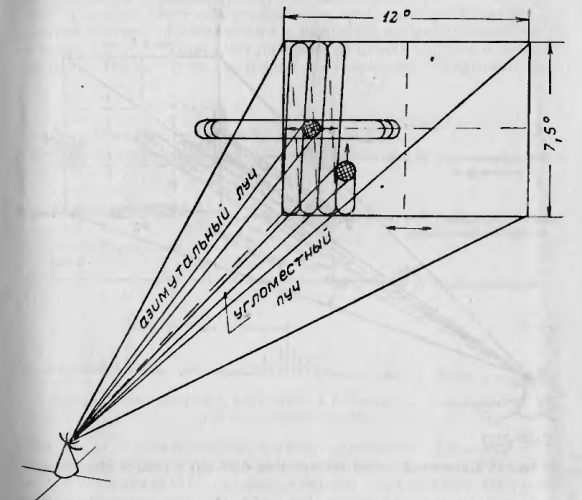
When scanning for target (usually by warning of separate early warning radar), two antennas produce synchronized fan-shaped beams (about 7 degrees wide) moving at right angle to each other in the 20 degrees sector in front of the cabin. The recieved echo signals were visualized by a pair of B-scopes; one for azimuth, one for elevation, both produced range data also. So basically the SNR-75 radar have two separate channels for azimuth and elevation data, which weren't directly connected.
When the target(s) was detected, operators used manual controls to turn the SNR-75 in azimuth and elevation until the chosen target was directly in the middle of both scopes - which means, at the direct boresight of both azimuth and elevation antennas. Then the azimuth, elevation and range gates were set for tracking.
The radar have three tracking modes; automatic (used for single targets), manual (used for tight group targets that automatic have troubles discriminating between), and semi-manual (the azimuth and elevation were tracked automatically, while range was set manually). The third mode was used because in 1950s range jamming was considered the greatest problem - it was rather easy to implement on plane jammers.
One important detail - the SNR-75 continued scanning the area around target even while scanning it. Any other targets nearby (within the 20 degrees angle) were therefore constantly scanned, and if operators decided to switch to another target, it could be done without initiating new search pattern.

When the target was sucsessfully tracked - manually or automatically - the missiles came into play. Up to six launchers were directly connected with SNR-75 by cables, and followed radar azimuth and elevation. The launched missiles were, therefore, "thrown into basket" of constantly scanning beams. The same beams that were used to scan for target, were also used to scan for flying missiles & determine their position in scanned sector. A special circuit amplified the transponders reports & filtered them as missile position data for fire control systems.
Tracking of the missiles was fully automatic, by using the onboard transponders on missiles. The P-16 parabolic dish antenna was constantly sending identification signals, on which missile transpoders replied, and those replies were received by scanning antennas. The missile track gates were actually prepared before missiles were launched, and "moved" along their projected courses until missile actually meet the track gate. After that, the track gate "stuck" to missile and fire control system started to track it. Three time-modulated fire control channels were available, which means up to three missiles could be controlled simultaneously (all against the same target).
After the missile were gained by fire control channel, the fire control system started to generate course commands to guide missile to target. Two guidance modes were available:
* Automatic command-to-the-line-of-sight (ACLOS) mode, when missiles were simply hold on the same azimuth and elevation as target. This method was considered efficient only on relatively short distances, but have an advantage of not requiring range data;
* Automatic "semi-straightening" mode, when a leading point was calculated for a target, and missiles were guided straight to that point. This method was used for long-range interceptions, since missile did not need to "chase" the target and followed more efficient trajectory;
The control signals were time-modulated, with "opening" pulse being the transponder identification pulse, and then a course correction commands (for each of control axis separatedly) followed. At the end of control period there were time slots for two specific high-amplitude command signals; the first set the missile proximity fuze delay mode (it have several), and the second activated the fuze itself, when the missile was relatively close to target (so the target would not have enough time to jam it or something).
The later modes - S-75 "Desna" and S-75M "Volkhov" - generally used the same radar set, but with improved functionality. Since S-75M "Volkhov" have much longer range than basic SA-75, its usual wide-beam scanning mode was not sufficient anymore; on long distances, the target data become too inaccurate.

To solve the problem, a pair of parabolic dish antennas were installed, each paired with one through antenna & fed from the same magnetron. Those parabolic dishes were used to generate very narrow, pencile-like beams, for long-range target acquisition. The through-like antennas served as receivers for the echos.
The improved radar thus have two main work modes: a narrow beam, and wide beam:
* A narrow-beam mode was used to seek and acquire targets at long distances with pencil-like beams scanning the narrow (+/- 3.45 degrees) sector. This mode was also used to seek for low-altitude targets, to reduce ground clutter;
* A wide-beam mode was used to seek and acquire targets at short distances with broad fan-like beams, scanning the wide (+/- 10 degrees) sector. The wide beam allowed for much quicker search and acquisition - important when the target was close and moving fast! - but wasn't accurate at long distances;
That's what I wanted to describe about those legacy Soviet radars. Pretty sophisticated tech for 1950s, heh? As far as I know, the cotemporary Western radars did not use two-beam track-while-scan mode.
The SNR-75/"Fan Song" radar was the heart of the whole S-75 family of SAM's. It was a direct decendant of B-200 multi-channel radar, used in monumental S-25 "Berkut" multi-channel SAM. But SNR-75, while following the same general idea - scanning for azimuth and elevation by two synchronized antennas, simultaneous track-while-scan, using the same radar to both track the target and guide missiles - was from the beginning designed to be smaller, cheaper, transportable (S-25's B-200 was fixed in place) and trainable (S-25's B-200 could not train - its two antennas required precise positioning relative to each other, and were too heavy to be put on single frame - so it could only scan the targets in fixed area).
Let's look at basic model - for SA-75 "Dvina" SAM system:
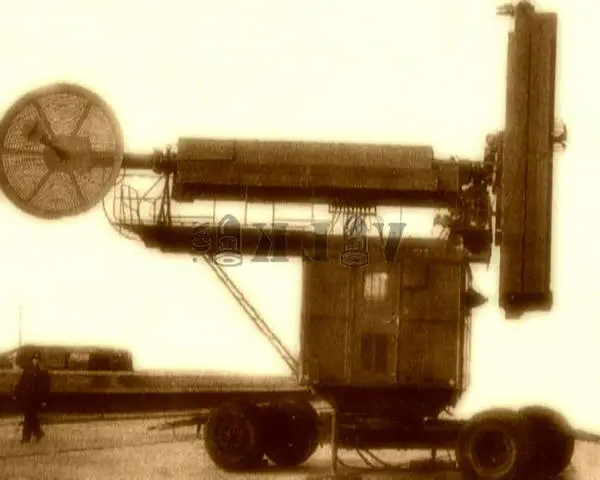
As you could see, there are three antennas over the cabin:
* On the right side, a vertical through-like antenna (P-12) was placed to scan for elevation. The scanning was achieved by the use of Lewis rotating scanner, fed from separate magnetron;
* On the top of cabin, a horizontal through-like antenna (P-11) was placed to scan for azimuth. It too used the Lewis rotating scanner, and its own magnetron. The scanners were synchronized, so both vertical and horizontal beams moved together - but on different working frequences, so they could be easily separated on receive;
* On the left side, a parabolic dish antenna (P-16) was placed to send guidance command to missiles. It wasn't scanning, it was merely a transmitter that send command signal in relatively narrow area;
All antennas are put on single frame, rotating in elevation, so they always maintain the same position relatively to each other. Training the whole antenna set is achieved by rotating the whole cabin on its mount.
When scanning for target (usually by warning of separate early warning radar), two antennas produce synchronized fan-shaped beams (about 7 degrees wide) moving at right angle to each other in the 20 degrees sector in front of the cabin. The recieved echo signals were visualized by a pair of B-scopes; one for azimuth, one for elevation, both produced range data also. So basically the SNR-75 radar have two separate channels for azimuth and elevation data, which weren't directly connected.
When the target(s) was detected, operators used manual controls to turn the SNR-75 in azimuth and elevation until the chosen target was directly in the middle of both scopes - which means, at the direct boresight of both azimuth and elevation antennas. Then the azimuth, elevation and range gates were set for tracking.
The radar have three tracking modes; automatic (used for single targets), manual (used for tight group targets that automatic have troubles discriminating between), and semi-manual (the azimuth and elevation were tracked automatically, while range was set manually). The third mode was used because in 1950s range jamming was considered the greatest problem - it was rather easy to implement on plane jammers.
One important detail - the SNR-75 continued scanning the area around target even while scanning it. Any other targets nearby (within the 20 degrees angle) were therefore constantly scanned, and if operators decided to switch to another target, it could be done without initiating new search pattern.
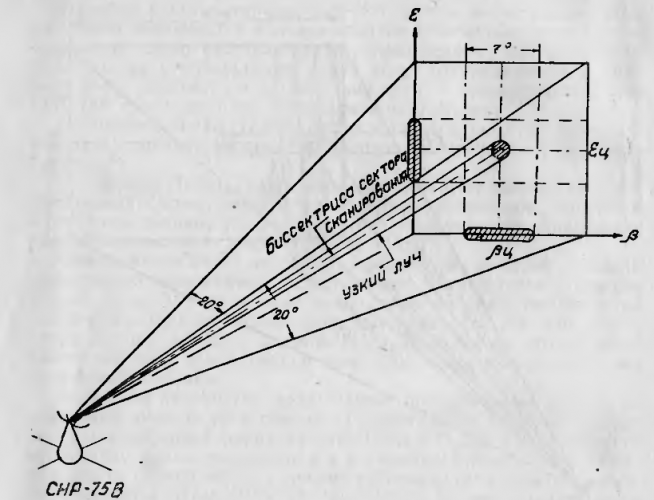
When the target was sucsessfully tracked - manually or automatically - the missiles came into play. Up to six launchers were directly connected with SNR-75 by cables, and followed radar azimuth and elevation. The launched missiles were, therefore, "thrown into basket" of constantly scanning beams. The same beams that were used to scan for target, were also used to scan for flying missiles & determine their position in scanned sector. A special circuit amplified the transponders reports & filtered them as missile position data for fire control systems.
Tracking of the missiles was fully automatic, by using the onboard transponders on missiles. The P-16 parabolic dish antenna was constantly sending identification signals, on which missile transpoders replied, and those replies were received by scanning antennas. The missile track gates were actually prepared before missiles were launched, and "moved" along their projected courses until missile actually meet the track gate. After that, the track gate "stuck" to missile and fire control system started to track it. Three time-modulated fire control channels were available, which means up to three missiles could be controlled simultaneously (all against the same target).
After the missile were gained by fire control channel, the fire control system started to generate course commands to guide missile to target. Two guidance modes were available:
* Automatic command-to-the-line-of-sight (ACLOS) mode, when missiles were simply hold on the same azimuth and elevation as target. This method was considered efficient only on relatively short distances, but have an advantage of not requiring range data;
* Automatic "semi-straightening" mode, when a leading point was calculated for a target, and missiles were guided straight to that point. This method was used for long-range interceptions, since missile did not need to "chase" the target and followed more efficient trajectory;
The control signals were time-modulated, with "opening" pulse being the transponder identification pulse, and then a course correction commands (for each of control axis separatedly) followed. At the end of control period there were time slots for two specific high-amplitude command signals; the first set the missile proximity fuze delay mode (it have several), and the second activated the fuze itself, when the missile was relatively close to target (so the target would not have enough time to jam it or something).
The later modes - S-75 "Desna" and S-75M "Volkhov" - generally used the same radar set, but with improved functionality. Since S-75M "Volkhov" have much longer range than basic SA-75, its usual wide-beam scanning mode was not sufficient anymore; on long distances, the target data become too inaccurate.
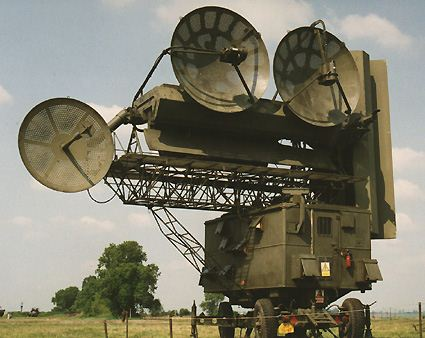
To solve the problem, a pair of parabolic dish antennas were installed, each paired with one through antenna & fed from the same magnetron. Those parabolic dishes were used to generate very narrow, pencile-like beams, for long-range target acquisition. The through-like antennas served as receivers for the echos.
The improved radar thus have two main work modes: a narrow beam, and wide beam:
* A narrow-beam mode was used to seek and acquire targets at long distances with pencil-like beams scanning the narrow (+/- 3.45 degrees) sector. This mode was also used to seek for low-altitude targets, to reduce ground clutter;
* A wide-beam mode was used to seek and acquire targets at short distances with broad fan-like beams, scanning the wide (+/- 10 degrees) sector. The wide beam allowed for much quicker search and acquisition - important when the target was close and moving fast! - but wasn't accurate at long distances;
That's what I wanted to describe about those legacy Soviet radars. Pretty sophisticated tech for 1950s, heh? As far as I know, the cotemporary Western radars did not use two-beam track-while-scan mode.