HiREX? "ARPA Project Defender Upstage Interceptor"

Sferrin

ACCESS: USAP
Senior Member
Joined
3 June 2011
Messages
20,999
Reaction score
19,269
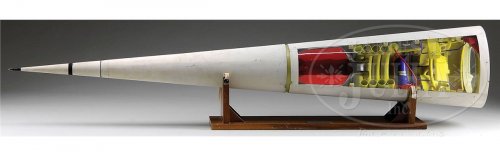
http://www.icollector.com/CUTAWAY-MODEL-OF-A-HIREX-MISSILE-NOSE-CONE_i16419356

"Purported to have been built for ARPA (Advanced Research Project Agency) who also worked Boeing. This plastic model shows the internal workings including generators, reservoirs and fuel lines. Set within a display rack with a metal plaque reading "ARPA Project Defender Upstage Interceptor". SIZE: 59-1/2" long. CONDITION: Generally good with some scuffs and stains. 1-12568"


Was this a real thing or did somebody get scammed? ???
 

Attachments

  • 16419356_1.jpg
    16419356_1.jpg
    49.9 KB · Views: 328
Looks real enough, though the seller doesn't know how to describe what they've got. No "fuel lines" in a solid propellant rocket.

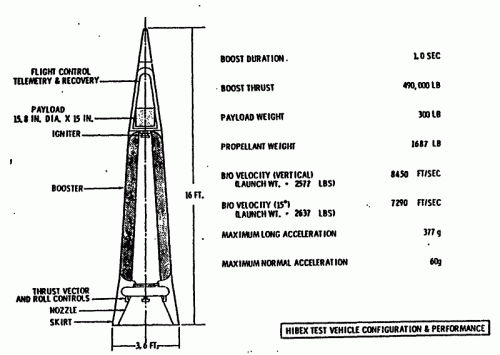
Not quite sure what it actually is, though. It's not a Sprint, and it doesn't quite match up with what I have on HiBEX, so I'd guess that this is an unbuilt concept for, as the label says, a new upper stage for an interceptor. Most of the nozzle seems to be missing.
 
Well Upstage was definitely real enough, and as Boeing built the original HiBEX it seems likely they at least had a proposal for the UpSTAGE as well.

That said, this looks like the HiBEX itself. That coiled tube appears to be the "finjector" freon tank.
 
Maury Markowitz said:
Well Upstage was definitely real enough, and as Boeing built the original HiBEX it seems likely they at least had a proposal for the UpSTAGE as well.

That said, this looks like the HiBEX itself. That coiled tube appears to be the "finjector" freon tank.

HiBEX was very different than this. The fineness ratio is all wrong for one thing. Maybe an early THAAD KV? This things diameter appears to be about 10.4".
 

Attachments

  • DARPA_II_3-5.gif
    DARPA_II_3-5.gif
    42.3 KB · Views: 312
The model *appears* to have a much shorter rocket motor than HiBEX. This would make sense for an upper stage. HiBEX needed the ginormous motor to accelerate fast through the thick lower atmosphere; an upper stage would be slight less horrifically constrained. This thing also seems to have a far longer and narrower nozzle than HiBEX or either stage of Sprint.

It also *seems* to have more freon. This would indicate that maneuvering is very important, appropriate for a hit-to-kill upper stage.
 
One version of UPSTAGE incorporated TVC via fluid injection, while the other used pyrophoric fuels for external burning. In either case a manifold at the aft end of the missile body was used to inject the liquid. This model may be one of the variants showing the internal lines and such.
 
I designed the Lateral-directional Electronic feedback control system for UPSTAGE in 1969, a Mach 9 Interceptor with an 18 pound Nuclear Warhead. However, it wasn't flown on the first launch, because an alternate design without a Motorola Electronic Multiplier was used, which went unstable 3 seconds after flight when the pitch angle of attack, Alpha, changed signs.

Ken Nielson, an excellent engineer and former Pilot , did confirm on the Analog Computer Simulation that my design did hit the center of the target (a maneuverable incoming ICBM Warhead) every time !

So the US Airforce did angerly cancel the McDonnel Douglas UPSTAGE contract saying "You should have used Nassir's design!", but instead you milked another 18 months of R&D expenditures and flew an alternate design without a Motorola Electronic Multiplier needed to accommodate a in-flight change in the sign of Alpha !

I have attempted to contact the current Secretary of War, Mr. Pete Hegseth, asking him to incorporate my successful UPSTAGE Autopilot design into the "Golden Dome" project ordered by President Trump, but couldn't reach him. So if someone reading my comments above can contact Mr. Pete Hegseth, and send him a copy of my above all-important comments, I would be much obliged, and so would the USA !

Sincerely, James Edward Nassir, BSEE With Honors and also MSEE from UC Berkeley College of Engineering, Jan 16, 2026.
 
Looks real enough, though the seller doesn't know how to describe what they've got. No "fuel lines" in a solid propellant rocket.

Not quite sure what it actually is, though. It's not a Sprint, and it doesn't quite match up with what I have on HiBEX, so I'd guess that this is an unbuilt concept for, as the label says, a new upper stage for an interceptor. Most of the nozzle seems to be missing.
From DARPA:

Toward the end of HIBEX, some external burning propellant experiments were conducted with encouraging results.

A study was then made of a maneuvering second stage interceptor, UPSTAGE, which would incorporate external burning for sidewise thrust.

PRESTAGE, the immediate follow-on project to HIBEX, was carried out in the 1965-68 time frame, to investigate external burning in a controlled hypersonic flow environment and the corresponding problems of thrust control, axial and lateral. "Disposable" vanes were studied along with lateral jets for thrust vector control. PRESTAGE was carried out by McDonnell-Douglas, and included laboratory and flight test experiments, using available rocket motors.

After PRESTAGE, project UPSTAGE began in 1968, dedicated to investigation of a second stage for intercepting maneuvering RVs. A HIBEX vehicle was used for UPSTAGE's first stage.

...

UPSTAGE reached several hundred lateral g's with response times of milliseconds. The UPSTAGE maneuvers were controlled in a simulated MARV chase but no actual interceptions were attempted.
 
Statement of Secretary of Defense Robert S. McNamara before a joint session of the Senate Armed Services Committee and the Senate Subcommittee on Department of Defense Appropriations on the fiscal year 1968-72 defense program and 1968 defense budget, January 23, 1967

a. Project DEFENDER

The DEFENDER program is the principal exploratory development effort designed specifically to provide the missile and reentry technology associated with strategic defensive and offensive systems, and to develop concepts for advanced defensive systems against ballistic missile attacks. In FY 1968, a substantial portion of the $118 million requested for this project will be devoted to missile reentry and midcourse phenomenology. An important series of studies and tests, called the Pacific Range Electromagnetic Signature Studies (Project PRESS) will be continued in FY 1968, but with some change in emphasis; in the future, more emphasis will be given to problems related to offensive systems.

The FY 1968 budget for DEFENDER also includes $0.7 million for the last increment of a $17 million "ALTAIR" radar that will be used for Project PRESS experiments, extending the capability of the PRESS system. This radar is designed to provide some of the data necessary for the development of penetration aids for MINUTEMAN and POSEIDON and for investigating discrimination criteria. And, as previously mentioned, Project DEFENDER has been an important complement to the NIKE-X development.

Another DEFENDER program, HiBEX (High-G-Boost Experiment), has completed its exploratory phase and this technology will be taken over by the Army for further advanced development work. HiBEX provided significant data on high acceleration technology, which contributed to the development of the SPRINT missile. The successor projects to HiBEX, called PRESTAGE and UPSTAGE, will explore technology for high acceleration, maneuverable interceptor missiles.

Work is also being done on Over-the-Horizon radars and on the development of an inexpensive array radar (HAPDAR) which would have the capability of being hardened and applied to Hard Point Defense systems.
 

Similar threads

Back
Top Bottom