HAL (Hindustan Aircraft Limited) 'H' Aircraft Designations
(??) -- (Project) 1940, HAL VTOL aircraft concept
- (??): Project patented by HAL engineer, Ajit Maitra
G-1 -- Aug 1941 10-seat troop glider, one prototype built*
- G-1 : Semi-monocoque wood-constr.** transport glider
- G-1 : 2 x tandem-sitting crew + 8 troops; span 17.285 m
- G-1 : Designed by Dr. V.M. Ghatage; serial HW885***
-- * 1 x completed; 10 x component sets (never finished)
-- ** Single-spar cantilever wing; upper surface spoilers
-- ** Semi-monocoque, 2-ply moulded plywood fuselage
-- *** RAF allocated serials HW885-909 & HW942-986
HT-2 -- 1951 military 2-seat primary training a/c; x 172
- HT-2 : V.M. Ghatage design; wood mockup built 1949
- HT-2 (prototype): 1 x 145 hp DH
Gipsy Major; VT-DFW
- HT-2 (series): 1 x 155 hp
Gipsy Major III; metal prop
- HT-2 : Indian Air Force x 160 + Ghanan Air Force x 12
- HT-2L: 1980s conv'n to 160 hp Lycoming AEIO-320-D2B
Hxx-3 - Hxx-9 - (??)
hypothetical designations
HT-10 -- (Project) 1954 side-by-side advanced trainer
- HT-10 : 1 x 1,050 hp P&W R-1830 radial; span 13.41 m
- HT-10 : Construction begun 1954; abandoned 1958(?)
-- HT-10 timeline: Basic design begun in 1948
-- HT-10 timeline: Mockup & wind tunnel models by 1952
-- Specs: Length 10.05 m; gross 4309 kg; max 230 mph
HT-11 -- (Project) 195? military basic training aircraft
- HT-11: Layout similar to HT-10 advanced trainer (
qv)
- HT-11: Intended as repl. for licenced Percival
Prentice?
Hxx-12 - Hxx-15 - (??)
hypothetical designations
HJT-16 -
Kiran 1964 intermediate jet trainer; x 190
- HJT-16 - Side-by-side seating trainer designed for IAF
-- Orig. engine options: AS Viper; RR RB.145; Turbomeca
-
Kiran Mk I : 1964; 1 x 2,500 lbf AS
Viper, 118 x built
-
Kiran Mk IA: 'Armed
Kiran', 2 x wing pylons; x 72
-
Kiran Mk II prototype: 1976; RR
Orpheus & fixed guns*
-- * Otherwise, similar to the Mk IA 'Armed
Kiran' airframe
-
Kiran Mk II production: 1985, 4,200 lbf RR
Orpheus
-
Kiran Mk II production: More powerful; 4 x pylons; x 61
HJT-17 - (Project) IAF intermediate jet trainer alternative
- HJT-17 : Parallel development to HJT-16
Kiran (
qv)
- HJT-17 : Mockup built; poss. HJT-16 but with staggered seating*
-- * As had been considered by HAL Chief Designer V.M. Ghatge
Hxx-18 - Hxx-23 - (??)
hypothetical designations
HF-24 -
Marut; 1961 twin-engined jet fighter; x 147
- HF-24 : Meant to be Mach 2 capable indiginous fighter
-- Kurt Tank/George W'm Benjamin/M.V. Ghatge design
- HF-24 Glider: aka X-241; April 1959 flight trials glider
-- X-241 was 2-seat, 1-to-1 scale, plywood-constr. glider
- HF-24 (as planned): 2 x BS
Orpheus BOr 12* w/ reheat
-- * Simplified reheat 8,170 lbf
Orpheus BOr 12 cancelled
-- * Alt. engines considered: RD-9F and Egyptian E-300
- HF-24 prototype: June 1961; 2 x BS
Orpheus Mk.703
- HF-24 prototype: aka HF-001, then X-24, later BR462
- HF-24 Mk I: Single-seat ground-attack/strike-fighter
- HF-24 Mk I: 2 x 4,850 lbf BS
Orpheus Mk.703 w/o reheat
-- HF-24 Mk I (pre-production): 1963 x 18; 1962 IAF order
-- HF-24 Mk I (production): 1964 x 62 a/c to an IAF order
- HF-24 Mk I BX: 1966 engine test airframe conversion
- HF-24 Mk I BX: Able to take BS/RR
Orpheus or E-300
- HF-24 Mk IT: 1970 2-seat '
Marut Trainer'; 18 x built
- HF-24 Mk IT: Designed by S.C. Das (after Tank left HAL)
- HF-24 Mk IA: 3rd pre-production a/c provided with reheat
- HF-24 Mk IA: 2 x 5,720 lbf RR
Orpheus 703R in reheat
- HF-24 Mk 1R: 1970 reheat devel. trials; clamshell canopies
- HF-24 Mk II : Sometimes applied to prototype reheat Mk IRs
- HF-24 Mk II : Other sources claim 2 x Turbomeca
Adours
- HF-24 Mk III: (Project) w/ "maximum hardware commonality"
- HF-24 Mk III: 2 x 6580 lb.st RR/MAN Turbo RB.153 turbofans**
-- ** Other sources listing SNECMA Atar 09K-50 or M 53 types
- HF-24 Mk III: Planned 1981-82 service; conf. w/ Mk II & HF-73
HF-25 - (Project) Single-engine HF-24 strike fighter derivative
- HF-25: Heavier, more-powerful deriv. with stronger main u/c
- HF-25: 1 x 15,640 lbf Tumansky R-25-300; span (??) m
- HF-25: Redesigned intakes; tailplane; & strengthened u/c
-- Desig. number duplicated; see unrelated HCP-25, below
--
https://www.secretprojects.co.uk/threads/hf-24-marut-derivatives-projects.902/#post-831045
HCP-25 - 1960 high-winged, single-engined utility a/c; x 1
- HCP-25: 2+8 utility conv. to ambulance, 10-pax, or cargo
- HCP-25: 1 x 600 hp P&W R-1340
Wasp radial; span (??) m
- HCP-25: V.M. Ghatage design to 1958 military requirement*
-- * But produced as a 'study' design by order of HAL Board
-- aka LAS (Logistic Air Support); aka 'HCP-125' (prob. typo)
-- Very strong resemblance to Noorduyn
Norseman**
-- ** NB: HAL reconditioned Noorduyns for RAF, then IAF
- HCP-25 (turboprop): (Project) developed piston HCP-25
-- Agreed to by Air HQ/DTD/P (Air) but not proceeded with
--
https://www.secretprojects.co.uk/threads/hindustan-hcp-25.3161/
HUL-26 -
Pushpak; 1958 licensed Aeronca
Super Chief; x 154
- HUL-26: 2-seat high-winged light aircraft/club training a/c
- HUL-26: 1 x 85 hp Continental C85/O-190 HO4; span 10.97 m
- HUL-26: 1st prototype; compl. Sept 1958; VT-XAA; wood wings
- HUL-26: 2nd prototype; metal spars & pressed aluminum ribs
- HUL-26: Production (1959-1968); as per 'metal' 2nd prototype
- HUL-26(?): (Project) Pushpak deriv.; 90 hp HAL PE-90H HO4
- HUL-26
Pushpak Mk.1: 1965 War Army civil impressments?
HAOP-27 -
Krishak; 1959 4-seat
Pushpak development; x 70
- HAOP-27: Army observation deriv. of failed 1959 light a/c
--
Krishak : 1 x 190 hp Continental O-470; span 11.43 m
--
Krishak Mk.2: 1 x 225 hp Continental O-470-J HO6
-- HAOP = Hindustan Army Observation Post; also for liaison
Hxx-28 - Hxx-30 - (??)
hypothetical designations
HA-31 -
Basant 1972 low-winged agricultural aircraft; x 39
- HA-31: Wing design possibly based upon that of HAOP-27
- HA-31: 1 x 400 hp Lycoming IO-720-C1B HO6; span 12.00 m
- HA-31:
Basant (Spring) design work begun back in 1968
- HA-31 Mk I : Prototype
Basant; forward-placed cockpit
-- NB: 'HAL-31' for
Basant Mk I is almost certainly a typo
- HA-31 Mk II: 1972; raised cockpit now behind hopper
- HA-31 Mk II: Pre-production example
Basants; x 20
- HA-31 Mk II: Full production example
Basants; x 18
- HA-31 (turboprop): (Project) Evolved turbine
Basant
-- 8 x ordered for Indian Min. of Agriculture; cancelled
HPT-32 - Deepak; 1977 primary trainer for IAF & IN; x 120
- HPT-32: Side-by-side 2-seater; HAL HT-2 replacement
- HPT-32: 1 x 260 hp Lycoming AEO-540-D4B5; span 9.50 m
- HPT-32 (turboprop): (Project) Became HAL HTT-34 (
qv)
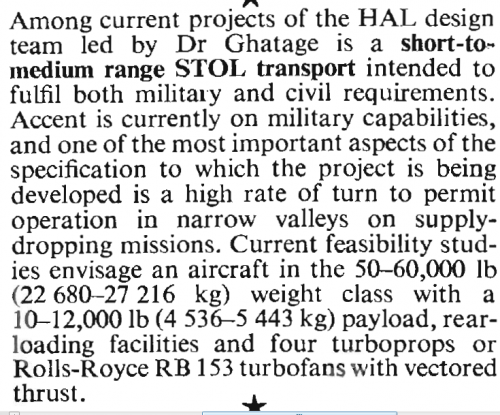
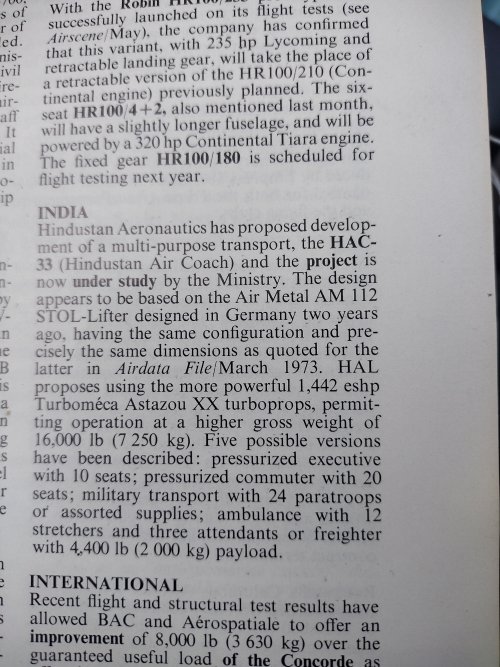
HAC-33 - (Project) 1973 twin-turboprop passenger transport
- HAC-33: 20-pax pressurized feeder airliner (no interest)
- HAC-33: 2 x 1412 shp Astazou XX turboprops; span (??) m
-- HAC-33 wind tunnel model built & tested but no funding
- HAC-33: 24-seat/12 litter military transport, cancelled
-- SPAG* studied scaled-down HAC-33 derivative in 1974
-- * SPAG = Small Passenger Aircraft Group
HTT-34 - 1984 turboprop-powered deriv of HPT-32; x 1
- HTT-34: HPT-32 X2335 converted to Allison turboprop
- HTT-34: 1 x 420shp Allison 250-B17D; span 9.50 m
- HTT-34: No IAF orders forthcoming; cancelled
HTT-35 - (Project) 199? military turboprop trainer
- HTT-35: To IAF AST (Air Staff Target) 208 requir.
- HTT-35: 1 x 950 shp P&WC PT6A-62;* span (??) m
- HTT-35: Tandem cockpit with individual canopies
-- * Or 1 x 1100 shp Garrett TPE331-12D turboprop
- HTT-35: To replace HPT-32 & HJT-16 in late '90s
HJT-36 - 2003 Sitara (Yashas after 2025) jet trainer
-- aka IJT (Intermediate Jet Trainer); Stage-2 trainer
- HJT-36: Subsonic trainer to replace HJT-16 Kiran
- HJT-36 (prototypes): 1 x 3,175 lbf SNECMA Larzac 04-H-20
-- PT-1 1st prototype re-engined with Saturn AL-55I in 2008
- HJT-36 (production): 1 x 3,900 lbf NPO Saturn AL-55I
-- 2026; still no firm IAF purchase orders for the HJT-36
- HJT-36 COIN: (Project) light attack pushed since 2011
- HJT-36 COIN: 2 x inboard 12.7-mm gun pods + rockets
Hx-37 - (??)
hypothetical designation
HTT-38 - (Project) 1998 turboprop military trainer
- HTT-38: Modernized development of HTT-34 conv.
-- Capability slot filled by IAF's Pilatus PC-7 trainers
HJT-39 - (Project) transonic IAF Lead-In Fighter Trainer
- HJT-39: Meant for IAF Advanced Jet Trainer (AJT) role
- HJT-39: 2 x 3,900 lbf NPO Saturn AL-55I; span (??) m
- HJT-39: Twin-engined transonic spin-off from HJT-36*
- HJT-39: all-composite (so less aluminum than HJT-36)
-- * All-composite constr.; so less aluminum than HJT-36
-- IAF requirement satisfied by BAe Hawk 132 purchase
--
https://www.secretprojects.co.uk/threads/hal-hjt-39-combat-and-jet-trainer-project.11371/
HTT-40 - 2016 turboprop trainer to replace IAF's HPT-32
- HTT-40: 2-seat ab initio trainer resembling
Texan II
- HTT-40: 1 x 950 shp Honeywell TPE331-12B; span 11.00 m
- HTT-40: Indig. design; HAL orig. seeking existing designs*
- HTT-40: 2 x prototypes - PT-1 (May 2016); PT-2 (May 2017)
- HTT-40: 1st prod'n (TH-4001) flown Bengaluru Oct 2025
- HTT-40: 2nd prod'n (TH-4002) flown Nashik in Dec 2025
- HTT-40: IAF split orders between HAL (x 70) & Pilatus
-- HAL blames programme delays on Honeywell deliveries
-- * After review, KT-1, PC-7, T-6C Texan II were short-listed
-- * G-120TP, M-311, PC-21, PZL-130 Orlik, & Tucano rejected
--
https://www.secretprojects.co.uk/threads/hal-htt-40-turboprop-trainer-project.17384/
Hxx-41 - (??)
hypothetical designation
HLFT-42 - (Project) 2017 Lead-in Fighter Trainer proposal
- HLFT-42: Single-engine, low-wing, tandem-seat trainer
- HLFT-42: 1 x (??) lbf (??) turbofan engine;* span 9.00 m
-- * No HLFT-42 engine type selection has yet been made
- HLFT-42: Displayed in mockup form at Aero India 2023
-- Intended to replace the BAE
Hawk 132s as IAF FLIT
Hxx-43 - (??) ...
hypothetical designations
HF-73 - (Project) strike fighter follow-on to HF-24
Marut
-- To IAF's 1971 ASA (Advanced Strike Aircraft) specification
- HF-24 Mk III: Orig. desig. for HSS-73/HF-73 strike fighter?
- HSS-73: 'Hindustan Supersonic Strike';
Marut devel.
- HF-73: Design concepts with assistance of Germany's MBB
- HF-73: Multiple configurations (esp. wing placement & tail)
- HF-73 (final config): Single-seat, twin tails, 10 t MTOW RB199 engines
- HF-73 (final config): Single-seat, twin tails, 10 t MTOW RB199 engines
- HF-73 (final config): 1 x 15,000 lbf Turbo Union RB.199 34R
-- HF-73 work aborted 1975; SEPECAT
Jaguar satisfied ASA
___________________________________