Gripen dispersed basing discussions

Wotan

ACCESS: Secret
Joined
18 April 2023
Messages
415
Reaction score
1,162
Who just happens to be paid by Saab to say the right thing...

Don't get me wrong. I like the Gripen and that it will be a useful addition to Ukraine. I also acknowledge that Jussi Halmetoja is highly experienced with the Gripen, but please don't try to imply that he is objective in this case.
The Gripens can do this:
View: https://www.youtube.com/watch?v=UDX7zYTgz7Y


Which is very useful when the opponent knows where your airbases are and has the means to attack them.
 
Which is very useful when the opponent knows where your airbases are and has the means to attack them.
Tbh, without Russian manned fixed wing ops over Ukraine, up for debate how much it's worth right now. As the Russian reach into Ukraine is limited to stand off air breathers and/or very limited numbers of long-range ballistics, it places aircraft within the range of numerous ballistics.
A smaller footprint doesn't decrease vulnerability as effectively as range does.

In this situation, the main advantage of Gripen shifts towards prices .... and Gripen E isn't all that cheap.
FA-50 is (3 times cheaper!), but it isn't available for Ukraine.
Currently, the best (possible) aircraft for Ukraine would be Typhoon...which is not procured.

Granted, Gripen capabilities would be supremely valuable again in case of either a second Russian attempt to gain air superiority, or return of maneuver warfare(which means the same). Neither appears likely anytime soon. I honestly wonder if VKS is directly prohibited from even trying.
 
Let´s remember reading those shiny charts that there are... Only 11 or so Gripen E/F in service*... Not a serious basis to evaluate and compare with any CPFH.

*10 in Brazil- 1 in Sweden.
We can evaluate costs based on existing Gripen fleets.
https://www.czdefence.com/article/c... its reliability and price/performance ratio.
"about 60 people are needed to secure 12 Gripen fighters while in case of the same number of aircrafts of the 3rd generation Panavia Tornado the number is around 200 people. Maintenance has not been performed according to a predetermined number of hours flown, but based on the actual condition of the machine. The state is being constantly monitored and any deviation from the standard is alerted by a complex on-board control device. Therefore, one flight hour requires 10 hours of maintenance on average.

The Gripen fighter is not only a reliable machine, but its operation is also economically advantageous. It is said that an hour of the Gripen fighter costs 4,500 dollars. In contrast, the American multipurpose jet fighters of the 4th generation General Dynamics F-16 Fighting Falcon cost 7,000 dollars, 16,500 dollars in case of the French multipurpose jet fighters Dassault Rafale and 18,000 dollars for the Eurofighter."

Also, the Gripen is on the small size regarding weight. A Gripen E has an empty weight at 8 tones, max takeoff weight is 16,500 kg. For comparisson, the lightest similar modern aircraft, the F-16V, has an empty weight of 9,200 kg and the MTW is over 21,000 kg. The fuel consumption is a significant part of the operating costs.

It may surprise you but so can many other platforms.
Maybe, but in the Gripen case this was considered from beginning around this capability.
https://www.flightglobal.com/fixed-...-austere-basing-system-influenced-the-gripen/
View: https://www.youtube.com/watch?v=MNak9lB_q00
 
Last edited:
Mirage 2000 does the same (some trainings were made in France, on motorways).
Why a Rafale can't ?
Why a F16 can't ?
Practically every fighter jet can use the highways, highway size and length required varies

But without whole support system in place this is just a party trick.

In cold war many countries had some stretches of highway made specifically so they could host fighters , often with concrete pavement

If an F4 can so can every other fighter
 
Last edited:
Can you drive a nail with a shovel? Yes, absolutely. Can you do it with a bottle of milk? We'll, in the right conditions, probably. But neither will be as optimized as a hammer.

The Gripen (as all the Swedish fighters before him) is optimized for dispersed airfield. Small footprint (physically and ground crew), accessible maintenance panels (no access ladder, heavy tooling or platform required), ability to refuel from regular fuel trucks, even HUD symbology and approach profile are closer to an aircraft carrier fighter than a land-based one.

Can you do it with other fighters? Only to some extent. You'll need longer/larger/cleaner stretches of road (less dispersion possibilities), heavier logistic (ground crew and vehicles, more noticeable from enemy recon assets) and so on... And you will not be able to do it for long periods of time.

Maybe not a game changer (what an overused term), but still an advantage.

Practically every fighter jet can use the highways, highway size and length required varies

But without whole support system in place this is just a party trick.

In cold war many countries had some stretches of highway made specifically so they could host fighters , often with concrete pavement

If an F4 can so can every other fighter

https://www.flightglobal.com/fixed-...-austere-basing-system-influenced-the-gripen/
 
600 hundred meters of straight road inside a forrest. One truck. One specialist and 5 conscripts. This is all what is needed in order to have the aircraft flying again in 10 minutes.
View: https://www.youtube.com/watch?v=HbkScZFCgro


You can land with other aircrafts on highway strips but you will not maintain them in operation with this minimal equipment.
 
If you want to know how good the Gripen E is, then there are IMHO two reliable indicators of this:

The first is Gripen's performance record in Red Flag exercises. The second is the level of noise semi-professional forum posters who love Eastern kit are making about it.

After all, if it really is as bad as they say it is, why do they feel the need to pound the podium Khrushchev style to insist just how bad it is? Are they perhaps afraid of something? ;)
 
Last edited:
Seeing another forum poster brought up current conflicts like Iran and Ukraine, and without getting political in any way, what seems to work there and what does not?

Well it seems that everything that is fixed in place is taken off the playing field pretty quickly: Hardended shelters get a lazed bomb through the roof no matter how thick the concrete is. Mobile SCUD launchers were a problem in Iraq. The Yugoslav's professional shot and scoot SAM tactics caused NATO massive headaches in 1991 even knowing about the pre-prepared positions. But they (NATO) never knew which ones they were at. And when the Yugoslavs did emit, they then packed their gear up quickly and were gone in no time. And this is also how the turn-around of a Gripen works: You are gone when the missile or ground attack hits the site.

So the one common denominator for what works in all these conflicts seems to be not being there when the strike package arrives. And this is what makes the Archer artillery system so good: Even if artillery location radar fixes you as the shells leave the barrel, you are simply not there when the counterbattery fire arrives. And this is also why the road basing system we had (and are now rolling out again) in Sweden was so good: You are simply not there long enough to get zapped by any missile or strike package. And both the Viggen and Gripen are designed around this concept.

And all of this is transferable. So if you buy the Gripen E, you can operate it like the SwAF intended from austere road bases with a minimal crew, both in terms of numbers and training. It was built to be serviced by conscripts, not AF professionals.

So yeah, I do think the Gripen would make a difference for anyone who buys it: Not only is it a good aircraft when airborne, but it would also be very difficult to take out on the ground.
 
600 hundred meters of straight road inside a forrest. One truck. One specialist and 5 conscripts. This is all what is needed in order to have the aircraft flying again in 10 minutes.
And if you believe that's all that is needed to operate for anything more than a couple of days (at most - it may even fall apart after one day) then you will believe anything. People need to rest, they need resources. Aircraft need fuel, spare parts, weapons etc.

The Gripen has the great advantage to be able to constantly operate from different locations at each flight, in a guerilla warfare style.
This scenario only works if there are either pre-positioned fuel, weapons, parts, support personnel at said location or a means to get them there. Otherwise all that happens will be that a jet lands somewhere and then sits...useless.

Stop being so ignorant and believing the marketing spin being put out.
 
Even with "fast" turn around, the aircraft are still on the ground for the vast majority of the time. It's not like 2-4hr sortie, 10min on ground, 2-4hr sortie, 10min on ground, etc

Dispersal only really works with limited numbers of aircraft and large areas (e.g. Sweden). Otherwise you're better off trying to defend and harden areas.

Dispersal also increases your vulnerability to other threats - e.g. Special Forces
 
And if you believe that's all that is needed to operate for anything more than a couple of days (at most - it may even fall apart after one day) then you will believe anything. People need to rest, they need resources. Aircraft need fuel, spare parts, weapons etc.


This scenario only works if there are either pre-positioned fuel, weapons, parts, support personnel at said location or a means to get them there. Otherwise all that happens will be that a jet lands somewhere and then sits...useless.

Stop being so ignorant and believing the marketing spin being put out.

Even with "fast" turn around, the aircraft are still on the ground for the vast majority of the time. It's not like 2-4hr sortie, 10min on ground, 2-4hr sortie, 10min on ground, etc

Dispersal only really works with limited numbers of aircraft and large areas (e.g. Sweden). Otherwise you're better off trying to defend and harden areas.

Dispersal also increases your vulnerability to other threats - e.g. Special Forces

And with dispersed, pre-positioned (or easily transportable) support resources such as fuel, weapons, parts, people. Otherwise it breaks down after 1 mission.

The above just shows that neither of you have bothered to read up on how dispersed road basing works, and are just setting up and shooting down straw-men based on your own pre-conceived ideas.

First of all, we can strike out the people need rest part: Military personnel need rest wherever they are based.

Next is the repositioning and resupply: You don't just have one strip in your road base complex. There are many. So the trucks and personnel move around in the complex, and both aircraft operating from the complex and the rearm and refuel units can be resupplied in turn from higher level supply at a number of different locations. So the same principle applies here: This is not done on one location in the complex only. And all these units are mobile. There are many pre-prepared places to meet up.

In peacetime you can drive around and see them. In wartime many will be camouflaged even if there are aircraft there or not. Protection is not based on the locations being secret. It is based on there being a few straight roads clustered together and dozens of places you can taxi to to refuel and rearm. And these keep constantly changing. So an enemy never knows where to strike.

In Sweden, dedicated special forces roam these bases. In Ukraine they could do the same. In addition: How will the enemy get THEIR special forces in place? Will they cover the whole country with special forces before starting a war just in case a Gripen lands there? What about those logistics? Is it time for general mobilization perhaps? Perhaps they could helicopter in the SOE? No wait, we learned in 2022 that doing that in enemy held territory is not such a good idea is it?

No, if recent conflict has taught us anything, it's that operating from fixed sites and trying to harden them to avoid being taken out is a thing of the past. The only way to stay alive today is to be mobile and quick on your feet. And the Gripen E system provides all of this.
 
and are just setting up and shooting down straw-men based on your own pre-conceived ideas.
Let me correct that for you: Knowledge gained from military service in an air force and a career around military platforms, in particular combat aircraft.
First of all, we can strike out the people need rest part: Military personnel need rest wherever they are based.
Excuse me? My point was in relation to the comment that the Gripen just needs "One specialist and 5 conscripts.". What I am trying to point out is that this can only go for a limited period of time due to the endurance of people and their ability to be sustained. This is far harder in multiple dispersed locations when people cannot necessarily be easily replaced/supported.
Next is the repositioning and resupply: You don't just have one strip in your road base complex. There are many.
Which actually reinforces my points. Supporting multiple locations (be that through pre-positioning or otherwise) requires more logistics support than fewer bases.
There are many pre-prepared places to meet up.
Which is what I was saying about "prepositioned". This is the critical thing people forget when they wax lyrical about the Gripen's ability to operate from roads. This works for the Swedes exactly because they have been doing it for decades, not just with the Gripen but the Viggen before that. They already have the system built in. You cannot simply buy Gripens and instantly have the same result. Sweden is somewhat of a unique case here. Without this well established system, another Air force might be able to land on a dispersed road but then they will potentially find themselves stuck. At most they might be able to operate from a couple of satellite fields near a main base but they certainly will struggle to just land and operate from any long enough piece of road.
In peacetime you can drive around and see them. In wartime many will be camouflaged even if there are aircraft there or not. Protection is not based on the locations being secret. It is based on there being a few straight roads clustered together and dozens of places you can taxi to to refuel and rearm. And these keep constantly changing. So an enemy never knows where to strike.
Again, only valid if you build up this system over many years beforehand. You can't just buy Gripen and bingo, get the rest.
In Sweden, dedicated special forces roam these bases. In Ukraine they could do the same. In addition:
Emphasis on "could".
How will the enemy get THEIR special forces in place?
In many, many ways...including on foot
Will they cover the whole country with special forces before starting a war just in case a Gripen lands there?
Now who is making straw man arguments?
What about those logistics?
A lot lower than a air platform such as a fighter.
And the Gripen E system provides all of this.
And so do many other platforms potentially...if one invests in the entire system. The Gripen is not unique in its ability to land/takeoff from suitable stretches of roadway. In fact, if you wanted to go even further, a Harrier or F-35B could be even better in that respect since they don't need the stretches of road. The key thing for all though is having the entire system like the Swedes. Without that the whole myth of the Gripen starts to fall apart.
 
And if you believe that's all that is needed to operate for anything more than a couple of days (at most - it may even fall apart after one day) then you will believe anything. People need to rest, they need resources. Aircraft need fuel, spare parts, weapons etc.


This scenario only works if there are either pre-positioned fuel, weapons, parts, support personnel at said location or a means to get them there. Otherwise all that happens will be that a jet lands somewhere and then sits...useless.

Stop being so ignorant and believing the marketing spin being put out.
I know it can be done. We received the Mig-21 M/MF between 1969 to 1975. We operated them from concrete slab runways and kept them outside in the elements, be it -20 degrees or +40 degrees. 50 years later when we retired them they were perfectly operational.
View: https://www.youtube.com/watch?v=TKplaYWHtmw


The Gripen was designed to be used in a similar manner. You can maintain it almost only by muscle power, without power tools.
View: https://www.youtube.com/watch?v=VeLo6f2DM8c


I read that you can even change the engine using only hand cranes.
 
I know it can be done...50 years later when we retired them they were perfectly operational.

The Gripen was designed to be used in a similar manner. Yo can maintain it almost only by muscle power, without power tools.

I read that you can even change the engine using only hand cranes.
I will assume you are trying to be funny here.
 
Last edited:
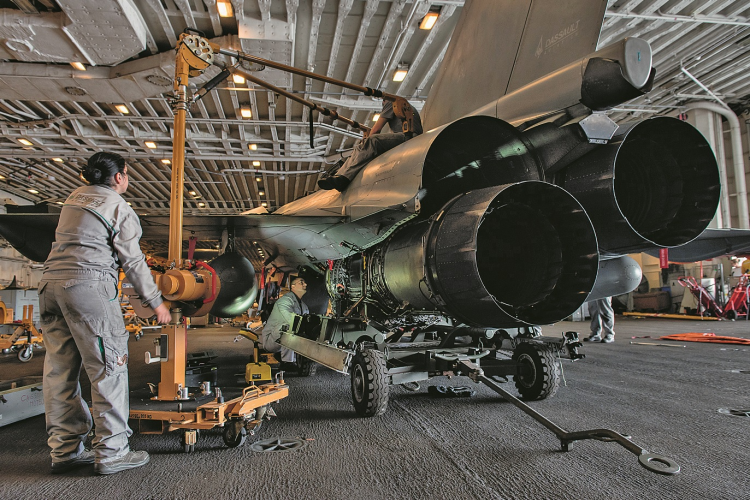
Engine change. Less than one hour, only several operators needed, no power tools (look at those green hand cranes).
Errr...same goes for any other F404, F414, F100 etc. :rolleyes: You do however need a dedicated engine trailer, a whole set of other specialised hand tools (they aren't just purchased at the local hardware store, trust me), a replacement engine (see below), a crane to move it...

F414-GE-100-Engine-.jpg


Not something easily done in the field without appropriate logistics support.
 
Last edited:
So basically you need a maintenance truck with the replacement engine and the necesarry tools to arrive at the highway rest area according to schedule.

And those green hand cranes which seem to be used for everything.
31141
 
So basically you need a maintenance truck with the replacement engine and the necesarry tools to arrive at the highway rest area according to schedule.
Biggish truck with crane to be in the right location at the right time. And guess what: most air forces don't have large numbers of engines above fit to just send anywhere/everywhere. You have to remove existing engine. Have it on engine trailer. Have another trailer for the replacement engine etc...

It is possible but needs well coordinated logistics and support teams and is not something just unique to the Gripen.
And those green hand cranes which seem to be used for everything.
Not for lifting a 1100kg engine
 
You can see from the engine installation video that four cranes are prepared to be used...
 
You can see from the engine installation video that four cranes are prepared to be used...
What you are seeing in that video is a nice clean factory producing new aircraft. It is not an operational setting. Moreover, my comment related to lifting the engine is more related to the spare engine that would need to be lifted out of its container and placed onto a trailer (if you don't have a spare it is pointless even starting). That is not something one easily uses small hand cranes like you are looking at. And yet again, (this is getting boring), the ability to remove engines by hand (with the appropriate tooling, equipment, people) is not something unique to the Gripen.
 
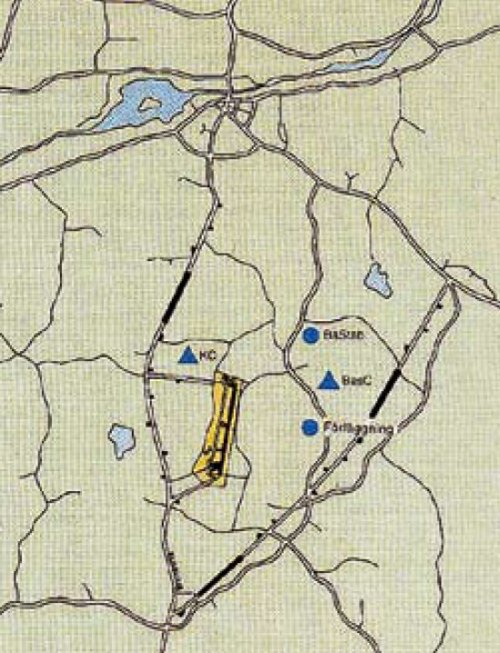
In the picture below, you can see an example of a Swedish road base dispersion in connection to a fixed airfield.

The small blue dots are places to park for turn-around or maintenance. The blue lines on the roads are the pre-prepared road strips. However, in a pinch, you can see that there are plenty of other straight road strips to choose from. I count close to 20 turn-around and maintenance spots.

But there are other road bases further away. This of course means you have to move equipment. But that's not a problem: Everything from engines, new instruments, weapons etc etc are transportable in standard 20-foot containers. So you can use requisitioned civil long haul trucks to do that job in time of war.

For daily operations however, smaller SUV type vehicles with trailers are used to haul stuff around the different turn-around and maintenance spots, and get new stuff from the dispersed road base depots.

So a typical mission could be a flight of Gripens taking off from another road base altogether, and upon completing their mission, being directed to land on one of the road strips below, taxi to one or more of the blue dots below where re-arm and re-fuel teams are waiting for them and be off again in under 10 minutes.

Kinda neat huh? ;)

Swedish road base vägbas Gripen Viggen Bas 90 example.jpg
 
Last edited:
But there are other road bases further away. This of course means you have to move equipment. But that's not a problem: Everything from engines, new instruments, weapons etc etc are transportable in standard 20-foot containers. So you can use requisitioned civil long haul trucks to do that job in time of war.

For daily operations however, smaller SUV type vehicles with trailers are used to haul stuff around the different turn-around and maintenance spots, and get new stuff from the dispersed road base depots.

It is good that you mentioned this. It is a very nice logistic capability to have, both for dispersed operation and also for distant deployment. This is what the producer states:

https://www.saab.com/products/gripen-support
"Two Gripen aircraft on a two week mission requires only what fits in a standard 20 feet container."

Quite impressive from the point of view of the logistic needs.
 
With spares for damages, fuel and weapons? Or just to fly Erickson's Christmas greetings cards?
The fuel used is standard NATO, based on the comercial jet fuel, so you can obtain basically at any airport. Weapons, depending of what intend to destroy, are of course in type and quantity mission specific. But again, standard NATO AA missiles, no need for exotic equipment.
 
Last edited:
For those who worry about the time it takes to change an engine on a Gripen at a road base:

Check the below video at about 1:15 in: They show 5 mechanics using 3 of the Swedish special hand operated pylon/loading cranes @Wotan mentioned earlier on to do it, and it takes just 1 hour!

Sure it's a SAAB video, but the guy in the uniform is a high FMV official, so video endorsed by the end customer as well.

 
Another video on road base operations: Equipment moved longer distances in standard 20-foot containers. Personnel in tents. Yes we do that. While perhaps not as tough as our allies the Finns, we too can camp out if necessary! ;)

Jokes aside: Re-arm and re-fuel turn-around time for a2a setup possible in less than 10 minutes by one technician and 5 conscripts.

 
Well, the so-called "achievment" of Thai Gripens taking off from roads and motorways have been sort of dumbed down by the fact of Indonesia's F-16s doing the same...
 
Well, the so-called "achievment" of Thai Gripens taking off from roads and motorways have been sort of dumbed down by the fact of Indonesia's F-16s doing the same...

I would say that dumbed down is a bit harsh: Sure, the F-16 and many other jets can take off and land on a strip of runway. But then what?

The point is that the Gripen can operate on just 800 m of runway. So not only take off and land in clean condition with 10% fuel in the tanks, but be re-armed and re-fueled and go off on another combat mission.

Very much doubt that they can accomplish that on an F-16 in Indonesia with one technician and 5 conscripts. ;)
 
I would say that dumbed down is a bit harsh: Sure, the F-16 and many other jets can take off and land on a strip of runway. But then what?
If the fuel, weapons and support is there (and the aircraft is serviceable) they can fly again, just like the Gripen. The point being that the ability to fly from dispersed road strips is not something unique to Gripen's design. It is at best arguably unique (or close to - see below) to the Swedish overall system or pre-positioning etc which is what I have been arguing.

And to prove the point, here is information on Ukrainian dispersed F-16 operations in actual war, not pre-planned exercises:
https://www.kyivpost.com/post/56911...ment, Taras,oil and gas producing enterprise.
https://www.airandspaceforces.com/u...reasingly contested electromagnetic spectrum.
View: https://youtu.be/tzsQBEOzlJg?si=XrRxdYRe1O05AXgn&t=457


Others also do things, to varying degrees, in peacetime to practise for war, such as Singapore:

View: https://www.youtube.com/watch?v=CBMD4QTSyqM


https://www.straitstimes.com/singap...unway-exercise-at-lim-chu-kang-road-nov-10-14
Finland:

https://www.keymilitary.com/article/finnish-hornets-road
View: https://www.youtube.com/watch?v=hTU5v3SJkm0


UK:

View: https://www.youtube.com/watch?v=Qo6mMX7rrr8


Poland:

https://www.key.aero/article/poland-conducts-highway-landing-ops-first-time-two-decades
I could go on...

The point is that the Gripen can operate on just 800 m of runway. So not only take off and land in clean condition with 10% fuel in the tanks, but be re-armed and re-fueled and go off on another combat mission.
A F/A-18 Super Hornet can do it in 750m (or less). A F-35B can do it in less than 200m if doing a rolling takeoff or mere metres id going VTOL.
Very much doubt that they can accomplish that on an F-16 in Indonesia with one technician and 5 conscripts. ;)
I also very much doubt the Swedish Gripen force can do so for any extended duration.

Once again, the entire point being that, despite the marketing, the Saab Gripen (which ever model) does not have a design that is unique in being able to operate from dispersed road way (or similar) style airfields. Many aircraft types can with some such as carrier based designs (such as F/A-18s or F-35s) maybe being a little more tolerant, though again as shown with multiple F-16s being used as such this is not a prerequisite. And as also mentioned, if one wanted to go even further STOVL/VTOL platforms such as Harrier or more so now, the F-35B give even greater flexibility ("why need even 800m of road when just a car park could do").

At the risk of repeating myself, the more critical thing is the ability to ensure logistics (including fuel, weapons, spare parts, S&TE, support staff etc etc...) is also able to be either pre-positioned or able to also disperse and be coordinated to be where the aircraft is. Unless Saab are offering to also set up all of this with their sales of Gripens then the pitch about the Gripen having this supposedly unique capability is a misnomer at best...
 
Last edited by a moderator:
I agree, to an extent.

Gripen was different from other Western fighters in the degree of emphasis in its requirements placed on reliability, availability, ease of maintenance, and low operational costs compared to achieving the best possible turn rate, range, LO capabilities etc. This leads armchair experts to underrate it compared to other fighters. Such things are in fact always tradeoffs - the Gripen that is available and does its mission has infinitely higher turn rate than the Typhoon stuck at base awaiting maintenance.

Sweden with the Bas 60 and then Bas 90 concept had an operational plan for dispersal that was brilliant, if costly, with specially designed dispersal bases all over Sweden. These had actual runways and some base facilities, with the surrounding roads' being designed with sections that served as additional runways and taxiways surrounding the base to allow wide dispersal of aircraft in the local area, versus lining them all up on a single taxiway next to the base. There were mobile repair units, etc which allowed the maintenance crew to go to where the Gripens were dispersed to.

Of course, with the ending of the Cold War stopped work on Bas 90, and in the 2000s most of this infrastructure was sold off.

Someone buying the Gripen does not magically get Bas 90 bases with it. This is true. However, the Gripen retains a primary design emphasis on reliablity, availability and ease of maintenance that would make dispersed operations for short periods significantly easier than for, say, a squadron of F-22 or F-35 aircraft.

If the current conflict with Iran has shown anything, it is that lining up all your aircraft next to each other on unprotected runways with no air defence is a bad idea in an era of cheap, accurate drones.

 
Last edited:

This leads armchair experts to underrate it compared to other fighters.
I don't underrate the Gripen and indeed, as previously stated a number of times, quite like the design (even more than I liked the Viggen before it). That said, I feel that it is also often overrated. Some of the things put out overemphasise some aspects and try to imply that the platform has capabilities that are unique when that is simply not the case - which is what I have tried to point out.
Sweden with the Bas 60 and then Bas 90 concept had an operational plan for dispersal that was brilliant, if costly, with specially designed dispersal bases all over Sweden. These had actual runways and some base facilities, with the surrounding roads' being designed with sections that served as additional runways and taxiways surrounding the base to allow wide dispersal of aircraft in the local area, versus lining them all up on a single taxiway next to the base. There were mobile repair units, etc which allowed the maintenance crew to go to where the Gripens were dispersed to.

Of course, with the ending of the Cold War stopped work on Bas 90, and in the 2000s most of this infrastructure was sold off.

Someone buying the Gripen does not magically get Bas 90 bases with it.
Agreed and this is the thing that I would (and have) argue should be more emphasised. It isn't necessarily the aircraft that has the capability but rather the entire system.
However, the Gripen retains a primary design emphasis on reliablity, availability and ease of maintenance that would make dispersed operations for short periods significantly easier than for, say, a squadron of F-22 or F-35 aircraft.
It will depend upon the system/sub system. Major things such as the RM12 (F404) or F414 will not be necessarily any better than the same engine in other platforms such as the F/A-18A-G. If anything, from the reporting I have seen in various Defence forums (real world, not internet) the single engined F404 (at least) applications actually have lower reliability - it is complicated though because many aspects seem to be around false reporting by the FADEC. this operational issue though is that even when the result is "no fault found", because issues are reported it still has to be taken offline and investigated.
If the current conflict with Iran has shown anything, it is that lining up all your aircraft next to each other on unprotected runways with no air defence is a bad idea in an era of cheap, accurate drones.
Most definitely. If anything, going to VTOL is even more of a benefit in this case (anyone remember Bill Gunston's regular arguments along this line...back in a different era?).
 
Last edited:
I agree, to an extent.

Gripen was different from other Western fighters in the degree of emphasis in its requirements placed on reliability, availability, ease of maintenance, and low operational costs compared to achieving the best possible turn rate, range, LO capabilities etc. This leads armchair experts to underrate it compared to other fighters. Such things are in fact always tradeoffs - the Gripen that is available and does its mission has infinitely higher turn rate than the Typhoon stuck at base awaiting maintenance.

Sweden with the Bas 60 and then Bas 90 concept had an operational plan for dispersal that was brilliant, if costly, with specially designed dispersal bases all over Sweden. These had actual runways and some base facilities, with the surrounding roads' being designed with sections that served as additional runways and taxiways surrounding the base to allow wide dispersal of aircraft in the local area, versus lining them all up on a single taxiway next to the base. There were mobile repair units, etc which allowed the maintenance crew to go to where the Gripens were dispersed to.

Of course, with the ending of the Cold War stopped work on Bas 90, and in the 2000s most of this infrastructure was sold off.

Someone buying the Gripen does not magically get Bas 90 bases with it. This is true. However, the Gripen retains a primary design emphasis on reliablity, availability and ease of maintenance that would make dispersed operations for short periods significantly easier than for, say, a squadron of F-22 or F-35 aircraft.

If the current conflict with Iran has shown anything, it is that lining up all your aircraft next to each other on unprotected runways with no air defence is a bad idea in an era of cheap, accurate drones.
Very true. Looking at the operations of Ukraine with their aircraft, I think its impressive what they have been able to do with F16s for example because Russia hasnt been able to strike a single one from the ground. So with the Gripen operations would even be easier.
 
I don't underrate the Gripen and indeed, as previously stated a number of times, quite like the design (even more than I liked the Viggen before it). That said, I feel that it is also often overrated. Some of the things put out overemphasise some aspects and try to imply that the platform has capabilities that are unique when that is simply not the case - which is what I have tried to point out.

Agreed and this is the thing that I would (and have) argue should be more emphasised. It isn't necessarily the aircraft that has the capability but rather the entire system.

It will depend upon the system/sub system. Major things such as the RM12 (F404) or F414 will not be necessarily any better than the same engine in other platforms such as the F/A-18A-G. If anything, from the reporting I have seen in various Defence forums (real world, not internet) the single engined F404 (at least) applications actually have lower reliability - it is complicated though because many aspects seem to be around false reporting by the FADEC. this operational issue though is that even when the result is "no fault found", because issues are reported it still has to be taken offline and investigated.

Most definitely. If anything, going to VTOL is even more of a benefit in this case (anyone remember Bill Gunston's regular arguments along this line...back in a different era?).
In the late 80s, the USSR could have hit NATO airbases with IRBMs but they were still somewhat innacurate and hence nuclear armed, so the West didn't really plan for this scenario in reality, rather opting for MiG-27s and Su-24s dropping submunitions on runways.
 
Of course, with the ending of the Cold War stopped work on Bas 90, and in the 2000s most of this infrastructure was sold off.
There have been reports recently that they are trying to reconstitute it. I have a feeling the effort may not be going smoothly though.
 
Back
Top Bottom