Gripen dispersed basing discussions

Ukraine has survived fine without the aircraft to date and fighting with what they have or have had donated. best way to deny an invasion is probably to build kilometers of dragon teeth and layer your border with mines...
Well, surviving invasion with completely ineffective aircraft was hardly the desired path.
Gripen has never been non-aligned though. With a US engine it always required US approval for a sale and the high UK content allowed them to veto Argentina, hence the market for Gripen has always been small and likely will remain so.
But it was bought by nations specifically trying to keep away: Thailand, SA. Or, nations counting money: central Europe.
 
Well, surviving invasion with completely ineffective aircraft was hardly the desired path.
But the aircraft haven't been completely ineffective, the difference is the acceptable risk of the Ukrainians in the early portions of the war was higher than a typical western military would accept.
But it was bought by nations specifically trying to keep away: Thailand, SA. Or, nations counting money: central Europe.
Thailand still operates far more F-16s than Gripens and even with the Gripen E order are not expected to operate more Gripens than F-16s. SA was bribery and Hungary and Czech operated as leases to reduce costs. None of those operates were seeking non alignment with the US.
 
But the aircraft haven't been completely ineffective, the difference is the acceptable risk of the Ukrainians in the early portions of the war was higher than a typical western military would accept.
To my knowledge, to this day, Ukrainian fighter aircraft of all types haven't managed to score a single A2A victory against manned aircraft.
Granted, they weren't /absolutely/ ineffective in that they managed to turn away some strike sorties very early in the war; they also found highly important roles later in the war. But this was later, and still not up to the desired standard.

Which is not just doing things well as they are now, it's being able to live through v 2022 No.2, and one when VKS potentially won't be completely technically blind and handcuffed by tank generals.

Which is two different aircraft, and why they're trying to go Rafale/Gripen split (beyond obvious politics).
Thailand still operates far more F-16s than Gripens and even with the Gripen E order are not expected to operate more Gripens than F-16s. SA was bribery and Hungary and Czech operated as leases to reduce costs. None of those operates were seeking non alignment with the US.
However, their F-16s were procured previously; subsequently, they acquired Gripens.
This is indeed a less provocative procurement v China.
 
Last edited:
would like to emphasise that I am not against the concept of dispersed field operations per se. I actually find the concept quite fascinating. My only issue within the context of the current discussion is the claim by some that the Saab Gripen (as a platform itself, not as part of a broader system) is either unique in this capability or that the platform itself automatically bestows the capability on any operator. If an air force is prepared to invest in either pre-positioning support and /or in appropriate support assets it is quite possible for many types to achieve the same.

This is my view as well. Gripen is a perfectly good combat aircraft. And it is, arguably, more suitable than most for smaller nations or those that only require air policing, with a limited combat capability. if Ireland, for example, ever got back into manned combat aircraft and was buying new...after LIFT aircraft like F/A-50 or M-346FA, then Gripen should be the only name on the list...

But comparisons with other, larger more capable platforms, make it clear that there is only so much you can do with a very small aircraft that is limited in real payload, range, performance, electrical power generation, radar size etc. etc. That doesn't mean its a bad aircraft...its a very good, but small, one...with capabilities restrained by the compromises that Saab/Sweden had to make. I think there is a good discussion to be had on whether Saab's marketing of Gripen has been as clever as they think...or if it has actually hindered sales...

Similar story with the BAS90/dispersed operations. It's not some Swedish magic....if you want to really see true dispersed operations you'd be looking at the RAF's Harrier force in the Cold War that took it to another level (including the purchase of Chinook to provide logistical support) or studying the West German and others efforts around STOVL dispersed ops.

And the fact that Finland has exercised dispersed operations with its F/A-18C far more regularly in recent decades than the Swedish Air Force have....never gets a mention...or how the fact that F/A-18 being developed for carrier operations makes it also ideal for dispersed operations....(or Rafale M for that matter).

I find this hard to believe. The US sales representative that sells you the airframe, ie LM or Boeing, is different to the one that sells you the missile, RTX and you don't get a package deal where LM or Boeing throw some missiles in to sweeten the sale...

Wouldn't be shocking to be honest. There has been very sharp dealing with the US and ITAR regulations in recent decades...for example the UK was looking to sell Saudi Asraam and Paveway IV. The US put repeated blockers in the way....whilst also selling Saudi AIM-9X (which used the earlier Asraam seeker) and GBU-12 (effectively the US Paveway IV). Net result is that the UK now has an un-written, unpublished rule of all UK built air weapons being ITAR free now....
 
Yes, you can operate basically any fighter from a road base.

But at what cost, and how well will they perform?

And yes, road base operations are not unique to the SwAF, and others have been doing it as well.

But why is it so hard to admit that Sweden has been way ahead of other Air Forces in using this as a central piece in their doctrine, and have developed aircraft uniquely suited to this task?

Pounding a square peg through a round hole, i.e. operating F-16s, F-18s and F-35s from road bases, is perfectly possible with enough force.

However, Gripen is the ONLY aircraft now on sale that has been DESIGNED to be operated in this way from the beginning. And since this is now the way of the future, hurry up and buy one today, before they run out!
 
Yes, you can operate basically any fighter from a road base.

But at what cost, and how well will they perform?

And yes, road base operations are not unique to the SwAF, and others have been doing it as well.

But why is it so hard to admit that Sweden has been way ahead of other Air Forces in using this as a central piece in their doctrine, and have developed aircraft uniquely suited to this task?

Pounding a square peg through a round hole, i.e. operating F-16s, F-18s and F-35s from road bases, is perfectly possible with enough force.

However, Gripen is the ONLY aircraft now on sale that has been DESIGNED to be operated in this way from the beginning. And since this is now the way of the future, hurry up and buy one today, before they run out!
Saab should hire you as their marketing manager.
 
But why is it so hard to admit that Sweden has been way ahead of other Air Forces in using this as a central piece in their doctrine, and have developed aircraft uniquely suited to this task?
It sticks into a very sore point since 1980s, which is can USAF even fight v opponent throwing lots of angry stuff at airfields.
Iran is inconclusive, as significant part of operations were effectively moved out, and those that didn't - hit headlines from time to time. Make no mistake about it, US Army does excellent job protecting the airfields, but ultimately it's just a target rich environment within range.
I am not sure how really advanced somewhat older PLA missiles are, but whatever the case - their current kit and its production tempo just won't allow what we see in the ME.
This is my view as well. Gripen is a perfectly good combat aircraft. And it is, arguably, more suitable than most for smaller nations or those that only require air policing, with a limited combat capability. if Ireland, for example, ever got back into manned combat aircraft and was buying new...after LIFT aircraft like F/A-50 or M-346FA, then Gripen should be the only name on the list...
Gripen is the lightest of high end fighters. Which is both a blessing and a curse.
Survivable basing is a nice promo line, but it is honestly the point at the wrong end of the stick - not in that it doesn't exist(like, seriously?), but in who really needs it, and who'll pay for that survivable basing(where aircraft is just a creme).

Especially as there's a significant price to pay for this capability: you can both get a larger fighter for same or less money (at least off the shelf), and you can get a fighter without unnecesary dispersal adaptations, but with, for example, far more necessary range instead. Small aircraft aren't necessarily short ranged, but specifically Gripen is certainly not a long range fighter.

Gripen is ultimately a Sweden-specific aircraft, and aircraft which even Sweden since 2022(or 1991?) doesn't really need. Sweden may get one last laugh if we'll find ourselves in full scale nuclear war, though...but Gripen doesn't carry nukes.
 
Saab should hire you as their marketing manager.

I'm retired now, but for the right price I'm always willing to go back Le Bourget and Farnborough to shoot the breeze. It's actually an open secret I have a horse in this race. The answer is on my homepage. ;)
 
Is it though...

Absolutely! You get this:

saab-37-viggen-parked-at-an-undisclosed-roadside-base-v0-RzX-3PDaSWxYWAUqvk4i2fGNHtddXUTLWHOnkhCuB6w.jpg


Versus this:

images


Special offer: Get your Bas 90 road base package today and save 25%!
 
Special offer: Get your Bas 90 road base package today and save 25%!
Delivery in 20 years.
;p

p.s. to be fair, dispersed basing would be a disaster in Arabian deserts. Every geoography has its own preferred solutions. Sweden is unique in having industry and will to develop theirs.
 
No worries: That's how long it's going to take before any potential Bas 90 customers need to worry about any special military operations anyway. ;)
But then it probably makes more sense to wait out this cycle on FA-50 now instead. ;p

p.s. big shame Switzerland never took off as aircraft manufacturer. Bas90 is cool, but Piranhas in automated mountain carriersbases are even more Gundam.
 
NATO had very famous programs early 60's that produced the G-90 (a design that will outnumber the Gripen even in a thousand year laps time), customized the 104 in the G version, saw the birth of the F-5A Freedom Fighter, The F-5E Tiger, the Gnat, the Jaguar, The Mirage F-1 (yes she has that non-delta wing and heavy landing gear for some reasons) etc.. etc... Heck, every fighters in the RAF before the Hunter could even takeoff from a grass field (that outnumber by far the number of 1km straight roads, even in the UK).
The F-22, the most high tech fighter in the world so far, is even designed to be maintained w/o scaffolds, with every pannels accessible from a man standing. nearly idem for the Rafale that has modular items, field replaceable that allows composite rebuild of systems (instead of changing the whole when a subpart malfunctions).

And that is without talking about the old Soviet Union (remember that Warsaw pact?) that made rough fields operations a mandatory design criteria!

So, I am sorry but, as great the nimble Gripen is, it is not unique or innovative. It is rather flabbergasting to say that to Canadians that have flown F-5 for decades.

The only valid question is: is it it well done for the task at hands?
 
Last edited:
Some people in this forum argue that because the Gripen has not sold in any greater numbers, that this would somehow prove that both the aircraft itself and the Swedish dispersed road base concept are not any good.

However, there are a couple of other explanations to this as well: The first of which is the procurement cost, which is arguably not one of the Gripen’s strongest sales points. And while the Gripen’s operating expenses are very competitive (and also the life cycle cost), the procurement price is on the high side.

Secondly, if a nation has ever expressed interest in SAAB aircraft, the US has not exactly been very supporting historically: First of all, India was very interested in the Viggen back in the 1970’s, but this was stopped by the US even though it was powered by a Swedish developed military aircraft engine based on the civilian Pratt & Whitney JT8D used in airliners. So it was fine for the US to sell it in the Boeing 727, 737, and Douglas DC-9’s etc, but not for Sweden!

In addition, one nation interested in the Gripen was apparently told by a US sales representative that there was a looooong backlog to fill before any AMRAAM’s could be delivered if they went with the Gripen. However, if they went with the US produced F-XX then those AMRAAM’s could be part of a package deal, wink, wink. True story or not? It was at least something I heard spoken about at the time I was in the industry.
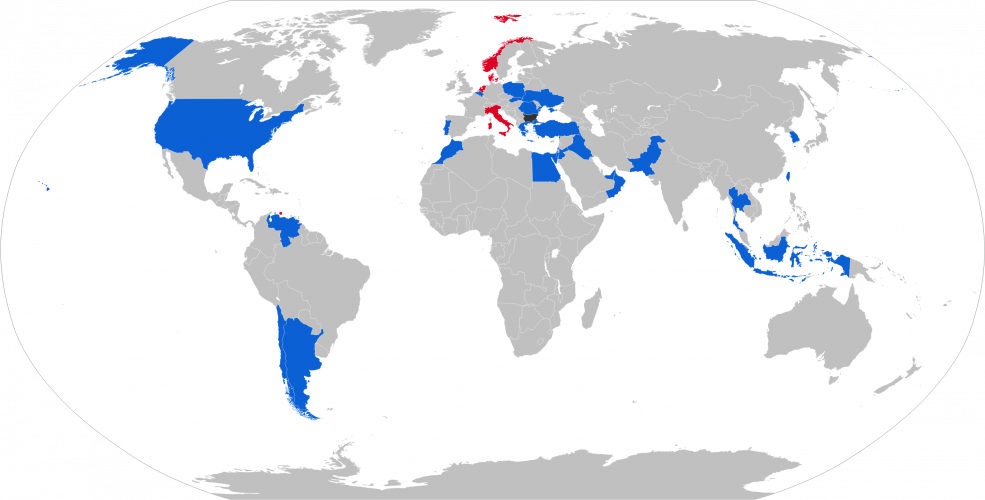
What you said is true. There is a lot of politics involved in the aquisition of armament. If you look at the european F-16 operators map, the newest F-16 operators are also new NATO members and also on the borderland of the Alliance.
1775583513168.png

They aligned themselves in this way with the strongest NATO nation, USA, and its military. In case of a conflict with a big bad guy from the East interoperability and capacity to service on their own airports the "saviour" US Air Force was very important. And also was the need to be perceived as a good customer who "buys american" and needs to be protected.

In the case of Romania for example, the Gripen was a favourite when the replacement of the Mig-21 Lancer started to be discussed. It has some similarities with the Mig-21. Small, rugged, not so costly to operate, but "good enough" for what is required from a multirole. But at the time Sweden was non aligned and there were concerns about what would happen in the case of a conflict. What if the swedes decide to remain neutral and don`t help us with spare parts and aircrafts? In case of buying the "de facto" standard NATO multirole fighter, the F-16, even if the operation was more demanding and costly the stocks of spare parts would come from american depots, without the need to keep everything on site, and replacement airframes would have been recuperated from the ones stored at AMARG.

There is a reason for which both Poland and Romania have chosen the F-16, the Abrams tank, the HIMARS and the Patriot missiles. And this not necesarily because they the best in their class. But they are sold by the "best ally".
 
So, I am sorry but, as great the nimble Gripen is, it is not unique or innovative. It is rather flabbergasting to say that to the Canadians that have flown F-5 for decades.
It would be more normal back then. But now it's certainly the most dispersable western fighter aircraft - especially (as usual for Sweden) if you have magic NCOs to make the system work.
Furthermore, it's somewhat unfair - these aircraft were rugged, but by modern standards they also were simple. Design effort spent on making Jas-39 easier to hide is obvious and considerable, in many ways(especially ecosystem part) it's beyond Viggen.

Yes, Su-57 is STOL in S/MTD sense, and has heavy duty landing gear; it's also big, and takes more service; it's certainly not Western. Yes, it is likely a better competitor in dispersal ... if you have a big enough country. Which is just a different requirement.

Yes, late Migs are still available for order, but they're also bigger aircraft. They lost their original extreme off-road capability, and hardly are that unique since 9-15 onwards.
 
and have developed aircraft uniquely suited to this task?

However, Gripen is the ONLY aircraft now on sale that has been DESIGNED to be operated in this way from the beginning.
Examples of what exactly makes the Gripen design unique please? I have yet to see any meaningful examples. Just talking about things such as LRUs doesn't count since all other alternates also use such.
And since this is now the way of the future, hurry up and buy one today, before they run out!
What before the production line closes down?:D
 
dispersed basing would be a disaster in Arabian deserts. Every geoography has its own preferred solutions. Sweden is unique in having industry and will to develop theirs.
That's quite a good point. Unless one was to base in buildings/built up areas (see above Harrier articles), some places are just going to be better suited to others to the entire concept.
 
There is a reason for which both Poland and Romania have chosen the F-16, the Abrams tank, the HIMARS and the Patriot missiles. And this not necesarily because they the best in their class. But they are sold by the "best ally".
A lot of the reason people buy the US produced items is that the scale of the support base is just so large which makes support much easier. This is getting off topic though.
 
...
So, I am sorry but, as great the nimble Gripen is, it is not unique or innovative. It is rather flabbergasting to say that to Canadians that have flown F-5 for decades.

The only valid question is: is it it well done for the task at hands?

And Canada would have flown the CF-5 for much longer had the Northrop Corporation not sued the GoC for an MLU programme which Northrop had played no part in.

Maybe US defence firm litigiousness should be added to any list of "valid question"s?
 
What you said is true. There is a lot of politics involved in the aquisition of armament. If you look at the european F-16 operators map, the newest F-16 operators are also new NATO members and also on the borderland of the Alliance.
View attachment 808295

They aligned themselves in this way with the strongest NATO nation, USA, and its military. In case of a conflict with a big bad guy from the East interoperability and capacity to service on their own airports the "saviour" US Air Force was very important. And also was the need to be perceived as a good customer who "buys american" and needs to be protected.

In the case of Romania for example, the Gripen was a favourite when the replacement of the Mig-21 Lancer started to be discussed. It has some similarities with the Mig-21. Small, rugged, not so costly to operate, but "good enough" for what is required from a multirole. But at the time Sweden was non aligned and there were concerns about what would happen in the case of a conflict. What if the swedes decide to remain neutral and don`t help us with spare parts and aircrafts? In case of buying the "de facto" standard NATO multirole fighter, the F-16, even if the operation was more demanding and costly the stocks of spare parts would come from american depots, without the need to keep everything on site, and replacement airframes would have been recuperated from the ones stored at AMARG.

There is a reason for which both Poland and Romania have chosen the F-16, the Abrams tank, the HIMARS and the Patriot missiles. And this not necesarily because they the best in their class. But they are sold by the "best ally".

All very good points and yes, politics plays a big part in these decisions doesn't it? Just look at Finland's F-18 deal before joining NATO. No one (neither the Finns nor the Russians) saw that coming (i.e. Finland and Sweden joining NATO), so I'm pretty sure establishing closer ties with the US when the opportunity arose was a big part in the decision to go with the F-18 at the time.
 

That’s going up on the wall right now. In a gilded frame:

“USAF Europe says Sweden has Agile Combat Employment (ACE) down better than any AF. And we are going to exploit that for NATO. It’s very exciting!”

Signed, CO USAFE, Gen James B Hecker

Well, well, well, looks like I can kiss that SAAB marketing job goodbye then don’t it? :D
 
Examples of what exactly makes the Gripen design unique please? I have yet to see any meaningful examples. Just talking about things such as LRUs doesn't count since all other alternates also use such.

Let's take it the other way around...

Which modern multirole supersonic fighter, small to moderate size, offers (easy) maintenance at low cost and footprint (in personal and ground equipment), STOL characteristics (such as direct no-flare approach with dedicated HUD symbology, sturdy landing gear, heavy duty brakes, oversized canards doubling as airbrakes with downward force), low turnover time, and compatibility with a large array of american and European armament?

Hate it or love it, for good or bad reasons, but the Gripen is the only one to tick all those boxes.

Is it a miracle weapon? Absolutely not. But it has non negligible advantages in some fields.
 
Let's take it the other way around...

Which modern multirole supersonic fighter, small to moderate size, offers (easy) maintenance at low cost and footprint (in personal and ground equipment), STOL characteristics (such as direct no-flare approach with dedicated HUD symbology, sturdy landing gear, heavy duty brakes, oversized canards doubling as airbrakes with downward force), low turnover time, and compatibility with a large array of american and European armament?

Hate it or love it, for good or bad reasons, but the Gripen is the only one to tick all those boxes.

Is it a miracle weapon? Absolutely not. But it has non negligible advantages in some fields.
Ahem rafale can do it all
 
Ahem rafale can do it all
Rafale misses half the list though.
It is not especially built for harder basing, and it's handcuffed to french weapons.
It's survival trait is range(via fuel tanks) and rather small unfolded footprint - a trait possible mainly via very light and lean airframe.

It's ultimately a French aircraft, French problem is not anyone at their borders, it's how to deliver problems to others beyond many sets of friendly borders.
 
Rafale misses half the list though.
It is not especially built for harder basing, and it's handcuffed to french weapons.
It's survival trait is range(via fuel tanks) and rather small unfolded footprint - a trait possible mainly via very light and lean airframe.

It's ultimately a French aircraft, French problem is not anyone at their borders, it's how to deliver problems to others beyond many sets of friendly borders.
Alright so depending on ITAR hence the goodwill of the US to procure weapons/radars/ew/engines/systems is an asset in your opinion?

Also how many gbu types can it carry ? The meteor is a french weapon since when ?

Also if it can land on an aircraft carrier it can land on the network of prepared wider highways that sweden have built for dispersed basing. Yes it was very smart of the swedes to prepare their highways for dispersed basing. It's silly to believe only gripens can use those.
 
Alright so depending on ITAR hence the goodwill of the US to procure weapons/radars/ew/engines/systems is an asset in your opinion?
To the end user, if he already managed to get on - certainly.
No purchasing country can afford long-term advanced weapon stocks; it is a deal with assumption(of support). France is a very bad source of such support, it just doesn't have much. We're talking barely 1 MICA load per aircraft at low point(which is just barely passed...if passed at all, taking into account significant expense in gulf). Furthermore, almost entire stock is badly outdated. Mica wasn't BVR world leader even when it just appeared. Now, we're talking about weapon substantially energetically weaker than vanilla RVV-AE. Which is known as non-competitive.
Also how many gbu types can it carry ? The meteor is a french weapon since when ?
...and meteors in french service very recently didn't even reach 1 weapon(not load) per aircraft. That's very little potential help France can spare.
Also if it can land on an aircraft carrier it can land on the network of prepared wider highways that sweden have built for dispersed basing.
It's two different rafales, with deck one having both less performance and (with that chassis) almost 100% different debris cone.
No one buys it for service beyond clean decks, and overall it's a big myth that carrier aircraft are automatically better on lesser strips.
 
Last edited:
You don't need a Rafale M to land on or take off from such a highway.
Those are specially prepared and enlarged highways which allow fighter jets to use them. Not the other way around.
 
You don't need a Rafale M to land on or take off from such a highway.
Those are specially prepared and enlarged highways which allow fighter jets to use them. Not the other way around.
You absolutely can disperse normal fighters, it's just less convenient and efficient, and places more burden on local support and higher requirement on strip.

Gripen(for it's generation) is everything, and it's the point. Should you remove these requirements, it probably could've been a substantially higher spec aircraft.
And Rafale is a good example here, because even M(which is deck, not dispersal - dispersal takes other features as well) takes performance hit.

We of course shouldn't overestimate too much Gripen itself here - it's a 1990s solution at core, and this isn't something refresh can fix.
Given how observation evolves, a truly up to date aircraft with ambitions to survive v superpower air attack(Russia isn't) now needs a substantially higher performance goal, both the aircraft and ground support. Both absolutely and especially for a given country size.
 
Last edited:
This is a quite old Gripen ground operations video, but I think it is still worth posting again since it has much more details than you usually see in more recent marketing videos.

It not only shows more details about how the aircraft has been designed for dispersed road operations and the type of ground gear used, but also details the responsibilities of the technician and each of the five "conscript type" assistants, and what they work with during a typical turn around.


Similar threads

Back
Top Bottom