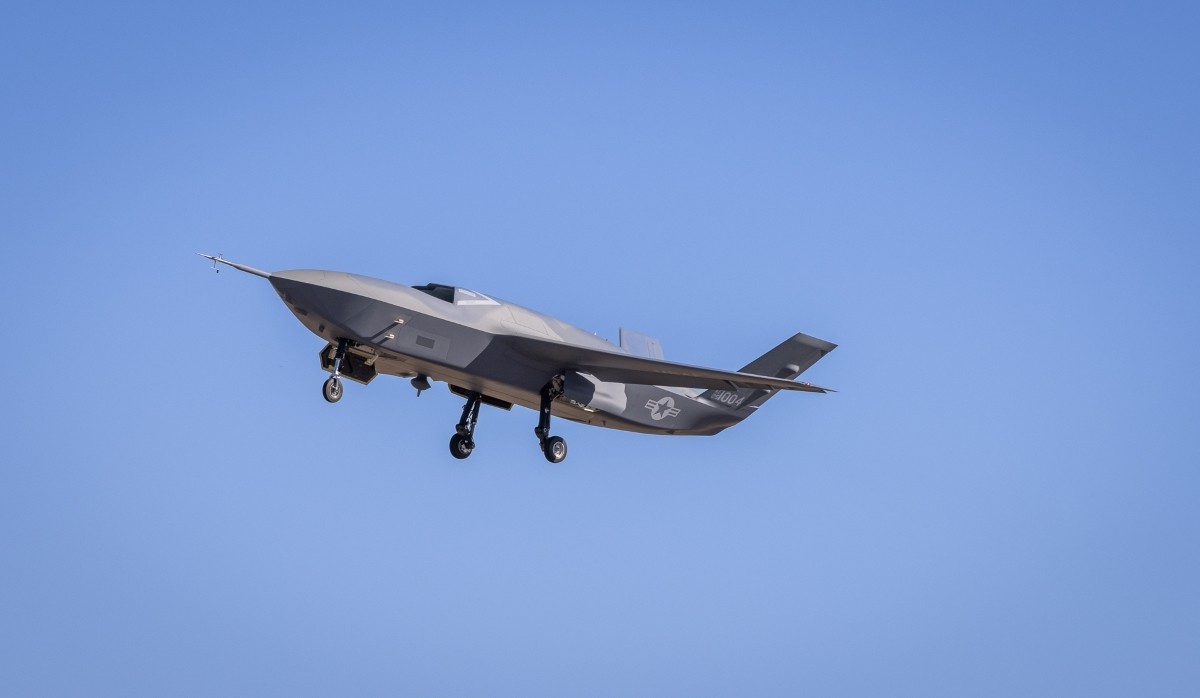
Up grade or not It still doesn’t explain the weird part which is that someone made a half-ass attempt at making it look stealthy but not actually making it so; making it looks like it can go fast but not actually making it so. It’s like converting a pick up truck for racing and all you did was hammer a few corners to make them rounded and call it a day.

It’s a surveillance aircraft. The priorities are different.
 
MQ-25 and (Y)FQ-42 look very promising. But why was the MQ-20 never blessed with much success regarding sales? A stealthy Reaper seems rather appealing to me at least. Could someone enlighten me?
It was a private-venture development, not a programme of record, it did what the MQ-9 was supposed to do, and if the USAF looked even remotely interested they risked Congress questioning the entire MQ-9 programme. Programmes that embarrass the customer rarely prosper.
 
@Josh_TN

You mentioned controlling CCAs with satellites and I was just reading today that SDA launched the first 21 transport layer satellites with laser downlinks and K band Link16 comms. Though part of the transport layer might get replaced by MILNET, seems like the laser data link that with what Kendall said previously between controlling aircraft and CCAs might soon have the infrastructure to do it from space - provided the weather allows (and link16 otherwise)

Indeed, this constellation was what I was thinking of. This is the first of 126 Incr1 communication satellites, all to go up inside ten launches every month or so. Assuming Incr2 is on time (incr1 was delayed a year), it will basically follow immediately on the heels of the first batch, with follow on increments refreshing the system every two years after.
 
Indeed, this constellation was what I was thinking of. This is the first of 126 Incr1 communication satellites, all to go up inside ten launches every month or so. Assuming Incr2 is on time (incr1 was delayed a year), it will basically follow immediately on the heels of the first batch, with follow on increments refreshing the system every two years after.
Would be really nice if they continued with these launches, but also integrate them with MILNET (Starshield) for added redundancy and mass. If they are equipped with laser comms like the SDA ones are, you probably couldn't make enough anti satellite missiles to wipe them out. Gateways are more targetable but you could strap them on MUSVs and ships to make them less so. To add to this, GA-EMS tested a while ago an airborne optical terminal that communicated with an LEO sat using a 10 watt laser so if this is fielded in 6th gens and CCAs, you won't need gateways anymore.
 
Would be really nice if they continued with these launches, but also integrate them with MILNET (Starshield) for added redundancy and mass. If they are equipped with laser comms like the SDA ones are, you probably couldn't make enough anti satellite missiles to wipe them out. Gateways are more targetable but you could strap them on MUSVs and ships to make them less so. To add to this, GA-EMS tested a while ago an airborne optical terminal that communicated with an LEO sat using a 10 watt laser so if this is fielded in 6th gens and CCAs, you won't need gateways anymore.
They do use laser cross links; I believe each satellite has four optical terminals to maintain connectivity to neighboring satellites. In fact it was a shortage of the optical sub assemblies that delayed the program.

I would think that the 180 Starshield NRO satellites also have optical cross links comparable with the SDA constellation, but maybe it operates as a stand alone system.
 
I hate how people who actually have a life and don’t obsessively follow defense matters, unlike us, compare every LO aircraft to the F-35.

But I gotta admit, this little bird does resemble the F-35 from behind, with that bulge, the vertical stabilizers, the exhaust shape, and all.
 
Last edited by a moderator:

Theres no news in here, but a really funny and oddly specific quote from GA taking a shot at someone:
“The concepts we’re talking about are novel, and because they haven’t been done before the door has opened for new starts and even major prime contractors to come forward with ideas that look good on paper but may be years from being fielded, if ever. Other companies are passing off old technology as new and unrelated work as a ‘legacy’ they haven’t earned to seem a less risky option than they are.

Any guesses as to who this is referring to?
 

Theres no news in here, but a really funny and oddly specific quote from GA taking a shot at someone:


Any guesses as to who this is referring to?
The only value I can see from the Anduril offering is its use of all off the shelf components. In a wartime scenario like the Ukraine war, it could he produced in numbers. But it seems much less capable than the other competitors.
 
The only value I can see from the Anduril offering is its use of all off the shelf components. In a wartime scenario like the Ukraine war, it could he produced in numbers. But it seems much less capable than the other competitors.
I can see the quote applying to Anduril under the "old technology as new" part maybe, but which company(s) are using "unrelated work as a legacy"? This sounds like a fairly well established company instead of a startup like Anduril.
 

Interesting…

The RTX mission autonomy software suite will be integrated into the General Atomics Aeronautical Systems Inc. (GA-ASI) YFQ-42, and Shield AI’s Hivemind-branded system will control the Anduril YFQ-44, sources tell Aviation Week.
 
I can see the quote applying to Anduril under the "old technology as new" part maybe, but which company(s) are using "unrelated work as a legacy"? This sounds like a fairly well established company instead of a startup like Anduril.
Fury was built by blue force technologies, which Anduril purchased.
 
Lol…

Alexander pushed back at questions about the sophistication of the YFQ-42 at first flight.

Speaking to reporters at the Air, Space and Cyber conference here on Sept. 22, Anduril executives said the YFQ-44 had not yet reached first flight because the company was still working on the semi-autonomous control system used during the aircraft taxi, takeoff and landing phases. Anduril claimed that the YFQ-44 was developing this technology on a CCA for the first time.

Alexander acknowledged that GA-ASI’s competitor in the CCA program was flown manually by the company’s chief test pilot during the first flight. But he noted that GA-ASI has been operating semi-autonomous uncrewed aircraft systems (UAS) since 2004, when the MQ-1C Gray Eagle first flew with an automatic landing system. All new GA-ASI aircraft are flown manually during the first several flight tests before the company moves to semi-autonomous control.

“I know there’s all that talk out there [from Anduril],” Alexander said. “But that’s a bunch of crap. Go ahead and print it.”
 
I did some sleuthing and started building a model of the YFQ-42A and I'm a bit surprised:

Wikipedia reports the length of the MQ-20 Avenger to be 13 meters. Went and looked at Gray Butte Field, which is owned by GA-ASI and found a few MQ-20s just sitting around on the tarmac. I also found the place where this photoshoot happened at. Measuring the MQ-20 in google earth comes out to around the same13 meters figure.


1762204925504.png Top Down View.jpg 1762207828610.png 1762207856819.png
yfq-42a.jpg So working off proportions as well and verifying by identifying the section of tarmac this photoshoot happened at, the YFQ-42 is:
  • 12.7m long
  • 12.6m wingspan
  • 2.09m widest nose width
  • a fuselage thickness of 1.86m
I'm not sure whether anyone else estimated the size in this thread or elsewhere, but this plane isn't actually as small as I thought it was. An F-16 is only 2m longer. Accounting for error, it's comparable in size to the T-45 trainer.

Unlike a trainer though, this thing apparently has a huge nose section even compared to full sized fighters.
1762209605418.png
1762208787693.png APG-77 array.jpg
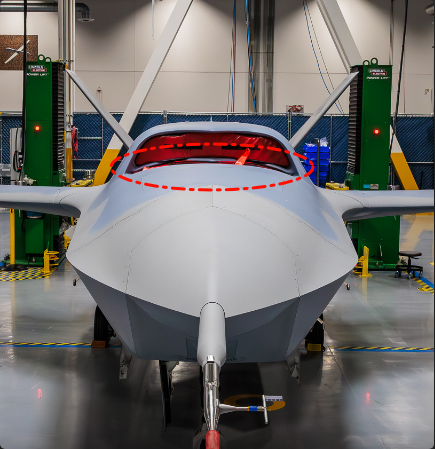
Cutting conservatively as shown on the screencap above, the radome area (outer ring) comes out to something like 1.54 m across with an area of 1.1 m2.

If we take photos from the F-22, F-35 and radars from other fighters, you could probably estimate it's effective aperture area to be 70% of the radome/bulkhead area, which leaves us at something like 0.64 m2 - the aperture area of something like an APG-68. While sensor's range also depends on available power and cooling, that's still a huge volume for whatever sensors they want to put in there. 1762208193801.png
 
Last edited:
I did some sleuthing and started building a model of the YFQ-42A and I'm a bit surprised:

Wikipedia reports the length of the MQ-20 Avenger to be 13 meters. Went and looked at Gray Butte Field, which is owned by GA-ASI and found a few MQ-20s just sitting around on the tarmac. I also found the place where this photoshoot happened at. Measuring the MQ-20 in google earth comes out to around the same13 meters figure.


View attachment 790359View attachment 790364View attachment 790382View attachment 790383
View attachment 790384So working off proportions as well and verifying by identifying the section of tarmac this photoshoot happened at, the YFQ-42 is:
  • 12.7m long
  • 12.6m wingspan
  • 2.09m widest nose width
  • a fuselage thickness of 1.86m
I'm not sure whether anyone else estimated the size in this thread or elsewhere, but this plane isn't actually as small as I thought it was. An F-16 is only 2m longer. Accounting for error, it's comparable in size to the T-45 trainer.

Unlike a trainer though, this thing apparently has a huge nose section even compared to full sized fighters.
View attachment 790391
View attachment 790387View attachment 790388
Cutting conservatively as shown on the screencap above, the radome area (outer ring) comes out to something like 1.54 m across with an area of 1.1 m2.

If we take photos from the F-22, F-35 and radars from other fighters, you could probably estimate it's effective aperture area to be 70% of the radome/bulkhead area, which leaves us at something like 0.64 m2 - the aperture area of something like an APG-68. While sensor's range also depends on available power and cooling, that's still a huge volume for whatever sensors they want to put in there.View attachment 790385
Nice use of 3D tools for the analysis here!
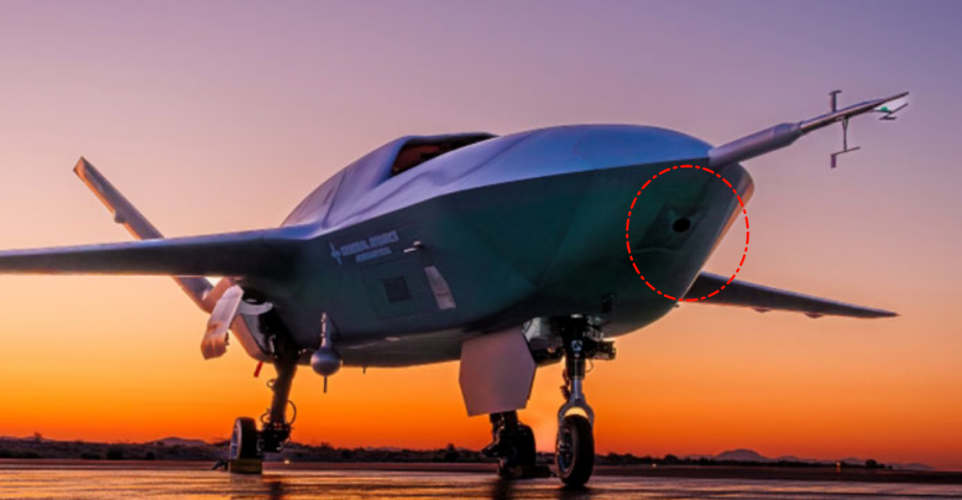
I would guess that they have only a far smaller area in the nose provisioned for radar thus far, judging from the fact that there seem to be camera apetures sitting just forward of the nose landing gear bay. I've outlined what looks like the area that they currently have reserved for radar... a very faint lighter tone and line is visible aronud this area of the nose.

I'm quite curious as to what the area of this is, versus the two areas you provided in your previous message. This also lines up with the Vectis rendering, where a small array sits in the topmost half of the nose.
1762214832609.png
 
I used this photo for reference too and it seems like its part of the air data probe?
Theres also a render without the probe but with a very similar section of nose.

1000006815.jpg
1762217418083.jpeg

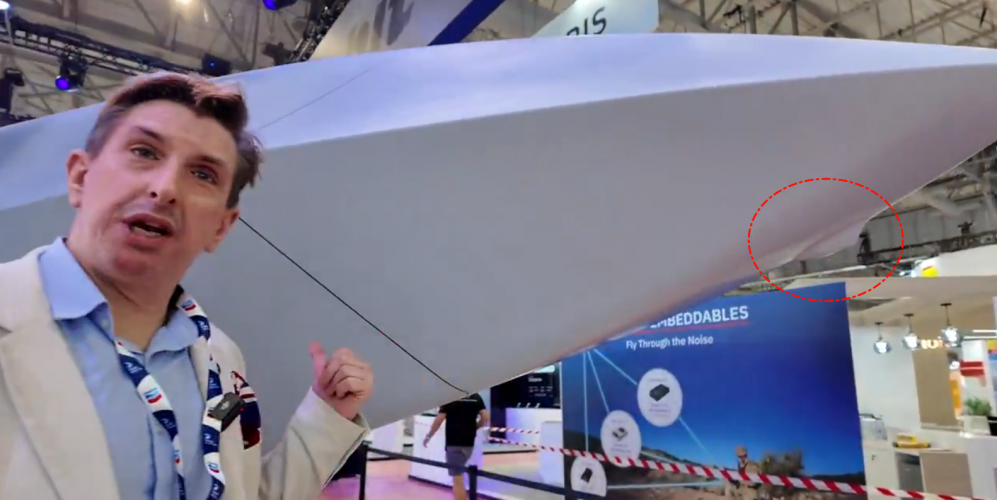
On this mockup though, there seems to be a radome that looks different from what's pictured on the actual plane:

1762216991610.jpeg
 
Last edited:
On this mockup though, there seems to be a radome that looks different from what's pictured on the actual plane:
Will likely be different noses for different payloads so radar, EW focused package or large EO/IR sensor etc. Could easily see the current nose being just temporary to assist with flight testing.
 
So I did a quick sectional cut of that front part of the nose. My model isn't very high poly yet, but with making the shape more high poly and making rounding and smoothing more accurate, I actually expect the area to be even smaller.
1762224346816.png 1762224385945.png
1762224483547.png
1762225494886.png

It seems unlikely to me that this is a radome here for a number of reasons. Radar arrays usually sit at a slant inside the radome, but
I'm pretty sure it can't be laying as flat as the seam line (I've never seen a radar sit flat that way). At such a flat angle, it may have a lot of distortion for targets just off the nose just because it's so far off boresight of the array face. If you're curious - that flat cut along the seam yields 1.16m2 for the radome cross section, but it yields much smaller room for the radar aperture face itself - only 0.58m (0.29 * 2)

1762225047189.png
I also did a number of normal cut / slant of what I would expect a normal radome face might have, but these yielded results that would seems to be more or less useless as a fire control radar - a radome cross section area between 0.18m2 and 0.24m2. 0.24m2 is already the actual array face of what what a light fighter / trainer might have. After using the 70% area rule, your upper bound becomes 0.168m2, which to me is functionally useless for an offboard sensing node. Phantom Strike and the YFQ-44 radome both seem to be much larger in area (although I'll find out when I model the YFQ-44 next).

1762225256841.png
Other things of note: If the radar array sat deeper into this small cone, then the walls on both sides of this section would have to be of the same material the radome is made of too so as to not greatly limit the scan area, so that also seems unlikely.

I think what @Ozair said is probably true - the nose section is for flight testing and may change depending on which sensors are used. There's an entire seamline wrapping all the way around the nose in the front view photo.

 
Last edited:
Because it’s not stealthy… it probably also doesn’t fly as fast as most people thinks it does.

It is not stealthy.
Exhibit A: It is not planform aligned. It has a straight inlet lip that’s perpendicular to the flow. The aileron hinge line appears to be held to a fix % chord and thus do not align to the leading edge of the wings. This is something you’d do for a traditional aircraft but not when you are trying to hold planform alignment.
Please note that certain surveillance aircraft have features that diverge from stealth shaping of.. say a fighter.

Look at the nose of the MQ-20, Darkstar, and Lockheed's proposal to replace U-2. The edge forming the nose section is round rather than straight edges angled away from head on radar.

Outside of that, the smaller details you mentioned is mainly due to being an internally funded prototype. If the aircraft was picked up for production, expensive layers of materials (not necessarily RAM) to control surface waves would dictate edge alignments of panels, doors and smaller features.
 

Attachments

  • hd-aspect-1458677921-451442578816.jpg
    hd-aspect-1458677921-451442578816.jpg
    30.2 KB · Views: 31
  • 1517625188030-dark_star_usaf.jpg
    1517625188030-dark_star_usaf.jpg
    396.9 KB · Views: 37
Interesting bit with an EU dedicated model of the Gambit 6 (YFQ-42A)

Alexander said the “modular architecture and signature-reducing internal weapons bay of Gambit 6 allow for easy integration of advanced autonomy, sensors, and weapons systems, ensuring the aircraft can adapt to a wide range of operational scenarios.”

The company said Gambit 6 “will be available for international procurement starting in 2027, with European missionized versions deliverable in 2029.” It added that GA “is building industry partnerships throughout Europe with the aim of providing sovereign capabilities for all its platforms.”

 
What do yall think they mean by "European missionized"?

I'm assuming the (different) transponder equivalent to ADSB, plus any software to talk to things that don't talk to the standard NATO data bus.
 
Weapons package, datalinks, Sensors.
Hypothetically, ensure that it´s fully compatible with both FCAS and GCAP and comes online at a relevant time (see early 2030 for availability).
 
Europe seems to be quite a lucrative market that everyone is going after with various forms of local partnership offerings, be it Anduril, General Atomics, Lockmart, Baykar, etc.
 
yep thanks to the war in ukraine, everyone raised their debt ceiling to buy more weapons in Europe.
 
Europe is like 80% of the sales in the past. But since this year everyone will shift toward domestic options.
 
So I did a quick sectional cut of that front part of the nose. My model isn't very high poly yet, but with making the shape more high poly and making rounding and smoothing more accurate, I actually expect the area to be even smaller.
View attachment 790427View attachment 790428
View attachment 790430
View attachment 790434

It seems unlikely to me that this is a radome here for a number of reasons. Radar arrays usually sit at a slant inside the radome, but
I'm pretty sure it can't be laying as flat as the seam line (I've never seen a radar sit flat that way). At such a flat angle, it may have a lot of distortion for targets just off the nose just because it's so far off boresight of the array face. If you're curious - that flat cut along the seam yields 1.16m2 for the radome cross section, but it yields much smaller room for the radar aperture face itself - only 0.58m (0.29 * 2)

View attachment 790431
I also did a number of normal cut / slant of what I would expect a normal radome face might have, but these yielded results that would seems to be more or less useless as a fire control radar - a radome cross section area between 0.18m2 and 0.24m2. 0.24m2 is already the actual array face of what what a light fighter / trainer might have. After using the 70% area rule, your upper bound becomes 0.168m2, which to me is functionally useless for an offboard sensing node. Phantom Strike and the YFQ-44 radome both seem to be much larger in area (although I'll find out when I model the YFQ-44 next).

View attachment 790432
Other things of note: If the radar array sat deeper into this small cone, then the walls on both sides of this section would have to be of the same material the radome is made of too so as to not greatly limit the scan area, so that also seems unlikely.

I think what @Ozair said is probably true - the nose section is for flight testing and may change depending on which sensors are used. There's an entire seamline wrapping all the way around the nose in the front view photo.
Out of curiosity, could you share orthographic views of your 3D model?
 

Similar threads

Back
Top Bottom