
You are using an out of date browser. It may not display this or other websites correctly.
You should upgrade or use an alternative browser.
You should upgrade or use an alternative browser.
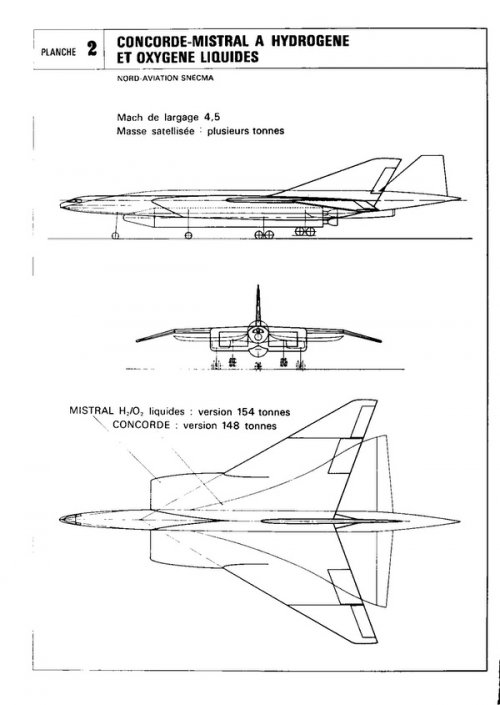
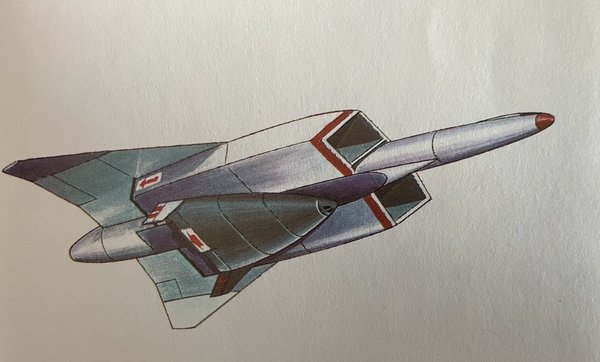
French TSTO studies of the 60's
- Thread starter Archibald
- Start date

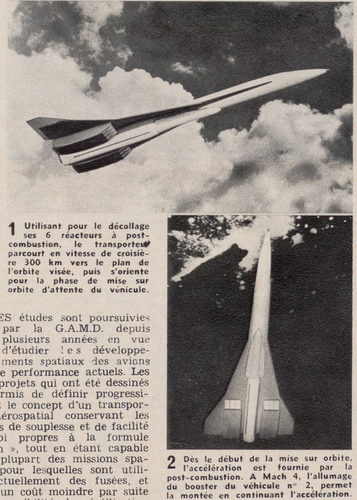
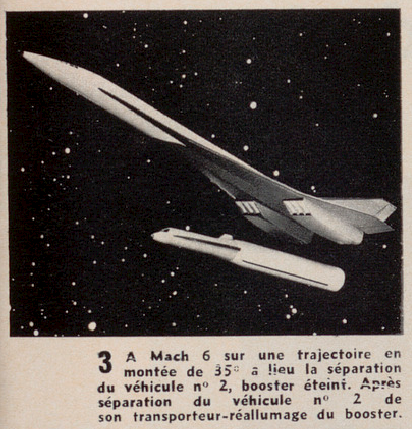
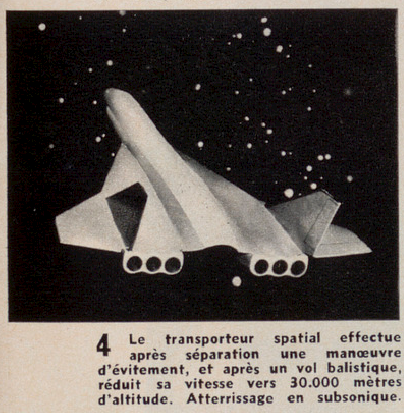
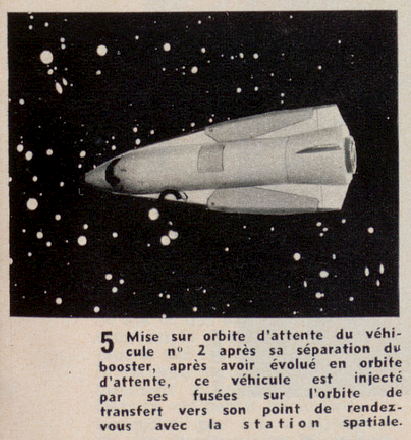
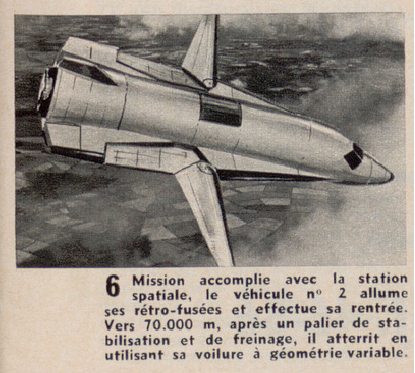
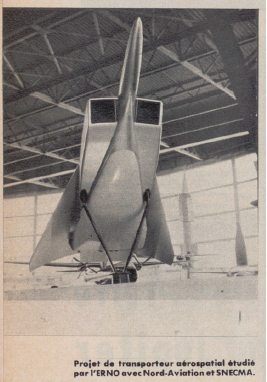

Now that swing wing design….we have seen designs shed tanks right. Thanks that when full of fluid could not possibly hold their own weight up right? And we don’t want ice getting on that RCC right?From Aviation magazine 1965.
So you don’t.
The thing launches….the RCC are flaps nowhere near anything. Tanks and engines slide out of the wing that’s folded flat against the rocket. Ice slides right off the wing. When safe, RCC folds back along the wings. Re-enter…deploy as unit.
Now that swing wing design….we have seen designs shed tanks right. Thanks that when full of fluid could not possibly hold their own weight up right? And we don’t want ice getting on that RCC right?From Aviation magazine 1965.
So you don’t.
The thing launches….the RCC are flaps nowhere near anything. Tanks and engines slide out of the wing that’s folded flat against the rocket. Ice slides right off the wing. When safe, RCC folds back along the wings. Re-enter…deploy as unit.
Well part of the "problem" is the TPS is right there along the outside edge of the REST of the vehicle as well so it can't easily be 'shadowed' from debris. I mean that's it's JOB after all to be exposed to ward off the heat.
Second part is that 'swing-wing' designs tend to be heavy as a general rule. (You can have somewhat 'lighter' one-off systems that only 'deploy' once and have to be essentially "factory reset" once deployed, much like the Falcon 9 landing legs. But those have their own issues you have to be wary of)
Now you can "get around" this somewhat with something like an 'expendable' TPS system covering the 'wings' before they deploy but that still leaves you with vulnerabilities and now you've got another event (along with wing deployment) to add to the list of 'things-that-might-go-wrong" along with the need to be able to deploy those wings quickly if things go south on the trip UP. So it's very much a 'trade-off' that is a less simple and easy than most people think.
Randy
I was thinking having the whole TPS not attached to tankage at all-but through hinges? No ice. No cold. No flex. Fold along now dry empty tankage and airflow keeps it in place.
That's still the mass of the 'folding' system and another point of failure if it does not deploy properly. You also have to have it rigidly attached to the vehicle since having it decide to 'slide' off one side could have "bad" results

Mind you I'm not totally against a 'deploying' TPS per-se as there's been some interesting work on the matter it's just that (unfortunately) none of the systems tested have actually worked in actual flight yet.
Randy
martinbayer
ACCESS: Above Top Secret
- Joined
- 6 January 2009
- Messages
- 5,062
- Reaction score
- 6,967
Everyone keep in mind the KISS principle. The STS got a whole lot of things wrong (SRBs and expendable flaking insulation tank tank), but at least the orbiter mostly made it back in one piece, except when solids (NEVER EVER use those on crewed missions) and flaking insulation throwaway tanks (also NEVER EVER use those on crewed missions) "malfunctioned". If you want true reusability, go all the way or not at all.I was thinking having the whole TPS not attached to tankage at all-but through hinges? No ice. No cold. No flex. Fold along now dry empty tankage and airflow keeps it in place.
That's still the mass of the 'folding' system and another point of failure if it does not deploy properly. You also have to have it rigidly attached to the vehicle since having it decide to 'slide' off one side could have "bad" results
Mind you I'm not totally against a 'deploying' TPS per-se as there's been some interesting work on the matter it's just that (unfortunately) none of the systems tested have actually worked in actual flight yet.
Randy
Last edited:
Everyone keep in mind the KISS principle. The STS got a whole lot of things wrong (SRBs and expendable flaking insuation tank tank), but at least the orbiter mostly made it back in one piece, except when solids (NEVER EVER use those on crewed missions) and flaking insulation throwaway tanks (also NEVER EVER use those on crewed missions) "malfunctioned". If you want true reusability, go all the way or not at all.I was thinking having the whole TPS not attached to tankage at all-but through hinges? No ice. No cold. No flex. Fold along now dry empty tankage and airflow keeps it in place.
That's still the mass of the 'folding' system and another point of failure if it does not deploy properly. You also have to have it rigidly attached to the vehicle since having it decide to 'slide' off one side could have "bad" results
Mind you I'm not totally against a 'deploying' TPS per-se as there's been some interesting work on the matter it's just that (unfortunately) none of the systems tested have actually worked in actual flight yet.
Randy
"flaking insulation throwaway tanks" is not a generic issue. They are in constant use and it doesn't cause problems. And it isn't the insulation, it is ice that can cause problems most of the time. The STS issue was putting impact sensitive TPS in a debris shedding environment.
not feasible. Loads are too high.Hmm...TPS as fairing/shroud? Above cluster tankage-slides down on rails? All dry by then...petals...all tech inward facing. TPS is the grid fin.
But being honest you'd likely still have some 'ice' issues with a fully reusable system given the use of hydrogen. (Heck Starship/Superheavy is going to have the same issues with liquid methane if we're honest, they are hoping to avoid issues by "stacking" things better but it's likely still going to be a general issue)Everyone keep in mind the KISS principle. The STS got a whole lot of things wrong (SRBs and expendable flaking insulation tank tank), but at least the orbiter mostly made it back in one piece, except when solids (NEVER EVER use those on crewed missions) and flaking insulation throwaway tanks (also NEVER EVER use those on crewed missions) "malfunctioned". If you want true reusability, go all the way or not at all.I was thinking having the whole TPS not attached to tankage at all-but through hinges? No ice. No cold. No flex. Fold along now dry empty tankage and airflow keeps it in place.
That's still the mass of the 'folding' system and another point of failure if it does not deploy properly. You also have to have it rigidly attached to the vehicle since having it decide to 'slide' off one side could have "bad" results
Mind you I'm not totally against a 'deploying' TPS per-se as there's been some interesting work on the matter it's just that (unfortunately) none of the systems tested have actually worked in actual flight yet.
Randy
Heck the Saturn V and Saturn 1/1B "shed" every launch you just didn't have the TPS in the debris zone.
Everyone keep in mind the KISS principle. The STS got a whole lot of things wrong (SRBs and expendable flaking insuation tank tank), but at least the orbiter mostly made it back in one piece, except when solids (NEVER EVER use those on crewed missions) and flaking insulation throwaway tanks (also NEVER EVER use those on crewed missions) "malfunctioned". If you want true reusability, go all the way or not at all.I was thinking having the whole TPS not attached to tankage at all-but through hinges? No ice. No cold. No flex. Fold along now dry empty tankage and airflow keeps it in place.
That's still the mass of the 'folding' system and another point of failure if it does not deploy properly. You also have to have it rigidly attached to the vehicle since having it decide to 'slide' off one side could have "bad" results
Mind you I'm not totally against a 'deploying' TPS per-se as there's been some interesting work on the matter it's just that (unfortunately) none of the systems tested have actually worked in actual flight yet.
Randy
"flaking insulation throwaway tanks" is not a generic issue. They are in constant use and it doesn't cause problems. And it isn't the insulation, it is ice that can cause problems most of the time. The STS issue was putting impact sensitive TPS in a debris shedding environment.
As Byeman notes and I really should read ahead
Randy
martinbayer
ACCESS: Above Top Secret
- Joined
- 6 January 2009
- Messages
- 5,062
- Reaction score
- 6,967
My apologies for derailing the conversation. I got triggered by the swing wings and went on to an old man rant/tear from there.And this relates to French TSTOs, how ?

Jareel
ACCESS: Secret Space Projects
- Joined
- 25 May 2022
- Messages
- 11
- Reaction score
- 13
I'd like to add another one to the list - a two-stage spaceplane system (orbital spaceplane carried on top of a hypersonic spaceplane) where the first stage used a cluster of Moteur Combiné - motors able to work in air-breathing and rocket modes. It was described in one of the 1989 Flight International issues (but sadly - no link I can provide, as the entire archive of the magazine went offline and the specific file (1989 - 0424.PDF) isn't stored even on the web archive)

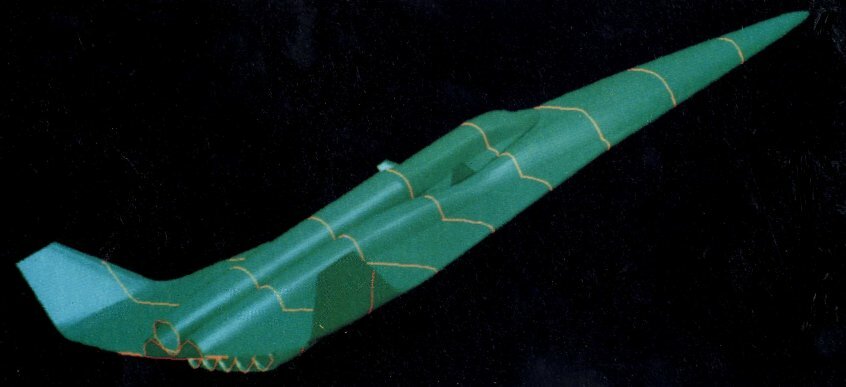
Hi, any chance you could get these in a higher resolution? It's pretty much impossible to read the text or numbersGot this a while back on Ebay...
An updated link: Rev. Phys. Appl. (Paris) 5, 455-465 (1970) DOI: 10.1051/rphysap:0197000503045500 - Utilisation d'un alliage de niobium dans la réalisation d'un véhicule hypersoniquePerez, Syre, Billon, Pichoir et Guyot (Tréfimétaux GP, Nord-Aviation, Onera
"Utilisation d'un alliage de niobium dans la réalisation d'un véhicule hypersonique"
Rev. Phys. Appl. (Paris) 5, 455-465 (1970)
link: http://rphysap.journaldephysique.or..._1970__5_3_455_0/rphysap_1970__5_3_455_0.html
Last edited:
martinbayer
ACCESS: Above Top Secret
- Joined
- 6 January 2009
- Messages
- 5,062
- Reaction score
- 6,967
That's the Dassault Star-H concept.
View: https://www.reddit.com/r/Giscardpunk/comments/r11u3p/dassault_starh_un_transporteur_spatial_capable/
Dedicated thread is at https://www.secretprojects.co.uk/threads/dassault-star-h-aerospace-plane.3232/.
Dedicated thread is at https://www.secretprojects.co.uk/threads/dassault-star-h-aerospace-plane.3232/.
Last edited:
In case you wonder, Giscard (Valery, Giscard d'Estaing) was the french president 1974-81. As for George Marchais he was first secretary of the french communist party at the same period.Giscard punk
Bring back Marchais
And Thierry Le Luron (think of a french Andy Kauffman: comic genius, same era, same tragic fate, died too young) imited Marchais to near perfection. You don't even need to understand french to grasp the caricature...
Inspired by the Spiral'50ish designs?
Flight diagram
https://arc.aiaa.org/doi/10.2514/1.A36169
Intake
https://arc.aiaa.org/doi/10.2514/1.A36358https://arc.aiaa.org/doi/10.2514/1.A36496
Fins
https://arc.aiaa.org/doi/10.2514/1.A36475
Papers on vehicle design
https://arc.aiaa.org/doi/10.2514/1.A36088https://arc.aiaa.org/doi/10.2514/1.A36295https://arc.aiaa.org/doi/10.2514/1.A36237
Complex designs
https://www.sciencedirect.com/science/article/abs/pii/S0094576525007362https://arc.aiaa.org/doi/10.2514/1.A35862
Waverider
https://arc.aiaa.org/doi/10.2514/1.A36326
Supersonic flow
https://arc.aiaa.org/doi/10.2514/1.A36286https://arc.aiaa.org/doi/10.2514/1.A36230https://arc.aiaa.org/doi/10.2514/1.A36333
Wake
https://arc.aiaa.org/doi/10.2514/1.A36228
Hypersonics
https://arc.aiaa.org/doi/10.2514/1.A36423https://arc.aiaa.org/doi/10.2514/1.A36501https://arc.aiaa.org/doi/10.2514/1.A36280https://arc.aiaa.org/doi/10.2514/1.A36425https://arc.aiaa.org/doi/10.2514/1.A36312
Aerodisk
https://arc.aiaa.org/doi/10.2514/1.A36199https://arc.aiaa.org/doi/10.2514/1.A36411
Shuttle MOSA
https://arc.aiaa.org/doi/10.2514/1.A36423
Flight diagram
https://arc.aiaa.org/doi/10.2514/1.A36169
Intake
https://arc.aiaa.org/doi/10.2514/1.A36358https://arc.aiaa.org/doi/10.2514/1.A36496
Fins
https://arc.aiaa.org/doi/10.2514/1.A36475
Papers on vehicle design
https://arc.aiaa.org/doi/10.2514/1.A36088https://arc.aiaa.org/doi/10.2514/1.A36295https://arc.aiaa.org/doi/10.2514/1.A36237
Complex designs
https://www.sciencedirect.com/science/article/abs/pii/S0094576525007362https://arc.aiaa.org/doi/10.2514/1.A35862
Waverider
https://arc.aiaa.org/doi/10.2514/1.A36326
Supersonic flow
https://arc.aiaa.org/doi/10.2514/1.A36286https://arc.aiaa.org/doi/10.2514/1.A36230https://arc.aiaa.org/doi/10.2514/1.A36333
Wake
https://arc.aiaa.org/doi/10.2514/1.A36228
Hypersonics
https://arc.aiaa.org/doi/10.2514/1.A36423https://arc.aiaa.org/doi/10.2514/1.A36501https://arc.aiaa.org/doi/10.2514/1.A36280https://arc.aiaa.org/doi/10.2514/1.A36425https://arc.aiaa.org/doi/10.2514/1.A36312
Aerodisk
https://arc.aiaa.org/doi/10.2514/1.A36199https://arc.aiaa.org/doi/10.2514/1.A36411
Shuttle MOSA
https://arc.aiaa.org/doi/10.2514/1.A36423
Last edited:

- Joined
- 12 November 2021
- Messages
- 44
- Reaction score
- 96
Star Raker/Mini? Well, the bigger would be ten…Well it also depends if the design is realistic or not!
Turboramjets are complex, heavy and expensive, and even with 6 of them the airbreathing first-stage top speed is "only" mach 6.
At such "low" speed you still need expendable upper stages to reach orbit...

- Joined
- 13 August 2007
- Messages
- 10,404
- Reaction score
- 18,040
So far i remember was Dassault Star-H, a french counter design to German Saenger II
Ok so: Aerospace Transporter / Transporteur Aérospatial : some documents from SAE plus a few pages from Flight International.
I did a quick search on AIAA using the french word transporteUr , got no results.
Same with browsing from the outside with Google
"aerospace transporter" site:https://arc.aiaa.org/
Seems there are a few additional documents at SAE @leovinus2001
https://www.google.com/search?q="ae...IHAKAHWrIHALgHAMIHAMgHAA&sclient=gws-wiz-serp
I did a quick search on AIAA using the french word transporteUr , got no results.
Same with browsing from the outside with Google
"aerospace transporter" site:https://arc.aiaa.org/
Seems there are a few additional documents at SAE @leovinus2001
https://www.google.com/search?q="ae...IHAKAHWrIHALgHAMIHAMgHAA&sclient=gws-wiz-serp
Attachments
Last edited:
This is a Google-books search "Aerospace transporter""transporteur" with time restricted to 1962-1969. Could bring additional documents.
https://www.google.com/search?q="aerospace+transporter""transporteur"&sca_esv=93059d63d912020b&udm=36&sxsrf=AE3TifPzO8_MK4CM-W2s9e5Scr9e2Zhd-g:1761500869854&source=lnt&tbs=cdr:1,cd_min:1961,cd_max:1969&tbm=
Of course the search terms can be changed at will.
This is a pretty good resource.
https://www.google.fr/books/edition/Scientific_and_Technical_Aerospace_Repor/Jh4tmO66wzsC?hl=en&gbpv=1&dq="aerospace+transporter""junkers"&pg=PA909&printsec=frontcover
Found this too
https://www.google.fr/books/edition/Air_Corps_News_Letter/is89AQAAIAAJ?hl=en&gbpv=1&dq="aerospace+transporter"&pg=RA8-PA63&printsec=frontcover
https://www.google.com/search?q="aerospace+transporter""transporteur"&sca_esv=93059d63d912020b&udm=36&sxsrf=AE3TifPzO8_MK4CM-W2s9e5Scr9e2Zhd-g:1761500869854&source=lnt&tbs=cdr:1,cd_min:1961,cd_max:1969&tbm=
Of course the search terms can be changed at will.
This is a pretty good resource.
https://www.google.fr/books/edition/Scientific_and_Technical_Aerospace_Repor/Jh4tmO66wzsC?hl=en&gbpv=1&dq="aerospace+transporter""junkers"&pg=PA909&printsec=frontcover
Found this too
https://www.google.fr/books/edition/Air_Corps_News_Letter/is89AQAAIAAJ?hl=en&gbpv=1&dq="aerospace+transporter"&pg=RA8-PA63&printsec=frontcover
Last edited:
leovinus2001
ACCESS: Restricted
- Joined
- 4 April 2025
- Messages
- 34
- Reaction score
- 65
Thank youThis is a Google-books search "Aerospace transporter""transporteur" with time restricted to 1962-1969. Could bring additional documents.
There are some good results in there. The challenge every time is to get a copy of the original materials, not just the snippets from Google. For example, the one from J. Dupin, A66-40664, sounds interesting to me. If you have time and interest then have a look at the references in part 1 [8,9,10] and part 2 [33] and maybe you have a lead somewhere? Cheers.leovinus2001
ACCESS: Restricted
- Joined
- 4 April 2025
- Messages
- 34
- Reaction score
- 65
Thanks. Actually, I meant these [8,9,10]Unfortunately, unlike you who dives into paper archives across many countries and continents, my searches are 100% internet : with all the associated caveats and limitations.
This duly noted, I'll see what I can do.
Do you mean those three ?
EUROSPACE and the European spaceplane (part 1)
https://www.thespacereview.com/article/5084/1
[8] Chronological list of Eurospace reports, conferences and memoranda. Those with a star (*) have not been located yet. NTIS accession numbers via STAR.
i. “Eurospace: Proposals for a European Space Programme”, by EUROSPACE , N63-46770, at National Aerospace Library, Farnborough (UK), CID 56419, 171 pages, May 1963.
etc
[9] The Eurospace Conference on the Space Transporter, 23-24 January 1964, Brussels, Belgium. All of these were presented at the conference. NTIS accession numbers via STAR but no copies located yet except xvi.
i. N65-23958#, Maurice Roy, “Minutes of the Technical Meetings held during the Eurospace conference in Brussels on the Space Transporter”, also called “Aerospace plane transporter systems engineering, structural designs, and cost estimates”, Eurospace Report-6525, Eurospace, Paris (France), 32p.
ii. N65-23959#, M. Kaufmann,”HIGH PRESSURE ROCKET POWER UNITS FOR SPACE TRANSPORTERS”, Bölkow Entwicklungen K. G.. Munich. (West Germany), 14p.
etc
[10] The Eurospace Conference held in Rome, Italy, on June 22-24 1964. All of these were presented at the U.S.-European Conf. NTIS accession numbers via STAR but no copies located yet.
i. N65-23968#, “PROCEEDINGS OF THE U.S.-EUROPEAN CONFERENCE HELD IN ROME ON THE 22-24 JUNE 1964”, Eurospace, Paris (France), 47p.
etc
(my previous post has fallen into a black hole - re-posting it)Thank you
Unfortunately, unlike you who dives into paper archives across many countries and continents, my searches are 100% internet : with all the associated caveats and limitations.
This duly noted, I'll see what I can do...
leovinus2001
ACCESS: Restricted
- Joined
- 4 April 2025
- Messages
- 34
- Reaction score
- 65
While we are at it, here are a few more papers I was looking for. All related to the Aerospace Transporter and various French and European designs. The conference proceedings are all missing but the paper titles have been found. Leads appreciated.
1) 1st "European Spaceflight Symposium", London, June 26-28, 1961.
- "New Aerospace Technologies" by F. Vinsonneau (Société d’Etude et de Realisation d'Engins Balistiques).
- "Comparison entre les Systèmes d’Alimentation des Moteurs d’Engins Spatiaux" par L. Melin (Société d’Etude et de Realisation d'Engins Balistiques).
2) 2nd European Symposium of Space Technology, Paris, 18-20 June 1962.
- N62-15022 Eurospace, Paris (France) ASPECTS INDUSTRIELS DE L'EXPLORATION SPATIALE EN EUROPE. (INDUSTRIAL ASPECTS OF SPACE EXPLORATION IN EUROPE.] F. Vinsonneau. Paris, Société française d'astronautique ( 10 pages )
3) "Third European Space flight Symposium, Stuttgart, Germany 21-24 MAY 1963.
- Oskar Scholze, Das Raumtransporter-Konzept
- Air-breathing Launch Vehicles by Prof T. R. F. Nonweiler, Glasgow University
- Etude d'un étage nucleaire pour lanceur lourd Européen by J. A. Dupont of SNECMA,
- A64-25158 KOELLE, REUSABLE AEROSPACE TRANSPORT DESIGN FOR GLOBAL, EARTH-TO-ORBIT AND INTERORBITAL TRANSPORTATION, ATAA PAPER 64-770
4) IV. Europäischen Raumfahrtkongreß in Rom vom 19.-21.6.1964.
- Effect of Engine Tank and Propellant Specific Cost on Single-stage Recoverable Booster Economics, Dennis S. Carton and B. Kalitventzeff , the College of Aeronautics, Cranfield.
- Hypersonic Ramjet Research, R. Hawkins, Bristol Siddeley Engines Ltd, Advanced Propulsion Research Group.
- Air-breathing Engines for Recoverable Boosters, F. Filippi, Politecnico di Torino.
- Studies on a European Recoverable Space Launcher System, J. Lambrecht, Junkers Flugzeug und Motorenwerke, Munich.
- Work of Eurospace concerning the Aerospace Transport, Prof Maurice Roy, Academie des Sciences, Paris.
5) none
6) "Sixth european symposium on space technology", Brighton, UK, 23-25 May, 1966,
- Revue des problêmes et des solutions envisageables pour la propulsion du premier étage du transporter aerospatial, by R. Jamieson. M. Flamand and P. Colombani
1) 1st "European Spaceflight Symposium", London, June 26-28, 1961.
- "New Aerospace Technologies" by F. Vinsonneau (Société d’Etude et de Realisation d'Engins Balistiques).
- "Comparison entre les Systèmes d’Alimentation des Moteurs d’Engins Spatiaux" par L. Melin (Société d’Etude et de Realisation d'Engins Balistiques).
2) 2nd European Symposium of Space Technology, Paris, 18-20 June 1962.
- N62-15022 Eurospace, Paris (France) ASPECTS INDUSTRIELS DE L'EXPLORATION SPATIALE EN EUROPE. (INDUSTRIAL ASPECTS OF SPACE EXPLORATION IN EUROPE.] F. Vinsonneau. Paris, Société française d'astronautique ( 10 pages )
3) "Third European Space flight Symposium, Stuttgart, Germany 21-24 MAY 1963.
- Oskar Scholze, Das Raumtransporter-Konzept
- Air-breathing Launch Vehicles by Prof T. R. F. Nonweiler, Glasgow University
- Etude d'un étage nucleaire pour lanceur lourd Européen by J. A. Dupont of SNECMA,
- A64-25158 KOELLE, REUSABLE AEROSPACE TRANSPORT DESIGN FOR GLOBAL, EARTH-TO-ORBIT AND INTERORBITAL TRANSPORTATION, ATAA PAPER 64-770
4) IV. Europäischen Raumfahrtkongreß in Rom vom 19.-21.6.1964.
- Effect of Engine Tank and Propellant Specific Cost on Single-stage Recoverable Booster Economics, Dennis S. Carton and B. Kalitventzeff , the College of Aeronautics, Cranfield.
- Hypersonic Ramjet Research, R. Hawkins, Bristol Siddeley Engines Ltd, Advanced Propulsion Research Group.
- Air-breathing Engines for Recoverable Boosters, F. Filippi, Politecnico di Torino.
- Studies on a European Recoverable Space Launcher System, J. Lambrecht, Junkers Flugzeug und Motorenwerke, Munich.
- Work of Eurospace concerning the Aerospace Transport, Prof Maurice Roy, Academie des Sciences, Paris.
5) none
6) "Sixth european symposium on space technology", Brighton, UK, 23-25 May, 1966,
- Revue des problêmes et des solutions envisageables pour la propulsion du premier étage du transporter aerospatial, by R. Jamieson. M. Flamand and P. Colombani

blackkite
Don't laugh, don't cry, don't even curse, but.....
- Joined
- 31 May 2007
- Messages
- 9,515
- Reaction score
- 9,652
Attachments
Similar threads
-
 France unbuilt space launchers of the 60's and 70's
- Started by bgire
- Replies: 64
-
 Early European earth observation satellites projects.
- Started by TheKutKu
- Replies: 1
-
List of reference books by period or manufacturer: French aircraft
- Started by c460
- Replies: 35
-
 PAH-2: alternatives to and evolution of the Tiger attack helicopter
- Started by overscan (PaulMM)
- Replies: 59