
You are using an out of date browser. It may not display this or other websites correctly.
You should upgrade or use an alternative browser.
You should upgrade or use an alternative browser.
French Space Rocket question
- Thread starter Michel Van
- Start date
D
Deleted member 4286
Guest
I never say it is a novel!Try COMAERO - same place, dozens of pdfs. A treasure trove.
Wut ?
I meant this https://www.eurosae.com/comaero/
I meant this https://www.eurosae.com/comaero/
D
Deleted member 4286
Guest
I thought you said the booklet on missiles was boring.Wut ?
I meant this https://www.eurosae.com/comaero/

- Joined
- 13 August 2007
- Messages
- 10,423
- Reaction score
- 18,113
from post 20# hereExcerpt from "Evolution of Liquid Rocket Propulsion in France in the Last 50 Years", J. Villain, IAC, 1989
Additional information :
Diamant-Hydrogene was to be Emeraude + stage with H2 engine + stage with H3 engine
Later replaced by
Diogene 1 : P16 + P10 + H3.5
Diogene 2 : P40 + P10 + H3.5
H3.5, also named Onyx (another gemstone), was to use an HM4 engine.

TheKutKu
ACCESS: Top Secret
- Joined
- 13 February 2023
- Messages
- 555
- Reaction score
- 1,854
final
From a purely technical point of view, October 1968 also represents the arrival of american tooling at Le Haillan's factories enabling far larger nozzle than before, nozzles were one of the more difficult aspect of the development of the booster stages of the M1 and S2 missiles (P16/P10 boosters) both from a structural and guiding (thrust vectoring) point of view, that larger tooling alongside the development of flex-seal bearing nozzles at around the same time (late 68 onward) were basic requirements for making far larger piloted solid rocket motors like that P40/P45.
Hum, that's one way of saying "paint additional targets on continental France even the chinese can't ignore"
Love the certainty this speaks of the Mirage G4
Researching about the context behind early hydrogen propulsion, Ballistic missile derived launchers, early observation satellite projects is interesting. If France had , from the mid 60s to early 70s, a National and an European space effort, it looks like it could also have had a true Military space effort, it was not to be.
Thanks a lot! Structure seems probably inspired from P16/902.
From a purely technical point of view, October 1968 also represents the arrival of american tooling at Le Haillan's factories enabling far larger nozzle than before, nozzles were one of the more difficult aspect of the development of the booster stages of the M1 and S2 missiles (P16/P10 boosters) both from a structural and guiding (thrust vectoring) point of view, that larger tooling alongside the development of flex-seal bearing nozzles at around the same time (late 68 onward) were basic requirements for making far larger piloted solid rocket motors like that P40/P45.
"the deployment of ICBM on French soil would enable the French to "relate with their own defense"."
Hum, that's one way of saying "paint additional targets on continental France even the chinese can't ignore"
Love the certainty this speaks of the Mirage G4
very good paper, alongside the others by comaero, but since ballistic missile development don't have that many sources, this one is particularly needed; a bit sad there has not been more comprehensive books in 20 years;
Researching about the context behind early hydrogen propulsion, Ballistic missile derived launchers, early observation satellite projects is interesting. If France had , from the mid 60s to early 70s, a National and an European space effort, it looks like it could also have had a true Military space effort, it was not to be.
Last edited:
TheKutKu
ACCESS: Top Secret
- Joined
- 13 February 2023
- Messages
- 555
- Reaction score
- 1,854
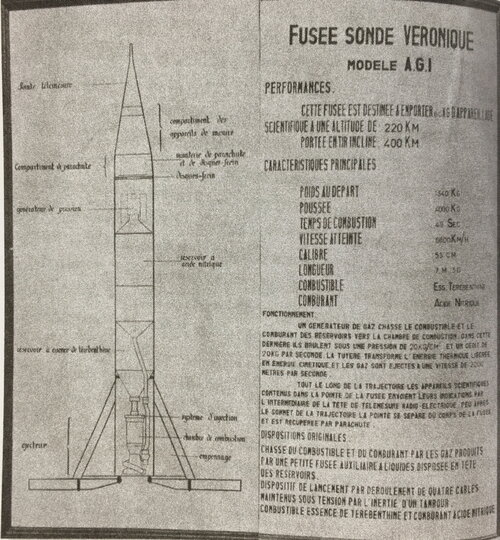
Veronique A.G.I. diagram, shown on 1959 Paris/Bourget Air show.
Such sounding rockets carried the first rat and cat in space.
Sounding Rocket Veronique AGI,
Performances: This rocket can carry 60kg to220 km altitude, with a ground range of 440km
Characteristics:
GLOW: 1,340kg
Thrust: 4,000 kgf
Burn time: 49s
Maximum speed: 6,800 kph
Diameter: 55cm
Length 7.30m
Fuel: Turpentine oil
Oxydizer: Nitric Acid
A gas generator expels the fuel and the oxidant from the tanks to the combustion chamber, in the latter they burn under a pressure of 20kg/cm² and a flow rate of 20kg per second, the nozzle transforms the released thermal energy into kinetic energy and the gases are ejected at a speed of 2000 meters per second
All along the trajectory the scientific devices contained in the tip of the rocket send their indications through the radio-electric telemetry head shortly after the top of the trajectory the tip separates from the body of the rocket and is recovered by parachute
Original Provisions:
Fuel and oxidant flushing by gases produced by a small auxiliary liquid rocket placed at the head of the tanks.
Launching device by unwinding four cables kept under tension by the inertia of a drum
Turpentine fuel and nitric acid oxidant
Diagram text, clockwise from tip:
Measurement instruments bay
Parachute and Drum brake timer
Drum brake
Nitric Acid tank
Injection system
Combustion Chamber
Stabilizer
Ejector
Turpentine oil tank
Gas/Pressure generator
Parachute bay
Telemetry tube.
Performances: This rocket can carry 60kg to220 km altitude, with a ground range of 440km
Characteristics:
GLOW: 1,340kg
Thrust: 4,000 kgf
Burn time: 49s
Maximum speed: 6,800 kph
Diameter: 55cm
Length 7.30m
Fuel: Turpentine oil
Oxydizer: Nitric Acid
A gas generator expels the fuel and the oxidant from the tanks to the combustion chamber, in the latter they burn under a pressure of 20kg/cm² and a flow rate of 20kg per second, the nozzle transforms the released thermal energy into kinetic energy and the gases are ejected at a speed of 2000 meters per second
All along the trajectory the scientific devices contained in the tip of the rocket send their indications through the radio-electric telemetry head shortly after the top of the trajectory the tip separates from the body of the rocket and is recovered by parachute
Original Provisions:
Fuel and oxidant flushing by gases produced by a small auxiliary liquid rocket placed at the head of the tanks.
Launching device by unwinding four cables kept under tension by the inertia of a drum
Turpentine fuel and nitric acid oxidant
Diagram text, clockwise from tip:
Measurement instruments bay
Parachute and Drum brake timer
Drum brake
Nitric Acid tank
Injection system
Combustion Chamber
Stabilizer
Ejector
Turpentine oil tank
Gas/Pressure generator
Parachute bay
Telemetry tube.
A report on Véronique dating from 1957.Veronique A.G.I. diagram, shown on 1959 Paris/Bourget Air show.
Such sounding rockets carried the first rat and cat in space.
Sounding Rocket Veronique AGI,
Performances: This rocket can carry 60kg to220 km altitude, with a ground range of 440km
Characteristics:
GLOW: 1,340kg
Thrust: 4,000 kgf
Burn time: 49s
Maximum speed: 6,800 kph
Diameter: 55cm
Length 7.30m
Fuel: Turpentine oil
Oxydizer: Nitric Acid
A gas generator expels the fuel and the oxidant from the tanks to the combustion chamber, in the latter they burn under a pressure of 20kg/cm² and a flow rate of 20kg per second, the nozzle transforms the released thermal energy into kinetic energy and the gases are ejected at a speed of 2000 meters per second
All along the trajectory the scientific devices contained in the tip of the rocket send their indications through the radio-electric telemetry head shortly after the top of the trajectory the tip separates from the body of the rocket and is recovered by parachute
Original Provisions:
Fuel and oxidant flushing by gases produced by a small auxiliary liquid rocket placed at the head of the tanks.
Launching device by unwinding four cables kept under tension by the inertia of a drum
Turpentine fuel and nitric acid oxidant
Diagram text, clockwise from tip:
Measurement instruments bay
Parachute and Drum brake timer
Drum brake
Nitric Acid tank
Injection system
Combustion Chamber
Stabilizer
Ejector
Turpentine oil tank
Gas/Pressure generator
Parachute bay
Telemetry tube.
Attachments
View attachment 742981
Veronique A.G.I. diagram, shown on 1959 Paris/Bourget Air show.
Such sounding rockets carried the first rat and cat in space.
Sounding Rocket Veronique AGI,
Performances: This rocket can carry 60kg to220 km altitude, with a ground range of 440km
Characteristics:
GLOW: 1,340kg
Thrust: 4,000 kgf
Burn time: 49s
Maximum speed: 6,800 kph
Diameter: 55cm
Length 7.30m
Fuel: Turpentine oil
Oxydizer: Nitric Acid
A gas generator expels the fuel and the oxidant from the tanks to the combustion chamber, in the latter they burn under a pressure of 20kg/cm² and a flow rate of 20kg per second, the nozzle transforms the released thermal energy into kinetic energy and the gases are ejected at a speed of 2000 meters per second
All along the trajectory the scientific devices contained in the tip of the rocket send their indications through the radio-electric telemetry head shortly after the top of the trajectory the tip separates from the body of the rocket and is recovered by parachute
Original Provisions:
Fuel and oxidant flushing by gases produced by a small auxiliary liquid rocket placed at the head of the tanks.
Launching device by unwinding four cables kept under tension by the inertia of a drum
Turpentine fuel and nitric acid oxidant
Diagram text, clockwise from tip:
Measurement instruments bay
Parachute and Drum brake timer
Drum brake
Nitric Acid tank
Injection system
Combustion Chamber
Stabilizer
Ejector
Turpentine oil tank
Gas/Pressure generator
Parachute bay
Telemetry tube.
No coyote? TV must have lied to me as a child

Randy
TheKutKu
ACCESS: Top Secret
- Joined
- 13 February 2023
- Messages
- 555
- Reaction score
- 1,854
From Espace & Temps #46 April 2026 https://institut-francais-histoire-espace.org/espace_et_temps/
The Diamant launch vehicle was an extension of the SEREB (Society for the Study and Development of Ballistic Missiles) test vehicle program, designed to develop the future ballistic missiles of the French nuclear deterrent force. Once these missiles became available, and even before, the use of certain stages intended for their propulsion was considered either to improve Diamant's performance or to create entirely different space launch vehicles. For ease of reading, the characteristics of these boosters, all measuring 1500 mm in diameter, are provided in the appendix.
The misfortunes of Emeraude and Diamant P10
The first three tests of Émeraude, the future liquid first stage of Diamant, were failures. While the first (June 1964) was due to a guidance problem, the next two (June and October 1964) involved propulsion issues. The use of the first stage of the future strategic missiles (P10, so called because it carried 10 tons of solid propellant) could have served as a backup solution if these problems could not be resolved quickly. But the last two Émeraude flights (February and May 1965) were successes, and during the 15 Saphir flights (between July 1965 and January 1967) and the 4 Diamant-A flights (between November 1965 and February 1967), Émeraude performed flawlessly.
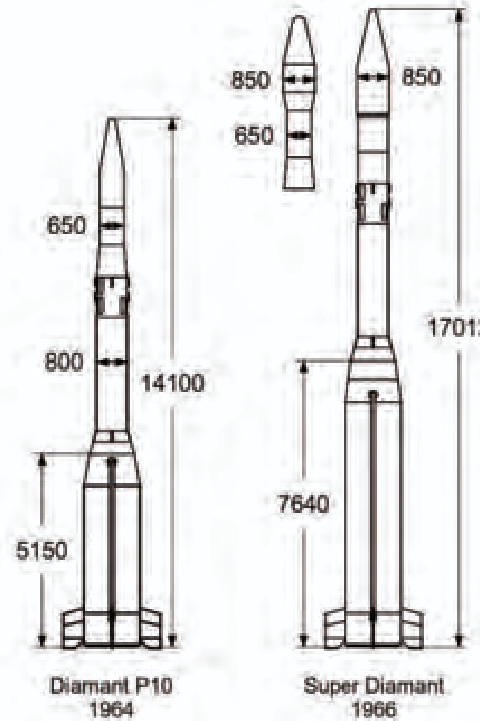
Using the P10 in place of Émeraude would have made it possible to gain 10 to 15 kg in payload mass. Moreover, the Diamant P10 project, as envisioned in 1966, planned to replace Diamant's third stage, the P0.6 (650 mm in diameter), with a new P0.9 stage (800 mm in diameter, matching the diameter of the Topaze second stage), carrying 850 kg of propellant instead of 640, which would yield an additional gain of 15 kg. The total payload mass (eastward launch, typical orbit of 400/1,300 km) could have reached or even exceeded 100 kg

The successor to Diamant-A: Super Diamant
"Established on January 1, 1966, the CNES Launch Vehicles Division was responsible for the development of national launchers and for managing contracts placed in France for the construction of the Coralie second stage of the European ELDO/Europa launch vehicle.
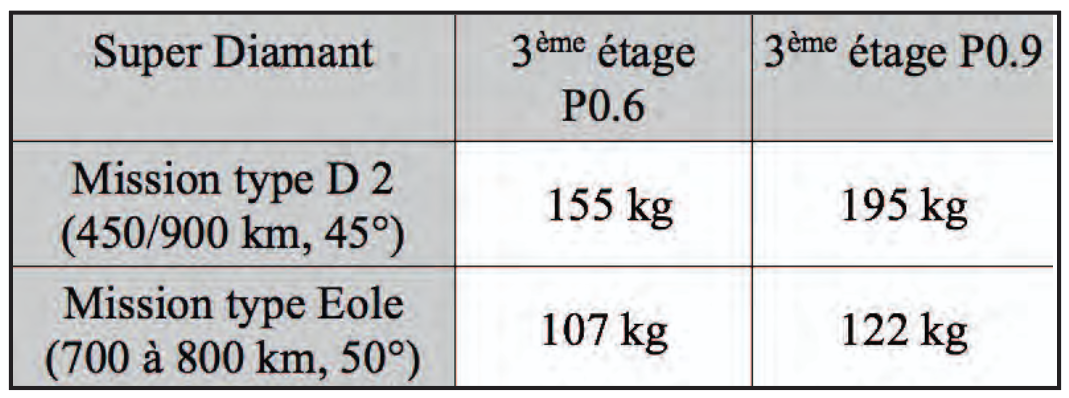
The successor to the Diamant launcher was initially envisioned as an improvement of the original vehicle, particularly regarding the first stage. SEREB proposed the P16, a new first stage for the SSBS missile replacing the initially planned P10, while LRBA proposed the L17 Améthyste, an elongated version of Émeraude using the same propellants as Coralie (nitrogen tetroxide and UDMH). SEREB's project, named Super Diamant, came in two versions. The first, which retained the original Diamant's P0.6 third stage, was equipped with a bulbous nose fairing (850 mm maximum diameter) to accommodate the D2 satellite (approximately 750 mm). The second used the 800 mm diameter P0.9 third stage already considered for the Diamant P10, along with a slightly wider fairing. The estimated performance for these two versions was as follows:

In May 1967, CNES selected the Diamant type L17, which became Diamant B, retaining the two upper stages of its predecessor.
At the same time, the Europa launcher was also to be improved with the addition of a PAS (Perigee-Apogee System) intended to enable it to reach geostationary orbit. To test the PAS in flight, ELDO decided in April 1967 to use the VEMPA (Véhicule d’Essai des Moteurs de Périgée et d’Apogée, Perigee and Apogee Motor Test Vehicle) proposed by CNES, consisting of an L17 and an inert Topaze stage.
The new launcher was then ordered in six units: 2 for CNES and 4 for ELDO. However, it then seemed advisable to retain the PAS perigee stage (P0.7, 688 kg of propellant, 800 mm diameter) as the upper stage of Diamant-B. The decision was made in July 1968. This both increased the launcher's performance and simplified the fairing. After the abandonment of VEMPA at the end of 1968, the five Diamant B vehicles built were launched on behalf of CNES (between March 1970 and May 1972)."
The geostationary orbit
"Great Britain's questioning of the viability of the Europa program was expressed as early as February 1966, and then confirmed by a note sent to the six ELDO members in June. Although the continuation of the program was decided at the interministerial conference of July 8, the concern generated by British hesitation led to the initiation of work on national solutions for reaching geostationary orbit. Thus, in June 1966, two studies were underway:

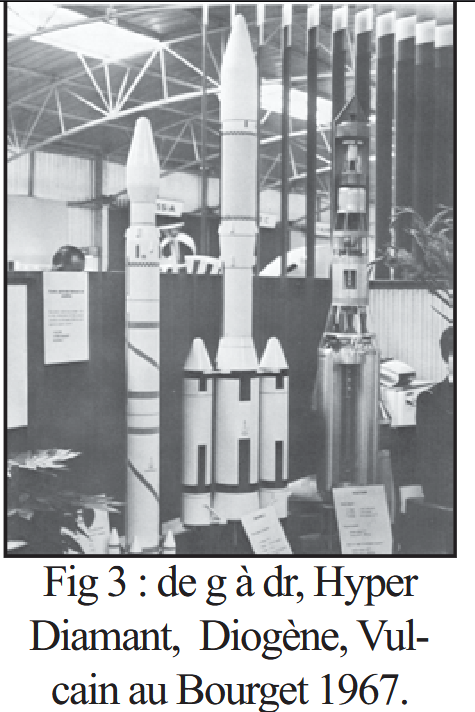
A new version of Hyper Diamant was revealed in 1967 and presented at the Le Bourget air show (fig. 3). In this version, the first two stages (P16 and P10) are retained, but the third stage is replaced by the P4 from the MSBS M1 missile. The fourth stage is a new P1.5 motor from Sud Aviation, measuring 1100 mm in diameter. It also features four small boosters, each loaded with 300 kg of propellant, and a bulbous fairing to house the payload, which can reach 75 kg in geostationary orbit."

The Turquoise series
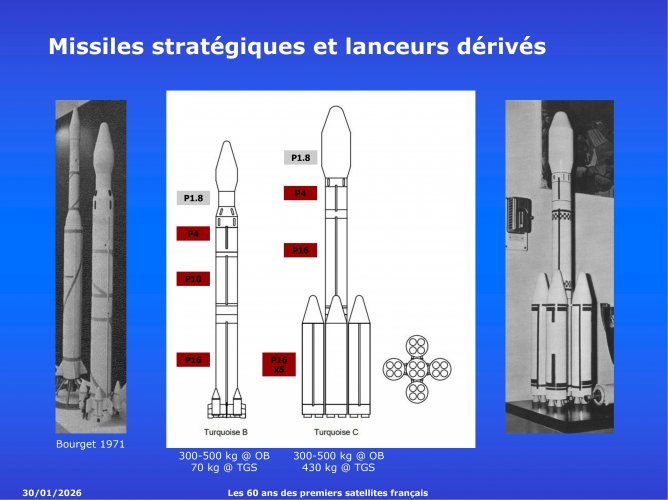
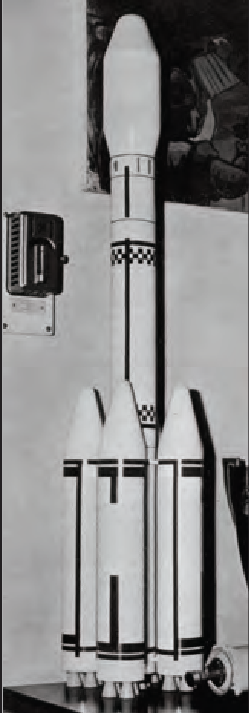
"The 1967 version of Hyper Diamant no longer had any elements in common with the original Diamant. In 1968, this launcher took the name Turquoise B; the only modification being the upgrade of the upper stage from P1.5 to P1.8. A mockup of Turquoise B was presented at the Le Bourget air show in 1971 (fig. 5). In the same series, Turquoise A was a P16-P4-P1.8 configuration. The announced low-Earth orbit performance for these launchers ranged from 170 to 280 kg for Turquoise A and 310 to 500 kg for Turquoise B.
For geostationary orbit, SEREB proposed a much more powerful launcher designated Turquoise C (fig. 6). Its first stage consisted of an assembly of 5 P16 motors, and the upper stages were identical to Turquoise A (P16-P4-P1.8). The fourth stage P1.8 was placed inside a 2-meter diameter fairing. The performance of Turquoise C on a transfer orbit from Kourou is given as 430 kg, i.e., 220 kg for the satellite's useful mass after positioning.

This launcher had room for improvement. By replacing the P4 stage:

Fig 5: Turquoise B between Diamant B and Obélix Launcher at Le Bourget 1971.

Turquoise C
Launchers for military applications
"In 1973, Aerospatiale proposed a space launcher intended for military applications, i.e., capable of launching communication, observation, and radar interception satellites. The main objective of this study was to show that a low-cost solution could be found without compromising the prospects for civilian launch vehicle programs, particularly the L3S, the future Ariane. With this in mind, the launcher designated LS 433 was composed of available, operational, and flight-proven elements.
Like the Hyper Diamant vehicles, the LS 433 used the two motors of the SSBS S2 missile (P16 and P10) as its first stages. These were topped by a P6, the second stage of the MSBS M2 and SSBS S3 missiles, and a P0.7, the third stage of Diamant B and BP4. Only the bulbous fairing (1600 mm diameter for low-Earth missions or 1100 mm for geostationary missions) and the connecting skirt needed to be developed. The launcher could be launched indifferently from the CEL at Biscarrosse or the CSG in Kourou.
In its nominal version, the LS 433 type A could place 400 kg into low Earth orbit or 68 kg into geostationary transfer orbit. These performance figures were roughly double those of the Diamant BP4 launcher used at the time.
Among the possible evolutions, the following were planned:
Aerospatiale planned a three-year development, followed by two test launches and operational entry into service in 1979.
Applications of a liquid first stage
The preceding examples concern space launch vehicle projects using strategic missile boosters for the first stage, and possibly for the upper stages as well. There are also cases where the use of this type of booster was proposed on a launcher with a liquid first stage from LRBA.
Vulcain
"In 1966, LRBA also proposed an alternative solution for reaching geostationary orbit in the event of the abandonment of the British Blue Streak. It was based on the use of a cluster of four Améthyste-type tanks, two of these tanks containing the oxidizer (N₂O₄) and the other two the fuel (UDMH). The assembly, designated Catherine or D4, featured four Valois-type engines. Three versions were studied:

In this table, the payload masses for geostationary orbit include the mass of the apogee motor casing, i.e., 23 kg for Vulcain C and 17 kg for Vulcain P."
Obelix
"Shortly before its merger with SEP, LRBA proposed a space launcher with performance superior to that of Diamant B, of which only two examples remained to be launched, and comparable to that of the American Delta launcher. The first stage, L33, with a diameter of 2 m (like Coralie), was to use a Viking engine (nitrogen tetroxide and UDMH), still under development, delivering a thrust of 60 t at sea level. The second stage was the P6 RITA 2 from the MSBS M2 missile, and the third stage was the P1.8, already proposed for the Turquoise series. Obélix was to be capable of placing payloads of 750 kg into equatorial orbit at 200 km altitude, 450 kg into polar orbit at 400 km, or 120 kg into geostationary orbit."
Diamant BP4
"As the end of Diamant B's career approached, CNES hoped to be able to build a successor through European cooperation. The first proposal was made to Germany, which would build a new equipment bay and the ground control system for a Diamant B/C ("C" for cooperation), with the propulsion stages being supplied by France. A second proposal was then made to Great Britain with a Black Diamant, which reused the Améthyste first stage topped by the second stage of the Black Arrow. The third stage could be either that of Diamant-B or that of Black Arrow. Neither proposal having been accepted, it was an all-French Diamant that would be built, but with production limited to three units. This Diamant BP4 reused the L17 Améthyste as the first stage and the P0.7 from Diamant B as the third stage. The modifications mainly concerned the second stage, the P4 RITA 1 from the MSBS M1 missile, and the Black Arrow fairing, a relic of the Black Diamant project. Diamant BP4 was launched three times in 1975."
Conclusion
"Although proposals for the use of French strategic missile motors as space launch vehicle stages were numerous and varied, they never materialized—with the exception of the three RITA motors of the Diamant BP4.
Appendix: Characteristics of the first-generation French strategic missile boosters:"


"Note 1: In 1966, SEREB's Super Diamant was to include a Sud Aviation P0.9 third stage of 800 mm diameter, loaded with 850 kg of propellant. This stage was to be retained for the 1966 version of the Hyper-Diamant project. In fact, the only Sud Aviation stage of 800 mm diameter ever built was the P0.7 of Diamant B/BP4 and PAS.
Note 2: In 1967, SEREB's Hyper Diamant was to include a P1.5 third stage of 1100 mm diameter. The following year, the stage became a P1.8 on the Turquoise series. The Turquoise P1.8 weighed 1,967 kg in total and burned for 56 seconds. The P1.8 was also the third stage of Obélix, and was to develop a thrust of 9 t. This 1100 mm diameter was later adopted for the 403 booster of the M4 missile's third stage; the casing was no longer made of fiberglass but of wound Kevlar fiber, and the propellant was no longer Isolane but Butalane.
Note:
1- Founded on September 17, 1959, SEREB brought together the major companies and organizations of the aeronautical industry. The shareholders were: Nord Aviation, Sud Aviation, SNECMA, SEPR, Dassault, MATRA, ONERA, and the Service des Poudres. LRBA, which was responsible for manufacturing the only liquid stage of the VE series, was not a part of it.
2- Air et Cosmos No. 136, January 22, 1966
3- The performance of the solid propellants available at the time (Isolane) proved insufficient to achieve the required range, which led SEREB to increase the propellant mass of the SSBS first stage.
4- Air et Cosmos No. 177, December 10, 1966
5- The two stages of the PAS were an 800 mm diameter perigee stage built by Sud Aviation and an Italian 400 mm apogee stage integrated into the payload.
6- The two 650 mm diameter P0.6 stages already built would be reassigned as upper stages for ONERA's two Tibère sounding rockets.
7- Aviation Magazine No. 439, March 15, 1966
8- "Consequences of the British attitude toward CECLES," French Diplomatic Documents, Note 133/QS, June 4, 1966
9- The Diogène project included, in addition to strategic missile motors, a large SNECMA solid booster P40 and a SEPR cryogenic H3.5 stage."
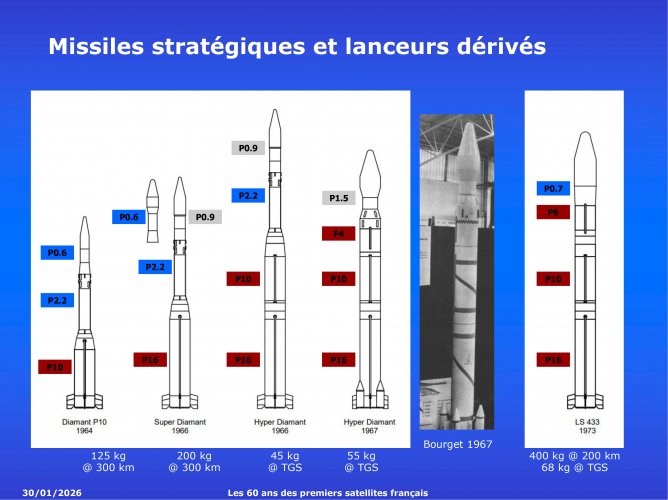
Additional slides from Histoire des fusées françaises à ergols solides par Jean-Jacques SERRA (PhD, ancien de la DGA, senior AAAF, membre IFHE), January 30, 2026
https://institut-francais-histoire-...miers-satellites-francais-le-30-janvier-2026/

The Diamant launch vehicle was an extension of the SEREB (Society for the Study and Development of Ballistic Missiles) test vehicle program, designed to develop the future ballistic missiles of the French nuclear deterrent force. Once these missiles became available, and even before, the use of certain stages intended for their propulsion was considered either to improve Diamant's performance or to create entirely different space launch vehicles. For ease of reading, the characteristics of these boosters, all measuring 1500 mm in diameter, are provided in the appendix.
The misfortunes of Emeraude and Diamant P10
The first three tests of Émeraude, the future liquid first stage of Diamant, were failures. While the first (June 1964) was due to a guidance problem, the next two (June and October 1964) involved propulsion issues. The use of the first stage of the future strategic missiles (P10, so called because it carried 10 tons of solid propellant) could have served as a backup solution if these problems could not be resolved quickly. But the last two Émeraude flights (February and May 1965) were successes, and during the 15 Saphir flights (between July 1965 and January 1967) and the 4 Diamant-A flights (between November 1965 and February 1967), Émeraude performed flawlessly.
Using the P10 in place of Émeraude would have made it possible to gain 10 to 15 kg in payload mass. Moreover, the Diamant P10 project, as envisioned in 1966, planned to replace Diamant's third stage, the P0.6 (650 mm in diameter), with a new P0.9 stage (800 mm in diameter, matching the diameter of the Topaze second stage), carrying 850 kg of propellant instead of 640, which would yield an additional gain of 15 kg. The total payload mass (eastward launch, typical orbit of 400/1,300 km) could have reached or even exceeded 100 kg
The successor to Diamant-A: Super Diamant
"Established on January 1, 1966, the CNES Launch Vehicles Division was responsible for the development of national launchers and for managing contracts placed in France for the construction of the Coralie second stage of the European ELDO/Europa launch vehicle.
The successor to the Diamant launcher was initially envisioned as an improvement of the original vehicle, particularly regarding the first stage. SEREB proposed the P16, a new first stage for the SSBS missile replacing the initially planned P10, while LRBA proposed the L17 Améthyste, an elongated version of Émeraude using the same propellants as Coralie (nitrogen tetroxide and UDMH). SEREB's project, named Super Diamant, came in two versions. The first, which retained the original Diamant's P0.6 third stage, was equipped with a bulbous nose fairing (850 mm maximum diameter) to accommodate the D2 satellite (approximately 750 mm). The second used the 800 mm diameter P0.9 third stage already considered for the Diamant P10, along with a slightly wider fairing. The estimated performance for these two versions was as follows:
In May 1967, CNES selected the Diamant type L17, which became Diamant B, retaining the two upper stages of its predecessor.
At the same time, the Europa launcher was also to be improved with the addition of a PAS (Perigee-Apogee System) intended to enable it to reach geostationary orbit. To test the PAS in flight, ELDO decided in April 1967 to use the VEMPA (Véhicule d’Essai des Moteurs de Périgée et d’Apogée, Perigee and Apogee Motor Test Vehicle) proposed by CNES, consisting of an L17 and an inert Topaze stage.
The new launcher was then ordered in six units: 2 for CNES and 4 for ELDO. However, it then seemed advisable to retain the PAS perigee stage (P0.7, 688 kg of propellant, 800 mm diameter) as the upper stage of Diamant-B. The decision was made in July 1968. This both increased the launcher's performance and simplified the fairing. After the abandonment of VEMPA at the end of 1968, the five Diamant B vehicles built were launched on behalf of CNES (between March 1970 and May 1972)."
The geostationary orbit
"Great Britain's questioning of the viability of the Europa program was expressed as early as February 1966, and then confirmed by a note sent to the six ELDO members in June. Although the continuation of the program was decided at the interministerial conference of July 8, the concern generated by British hesitation led to the initiation of work on national solutions for reaching geostationary orbit. Thus, in June 1966, two studies were underway:
- Hyper Diamant, with a capacity of 45 kg by 1970;
- Diogène, with a capacity of 150 kg by 1973.
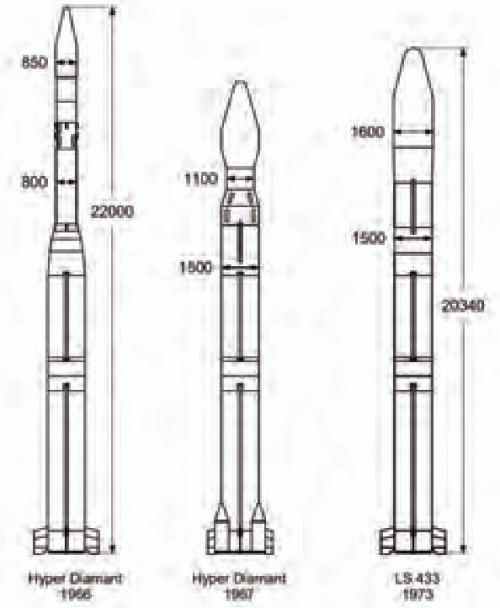
A new version of Hyper Diamant was revealed in 1967 and presented at the Le Bourget air show (fig. 3). In this version, the first two stages (P16 and P10) are retained, but the third stage is replaced by the P4 from the MSBS M1 missile. The fourth stage is a new P1.5 motor from Sud Aviation, measuring 1100 mm in diameter. It also features four small boosters, each loaded with 300 kg of propellant, and a bulbous fairing to house the payload, which can reach 75 kg in geostationary orbit."
The Turquoise series
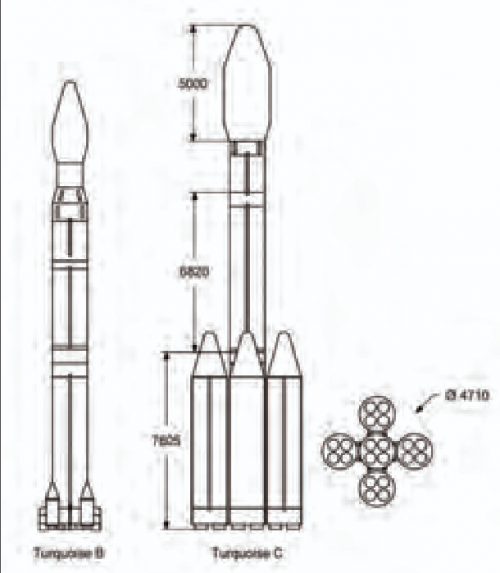
"The 1967 version of Hyper Diamant no longer had any elements in common with the original Diamant. In 1968, this launcher took the name Turquoise B; the only modification being the upgrade of the upper stage from P1.5 to P1.8. A mockup of Turquoise B was presented at the Le Bourget air show in 1971 (fig. 5). In the same series, Turquoise A was a P16-P4-P1.8 configuration. The announced low-Earth orbit performance for these launchers ranged from 170 to 280 kg for Turquoise A and 310 to 500 kg for Turquoise B.
For geostationary orbit, SEREB proposed a much more powerful launcher designated Turquoise C (fig. 6). Its first stage consisted of an assembly of 5 P16 motors, and the upper stages were identical to Turquoise A (P16-P4-P1.8). The fourth stage P1.8 was placed inside a 2-meter diameter fairing. The performance of Turquoise C on a transfer orbit from Kourou is given as 430 kg, i.e., 220 kg for the satellite's useful mass after positioning.
This launcher had room for improvement. By replacing the P4 stage:
- with a P6 booster (from the MSBS M2 missile), the payload mass in geostationary orbit increases by about 20 kg;
- with a cryogenic H6 stage of 2.25 m diameter (4 motors of 15 kN each), the satellite's useful mass after positioning reaches 350 to 400 kg.
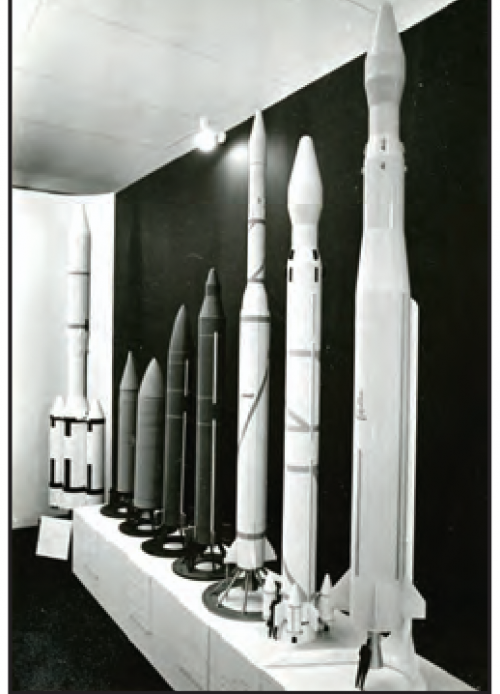
Fig 5: Turquoise B between Diamant B and Obélix Launcher at Le Bourget 1971.
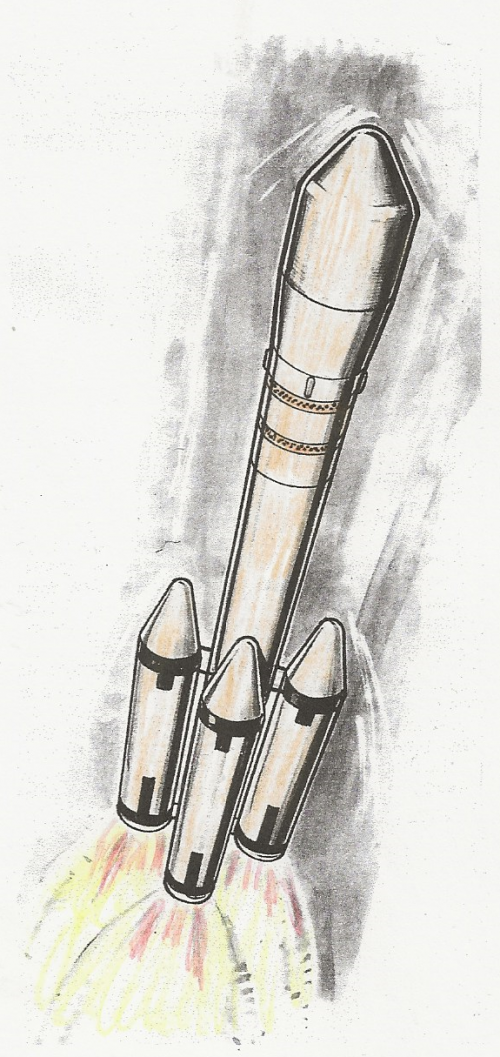
Turquoise C
Launchers for military applications
"In 1973, Aerospatiale proposed a space launcher intended for military applications, i.e., capable of launching communication, observation, and radar interception satellites. The main objective of this study was to show that a low-cost solution could be found without compromising the prospects for civilian launch vehicle programs, particularly the L3S, the future Ariane. With this in mind, the launcher designated LS 433 was composed of available, operational, and flight-proven elements.
Like the Hyper Diamant vehicles, the LS 433 used the two motors of the SSBS S2 missile (P16 and P10) as its first stages. These were topped by a P6, the second stage of the MSBS M2 and SSBS S3 missiles, and a P0.7, the third stage of Diamant B and BP4. Only the bulbous fairing (1600 mm diameter for low-Earth missions or 1100 mm for geostationary missions) and the connecting skirt needed to be developed. The launcher could be launched indifferently from the CEL at Biscarrosse or the CSG in Kourou.
In its nominal version, the LS 433 type A could place 400 kg into low Earth orbit or 68 kg into geostationary transfer orbit. These performance figures were roughly double those of the Diamant BP4 launcher used at the time.
Among the possible evolutions, the following were planned:
- a version B with four Styx solid boosters (motor of the Pluton missile);
- a version C by replacing the final P0.7 stage with a P2 to be developed.
Aerospatiale planned a three-year development, followed by two test launches and operational entry into service in 1979.
Applications of a liquid first stage
The preceding examples concern space launch vehicle projects using strategic missile boosters for the first stage, and possibly for the upper stages as well. There are also cases where the use of this type of booster was proposed on a launcher with a liquid first stage from LRBA.
Vulcain
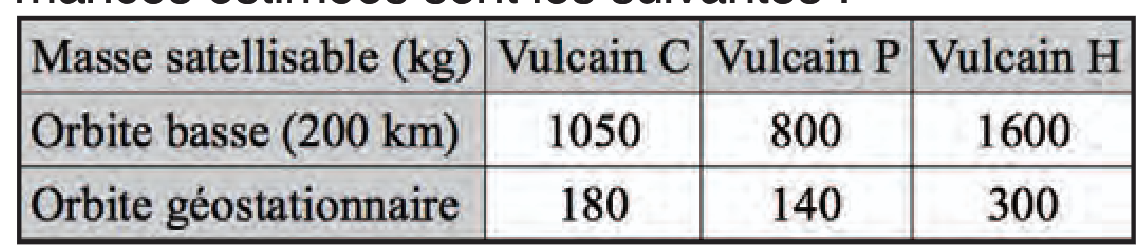
"In 1966, LRBA also proposed an alternative solution for reaching geostationary orbit in the event of the abandonment of the British Blue Streak. It was based on the use of a cluster of four Améthyste-type tanks, two of these tanks containing the oxidizer (N₂O₄) and the other two the fuel (UDMH). The assembly, designated Catherine or D4, featured four Valois-type engines. Three versions were studied:
- Vulcain C, with the upper stages being an elongated Coralie (LRBA) and P4;
- Vulcain P, with P16 and P4;
- Vulcain H, with P16 and the SEPR cryogenic H3.5 stage.
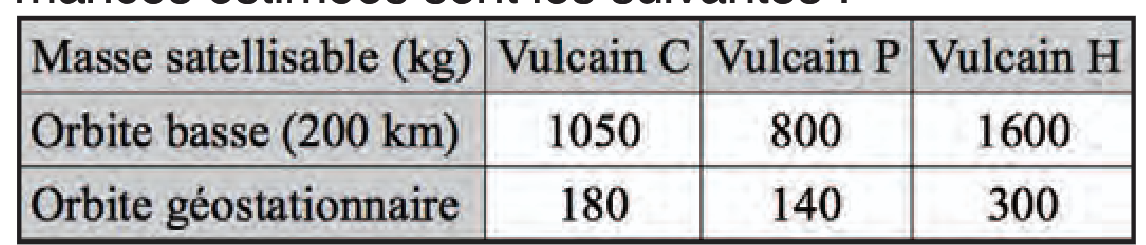
In this table, the payload masses for geostationary orbit include the mass of the apogee motor casing, i.e., 23 kg for Vulcain C and 17 kg for Vulcain P."
Obelix
"Shortly before its merger with SEP, LRBA proposed a space launcher with performance superior to that of Diamant B, of which only two examples remained to be launched, and comparable to that of the American Delta launcher. The first stage, L33, with a diameter of 2 m (like Coralie), was to use a Viking engine (nitrogen tetroxide and UDMH), still under development, delivering a thrust of 60 t at sea level. The second stage was the P6 RITA 2 from the MSBS M2 missile, and the third stage was the P1.8, already proposed for the Turquoise series. Obélix was to be capable of placing payloads of 750 kg into equatorial orbit at 200 km altitude, 450 kg into polar orbit at 400 km, or 120 kg into geostationary orbit."
Diamant BP4
"As the end of Diamant B's career approached, CNES hoped to be able to build a successor through European cooperation. The first proposal was made to Germany, which would build a new equipment bay and the ground control system for a Diamant B/C ("C" for cooperation), with the propulsion stages being supplied by France. A second proposal was then made to Great Britain with a Black Diamant, which reused the Améthyste first stage topped by the second stage of the Black Arrow. The third stage could be either that of Diamant-B or that of Black Arrow. Neither proposal having been accepted, it was an all-French Diamant that would be built, but with production limited to three units. This Diamant BP4 reused the L17 Améthyste as the first stage and the P0.7 from Diamant B as the third stage. The modifications mainly concerned the second stage, the P4 RITA 1 from the MSBS M1 missile, and the Black Arrow fairing, a relic of the Black Diamant project. Diamant BP4 was launched three times in 1975."
Conclusion
"Although proposals for the use of French strategic missile motors as space launch vehicle stages were numerous and varied, they never materialized—with the exception of the three RITA motors of the Diamant BP4.
Appendix: Characteristics of the first-generation French strategic missile boosters:"
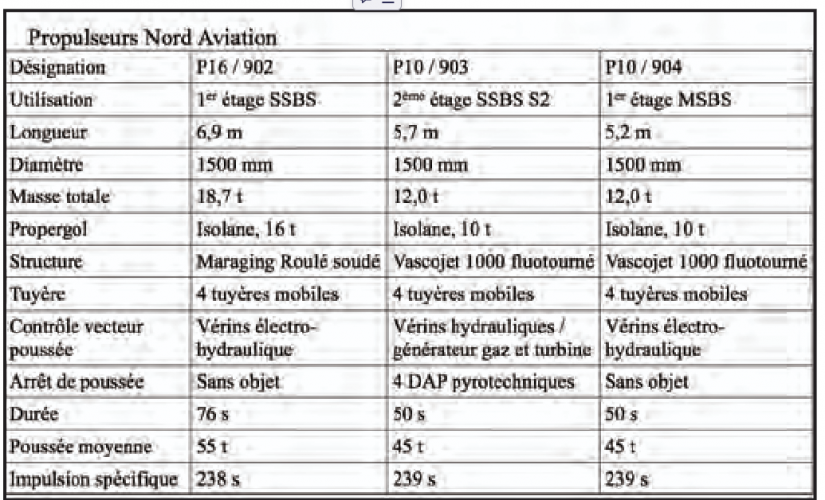
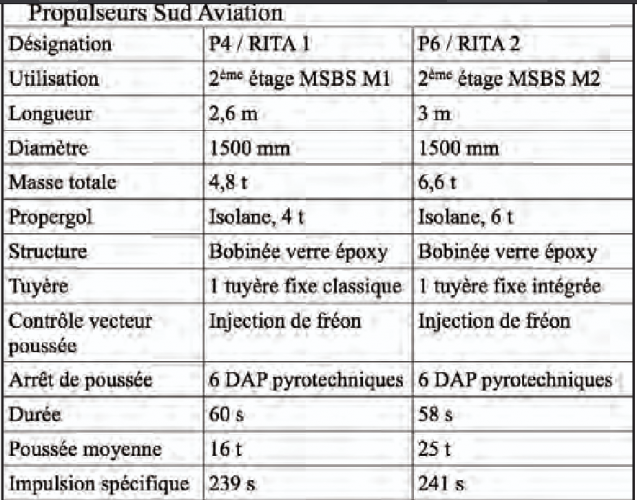
"Note 1: In 1966, SEREB's Super Diamant was to include a Sud Aviation P0.9 third stage of 800 mm diameter, loaded with 850 kg of propellant. This stage was to be retained for the 1966 version of the Hyper-Diamant project. In fact, the only Sud Aviation stage of 800 mm diameter ever built was the P0.7 of Diamant B/BP4 and PAS.
Note 2: In 1967, SEREB's Hyper Diamant was to include a P1.5 third stage of 1100 mm diameter. The following year, the stage became a P1.8 on the Turquoise series. The Turquoise P1.8 weighed 1,967 kg in total and burned for 56 seconds. The P1.8 was also the third stage of Obélix, and was to develop a thrust of 9 t. This 1100 mm diameter was later adopted for the 403 booster of the M4 missile's third stage; the casing was no longer made of fiberglass but of wound Kevlar fiber, and the propellant was no longer Isolane but Butalane.
Note:
1- Founded on September 17, 1959, SEREB brought together the major companies and organizations of the aeronautical industry. The shareholders were: Nord Aviation, Sud Aviation, SNECMA, SEPR, Dassault, MATRA, ONERA, and the Service des Poudres. LRBA, which was responsible for manufacturing the only liquid stage of the VE series, was not a part of it.
2- Air et Cosmos No. 136, January 22, 1966
3- The performance of the solid propellants available at the time (Isolane) proved insufficient to achieve the required range, which led SEREB to increase the propellant mass of the SSBS first stage.
4- Air et Cosmos No. 177, December 10, 1966
5- The two stages of the PAS were an 800 mm diameter perigee stage built by Sud Aviation and an Italian 400 mm apogee stage integrated into the payload.
6- The two 650 mm diameter P0.6 stages already built would be reassigned as upper stages for ONERA's two Tibère sounding rockets.
7- Aviation Magazine No. 439, March 15, 1966
8- "Consequences of the British attitude toward CECLES," French Diplomatic Documents, Note 133/QS, June 4, 1966
9- The Diogène project included, in addition to strategic missile motors, a large SNECMA solid booster P40 and a SEPR cryogenic H3.5 stage."
Additional slides from Histoire des fusées françaises à ergols solides par Jean-Jacques SERRA (PhD, ancien de la DGA, senior AAAF, membre IFHE), January 30, 2026
https://institut-francais-histoire-...miers-satellites-francais-le-30-janvier-2026/
Attachments
Thank you for translating my paper.From Espace & Temps #46 April 2026 https://institut-francais-histoire-espace.org/espace_et_temps/
Similar threads
-

-

-
 France unbuilt space launchers of the 60's and 70's
- Started by bgire
- Replies: 64
-

-