interesting but how far off were they from fitting larger engines to the real E?
Significantly.interesting but how far off were they from fitting larger engines to the real E?
I don't think it was ever even a consideration. The F414 was the larger engine over the F404. (Yes, I know they're roughly the same size, but it was the upgrade.)interesting but how far off were they from fitting larger engines to the real E?
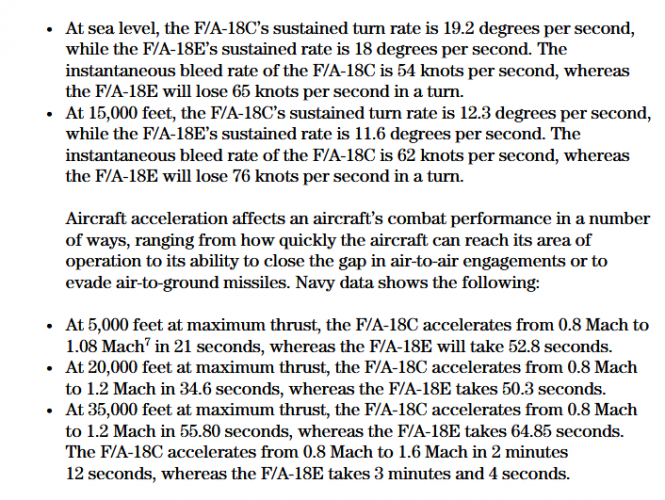
nope apparently part of the manual so the lethargy is realAre those figures about the F/A-18E performance compared to the F/A-18C accurate? I believe some early Super Hornet prototypes were flown with F404 engines installed because the F414 wasn't ready and the performance characteristics were downright awful as one might expect.
Never happened.I believe some early Super Hornet prototypes were flown with F404 engines installed because the F414 wasn't ready and the performance characteristics were downright awful as one might expect.
The 1993 Bottom-Up Review decided the Super Hornet was the low-risk, and cheaper, approach in comparison to the A/F-X. That decision is still not wrong.In hindsight the Super Hornet probably wouldn't have been purchased. The funds could have gone towards A/F-X and Classic Hornets could have been purchased as a cheap interim solution. The Classic Hornet could have received an AESA radar and it would have performed nicely.
An easy solution to the Hornets lack of range would have been to make a tanker version of the E-2 Hawkeye frame. The E-2 was in production. Without the radar and systems it could have carried 12 ton of fuel and being a turboprop it would have very high endurance/loiter.
The Super Hornet had not flown yet and that review was based on optimistic performance numbers of the Super Hornet. If the real Super Hornet figures were provided during that review I highly doubt it would not have been selected.The 1993 Bottom-Up Review decided the Super Hornet was the low-risk, and cheaper, approach in comparison to the A/F-X. That decision is still not wrong.
Yes lots of options with the A-6 and S-3 tankers. they would both have similar fuel capacity to an E-2 based tanker.If you want a carrier-capable tanker in that timeframe, the KA-6H would be in the ballpark considering it was a relatively simple conversion of the flight-tested A-6F Intruder II, it was F404 powered, and the Intruder line had only been shuttered in 1992. The S-3s were also seeing heavy use as buddy-tankers at that time and a KS-3A tanker version had been flown in the early '80s with a load of 16,600l. A tanker version of the US-3As would presumably also have been possible
No, those canted pylons were a result of a bad computer model.However also in hindsight the Super Hornet would not have received canted pylons and the performance numbers wouldn't have been as bad.
Surprisingly reviews are done on the numbers and needs that exist at the time. And the really significant figure going into the BUR wasn't any performance number, it was 'How much is this thing going to cost?'The Super Hornet had not flown yet and that review was based on optimistic performance numbers of the Super Hornet. If the real Super Hornet figures were provided during that review I highly doubt it would not have been selected.
As a nice big here I am? If you need a tanker above the carrier, you need it there for the minimum time possible, not maximum.The E-2 could easily loitor above the carrier for 50% greater durstion than any S-3 or A-6
The E-2 Hawkeye is already flying above the CBG for as long as possible. It is pumping out radar signals saying here I am. Having a tanker version would make no difference.As a nice big here I am? If you need a tanker above the carrier, you need it there for the minimum time possible, not maximum.
The original F-15A weighing in at just under 13 ton empty with that relatively large 56m2 wing had potential for being carrier capable. The landing speed could have been made acceptable with just double slotted flaps like the Su-33.Base it off a modified Eagle with canted rudders. Boeing consolidates the program to some degree while ensuring USAF and USN get their needs met.
Why give away the location of the CVBG when you can offset the AEW station a couple of hundred miles from the carrier, especially if you know the threat axis?The E-2 Hawkeye is already flying above the CBG
The E-2 Hawkeye is already flying above the CBG for as long as possible. It is pumping out radar signals saying here I am. Having a tanker version would make no difference.
If the enemy has a radar system that can detect a recovery tanker loitering 10,000ft above the carrier then they can also detect the fighters flying in and out at 30,000ft. The recovery tanker is then not responsible for giving away the position.Why give away the location of the CVBG when you can offset the AEW station a couple of hundred miles from the carrier, especially if you know the threat axis?
That is nowhere near as simple or as cheap as you think it is.In terms of the Super Hornet using the F110 there was actually a more suitable engine under development. Two of the A/F-X cleansheet designs used an afterburning F412 engine. This is an engine approximately half way between the F414 and F110 in terms of size and performance. The F412 non-afterburning engine was developed for the A-12 subsonic attack aircraft. This was effectively an F404 engine with a 25% larger fan and second low pressure turbine like the F110 to drive that fan. It had a much higher bypass ratio estimated to be between 0.8 to 1:1.
This higher bypass ratio afterburnering F412 could have been fitted to the Super Hornet design if the engine bays were slightly widened in a similar fashion to how the F-4 phantom bays were widened to fit Rolls Royce Spey engines. The higher bypass ratio engines would have massively improved fuel efficiency and would have perfectly matched the slow design. The weight increase from the wider engines would have been more than offset by the lower fuel consumption.
The F414 is ~2,400lb
The F110 is ~3,800lb
I would expect the afterburning F412 to weigh 2,800-3,000lb.
The DOD looked at an F-15N Sea Eagle instead of the Tomcat. Once the Eagle airframe was beefed up and fitted for AWG9 and Phoenix missiles, it wouldn't have been much lighter than a Tomcat.The original F-15A weighing in at just under 13 ton empty with that relatively large 56m2 wing had potential for being carrier capable. The landing speed could have been made acceptable with just double slotted flaps like the Su-33.
The F-15EX with conformals is now over 18 ton empty. It still has that small 56m2 wing and it now lands at incredibly high speed. The F-15E not only lands faster than the F-22 but often lands faster than the F-117. It would have been easier to navalise the fixed wing F-22 compared to the F-15SE.

The original poster was talking about redesigning the Super Hornet to fit the even larger F100/F110 engines. The F412 would have been the engine of choice if MD was willing to move away from the Classic Hornet sized engine bays. The Super Hornet had already enlarged most parts of the aircraft compared to the Classic Hornet.That is nowhere near as simple or as cheap as you think it is.
How much did it cost to redesign the F-4J into the F-4K/M, again? 500mGBP total, 170 aircraft delivered. 200mil more than planned. That's 2.94milGBP per plane, at at time when the exchange rate put a brand new F-4J at 856,000GBP.
But sure, let's redesign the engine bay.
That proves my point. I said only the light single seat F-15A with the lighter APG-63 and sparrow missile combination could have been successfully converted into a carrier aircraft. It is the only F-15 model that is light enough as a starting point to maintain the existing 56m2 wing. It would have been on par to the A-5 Vigilante in terms of landing speed with minimal changes.The DOD looked at an F-15N Sea Eagle instead of the Tomcat. Once the Eagle airframe was beefed up and fitted for AWG9 and Phoenix missiles, it wouldn't have been much lighter than a Tomcat.
Okay, point taken there.The original poster was speculating if a better could could improve the Super Hornet. He concentrated on the poor acceleration but I think the poor fuel burn is a bigger issue in the bomb truck role.
No. Even the single seater would need massive reinforcements compared to the USAF version.That proves my point. I said only the light single seat F-15A with the lighter APG-63 and sparrow missile combination could have been successfully converted into a carrier aircraft. It is the only F-15 model that is light enough as a starting point to maintain the existing 56m2 wing. It would have been on par to the A-5 Vigilante in terms of landing speed with minimal changes.
The F-15 two seat frame with the heavier AWG9 radar would be just like the heavier two seat F-15E in terms of difficulty. Nearly all commonality with the air force variant would be lost with the level of modification required to get an acceptable landing speed. It would need a significantly larger wing to support the heavier weight.
F-15N Sea Eagle did.Why would a Super Hornet need AWG-9?
F-15N Sea Eagle did.
Insidersource was suggesting an F-15NBut I don't think anyone was suggesting an F-15N.
It is F-15SE fyiThe F-15S Silent Eagle.
I'm not sure about that, it only says F/A-18C when the F/A-18A would perform almost identically to early F/A-18Cs and could have also been included in the comparison. I'd hope that whenever that manual was written would be comparing the aircraft to the late production lots with the F404-GE-402 since the US Navy received a respectable number of those.The superior acceleration figures of the Classic Hornet in the first post was most likely using the 17,700lb thrust level. The F404 eventually went up to 19,000lb which would have allowed the Classic Hornet to approach F-16 acceleration levels.
Problem of course being that the navy could have gotten that with the a-7x program for both cheaper (both in not haveing to procure a new plane and haveing the same engine) and better range (for the same payload) all without having to damage the f-14 program the way the f-18 did.The whole point of the Hornet program was consolidation of several previous jet roles. Super Hornet does not need to be better than a Tomcat, just more affordable while replacing other jet roles at a minimum of 80% as well. The promise of the Super Hornet to fill the void of the Tomcat failed miserably with F414s. But with F100/F110 its got the power to haul much more juice. I don't even think the Super Hornet with F1x0 needs the front end of the F-15. What it needs is long legs as a result to focus on fuel fraction. The avionics and weapons of Super Hornet were never its weakness, but range certainly is/was.
I'm not sure if the A-7X would have been suitable. The US Navy had the option of creating a super variant of four different frames. F/A-18, F-14, A-6 and A-7. Picking the F/A-18 Hornet and turning it into the Super Hornet was probably the incorrect choice. The avionics of the Super Hornet could have been fitted to the Classic Hornet. The lack of range of the Hornet could easily have been fixed with minimal tanking.Problem of course being that the navy could have gotten that with the a-7x program for both cheaper (both in not haveing to procure a new plane and haveing the same engine) and better range (for the same payload) all without having to damage the f-14 program the way the f-18 did.
Something tells me the proposed F404-powered A-6F was not an ideal solution in a 1995 timeframe. Seems like they could have found a more efficient motor to use, one less fuel thirsty and with more thrust.
The diameter is far too large for the A-6 engine bays. It would need a complete redesign.A non-afterburning F401 maybe would have been a better candidate. More weight but also way more power and significantly lower fuel burn. Allison TF41 was off the shelf with the same thrust as F401 but an even better SFC. People also forget some of the non-afterburning F100 variants are even better at efficiency.
The US Navy could only afford one jet aircraft development in the 1990's. Corsair, Intruder, Hornet and Tomcat. Which one would you pick to make Super variant?Imagine going to an all-F100 or F110 powered fleet of fighters. Non-afterburning fighters would include E-3F, A-6F, and A-7F. Afterburning fighters would include F-14, F-18 (maybe call it a more distinctive F-24), EA-18G (or EF-24?), and F-16N. Choose one engine family for them all. E-3F? Because the Viking was still useful in 1995 and only retired in 2009.
Yes, major logistical advantages going to all one engine (crud, the USAF and USN were close to that for a while with all the J57 powered birds).Something tells me the proposed F404-powered A-6F was not an ideal solution in a 1995 timeframe. Seems like they could have found a more efficient motor to use, one less fuel thirsty and with more thrust. A non-afterburning F401 maybe would have been a better candidate. More weight but also way more power and significantly lower fuel burn. Allison TF41 was off the shelf with the same thrust as F401 but an even better SFC. People also forget some of the non-afterburning F100 variants are even better at efficiency.
Imagine going to an all-F100 or F110 powered fleet of fighters. Non-afterburning fighters would include E-3F, A-6F, and A-7F. Afterburning fighters would include F-14, F-18 (maybe call it a more distinctive F-24), EA-18G (or EF-24?), and F-16N. Choose one engine family for them all. E-3F? Because the Viking was still useful in 1995 and only retired in 2009.