Eurofighter Typhoon's FBW FCS and AOA limits

Actually, I may be biased, but it's difficult to think of a team that was more qualified. At the time FBW control of an actively unstable aircraft was a new technology and teams with experience were in short supply. Typhoon was the third FBW/unstable FCS developed by BAE Systems Rochester* (after ACT Jaguar and EAP)
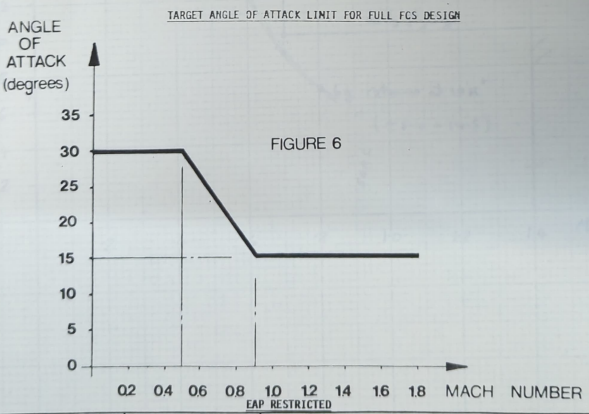
Good point. I was thinking more of the German team involved in the Typhoon FCS, but the UK had flown EAP to 35 degrees AOA without any apparent issues…

…what do you think explains that Typhoon had AoA issues where EAP didn’t ?
 
Good point. I was thinking more of the German team involved in the Typhoon FCS, but the UK had flown EAP to 35 degrees AOA without any apparent issues…

…what do you think explains that Typhoon had AoA issues where EAP didn’t ?
That’s a good question

I’ve always found it strange you have LERX on the 1986 mock up but they were omitted from the final design.
 
what do you think explains that Typhoon had AoA issues where EAP didn’t ?
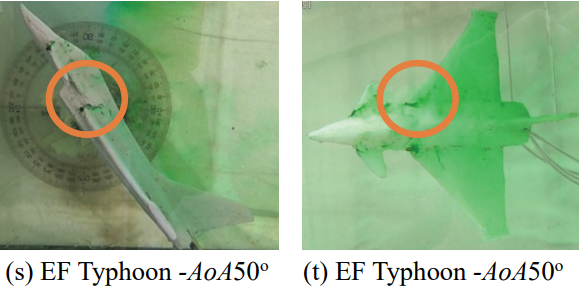
Not a clue, AoA limits are largely an aerodynamics thing, not an FCS thing. The different wing is a bit of a smoking gun.

The UK CONOPS for Typhoon vs Flanker assumed blowing them away via Meteor and/or ASRAAM before the merge, so it's likely max AoA was not highly valued, particularly given Typhoon has a good sustained turn capability, and still had a high-off-boresight capable SRAAM if it is forced to merge. Germany seems to have strayed down a different path of emphasising agility partway through development (1990) when it evaluated MiG-29 and decided agility trumped everything and that rather than the increased range of ASRAAM it would choose the increased agility of IRIS-T (coincidentally opting for the German proposal, not the British).
 
The gun side is not tapered so there's a minor imbalance.
EF Typhoon-AoA_airlow.png

But I think it having a low wing is the bigger deciding factor as the fuselage "blocks" and cause airflow to breakup sooner.
 
…what do you think explains that Typhoon had AoA issues where EAP didn’t ?
The cranked wing leading edge on EAP vs uncranked on Typhoon produces reduced shift in pitching moment at these AoA because the vortex position is more stable. I think there's some charts in Whitford's book on this.

Is it actually an issue?
 
Is it actually an issue?
Not AFAICS. If you're relying on max AoA, you're doing it wrong. It's the non-Harrier version of VIFFing in terms of general applicability.
 
Agreed. The British conception of Typhoon operations was high speed manouvering and BVR missile shots, not low speed high alpha manouvering. In YF-16 versus YF-17 testing, it was found that limiting max AOA to 25 deg in the YF-16 helped keep its energy state up, which overall lead to better results in combat. MBB was rather keener on post-stall manouvering.
 
Agreed. The British conception of Typhoon operations was high speed manouvering and BVR missile shots, not low speed high alpha manouvering. In YF-16 versus YF-17 testing, it was found that limiting max AOA to 25 deg in the YF-16 helped keep its energy state up, which overall lead to better results in combat. MBB was rather keener on post-stall manouvering.
I guess Germans were vary of a Fulda flashy furball, with several thousand combat aircraft pressed into just a couple of million square km.

Interesting that by tradition they still remain like this, choosing AMK over pirate.
 
Good point. I was thinking more of the German team involved in the Typhoon FCS, but the UK had flown EAP to 35 degrees AOA without any apparent issues…

…what do you think explains that Typhoon had AoA issues where EAP didn’t ?

The Brits had Jaguar ACT, the Germans F-104CCV.
The Brits had EAP, the Germans X-31.
Both were working on the Typhoon. Can't see a gross mismatch in experience here!

The EAP had cranked deltas, 45° outboard, 57° inboard. Higher sweep angle = more powerful vortex generation and later breakdown, lower sweep angle = better low speed characteristics. The higher inboard wingsweep performes the same function as a LEX. On the EAP you'll also notice that the wing apex is closer to the foreplanes, compared to the eventual Eurofighter. I.e. foreplane vortices have a greater impact on wing lift than it's the case with the Typhoon and the wings were symetric, unlike on the Typhoon. The AMK equipped Typhoon recovers that performance, the gun muzzle is now below the stareboard LEX and the wings are symetric, with a lift increase through the apex strakes and delta shaped fuselage strakes.
 
Interfernce drag caused the non-linear leading edge, but also RCS considerations and ease of manufacturing may have been other reasons, that have been stated at times. At the end it's like any solution the result of trade off considerations and the less sophisticated predictions have certainly not predicted the eventual problems encountered. The target was still 35° AoA, as confirmed by Keith Hartley and Wolfgang Schirdewahn in 1999. That both were stating brackets (30-35 and 33-35 respectively) indicates that there wasn't complete confidence in reaching the 35° target.
 
Not a clue, AoA limits are largely an aerodynamics thing, not an FCS thing. The different wing is a bit of a smoking gun.

The UK CONOPS for Typhoon vs Flanker assumed blowing them away via Meteor and/or ASRAAM before the merge, so it's likely max AoA was not highly valued, particularly given Typhoon has a good sustained turn capability, and still had a high-off-boresight capable SRAAM if it is forced to merge. Germany seems to have strayed down a different path of emphasising agility partway through development (1990) when it evaluated MiG-29 and decided agility trumped everything and that rather than the increased range of ASRAAM it would choose the increased agility of IRIS-T (coincidentally opting for the German proposal, not the British).

IRIS-T is not exactly a short range missile only, with a stated 25 km engagement range it covers the near BVR spectrum as well, as does ASRAAM, with a slight advantage in kinematics and max range, but noteably inferior off-rail capability.

Typhoon was supposed to be both, a good sustainer and nose fighter, giving the flexibility, even without extreme post-stall menoeuvrability. 35° would have been better than anything else short off TVC equipped platforms and not FCS limited aircraft, that were more difficult and risky to fly.

MBB's prediction in the 70s was that WVR battles would more likely be decided in the frontal hemispere, instead of chasing the enemy's tail to get a rear aspect shot. Being able to point your nose quickly to score a decision shot, rather than engaging into a lenghtier circle fight was a saver bet under these conditions. Back then HOBS missiles and HMD were not a thing though. An increase in off-boresight capability was assumed, and reality proved that it took almost another quarter century, before true HOBS missiles actually became a thing.

By the way, METEOR didn't even exist on paper when the eventual Typhoon was designed and the RAF knew very well, that if the Cold War had turned hot the risk of WVR encounters was very high over central Europe. For a reason AST403 specified a F-16 like WVR only fighter.

Had the Typhoon lived up to its promise in this respect the aircraft would have been more capable and having more options is always better than being restricted to a single trick that makes you more predictive to the enemy.
 
IRIS-T is not exactly a short range missile only, with a stated 25 km engagement range it covers the near BVR spectrum as well, as does ASRAAM, with a slight advantage in kinematics and max range, but noteably inferior off-rail capability.
I find it difficult to believe ASRAAM only has a "slight advantage" in kinematics over IRIS-T.
TVC, whilst great for manoeuvrability off the rail, is ultimately an inefficient use of thrust.
It also has far more aerodynamic surfaces, which drastically increase drag.
More importantly, the ASRAAM has a completely different class of rocket motor.
 
I find it difficult to believe ASRAAM only has a "slight advantage" in kinematics over IRIS-T.
TVC, whilst great for manoeuvrability off the rail, is ultimately an inefficient use of thrust.
It also has far more aerodynamic surfaces, which drastically increase drag.
More importantly, the ASRAAM has a completely different class of rocket motor.

Don't take that statement too exact, it's M 3.5 vs M 3.0 which is a noticeable difference. Feel free to elaborate on the rocket motor part.

The question is whether IRIS-T is utilizing TVC when it doesn't need to and in some conditions TVC might be less draggy than utilizing control surfaces.
 
UK had flown EAP to 35 degrees AOA without any apparent issues
Wasn’t the limit for eap 30 degrees?
 

Attachments

  • 1780583819623.png
    1780583819623.png
    149.5 KB · Views: 40
Mate I've flown a Hornet way past 35 degrees.
Prolly not for sustainable flight , for example su-30sm with thrust vectoring has sustainable aoa of 35 degrees. Sure it can pull more but it can’t maintain jt
 
IRIS-T is not exactly a short range missile only, with a stated 25 km engagement range it covers the near BVR spectrum as well, as does ASRAAM, with a slight advantage in kinematics and max range, but noteably inferior off-rail capability.

Typhoon was supposed to be both, a good sustainer and nose fighter, giving the flexibility, even without extreme post-stall menoeuvrability. 35° would have been better than anything else short off TVC equipped platforms and not FCS limited aircraft, that were more difficult and risky to fly.

MBB's prediction in the 70s was that WVR battles would more likely be decided in the frontal hemispere, instead of chasing the enemy's tail to get a rear aspect shot. Being able to point your nose quickly to score a decision shot, rather than engaging into a lenghtier circle fight was a saver bet under these conditions. Back then HOBS missiles and HMD were not a thing though. An increase in off-boresight capability was assumed, and reality proved that it took almost another quarter century, before true HOBS missiles actually became a thing.

By the way, METEOR didn't even exist on paper when the eventual Typhoon was designed and the RAF knew very well, that if the Cold War had turned hot the risk of WVR encounters was very high over central Europe. For a reason AST403 specified a F-16 like WVR only fighter.

Had the Typhoon lived up to its promise in this respect the aircraft would have been more capable and having more options is always better than being restricted to a single trick that makes you more predictive to the enemy.
You can gauge how the range of the 2 missiles compare by comparing their ground launched ranges. Asraam has a launch range in excess of 25km while iris-t is only 12km.
Some speculation from me from now on from playing flight sims.
Also extra maneuverability for missiles is super overrated imo, r-73 basic had a turning radius of only 200m. You don’t need a turning radius tighter than that which what iris-t achieves, basically any modern ir missile will be able to hit a target in a circle around the host aircraft if they have iog which basically every modern ir missile has
 
Last edited:
By the way, METEOR didn't even exist on paper when the eventual Typhoon was designed and the RAF knew very well, that if the Cold War had turned hot the risk of WVR encounters was very high over central Europe. For a reason AST403 specified a F-16 like WVR only fighter.
AST403 was initially, in 1972, a Harrier/Jaguar replacement. In 1979 the STOVL replacement was split off increasing the air combat role. What was required then was not what was required circa 2000. The RAF knew from an early stage that they wanted a longer ranged missile as a Skyflash replacement. The eventual CONOPS was built around long-range engagement of the Su-27, which didn't enter service until 1985, so what was required by AST403 in its initial form, or in its eventual 1979 form, was not what we built Typhoon for, the role evolved. Nor was even an evolved AST403 the requirement for Typhoon; AST403, by now emphasizing long range interception over the North Sea schemed around the BAe P.110,, was ultimately the British entry point into negotiations with France, bringing ACT 88, and Germany with TKF 90, and the Typhoon design emerged out of those negotiations, combining elements of the British and German designs after France went its separate way.

By 1995 or so, with Typhoon entry into service now projected at post 2000 (thanks, Volker Ruhe!), the RAF issued SR(A) 1239 for an FMRAAM (later renamed BVRAAM because Raytheon nicked the name) replacement for Skyflash (with AIM-120 as an interim borrowed from the Sea Harrier fleet). This became Meteor and was much closer to a contemporaneous timeline with Typhoon than the initial start date might suggest.
 
Last edited:
@DWG

Ofcourse did the requirements change and evolve, otherwise there would have been no need to abandon AST403. What became EFA was not supposed to be a long range interceptor though, that role was to be filled by the ADV. EFA was more geared towards the centeal European theater, replacing the Phantom FGR.2 in the airsuperiority role and the Jaguar in the attack role. I don't know what the exact envisioned CONOPS was for the RAF, but it's rather doubtful that they had ignored the very high probability of being forced into the merge, given the dense airspace and the sheer numbers that the WP could throw against NATO.

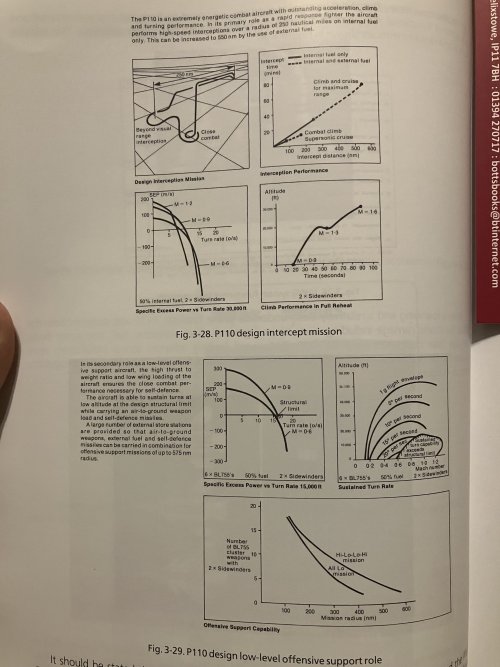
What has ever puzzled me is, what exactly did the P.110 contribute to EFA in terms of layout? This is often claimed, but I fail to see anything from P.110 on EFA, at least nothing that hasn't been on TKF already.
 
@DWG

What became EFA was not supposed to be a long range interceptor though, that role was to be filled by the ADV.
The British requirement was to outrange the Su-27 in radar detection and AAM launch range for all classes of AAMs. The British requirement was absolutely driven by BVR. German opinions differed.
What has ever puzzled me is, what exactly did the P.110 contribute to EFA in terms of layout? This is often claimed, but I fail to see anything from P.110 on EFA, at least nothing that hasn't been on TKF already.
P.110 was initially not directly related to EFA at all, it was a private venture aimed at Saudi Arabia and other Gulf states taking the ADV radar and engines and putting them in a more F-15 competitive airframe. It evolved to a more generic new fighter study for export and RAF use with Ferranti radar, improved engines. Typhoon's direct ancestor is the joint ACA. BAE conceded intake and canard position to German wishes on the collaborative ACA, P.110 (and the smaller P.106) show Britain's ideas in isolation for a canard delta without German input. The intake position alone makes it clear post-stall high AOA performance was not a big driver.
 
Last edited:
Also extra maneuverability for missiles is super overrated imo, r-73 basic had a turning radius of only 200m. You don’t need a turning radius tighter than that which what iris-t achieves, basically any modern ir missile will be able to hit a target in a circle around the host aircraft if they have iog which basically every modern ir missile has
The difference is substantial when a WVR weapon is used on collision course launches at close ranges. Extreme maneuverability off the rail substantially increases margin(be it LOBL or LOAL), but others start to struggle, and a desperate Fulda furball was likely understood as exactly such a fight.
 
The Brits had Jaguar ACT, the Germans F-104CCV.
The Brits had EAP, the Germans X-31.
Both were working on the Typhoon. Can't see a gross mismatch in experience here!
Missed this earlier. At the start of things, in theory MBB Ottobrunn were FCS programme lead with GMAv* Rochester backing them. When I came on board just after first flight, requirement/systems development was still in Ottobrunn, but being jointly run by MBB and GMAv, while Rochester was running the show on software and hardware, with small teams from the other partners integrated into the Rochester software team (less than a dozen Germans, half a dozen Italians, couple of Spaniards in a team of 130 or so). Part of the problem had been coordinating split-site software development (I've been on projects where that wasn't an issue), but Rochester had also stepped up to at least joint programme lead. The impression I got from ground level was MBB had lacked experience in running large, particularly large multinational, programmes and the initial model of farming out work packages to all four partners just hadn't worked.

There was a rather good cartoon circulating showing how the management issues had been resolved. In the first frame all four partners are sitting around a table, but Rochester has a vulture on its shoulder. In the second frame Rochester is sitting around the table with three skeletons, and the vulture is looking fat.

WRT X-31, that ran later than EAP. EAP flew in 1986, X-31 in 1990, Eurofighter in 1994. The EAP team became the Typhoon team, whereas X-31 was ongoing during Typhoon development.

* Rochester was still GEC-Marconi at that point, not part of BAe.
 
The British requirement was to outrange the Su-27 in radar detection and AAM launch range for all classes of AAMs. The British requirement was absolutely driven by BVR. German opinions differed.

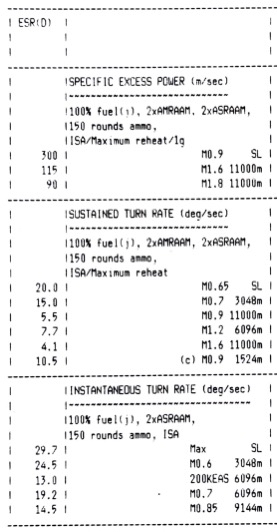
I don't disagree on that in general, though I doubt that WVR capability was ignored by the RAF and I'm not talking about HOBS AAM+HMD. I think @F-2 had shared an excerpt from the ESR-D, or AST414 (the related RAF requirement) specifying the STR and ITR performance that was even above what was published by Air International on Luftwaffe requirements for the JF90! Typhoon was designed to excel at both WVR and BVR combat. Why are people so eager to talk that away? Retrospective justification for a shortcoming, by reinventing or denying existance of requirements?

P.110 was initially not directly related to EFA at all, it was a private venture aimed at Saudi Arabia and other Gulf states taking the ADV radar and engines and putting them in a more F-15 competitive airframe. It evolved to a more generic new fighter study for export and RAF use with Ferranti radar, improved engines. Typhoon's direct ancestor is the joint ACA. BAE conceded intake and canard position to German wishes on the collaborative ACA, P.110 (and the smaller P.106) show Britain's ideas in isolation for a canard delta without German input. The intake position alone makes it clear post-stall high AOA performance was not a big driver.

The post-stall idea was a MBB thing in the first place, the Luftwaffe had no such requirement either. Sure BAe had independently developed P.103/106B/110, but other than being delta/canard there is no real commonality between these and TKF and it's not just foreplane or intake location and arrangement, it also impacts the fuselage design in general, as well as wing planform and positioning. The joint ACA is 100% TKF and 0% P.110, at least from an aerodynamic/layout point of view. The only reason for denying that, or artificially inventing a P.110 input, when there is evidently none, at least not in the aforementioned sense, is the reluctance to accept that the Typhoon layout as such is not a British design, there may have been inputs from the joint studies impacting minor details/refinements. At the end we don't know who exactly drove the reversion from cranked to normal delta and from twin fin to single fin, though we generally know/understand the underlying rational behind it.
 
Don't forget drag. Cranked is more draggy. And also more complex to build, hence more costly.

The EF2000 was supposed to excel in wvr and as such was to be the next step in maneuverability.
 
@DWG That is also my recollection/understanding but it would be interesting to hear a viewpoint from someone on the MBB side
 
@DWG

thanks for your insight view on the subject matter. Sounds a bit like the supplier tried to size control of the project that was to be managed under EPC SDR authority. How was BAe involved at that stage, or wasn't it?

You are ofcourse right that EAP predated X-31 and that the experience from it was available at the time EFA MDC was signed, whereas X-31 followed thereafter. What X-31 proved is that MBB got it managed, so the EFA FCS problems were really a management problem with different companies competing and fighting for the control of a project that both were eager to lead and get as much share as possible. The resulting arrangement was a compromise that had to be sorted out to make it work in the end.
 
Typhoon was designed to excel at both WVR and BVR combat. Why are people so eager to talk that away? Retrospective justification for a shortcoming, by reinventing or denying existance of requirements?

Because we were there at the time and BVR was being emphasised in everything we were told. Shoot BVRAAM, disengage in a supersonic turn, re-engage, shoot BVRAAM, disengage in a supersonic turn, re-engage, shoot ASRAAM from well outside Archer range, and only merge if there is no alternative.

That doesn't mean exceling at WVR combat wasn't valued, but rather that it's far better to have high-end WVR combat capability that you never need because your BVR capability is superlative. This approach wasn't someone's personal flight of fancy, but had been extensively modelled in comparison with other alternative CONOPS.

Remember, there's no 'shortcoming' to defend if you don't value ludicrously high-AoA. The test pilots I talked to considered the idea of deliberately manipulating yourself into a low-energy state to be idiotic - 'if he doesn't get you, his wingman will'.

And let's not forget, the RAF seriously considered removing the gun.
 
Sounds a bit like the supplier tried to size control of the project that was to be managed under EPC SDR authority. How was BAe involved at that stage, or wasn't it?
BAe wasn't involved with the FCS, that was a MBB/GMAv/Alenia*/Enosa contract; GMAv later became part of BAE Systems following the BAe/GEC merger in November 1999, but that's irrelevant. There was Eurofighter involvement, at the contractual level (and in being perpetually late in delivering requirements) , but they had zero involvement with the actual running of the project on a day to day basis.

* Not 100% sure it was Alenia for the Italian side, it might have been an electronics house like Officine Galileo (which still might have been part of Alenia).

What X-31 proved is that MBB got it managed, so the EFA FCS problems were really a management problem with different companies competing and fighting for the control of a project that both were eager to lead and get as much share as possible.

Not at all. 'It worked on X-31' proves nothing about Typhoon, a different project, with different workshare arrangements and different managers.

My understanding is the project turned into a mess under MBB all on its own. A German company being the Flight Control Lead was an important point for Germany as quid-pro-quo for BAe being aero lead, there was nothing to fight over because workshare percentages were fixed. I seem to very vaguely remember being told that the work package approach in particular wasn't working because changes in requirements were being treated as contractual changes by the Italians and Spanish and simply weren't being processed fast enough. The ultimate solution was to fly the entire Rochester software team out to Ottobrunn for a year (ditto the Italian and Spanish softies) in order to get the FCS ready for first flight. When they came back, Rochester were running things* because they had demonstrated they could fix the problems in the programme structure, and MBB hadn't, with confidence in the initial structure lost at the Eurofighter and parent company level.

* The eventual structure was something like:
Overall (Ottobrunn): GMAv/MBB
Systems (Ottobrunn): GMAv/MBB
Software (Rochester): GMAv
Hardware (Rochester): GMAv

As I say, I wasn't there at the time, but rather a little later, and I got the GMAv side of things, but it was 'there was a problem, we fixed it, so now we run things'.
 
I don't disagree on that in general, though I doubt that WVR capability was ignored by the RAF and I'm not talking about HOBS AAM+HMD. I think @F-2 had shared an excerpt from the ESR-D, or AST414 (the related RAF requirement) specifying the STR and ITR performance that was even above what was published by Air International on Luftwaffe requirements for the JF90! Typhoon was designed to excel at both WVR and BVR combat. Why are people so eager to talk that away? Retrospective justification for a shortcoming, by reinventing or denying existance of requirements?


The post-stall idea was a MBB thing in the first place, the Luftwaffe had no such requirement either. Sure BAe had independently developed P.103/106B/110, but other than being delta/canard there is no real commonality between these and TKF and it's not just foreplane or intake location and arrangement, it also impacts the fuselage design in general, as well as wing planform and positioning. The joint ACA is 100% TKF and 0% P.110, at least from an aerodynamic/layout point of view. The only reason for denying that, or artificially inventing a P.110 input, when there is evidently none, at least not in the aforementioned sense, is the reluctance to accept that the Typhoon layout as such is not a British design, there may have been inputs from the joint studies impacting minor details/refinements. At the end we don't know who exactly drove the reversion from cranked to normal delta and from twin fin to single fin, though we generally know/understand the underlying rational behind it.
I think I got this from @Flame2512 thru apparently also had the p.120 which was very good too. In fact on the STR the only thing I’m aware of that *might* match it is a Block 30 F-16 based on the chart the USAF Air Force academy used to have online. This is better then a F-16a, block 50, Eagle, CFTless strike Eagle, Hornet, Fulcrum, Flanker and basically every other chart I’ve seen.


It’s pretty crazy


I have some target for the p.110 from the EAP book “Britain’s Last manned fighter” not sure if this was the target of the configuration we know or something else but it’s comparable.
 

Attachments

  • IMG_8451.png
    IMG_8451.png
    115.3 KB · Views: 28
  • IMG_5746.jpeg
    IMG_5746.jpeg
    2.2 MB · Views: 24
Thanks @DWG for all those fascinating insights. I wonder how Edgewing and also the FCAS countries will avoid relearning some of the same extensive mistakes around allocate work share and/or work package leadership to the wrong teams just to keep some kind of national balance, requiring the other partners to eventually jump in and fix things.
 
Because we were there at the time and BVR was being emphasised in everything we were told.

I'm not questioning the principle doctrine of avoiding the merge and blowing your opponent out of the sky by outranging him. I have been questioning the insistance of the RAF being ignorant of the WVR battle, that in a central european battlefield would have been essentially unavoidable. The RAF was aware of it and close-in performance was evidently given appropriate consideration in the spec, but ofcourse this spec wasn't written by the RAF alone.

Remember, there's no 'shortcoming' to defend if you don't value ludicrously high-AoA. The test pilots I talked to considered the idea of deliberately manipulating yourself into a low-energy state to be idiotic - 'if he doesn't get you, his wingman will'.

When the specification calls for performance X and the actual performance is less than X then it is a non-compliance, or shortcoming. Whatever you consider as "ludicrously high-AoA", I'm not talking about poststall manoeuvrability here, but simply about specified vs achieved performance!

In general you surely try to keep energy level high, especially in a multi-bogey scenario, but it simply depends on the situation. If bleeding energy to get a quick decisive shot saves you from a fuel guzzling rate fight that may just as well turn you into a target, it can be the better option. As said before, it's always better to have options and more than one ace up to your sleeve, to be able to adapt dependent on the conditions and to be less predictable to your enemy. Ofcourse modern HOBS+HMD have reduced that need, compared to all aspect with limited OBS capability, but HOBS has its limits and the PK degrades.

And let's not forget, the RAF seriously considered removing the gun.

Yes in 2001, for cost saving reasons... just to get reverted after a few months. Irrelevant when we talk about the requirements and original design considerations!
 
By the way, at a risk of offtop, has France ever described their air combat views in regards to Rafale in a similar manner, and did it contribute to the split?

As the conops there is just fundamentally different (especially before meteor).
 
By the way, at a risk of offtop, has France ever described their air combat views in regards to Rafale in a similar manner, and did it contribute to the split?

As the conops there is just fundamentally different (especially before meteor).
This would be very interesting as its own topic. Of all the jets that were designed at the end of the Cold War the actual intended role and philosophy of the Rafale is something of a mystery to me.
 
By the way, at a risk of offtop, has France ever described their air combat views in regards to Rafale in a similar manner, and did it contribute to the split?

As the conops there is just fundamentally different (especially before meteor).
Don't quote me on it this, but from what I understand the design/philosophy deal-breakers for France were carrier capability and emphasis on multi-role from the ground up. Eurofighter design was primarily focused for air-to-air interception with capacity for multi-role.

The industrial/political concerns were probably the major drivers in the split though. France wanted to lead the project with 50% of the workshare, and insisted on using SNECMA M88s as the engines.
 
@Scorpion82 you seem to be be mischaracterising what everyone is saying. I just agreed that P.110 was not related directly to Eurofighter at all.

Noone is arguing that Typhoon wasn't supposed to have good WVR performance, but as designed (not what MBB wanted with TKF90) was conceptually more akin to F-16 in this area (low drag, high STR, fast transients) than F-18 (high ITR, high AOA, less speedy transients).

The core tradeoff of 2 tails to 1 tail going from ACA to EFA (and also, let me say, on General Dynamics Configuration 401F to F-16) was reduced weight, reduced drag, (both help with STR) and simpler vortex flow interactions with the vertical tail, but less tail authority and less benign characteristics at high AOA.This was accepted on Typhoon, with the idea that a future development could add thrust vectoring which would allow post-stall capability to appease the Germans. BAE Systems was aero lead, not MBB, even if Typhoon looks more like TKF90.

The F-16 FCS AOA limit is 25 deg, but would you argue it isn't optimised for WVR?
 
Don't quote me on it this, but from what I understand the design/philosophy deal-breakers for France were carrier capability and emphasis on multi-role from the ground up. Eurofighter design was primarily focused for air-to-air interception with capacity for multi-role.

The industrial/political concerns were probably the major drivers in the split though. France wanted to lead the project with 50% of the workshare, and insisted on using SNECMA M88s as the engines.
The impression I got is that it’s very hornet like, consolidation of several aircraft into one.

How it was mean to be use tactically in a little less clear on, my thoughts are that it was a kind of penetration fighter.
 
@Scorpion82 you seem to be be mischaracterising what everyone is saying. I just agreed that P.110 was not related directly to Eurofighter at all.

Noone is arguing that Typhoon wasn't supposed to have good WVR performance, but as designed (not what MBB wanted with TKF90) was conceptually more akin to F-16 in this area (low drag, high STR, fast transients) than F-18 (high ITR, high AOA, less speedy transients).

The core tradeoff of 2 tails to 1 tail going from ACA to EFA (and also, let me say, on General Dynamics Configuration 401F to F-16) was reduced weight, reduced drag, (both help with STR) and simpler vortex flow interactions with the vertical tail, but less tail authority and less benign characteristics at high AOA.This was accepted on Typhoon, with the idea that a future development could add thrust vectoring which would allow post-stall capability to appease the Germans. BAE Systems was aero lead, not MBB, even if Typhoon looks more like TKF90.

The F-16 FCS AOA limit is 25 deg, but would you argue it isn't optimised for WVR?

The topic matter was AoA performance of the Typhoon. When I hinted at the aircraft performing not as well as many apparently believed, I was met with sceptism. When I stated the 24° figure I was met with disbelief. When I eventually backed that figure with an authorative source, "everyone" suddenly jumped into a defensive mode, not recognizing that 24° vs 35° requirement is a significant shortfall, "everyone" was suddenly talking about "requirements" insisting that a higher ITR and AoA is not only, not needed spouting decades old "wisdoms" paraphrasing some pilot's gospel, but pretending that Typhoon's requirements were different and that Typhoon's lack in this respect isn't a deficiency, but "intend by design".

You just continue doing that with this very post I'm responding to. The evidence shown here in this thread proves "everyone" wrong who claims that the Typhoon's requirement was for an F-16 like STR only performance. 35° was the REQUIREMENT, ending up in the F-16 domain of 24° is a 30+% underperformance against the specification! It's the specification that expresses this requirement, but instead "everyone" simply carries on, ignoring the facts and pretending something else is the truth...

The F-16 is completely irrelevant as it was designed against different assumptions! Back when the F-16 was designed, rear-aspect heat seekers were the norm and in order to shoot your enemy down close in, it was necessary to get at his tail. For this, outrating the opponent was key and a principle design driver for the majority of the teen series.

MBB accurately predicted that this would change and drew its conclusions from it, I have discussed this before.

Wrt to BAe being the "Aero" authority it's the first time I hear about that and I seriously question it. Aerodynamics fall under the responsibility of the Manching based flight joint team. Unless this was a switch of responsibilities in this respect during the transition into the production phase (some responsibilities have indeed been shuffled around). What BAe was responsible for in the flight test programme, was carefree handling and envelope expansion, maybe this is being confused with "aero authority" here.

As far as "mischaracterizing" is concerned, I'm not the one inventing a "super manoeuvrability" requirement, that people repeatedly allude to, as if I have ever claimed it. All I did was explaining the underlying rationals behind it, taking the historical context into account, that others are in this respect ignore.
 
35° was the REQUIREMENT
I don't believe this was actually a "requirement" vs "prediction" from CFD and wind tunnel testing. Some flight physics phenomena emerged during flight test that hadn't been captured in these predictions.

And as well the money/prioritisation of money being diverted to other areas at thatstage of the flight test programme
 

Similar threads

Back
Top Bottom