
Developments and News in clean energy: Wind, solar and batteries grow despite economic challenges

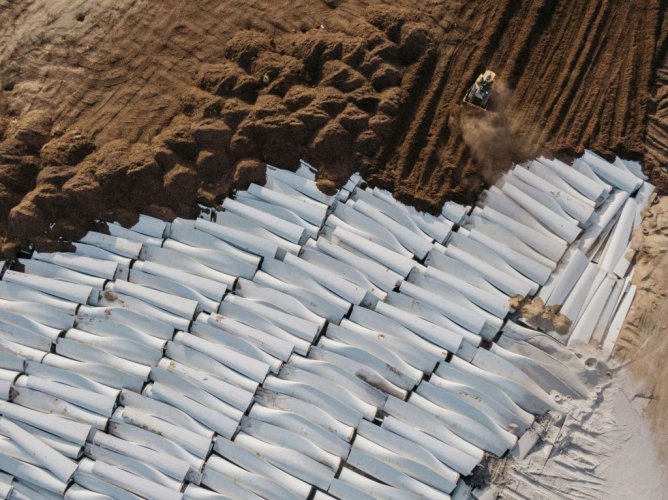
Almost 20,000 broken windmill blades threaten an ecological disaster in Spain.

Wind energy, the cleanest, shows its polluting face due to the lack of a recycling protocol for 18,000 tons of fiberglass with carcinogenic resins

The ruin of the sector prevents systematic action of destruction and recycling of the blades damaged by the weather adversities

Only 10% of discarded shovels are treated, the rest are in one hundred illegal cement plants, most of them in Galicia
 

Attachments

  • bloomberg-1024x767.jpg
    bloomberg-1024x767.jpg
    175.6 KB · Views: 15
Hopefully those kinds of blades will be made of these materials:

Now that I think of it---perhaps existing blades can be coated with these new substances.

A looming threat
Researchers at the Helmholtz Center Hereon have analyzed the long-term overall impact of this large number of wind farms on the hydrodynamics of the North Sea for the first time. They found that the current pattern could change on a large scale. The study highlights approaches for minimizing potential risks to the environment at an early stage. The work was recently published in the journal Communications Earth & Environment.

Alternative energy by A.I.
Aquavoltaics combines aquaculture and solar power on the same site. Solar panels are mounted above ponds, generating electricity while aquatic animals grow below. The panels provide shade, reducing direct sunlight reaching the water. This shading can be beneficial, but it also creates trade-offs.

New developments

On water

Particulates

Other topics

Nitrogen woes

The nuclear option

Busy-bodies

pushback
 
Last edited:
Yes, recycling fibreglass products (of any kind) are a major challenge and ecologically-responsible disposal options are non-existent. But why stoop to hyperbole?

... the lack of a recycling protocol for 18,000 tons of fiberglass with carcinogenic resins...

This is entirely irrelevant at the end of service life for fibreglass products. The health concerns relating to fibreglass resin are for the styrene emissions while those resins cure during manufacturing.

"Styrene has been classified by the International Agency for Research on Cancer (IARC) as Group 2A, probably carcinogenic to humans." (Emphasis mine.)

This means that appropriate PPE must be worn while laid-up fibreglass blades are left to cure. But, if those cut-up blades you're talking about are still emitting styrene, look no further for the cause of their structural failure!
 
Solar improvement
Researchers from the Qingdao Institute of Bioenergy and Bioprocess Technology (QIBEBT) of the Chinese Academy of Sciences, in collaboration with international partners, have engineered a thin two-dimensional perovskite phase at the buried interface of three-dimensional (3D) perovskite solar cells (PSCs) to boost device performance and operational stability.The method, published in Nature Energy, improves the crystallization quality of perovskite films and reduces defect concentrations at the buried interfaces by more than 90% (a 10-fold decrease).

For space use
"Antimony chalcogenide solar cells exhibit superior radiation robustness compared to the conventional technologies we're deploying in space," said Alisha Adhikari, a doctoral student in physics who co-led the team of undergraduate, graduate and faculty researchers at UToledo. "But they'll need to become much more efficient before they become a competitive alternative for future space missions."

Radiation
View: https://m.youtube.com/watch?v=gdcyphtu26k&pp=0gcJCYcKAYcqIYzv

Pumps

Clean energy


Oops

Setback

Odd

Outages

No CO2 storage in the ocean please
 
Last edited:
Just in

In depth.

Pyrimidone has the MOST....never mind...
_____________________________________________________________________________________________________________________________________
The grid

Nasty
View: https://m.youtube.com/shorts/VDmCm-SA24Y
 
Last edited:
On hydrogen
Earlier this year, the researchers succeeded for the first time in generating electricity with a hydrogen gas turbine without a mechanical compressor. While previous tests lasted only fractions of a second—otherwise the combustion chambers would melt—the KIT team has now extended the runtime to more than five minutes. "This is an important step toward highly efficient and flexible hydrogen energy for a fossil-free energy system," explains Professor Daniel Banuti, Director of the Institute of Thermal Energy Technology and Safety (ITES).

Paste

Water splitting

Combinations

Infrared optics

Safer public transit

How grids fail

Flywheels
View: https://m.youtube.com/watch?v=Z95t-f-0IjI&pp=ugUHEgVlbi1VUw%3D%3D

Concrete
View: https://m.youtube.com/watch?v=A-mZ853HJqM&pp=ugUHEgVlbi1HQtIHCQmiCgGHKiGM7w%3D%3D

novel device
A nanodevice developed at EPFL produces an autonomous, stable current from evaporating saltwater by using heat and light to control the movement of ions and electrons. Previously, researchers in the Laboratory of Nanoscience for Energy Technology (LNET) in EPFL's School of Engineering reported a platform for studying the hydrovoltaic (HV) effect—a phenomenon that allows electricity to be harvested when fluid is passed over the charged surface of a nanodevice. Their platform consisted of a hexagonal network of silicon nanopillars, the space between which created channels for evaporating fluid samples.

CO2 to useful compounds

Farming

Fuels

Data footprint

On solar

Trouble
 
Last edited:
Wind

Solar

Alternative power

in the news

Record

Strain

Wearables

E-waste

Steelworks
Steel sits at the center of overlapping, nested systems—from local communities to the national economy and global markets. Altering one part of a system sends tremors through the rest. Systems scientists describe this dynamic as panarchy: a concept from ecology that explains how interconnected systems operate at different scales and timescales, so change propagates unevenly and often in unexpected ways.

With this approach, focusing only on emissions risks a kind of carbon tunnel vision. Judging success by a single metric misses how one decision ripples into livelihoods, culture, mental health and identity.

After the immediate change came quieter, more troubling effects which emerged more slowly. Steelmaking wasn't just a job. Many former steelworkers told me of the pride, dignity and identity it gave them. When the furnaces closed, loss of purpose, stress and depression followed in ways that don't show up in emissions data or balance sheets.

The local economy shifted again too. The short-term boost from redundancy money faded. Businesses that relied on a large, stable workforce began to feel the loss. The town entered an uncertain medium-term phase, where opportunity and fragility coexisted
.

Chemistry

Water footprint

Air capture
Researchers at Northwestern University and California Institute of Technology recently introduced a new electrified mineral-based system that could remove CO2 from the atmosphere more efficiently and reliably. This system, presented in a paper published in Nature Energy, was developed by Prof. Ted Sargent's group in collaboration with Prof. Omar K. Farha.

"Direct air capture can help address hard-to-abate emissions derived from aviation, shipping, cement, etc.) and could reduce the total amount of CO₂ already accumulated in the atmosphere," Prof. Ted Sargent, co-senior author of the paper, told Tech Xplore. "Even with aggressive emissions cuts, most net-zero plans assume we'll need some form of carbon removal for leftover, hard-to-eliminate emissions. The paper frames electrified DAC as a route toward net-negative emissions when powered by low-carbon electricity
."

Membrane
Researchers have found a way to fabricate film-thin membranes imbued with super strength that could extend the durability of decarbonization technologies. Chemical engineers at The University of Queensland are harnessing an intricate building technique to produce the hyper-thin film membranes that boost the reliability, efficiency, and lifespan of key clean energy systems. The research is published in Nature Synthesis.


Future Dynamics
 
Last edited:
Solar battery

Self cleaning fuel cells

Green chemistry

Hold ups

sealing packages

Rare Earths

On politics

Unrealistic

Maybe don't tell people to eat bugs
 
Last edited:
Solar for styrene

Better solar cell

Solar boost?

Electrons can be "kicked across" solar materials at almost the fastest speed nature allows, scientists have discovered, challenging long-held theories about how solar energy systems work. The finding could help researchers design more efficient ways of harvesting sunlight and converting it into electricity. The research is published in Nature Communications.

The research challenges decades of design rules in solar energy research. Until now, scientists believed ultrafast charge transfer required large energy differences between materials and strong electronic coupling, features that can reduce efficiency by limiting voltage and increasing energy loss.

The discovery reveals a new pathway to designing more efficient light-harvesting technologies. Ultrafast charge separation underpins systems such as organic solar cells, photodetectors and photocatalytic devices used to produce clean hydrogen fuel and similar processes occur in natural photosynthesis.


More of the same
In the article "Upconversion materials: a new frontier in solar water splitting," published in RSC Advances, the authors present a focused overview of how upconversion strategies can expand the photoresponse of hydrogen generating systems.

Drat

The Grid

Why outages are not acceptable

Sewage

Sterling DIY

Cheaper catalytic converters?

Positive human impact

Green source of mineral harvest

Desalinization

Uh oh
 
Last edited:
Graphene foam

High temperature conversion of carbon dioxide to carbon monoxide

Methane eater

Rubber waste

For plastics and fuels

Safe sawdust?

On plants and food

Harvesting electricity via vibration?

Solar finds

Space-grade solar cells
 
Last edited:
The central message here is something I have been arguing for years.

 
In an effort to ease the financial burdens of US taxpayers, the US government is paying French energy company Total $1 billion to stop it building offshore wind parks.
Department reaches an agreement with TotalEnergies to renounce costly offshore wind leases and redirect company’s investment into U.S. LNG production
 
Last edited:
Harvesting heat and electricity when needed

Other solar advances

Methanol and biofuels

capture

For plants

For supercapacitors

Models

How to soften tech risks

Sawdust, lignin, etc.

Wearables

The trouble with wind farms
 
Last edited:
Observing sunlight-to-fuel first hand

Somebody tell the Donald that chloroplasts and such don't snipe at downed pilots...

Meanwhile, my state's Governor, who put the Guber in Gubernatorial---actually did rate-payers a solid:

The coal magnates and timber barons run my state, but even the GOPpers can't take votes from poors for granted anymore...

Oops

Recycling

Good news

hydrogen and more
 
Last edited:
Britain Urges G7 to Accelerate Clean Energy Push Amid Global Turmoil


  • The U.K. is pushing G7 nations to speed up clean energy adoption to reduce exposure to volatile fossil fuel markets.
  • New data questions the effectiveness of North Sea oil and gas expansion, reinforcing the case for renewables.
  • The Iran-related disruption and Hormuz blockage highlight the urgency of diversifying global energy systems.

Regards,
 
For example I know for a fact that wind farms in my region have been often officially listed as having being producing their full output when they were actually fully or partly down for maintenance or other reasons (such as, ironically, wind speed limits during stormy weather). Also, a number of areas including my own are experiencing what are in effect continuous unannounced brownouts. Which would also seem to give the lie to the increasingly rather desperate reassurances of the renewable energy advocates. And that's even before things like ever rising electricity bills. All of which are clobbering families and businesses alike.
 
California’s Battery Boom Is Rewriting Power Markets


Finally, hopefully others will follow.

Regards,
 
For example I know for a fact that wind farms in my region have been often officially listed as having being producing their full output when they were actually fully or partly down for maintenance or other reasons. Also, a number of areas including my own are experiencing what are in effect continuous unannounced brownouts.
Where is this and any info that someone online can verify with? It would be interesting to figure out what kind of stats manipulation could be going on.

If it is a brownout it should be possible to just measure voltage and freq directly to verify right?
 
For example I know for a fact that wind farms in my region have been often officially listed as having being producing their full output when they were actually fully or partly down for maintenance or other reasons (such as, ironically, wind speed limits during stormy weather). Also, a number of areas including my own are experiencing what are in effect continuous unannounced brownouts. Which would also seem to give the lie to the increasingly rather desperate reassurances of the renewable energy advocates. And that's even before things like ever rising electricity bills. All of which are clobbering families and businesses alike.
May I ask whether the state you live in has democrat or republican governor and/or parliament (yeah, you heard me...)?
 
Last edited:
May I ask whether the state you live in has democrat or republican governor and/or parliament (yeah, you heard me...)?
The rule in Getmany e.g. is, that even if wind or solar plants have to he shutdown because of an oversupply of electricity, they get their full payment for the hypothetical produced electricity. Also the fictional electricity is used in statistics as "produced electricity".
 
I’m
As ever, CA leads the way in the union, if not the world.
Never in a positive way. California shuts off the electricity to millions of residential customers every time the wind blows and the typical Californian now suffers without air conditioning during peak hours because of “smart meter” billing. I can’t think of a state with a worse track record in managing energy, green otherwise.
 
The rule in Getmany e.g. is, that even if wind or solar plants have to he shutdown because of an oversupply of electricity, they get their full payment for the hypothetical produced electricity. Also the fictional electricity is used in statistics as "produced electricity".
And in Canada, Ontario in particular, hydroelectric generation is often shut down because solar and wind investors have the first call to sell electricity. Due to this policy and a lack of separate slipways, Canadian green energy policies have caused massive flooding behind the dams when the hydro turbine are shut down to protect privileged wind and solar investors. None of this takes into account the massive unpaid “carbon debt” of the new wind and solar projects while the carbon debt of the decades old hydro dams are long since paid off.

The real problem with “green” energy is the corruption, with a handful of wealthy investors buying legislators and member of parliament in just about every developed country.
 
And if that wasn't bad enough, newer solar panels are suspect:


Data centers may at least be able to run hotter... perhaps require less cooling:

Solar thermal doesn't rely on expensive PV cells, simply needing reflectors that could better resist holes. Working fluids--though hot--are still enough to perhaps cool tougher chips and not rely on as much water--are more resistant to EMP and space use....etc.

Hmm

Um
 
Last edited:
The Republic of Ireland, actually....
If it makes you feel better, actual Irish Ministers talking about potential nuclear capacity in the future, in fact hell has just frozen over with Eamon Ryan writing an article saying nuclear could have a role in Ireland's future energy mix... Pity he didn't come to that view when he was the leader of the Greens.
 
No matter what country you live in nuclear is years away from getting up and going.

You are looking at 15 years +++ before it goes online. Here in Aus every Govt project is double time frame and huge cost blowout, probably just like every other country.

So, if you're looking for something in 20+ years nuclear is potentially the way to go, yet if you need something now, as in 2~3 yrs renewables are the real only option.

Regards,
 
No matter what country you live in nuclear is years away from getting up and going.

You are looking at 15 years +++ before it goes online. Here in Aus every Govt project is double time frame and huge cost blowout, probably just like every other country.

So, if you're looking for something in 20+ years nuclear is potentially the way to go, yet if you need something now, as in 2~3 yrs renewables are the real only option.

Regards,
It's Ireland, every Capital program is always 15+++ years from coming online, just keep shifting the timeline.
 
This could be useful across a wide range of fields:

Droplet control can be useful for combustion

Algae

Emissions findings

Soil

Eddy

Concrete

Plastic eater

New catalyst

Hydrogen

Ocean energy

Fuel cell

Mutant 59, 60, 61...the plastic eaters

bio-oil
 
Last edited:

Similar threads

Back
Top Bottom