Developments and News in clean energy: Wind, solar and batteries grow despite economic challenges

We (well not me anymore...) do have coal and gas power (orange and brown colour) but all coal power plants shall be closed until 2030/2035 which is extremly unrealistic, even with the ongoing deindustrialisation.

Needing back up power makes wind energy neither cheap nor CO2 neutral.
 
If you are using wind for base load you are doing it wrong, if your wind power requires significant backups, you are doing it wrong, if you are using coal as a backup/top up, you are doing it wrong. The only fossil fuel plants being built/used should be natural gas, which works great to balance out the grid.
 
If you are using wind for base load you are doing it wrong, if your wind power requires significant backups, you are doing it wrong, if you are using coal as a backup/top up, you are doing it wrong. The only fossil fuel plants being built/used should be natural gas, which works great to balance out the grid.
If you have natural gas on the cheap, then sure. What the Chinese have is coal. What many countries have is coal. Unless they want to run down their forex reserves, that's what they're going to use.


Wonder if they are doing it to make a difference or maybe going after tax credits and no doubt AI needs????????

Regards,
 
If you have natural gas on the cheap, then sure. What the Chinese have is coal. What many countries have is coal. Unless they want to run down their forex reserves, that's what they're going to use.
Coal is only good for base load, you can't balance the grid with it.
 
Coal is only good for base load, you can't balance the grid with it.
Of course you can.
They're already doing it in China.

 
Of course you can.
They're already doing it in China.

All that report does is claim its possible, it does not get into the how. Coal-fired steam turbines are not easy to turn on or off, they are not as throttleable as gas turbines, can they do it? Probably. But it is not the ideal method of regulating power and only makes sense in China because they have a surplus of coal plants.
 
Renewables are expensive and ultimately may be unaffordable.


Garbage from two biased organisations.
 
Just remember leftie anti-nukes were funded in part by big oil.

Lots of stupidity across the political spectrum.
Greens hated factories--Executives hated labor...NIMBYs hate everything...a one-two-three punch that killed heavy industry in the states.

Deinstitutionalization also came about with a Hitler/Stalin pact between well-meaning civil libertarians and the stingy.

Green headlines
 
Last edited:
At least folks tried to entice Ralph Nader with beautiful women. I don't get those deals either.

Big improvement

Challenges

Why do people do what they do?

On aviation

New book

Good news

Solar

Policy matters
 
Last edited:
All that report does is claim its possible, it does not get into the how. Coal-fired steam turbines are not easy to turn on or off, they are not as throttleable as gas turbines, can they do it? Probably. But it is not the ideal method of regulating power and only makes sense in China because they have a surplus of coal plants.
Again, click on my link and you see exactly how they go up and down in Germany every day....

On the same side, you can also see, how the French nuclear reactors react flexibel to the power demand.

BTW the most common method of power reduction in steam turbins is partially (meaning less than 360 degree) reducing the intake area.
 
Last edited:
Batteries and micro grids.

Australia has massive, long distance power lines which are a total waste of money and time.

Localising power with less distribution would make the grid less prone to disruptions.

Regards,
 
Heads up: new invention called batteries that store power...
Your head is up somewhere...

Right now, batteries cost about $225 a kwh installed. 1 megawatt is a thousand kilowatts. Large commercial generation stations produce hundreds of megawatts of power. Do the math. A reasonable sized battery storage system for a large solar array storing say, 16 hours of power runs into the billions.

Example

250 MW station x 225 per kwh x 16 hours = $9 billion. That's on top of the solar array itself.
 
Micro grid mean even more fluctuarions in power production and consumption with even more storage capacity.
 
Riiiiggggghhhttt..........


Regards,
 
The ode to the micro-grid...............

Disruption of the traditional business model: Microgrids provide energy independence and resilience at a local level, reducing reliance on the central grid. This can be seen as a challenge to a utility's established control over energy distribution and revenue streams.

In Australia case the grids have been sold off left right and centre to companies that need to get the returns on their investment.

Loss of control over energy flow: As more communities develop independent microgrids, the central grid loses control over energy flow. This can make managing what is left of the grid more complex, potentially impacting stability and reliability standards if not managed properly.

As more communities drop off the main grid the costs of the remining grid will skyrocket.

Regulatory and legal hurdles: Utility companies often have significant legal and regulatory control over energy distribution. This can create barriers for microgrid development as utilities may oppose projects that threaten their monopoly over power supply.

Many solar projects in NSW (AUST) are idle as they cannot connect to the grid because of the above.

On the upside............

Enhanced resilience and reliability: Microgrids can provide a more reliable energy supply, particularly in remote areas or locations prone to natural disasters, by operating independently from the main grid during power outages.

Integration of renewable energy: They offer a way to integrate local renewable energy sources like solar panels and wind turbines, leading to a cleaner energy supply.

Cost reduction: Microgrids can lead to lower energy costs for businesses and communities by optimizing local generation and storage.

Regards,

 
Last edited:
The ode to the micro-grid...............

Disruption of the traditional business model: Microgrids provide energy independence and resilience at a local level, reducing reliance on the central grid. This can be seen as a challenge to a utility's established control over energy distribution and revenue streams.

In Australia case the grids have been sold off left right and centre to companies that need to get the returns on their investment.

Loss of control over energy flow: As more communities develop independent microgrids, the central grid loses control over energy flow. This can make managing what is left of the grid more complex, potentially impacting stability and reliability standards if not managed properly.

As more communities drop off the main grid the costs of the remining grid will skyrocket.

Regulatory and legal hurdles: Utility companies often have significant legal and regulatory control over energy distribution. This can create barriers for microgrid development as utilities may oppose projects that threaten their monopoly over power supply.

Many solar projects in NSW (AUST) are idle as they cannot connect to the grid because of the above.

On the upside............

Enhanced resilience and reliability: Microgrids can provide a more reliable energy supply, particularly in remote areas or locations prone to natural disasters, by operating independently from the main grid during power outages.

Integration of renewable energy: They offer a way to integrate local renewable energy sources like solar panels and wind turbines, leading to a cleaner energy supply.

Cost reduction: Microgrids can lead to lower energy costs for businesses and communities by optimizing local generation and storage.

Regards,
I remember the same people who once told about the adbantages of a decentralized electricity production in Germany are now promoting a large net of ''Stromautobahnen'' (electricity highways) to transport the wind energy from the north to the south and the solar electricity from the south to the north.....
 
Renewables are fiction. Wind and solar fill niches. They are expensive relatively speaking. We've got a 10 million year supply of methane under the ocean that is underdeveloped and looked at as a scary risk to tap. Oil rigs hit it every day but aren't there for it, they want the heavy oil and lighter gases that are easier to handle. Trash dumps are another methane source. We literally throw out millions of tons of agricultural wastes. We are surrounded by many untapped sources of energy. Renewables replacing coal and gas on the other hand are draining your children's financial stability.
 
We literally throw out millions of tons of agricultural wastes. We are surrounded by many untapped sources of energy.
Speaking of farming and methane, shouldn't it also be possible to harvest lots of it from cattle farms?
 
Renewables are fiction.
So they don't exist? Made up fiction? Really?
Wind and solar fill niches.
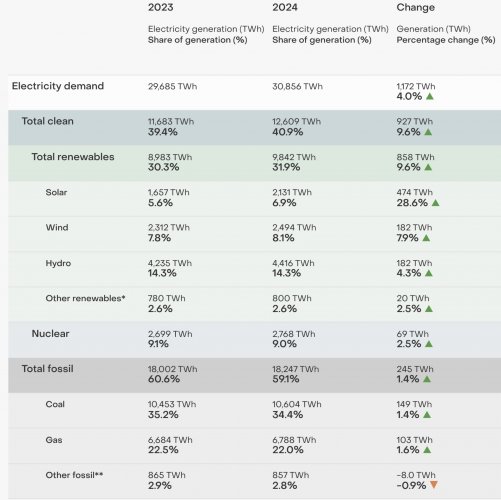
They are growing rapidly beyond niche:

Image 19-10-2025 at 5.11 am.jpeg
They are expensive relatively speaking.
If one does a full, true comparison that also includes all the subsidies traditional non-renewable fossil fuels have enjoyed for decades and include the costs associated with the damage they produce, one will see that renewables aren't necessarily expensive. Moreover, when one considers that you don't have to feed fuel in continuously it gets better.

Moreover, just doing straight comparisons without all the above, one sees that in the last year solar photovoltaic (PV) was 41% cheaper on average than the lowest-cost fossil fuel alternatives, such as gas, while onshore wind projects were 53% cheaper. See:

Renewables replacing coal and gas on the other hand are draining your children's financial stability.

How?

BTW, the attached report makes for interesting reading.
 

Attachments

  • Report-Global-Electricity-Review-2025.pdf
    15.2 MB · Views: 5
Wind costs are always hidden with projections, never presented with true costs based on real data. For the most part after one round of maintenance it is not uncommon to take them out of services less than 10% into their projected lifespans. Solar and coal have their downsides with disposables. The best performing solar in the south is also in hurricane and tornado paths. They do not perform well 25% of the year seasonally, ignoring cloud cover, and get blasted by mother nature.

/Fixed 1st word
 
Last edited:
Hydrogen production from urea is a step closer

Better catalysts

Lower dairy costs

solar recycling

Teflon

other finds

In the news

Aviation fuel

Reactors
 
Last edited:
Hydrogen production out of ammonia is completely uneccessary, exapt you need hydrogen as chemical element and not as energy
 
I think the folks proposing that idea may have been thinking about ways for waste management to help pay for itself. We are going to have sewage treatment plants anyway--but here I am just guessing motives.

An aid for agriculture’s role in putting carbon into food

Oops
 
Last edited:
“Although climate change will have serious consequences – particularly for people in the poorest countries – it will not lead to humanity’s demise,” Gates wrote. “This is a chance to refocus on the metric that should count even more than emissions and temperature change: improving lives. Our chief goal should be to prevent suffering, particularly for those in the toughest conditions who live in the world’s poorest countries.”
[...]
Gates denied his new position represents a reversal from his past stances. He said in Tuesday’s essay that the world must continue to support its past efforts to achieve zero carbon emissions.
 
That might be in response to things like this:

I remember a CNN story about the canned hunt that ended in a lion with a radio collar being killed. Many natives noticed both hunters and the ecologists who didn't like that practice both ignore poor native people.

"Indigenous groups themselves are increasingly vocal in pushing back against conservation efforts that exclude them and challenging colonial-era assumptions about their environmental impact. Groups like the Native American Fish and Wildlife Society address issues like invasive species and highlight the unique concerns of Tribal nations." (from Gemini)

If there are no efforts to reduce poverty--individuals overseas will continue to see Western ecologists as just the latest colonials--seeing the Green movement as rich white John Kerry telling poor folks they can't have electricity because carbon footprint.

Mr. Gates is adjusting accordingly.

Another example of alienating folks you need for a cleaner future:

Some good news

Here you see a flex fuel situation--though the older facilities needed to be kept as well.
 
Last edited:
This is interesting, especially the second half given what it could mean for the US and indeed Australia and Canada. Sticking to the old fossil fuels centric approach is not just an environmental issue (though that should be enough), but also an economic and national security issue. China is leading the way in changing over and will be much, much better for it and arguably dominant.

View: https://youtu.be/ECYMHIbBYyI?si=XbEHAAk5K5HMUD-s
 
Hence the micro-grid.

Regards,
Home solar is, in the grand scheme of things, a complete waste of time and money. The installs only pay out with heavy government subsidies. Nobody would install or pay for one without those. The amount of energy produced is so miniscule as to be irrelevant.

Let's say, when a home solar array is up and running, it returns 2 kw to the grid (I'm being generous) for a few hours. To get 1 megawatt, you need 500 homes. But that output is variable continuously to an extent as each home grid experiences clouds, shade from trees, poor positioning of the panels, etc. Thus, the supply to the grid is unstable making it hard to keep loading overall constant. More home solar, more instability.

Then there's the payout for that electricity to homeowners. This too is problematic. It involves more accounting and paperwork. If the scheme pays the homeowner above wholesale rate the utility is losing money buying expensive, unreliable, power from those homeowners.

It all becomes one expensive mess.
 

Similar threads

Back
Top Bottom