Forest Green
ACCESS: USAP
- Joined
- 11 June 2019
- Messages
- 14,521
- Reaction score
- 31,570


From LEO would make sense...Golden Dome czar signals space-based interceptors not guaranteed, as DoD weighs cost
https://breakingdefense.com/2026/04...rceptors-arent-guaranteed-as-dod-weighs-cost/
Direct Energy Weapons?
Yes, I think so, but it seems intended to cover a fairly broad range of threats.So, sort of like european gpi? Any deployment timetable available? Mid to Late 2030s maybe?
Which of the 2 hypersonic threat interceptor projects will continue its path with the support of the European Union? Only one concept will receive a new allocation from the European Defence Fund (EDF). For the other, the next chapter will depend on self-financing and possible state support.
In the end, will only one remain? Far from the tropical atmosphere of a certain reality TV show, 2 endo-atmospheric interceptor programs are putting everything on the line in an attempt to secure funding from the EDF.
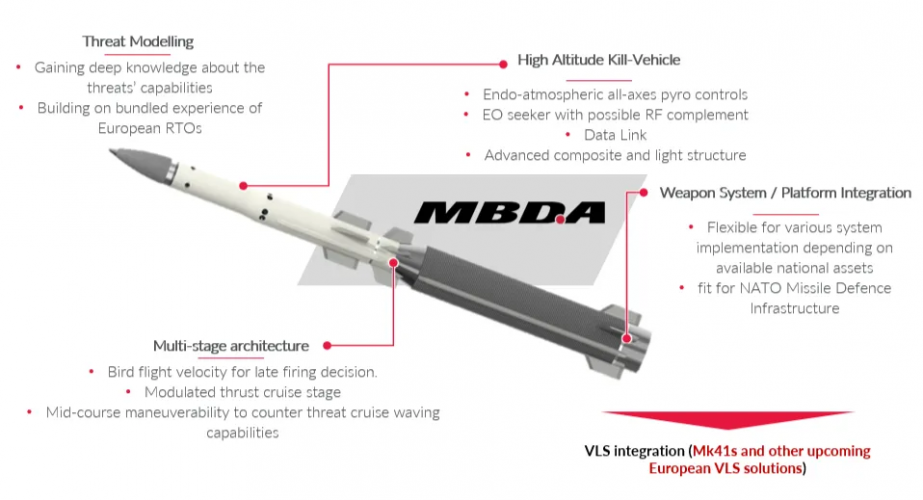
On one side is HYDIS, led by MBDA France on behalf of France, Germany, Italy, and the Netherlands. The United Kingdom is participating as an observer.
On the other side is HYDEF, led by Spain’s SMS and Germany’s Diehl, representing Belgium, Germany, Spain, Norway, and Poland.
For each of them, a 3-year conceptual phase will end this year or in 2027. Managed by OCCAr, this stage will lead to the selection of one concept per consortium. This should be completed by next August for HYDEF. Out of the 11 initial concepts, the 19 partners of HYDIS “have selected two potential concepts, and the selection will continue until reaching a single concept by the end of the year,” explained MBDA CEO Éric Béranger last week in Paris.
The next steps fall within the call for projects launched in December 2025 by the European Commission. The €100 million in subsidies it provides will allow the program to enter a maturation phase expected to lead to demonstrators (TRL 5) and lay the groundwork for two major upcoming milestones: achieving technological maturity at TRL 6 by 2030, and then an operational system (TRL 9) as of 2035.
Unless there is a last-minute reversal, the funding will be allocated to only one proposal. It is therefore difficult to imagine any outcome other than a head-to-head competition between HYDIS and HYDEF. For one of the 2 consortia, the next steps will have to be considered without European backing. OCCAr is not hiding this fact: any activity planned beyond 2026 remains subject to “approval of the second phase.” The HYDIS team goes even further, explicitly conditioning the continuation of its work on the results of the European call for projects.
The Programme coordination within the HYDEF Consortium is led by the Spanish company SMS, based in Madrid, Spain, while the Technical Coordination, from the development of the overall system, is the responsibility of the German air defence systems company Diehl Defence, based in Lake Constance.
The Consortium integrates the following members: SONACA from Belgium; Diehl Defence from Germany; NAMMO from Norway; ILOT and ITWL from Poland; SMS, EM&E, GMV, Instalaza, INTA, Navantia and Sener from Spain.
The HYDIS Consortium is led by the French company MBDA FR who acts as prime contractor, and integrates the following companies: MBDA IT, MBDA DE, MBDA SP, ROXEL FR, Ariane Group SAS (FR), LYNRED (FR), ONERA (FR), Bayern Chemie (DE), TDW (DE), DLR (DE), OHB System AG (DE), Avio Aero GE Avio S.r.l. (IT), AVIO SpA (IT), C.I.R.A. (IT), Fokker Aerostructures B.V. (NL), Thales Nederland B.V. (NL), TNO (NL), THALES LAS (FR).
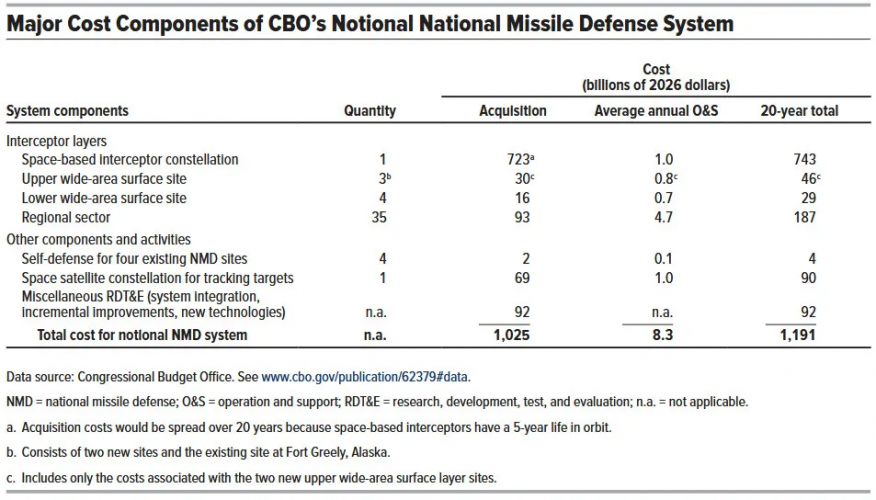
*Presumably will include GPI too.The architecture laid out in CBO’s report assumes four interceptor layers designed to target multiple missile types and to operate either independently or in concert with an associated command-and-control network:
- A space-based constellation of 7,800 satellites each designed to take out up to 10 intercontinental ballistic missiles launched near simultaneously as well as hypersonic glide vehicle threats
- An upper wide-area surface layer comprised of three Ground-Based Midcourse Defense sites, each with 60 Next-Generation Interceptors or Ground-Based Interceptors focused on engaging ICBM threats
- A lower wide-area surface layer with four U.S.-based sites, each equipped with 48 SM-3 Block IIA interceptors to defeat ICBMs or hypersonic glide vehicles*
- A “regional sector” layer with 35 interceptor and radar sites loaded with THAAD, SM-6 Block IB, and Patriot interceptors that can target ICBMs, glide vehicles, and cruise missiles
I've been assuming that any "Brilliant Pebbles" garage/lifejacket would also have a conventional kinetic brick to drop on any ground station engaging the Brilliant Pebbles constellation. Orbital mechanics says that the unit shooting back cannot be the same garage/lifejacket as the one getting engaged, at least not in a reasonable length of time.$60B a year is not that bad. Add some space based conventional strike weapons capable of strategic counter-force and we could probably cut the nuclear forces by ~90%. That would save anywhere from ~$40B/yr on warheads alone to ~$100B/yr if you include the cost of all the delivery platforms. The SSBNs could easily be converted to CPS and/or cruise missile platforms. ICBMs can either be retired or repurposed as interceptors carrying EKVs. Nuclear cruise missiles could be the bulk of our deterrent, and even conventional weapons can have massive counter-value effects these days.
I've been assuming that any "Brilliant Pebbles" garage/lifejacket would also have a conventional kinetic brick to drop on any ground station engaging the Brilliant Pebbles constellation. Orbital mechanics says that the unit shooting back cannot be the same garage/lifejacket as the one getting engaged, at least not in a reasonable length of time.
What happens when a disabled satellite drops out of orbit after its attacked? A warhead designed to penetrate atmosphere and especially if containing heavy metals isn't going to burn up on re-entry.I think we are going to see a variety of space based weapons for offense and defense, and yeah each bird will likely carry multiple types. Space is going to be the cheapest place to deploy strike weapons from once Starship is up and running. Elon still says it will be $10/kg to orbit. At that price, you can loft a Minuteman III size missile to orbit for about half a million and drop it more or less straight down. But the weapon doesn't need to be so big. You can cut the rocket motor to ~20% the size for ~3km/s Delta-V (about a 20-30% payload mass fraction), and you have something that can drop from ~250km to the surface in about a minute and a half, or less if you use lift to pull into a vertical dive as it enters air dense enough. How's that for a prompt strike weapon? And other weapons with a lot less rocket motor can be far cheaper and still strike as fast as current ballistic missiles. If you go all in on a space arsenal you really only need weapons on warships to defeat threats that are detected less than a few minutes away.
Someplace gets a new crater.What happens when a disabled satellite drops out of orbit after its attacked? A warhead designed to penetrate atmosphere and especially if containing heavy metals isn't going to burn up on re-entry.
What happens when a disabled satellite drops out of orbit after its attacked? A warhead designed to penetrate atmosphere and especially if containing heavy metals isn't going to burn up on re-entry.

Depends on the nature of the impact. If the KKV hits the warhead it will fragment it. If not, well, the warhead won't be hitting its target.What happens when a disabled satellite drops out of orbit after its attacked? A warhead designed to penetrate atmosphere and especially if containing heavy metals isn't going to burn up on re-entry.
Its not just kinetic weapons, lasers or other things could inadvertently damage the comms or computers, so the self destruct mechanism isn't guaranteed to work. If the disabled sat hits the wrong country...Depends on the nature of the impact. If the KKV hits the warhead it will fragment it. If not, well, the warhead won't be hitting its target.
Not our problem.Its not just kinetic weapons, lasers or other things could inadvertently damage the comms or computers, so the self destruct mechanism isn't guaranteed to work. If the disabled sat hits the wrong country...
Beats a nuke hitting some place important - it's a low bar but a relevant one.Its not just kinetic weapons, lasers or other things could inadvertently damage the comms or computers, so the self destruct mechanism isn't guaranteed to work. If the disabled sat hits the wrong country...

The owner of whatever is hit might make it your problem, reasonably so or not. Sure they would blame whoever shot at it, but you put it up there.Not our problem.
Its not just kinetic weapons, lasers or other things could inadvertently damage the comms or computers, so the self destruct mechanism isn't guaranteed to work. If the disabled sat hits the wrong country...
Two operational programs sit at the frontier of what non-kinetic warfare can reach. Talon LURCHER is designed to deliver non-kinetic effects against targets moving faster than Mach 20. At those speeds, data latency in the track and fire control loop makes conventional targeting geometry unreliable before a solution can even be computed. LURCHER develops and integrates technology specifically designed to close that gap, enabling consistent and accurate delivery of effects to fast-moving, long-range targets, and serving as the key technical enabler to properly aim the weapon system at hypersonic threats.
Talon UPCYCLE operates in a different domain entirely. Using Compass Call SPEAR Gen 3 pods, it develops tactical counter-space EW systems capable of degrading, denying, disrupting, and deceiving adversary SIGINT and IFTU satellites in proliferated low Earth orbit. An aircraft that has spent decades dismantling adversary ground networks is now being extended into space. Electromagnetic Battle Management connects all of it to the force with real-time spectrum situational awareness, targeting Early Operational Capability in early FY2028.

I was wondering the same. Apparently, the MRBM range is based on a purely ballistic trajectory (reentry speed of 4500–4700 m/s), whereas the ASBM is expected to maneuver during the later stages of reentry.Can't really understand why there's a 1000km reduction in range for ASBM intercept capability vs general MRBMs.
So is IRIS-T for that matter with a lot of small users.With the growing Aster user base, now more than a dozen countries and most recently Greece, Sweden, Denmark and Portugal, with the Netherlands likely to follow, I really hope it goes to MBDA.
So just because they have a different system they don't need it?By contrast, the HYDEF countries are already major Patriot/Mk41 users, and in Germany’s case even Arrow 3 and soon AEGIS/SM-6 … How much is this a priority for them ?
For one i believe a larger issue here is the fact that those programms aren't requiered to be designed for "open" use within EU systems and the other is how easily would EUROSAM make it for the HYDEF consortium so they can actualy integrate there system? In fact it would be more logical if instead of everyone doing there own system one would open but to creating a common baseline but this means lost business and revenue so of course it wont happen. While i can't say for certain if HYDIS could fit Sylver but SAMP/T shouldn't be a problem at all compared to Sylver but someone needs to create the demand and market for it.Especially because the two main Hydis countries, France and Italy, cannot really do without these systems, for their navies and their GBAD.
Just as an example, is a consortium centred around Germany, Spain and Poland really going to design its interceptor around compatibility with a European VLS, non aegis CMS and integration into SAMP/T NG ?
“In the spirit of the Acquisition Transformation Strategy’s focus on delivering capability at speed and scale, embracing proven capabilities that are ready now, the committee directs the U.S. Space Force to prioritize acquisition and operational deployment of a full constellation of at least 45 space vehicles equipped with proven HBTSS payloads,” the committee wrote in a report accompanying the bill.
House panel ties Pentagon microreactors to Golden Dome mission
https://insidedefense.com/daily-news/house-panel-ties-pentagon-microreactors-golden-dome-mission
House appropriators are urging the Pentagon to evaluate advanced nuclear reactors as a power source for Golden Dome, missile defense and Space Force missions, a move that comes as the Defense Department is establishing the organizations and regulatory framework needed to begin deploying military microreactors. In report language accompanying its mark of the FY-27 defense appropriations bill, the House Appropriations Committee wrote, “advanced reactors and microreactors have unique attributes that can ensure reliable power, have geographic flexibility
Frankenburg Technologies, which recently opened its first production facility in Latvia, is finalizing 100 million euros in Series B funding to develop and manufacture an anti-ballistic missile defense system.
According to the report, Frankenburg seeks to build a system competitive with the American Patriot at a substantially lower price point.
European customers have had access to essentially two ballistic missile defense systems: the American Patriot, equipped with either PAC-3 MSE or PAC-2 GEM-T interceptors, and the Franco-Italian SAMP/T NG system, equipped with Aster 30 B1 and, soon, Aster 30 B1NT interceptors.
Supply chains for both systems are stretched.
*They've neglected to mention Israeli systems here.Diehl Defence is developing the IRIS-T SLX, which will reportedly offer some capability against theater ballistic missile threats
The key metric in today’s environment is arguably not how reliably a single interceptor destroys a single missile, but rather what it costs to achieve a required intercept probability across multiple shots and salvos, and the ability to reconstitute arsenals in an ongoing conflict environment. Here, low-cost, mass-producible interceptors have an advantage — as shown in the figure below — provided they meet minimum requirements.
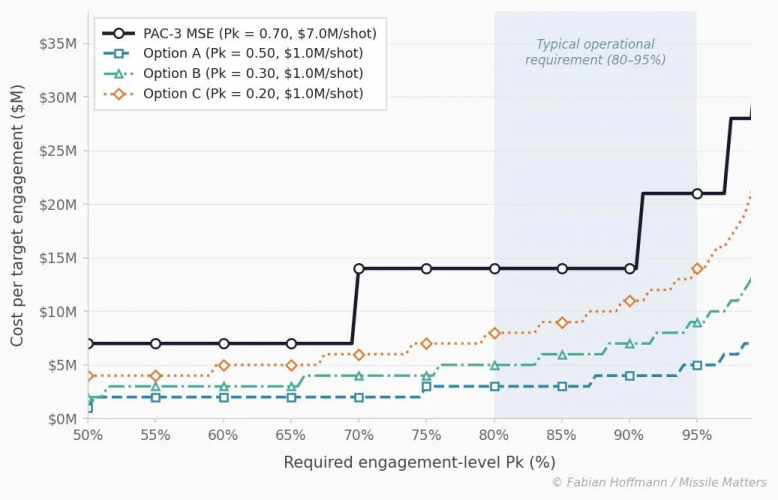
Assuming a per-unit cost of $7 million (export cost is $6-7m, US internal cost is $4m) per Patriot PAC-3 MSE, as per recent export contracts, and a (generous) individual intercept probability of 70 percent per shot, it will typically be necessary to allocate two to three interceptors per target to meet operational requirements of 80 to 95 percent intercept probability per engagement, resulting in an engagement cost of $14-21 million per incoming ballistic missile.
Several low-cost, lower-intercept-probability ballistic missile defense interceptors outperform the PAC-3 MSE at the engagement and salvo levels. For example, a ballistic missile defense interceptor with an intercept probability of “only” 20 percent but a per-unit cost of around $1 million falls below the PAC-3 MSE cost curve at relevant operational thresholds.
sure but looking at cost is not always the answer because the 1M dollar missile could take a similar amount of time to manufacture compared to the Pac 3 and therefore you neeed more misssiles for the same target, you also need t take into account the amount of missiles that can be fired from a single Ad sytem(including all launcher and and radars) at a time. So you need more launchers for the same capability and the launchers themselves cost a lot of money.The Last Frontier: European Manufacturers Move Ahead on Ballistic Missile Defense
https://missilematters.substack.com/p/the-last-frontier-european-manufacturers
*They've neglected to mention Israeli systems here.
View attachment 816516
It does actually mention that in the article. Launchers can be reloaded between attacks but yeah, you have to keep up on manufacturing rate for it to work, however, a cheaper missile is cheaper for a reason, generally because it's simpler and quicker to make.sure but looking at cost is not always the answer because the 1M dollar missile could take a similar amount of time to manufacture compared to the Pac 3 and therefore you neeed more misssiles for the same target, you also need t take into account the amount of missiles that can be fired from a single Ad sytem(including all launcher and and radars) at a time. So you need more launchers for the same capability and the launchers themselves cost a lot of money.
Not that easy to calculate.
HYDIS REACHES ANOTHER KEY MILESTONE TOWARDS THE DEFINITION OF A EUROPEAN INTERCEPTOR
The HYDIS Project has just achieved another significant milestone for the concept development of the future European counter-hypersonic and anti-ballistic interceptor by successfully completing its Final Concept Review. One interceptor concept has proven its relevance and has been selected by the Participating States (France, Germany, Italy, The Netherlands), over the two concepts from the Initial Concept Review. This marks a significant step before the conclusive milestone of the Concept Phase in May 2027.
Over the past few months, the consortium partners led by MBDA have worked hard in all domains of the interceptor and weapon system design, renowned institutes, academics and start-ups - on the design and technology maturation activities. The technical activities encompassed the design studies to refine the solid rocket motor-based concepts to match our customer requirements.
The HYDIS team specifically established an extensive performance assessment to evaluate the interception capabilities and the area protection of the most promising concepts based on a simulation with enhanced representation of the several phases of the interceptor fly-out.
The selected interceptor concept has also benefitted from the unique expertise of consortium members, notably
All integrated in a coherent concept based on MBDA’s expertise in complex weapon systems.
- AVIO for the Solid Rocket Motor propulsive architecture,
- ArianeGroup and ROXEL for the final interceptor stage control mechanism
- LYNRED for the terminal IR sensor.
The consortium has also made progress on integrating this interceptor into a complete weapon system.
The results of these studies were scrutinised by the HYDIS customer community (OCCAR – the Organisation for Joint Armament Cooperation - and the 4 Participating States) along a period of six weeks, allowing a solid exchange and fruitful iterations among the customers and the consortium. The convergence week provided the opportunity to address, resolve and converge on all the technical questions, allowing the consortium to present a clear and agreed picture to the HYDIS nations Steering Committee on July 10th. This new milestone demonstrates the consortium's full expertise in the fields of hypersonic and ballistic threats, backed by in-depth knowledge of air defence systems. Together, the HYDIS team members leverage on a robust capability to design a sovereign, advanced interceptor, that is timely responding to Europe’s operational needs.
- Thales Netherlands has provided refined performance data for both naval and ground sensor suite options
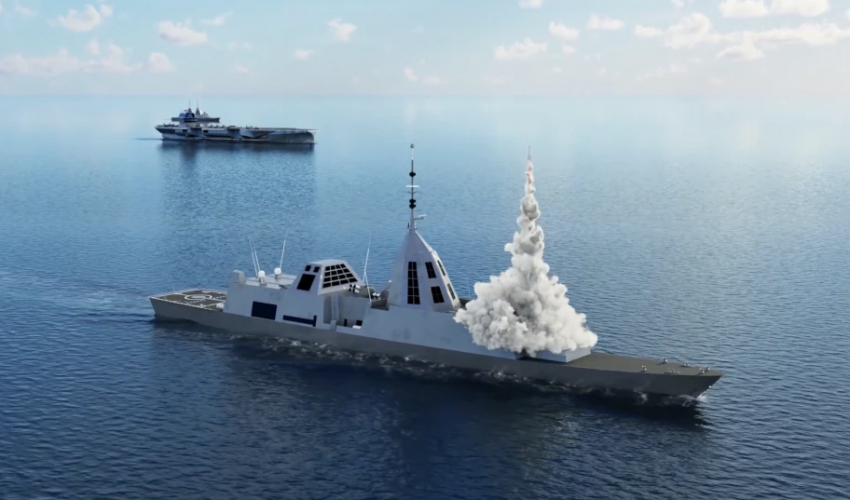
- GKN Fokker has gotten forward on the integrability assessment of the ammunition into the MK41s naval launcher.
From now on until the end of the Concept Phase in 2027, the consortium will put all its effort into the refinement of a unique concept, paving the way for a strong technical basis for the following Programme phases.
"GKN Fokker has gotten forward on the integrability assessment of the ammunition into the MK41s naval launcher."HYDIS/Aquila will be integrated on Mk41, great for the Netherlands whose FuAD would probably feature ESSM + Aster + HYDIS/Aquila + Tomahawk … we really need Aster integration.
If Bayern-Chemie GmbH offered the ramjet then its likely they where one of the 2 other concepts engine producer under HYDEF.The list of the main partner companies also suggests that Germany is focusing on HYDEF rather than HYDIS.
Yes of course, but the prefered missiles for FuAD are rumoured to be ESSM+Aster+Tomahawk + hypersonic interceptor (either HYDIS or HYDEF).Depends entirely on the US if they can same for HYDEF.....
I'm confident Bayern-Chemie was part of HYDIS.If Bayern-Chemie GmbH offered the ramjet then its likely they where one of the 2 other concepts engine producer under HYDEF.
OHB and TDW as well as Mbda will probaly still do the usual minor stuff