Scott Kenny
ACCESS: USAP
- Joined
- 15 May 2023
- Messages
- 19,511
- Reaction score
- 27,958
With SpaceX and Falcon/Falcon Heavy, it's now affordable to put tens of thousands of Brilliant Pebbles into orbit.

With SpaceX and Falcon/Falcon Heavy, it's now affordable to put tens of thousands of Brilliant Pebbles into orbit.

Who knows, watchSo do you think we'll see a 21st century version of Brilliant Peebles deployed?
Yes.So do you think we'll see a 21st century version of Brilliant Peebles deployed?

With an upgraded SM6.Aegis Combat System Demonstrates System’s Capability to Counter Hypersonic Threats
https://www.secretprojects.co.uk/threads/standard-missile-discussion.43296/post-771568

Elon has proposed this very thing basically saying “if I can launch that many Starlinks I can launch that many interceptors.”Yes.
I'd go with Starlink-sized "garages" so we can launch them 100 at a time.
With an upgraded SM6.

SM-6 Block IAUDo we know what upgrades exactly?

Only 450,000 rpm? Metal Storm was getting a million decades ago.I think this is the best thread for this:
https://armyrecognition.com/focus-a...erful-machine-gun-to-stop-hypersonic-missiles
Regards
Pooneer
The problem with intercepting hypersonics with guns is that the smaller caliber guns simply have too short range. You NEED a kill zone at least a few miles out, because even the debris of a successful intercept will be moving at mach 5. And thus will be a danger.I think this is the best thread for this:
https://armyrecognition.com/focus-a...erful-machine-gun-to-stop-hypersonic-missiles
Regards
Pooneer
Or a rail gun. The US did look at using GAU-8's to defend missile silos but all they had to do was damage the RVs and let the silo deal with the fragments. As long as it didn't detonate that's all that mattered.The problem with intercepting hypersonics with guns is that the smaller caliber guns simply have too short range. You NEED a kill zone at least a few miles out, because even the debris of a successful intercept will be moving at mach 5. And thus will be a danger.
There's a reason most navies are going to RAM or even CAMM type weapons and dropping low caliber gun type CIWS.
The only gun type CIWS that seems worth a damn against hypersonics might be something like the 76 mm type with guided ammo.
Is this actually any better or cheaper than air-bursting rounds? This would actually spread out the fragments, whereas electronic firing mechanisms fire out a shed load of rounds really fast in the same direction unless you use air-burst rounds with it I guess.I think this is the best thread for this:
https://armyrecognition.com/focus-a...erful-machine-gun-to-stop-hypersonic-missiles
Regards
Pooneer
Good question, one that I'm not qualified to answer.Is this actually any better or cheaper than air-bursting rounds? This would actually spread out the fragments, whereas electronic firing mechanisms fire out a shed load of rounds really fast in the same direction unless you use air-burst rounds with it I guess.

I'm assuming if it's found difficult to accurately calculate the optimal detonation time, then a cloud of bullets is not a bad alternative.Is this actually any better or cheaper than air-bursting rounds? This would actually spread out the fragments, whereas electronic firing mechanisms fire out a shed load of rounds really fast in the same direction unless you use air-burst rounds with it I guess.
Don't know the answer to that. Given the range of gun-type systems and the speeds involved, we're really talking about the last second before impact here. Is anything that doesn't completely obliterate the missile outright sufficient at that point?Good question, one that I'm not qualified to answer.
I'm wondering if a fragment from an air-burst would have the density and kinetic energy to damage a hypersonic system?
Regards
Pioneer
Depends on impact velocity.Don't know the answe to that. Given the range of gun-type systems and the speeds involved, we're really talking about the last second before impact here. Is anything that doesn't completely obliterate the missile outright sufficient at that point?
For example, ICBM RVs have slowed down to Mach 2 at about 20,000ft, just because of the dense air.
A lot higher than that even for depressed trajectories. Someone has a pdf somewhere on this very subject already posted in some thread.For example, ICBM RVs have slowed down to Mach 2 at about 20,000ft, just because of the dense air.
 For MET (Minimum Energy Trajectory) it's ~2.75km/s (Mach 8+) at impact (0ft) and you can see from the DT (Depressed Trajectory) lines that lifting body RVs can come down significantly faster than standard. Sadly there is no line for lifting body MET speed but it's ~3.3km/s even for DT which is about Mach 10.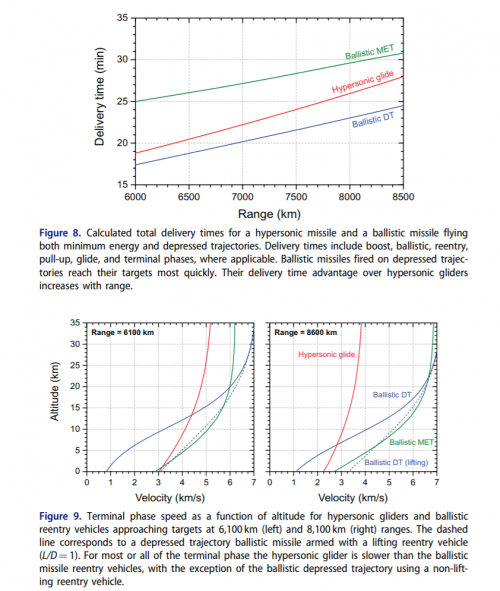
For example the Mk-1 RV used by the Polaris A1 and A2 had a terminal velocity of M1.2 (It was barely supersonic).
Crud, I think an old "Slow but deadly" SBD Dauntless dive bomber could have caught one!I was reminded of this fun fact, that the terminal velocity of the Mk-2 RV (Carrying the W49 and was used by early Atlas Ds) was only 350mph, a high-performance piston-engine fighter in the right location could've intercepted a Mk-2.
A lot higher than that even for depressed trajectories. Someone has a pdf somewhere on this very subject already posted in some thread.
EDIT: Well crap, that took ages to find but finally.
Post #206 GBI Thread.
https://www.secretprojects.co.uk/threads/ground-based-interceptor-gbi.18293/post-575521https://scienceandglobalsecurity.org/archive/sgs28tracy.pdf
View attachment 765221
Except that IIRC from stuff that's been posted on this forum, a Trident II's depressed trajectory range is under 6000km, with ONE warhead.A lot higher than that even for depressed trajectories. Someone has a pdf somewhere on this very subject already posted in some thread.
EDIT: Well crap, that took ages to find but finally.
I don't think so. The equations only care about distance flown, weight of "projectile", and I'm not sure those numbers included atmospheric drag at low altitudes.Surely the terminal velocity is dependent on the specific missile/fuel stack?
Possibly but that has little bearing on the conversation. Clearly for an ICBM warhead (like Minuteman) on an MET, the speed is nearer Mach 8+ at impact and would be significantly higher with a lifting body RV and at 20,000ft it's 4.5km/s or about Mach 12-13 for a standard ballistic MET at 8,600km range (actual MMIII range is 13,000km), which is slightly above Mach 2.Except that IIRC from stuff that's been posted on this forum, a Trident II's depressed trajectory range is under 6000km, with ONE warhead.
Except that DT drag is so high that impact velocity drops to under 1km/s at the practical DT range. And at 5km altitude is about 1.6km/s. (This is all straight off the chart you posted for 6100km range.)Possibly but that has little bearing on the conversation. Clearly for an ICBM warhead (like Minuteman) on an MET, the speed is nearer Mach 8+ at impact and would be significantly higher with a lifting body RV and at 20,000ft it's 4.5km/s or about Mach 12-13 for a standard ballistic MET at 8,600km range (actual MMIII range is 13,000km), which is slightly above Mach 2.
Per the charts you posted, about 2.75km/s at zero elevation.A Trident D5 MET range with 4 warheads is >6,000nm, think it was 6,100nm (11,500km) from memory, so again well over Mach 2 even at impact.
Why are we even talking about DTs again? We were discussing the use of a gun-type system against hypersonic objects, which implies lifting body warheads and scramjet weapons. You mentioning that the speed of an ICBM warhead at 20,000ft is only Mach 2 with no reference to DTs or range. As regards D5s, the DT ranges looked at for those seem to be 1,850-3,000km when dealing with a 7,400km MET configuration, which is 8 warheads.Except that DT drag is so high that impact velocity drops to under 1km/s at the practical DT range. And at 5km altitude is about 1.6km/s. (This is all straight off the chart you posted for 6100km range.)
That's for an 8,600km MET, 3km/s for a 6,100km MET. Add a hypersonic lifting body warhead and it's even higher, even for DT. So the bottom line is that with a gun you get exactly 1 go at obliterating it then you're done, all inside a second.Per the charts you posted, about 2.75km/s at zero elevation.
So, about like any other CIWS gun.So the bottom line is that with a gun you get exactly 1 go at obliterating it then you're done, all inside a second.
Except worse because the object is going about 10x as fast as a typical CWIS target. If you think about this, a burst length is typically about 1s, in half that time the lifting body MaRV has already travelled the final mile and hit you.So, about like any other CIWS gun.