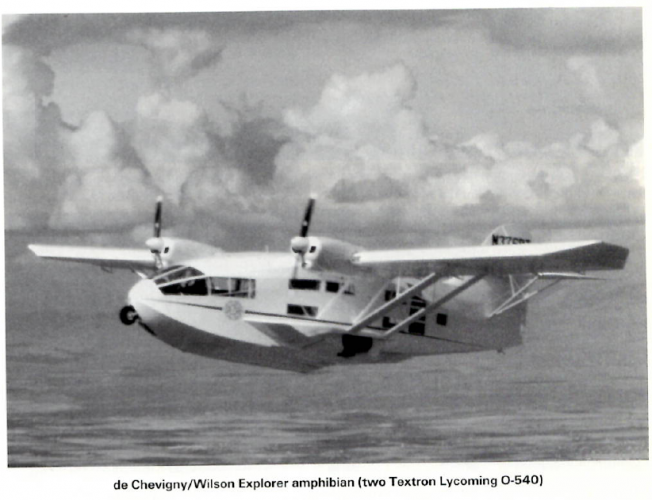
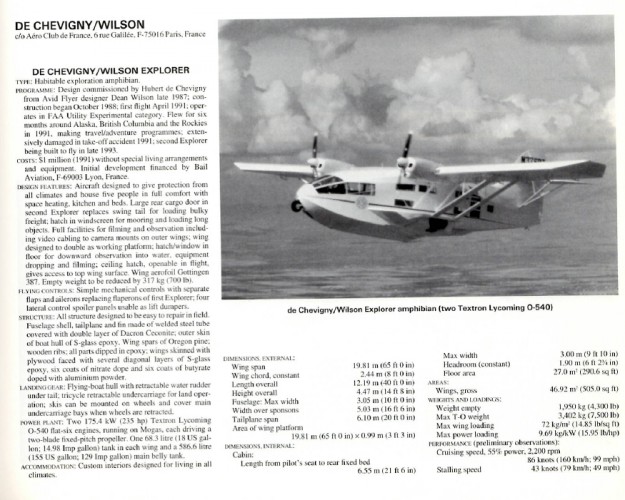
De Chevigny/Wilson Explorer Amphibian of 1990s

Although rather off topic, the following might be of some interest.

The prototype of an original amateur-built aircraft took to the air in late 2001 or early 2002. With enough space for two adults to sleep in and a small table with folding chairs as well as a small sink, that Nordic 8 Mini Explorer was a reduced-size derivative of a flying caravan designed by the American Dean W. Wilson and tested around January 1998, the four-seater Wilson Private Explorer, itself a single-engine derivative of the twin-engined Explorer / Global Explorer.

Between April and June 2001, Gérard d’Aboville, a French navigator and politician, Hubert de Boissonneaux de Chevigny, a French explorer and pilot, and Bernard Laferrière, a Québec pilot and businessmen, had completed an expedition to the North Pole in the Private Explorer, a flight performed without using a satellite positioning system.

De Chevigny had known Wilson for about fifteen years and helped design the Private Explorer. In fact, it was apparently he who owned the production rights of this aircraft.

According to some, it was Laferrière’s spouse, pilot and former Canadian long-distance mixed canoe champion Sylvie Gervais, who, in 2001, conceived the idea of creating a small derivative of the Private Explorer. De Chevigny gave his approval with enthusiasm.

Norman Aviation of Lévis, Québec, a small firm later based in Saint-Anselme, also in Québec, seemingly manufactured 15 or so Mini Explorer kits at around $34,500 each, and delivered them to buyers in North America and Europe. An airworthy aircraft would have sold for double that.

Jacques Normand, a former bush pilot and distributor of ultralights, had founded Norman Aviation around 1985-86. He had discovered a passion for this type of machine even before the end of the 1970s. Aware of the crucial importance of the English-speaking North American market, Normand used the name Jack Norman in his promotional material.
 
Although rather off topic, the following might be of some interest.

The prototype of an original amateur-built aircraft took to the air in late 2001 or early 2002. With enough space for two adults to sleep in and a small table with folding chairs as well as a small sink, that Nordic 8 Mini Explorer was a reduced-size derivative of a flying caravan designed by the American Dean W. Wilson and tested around January 1998, the four-seater Wilson Private Explorer, itself a single-engine derivative of the twin-engined Explorer / Global Explorer.

Between April and June 2001, Gérard d’Aboville, a French navigator and politician, Hubert de Boissonneaux de Chevigny, a French explorer and pilot, and Bernard Laferrière, a Québec pilot and businessmen, had completed an expedition to the North Pole in the Private Explorer, a flight performed without using a satellite positioning system.
And before that date - the Explorer 1 and 2 flying boats, by Hubert de Chevigny. Explorer 1 for TF1 and Nicolas Hulot; Explorer 2 for Canal+ and Stephane Peyron, both nature explorers.

https://fr-wikipedia-org.translate.goog/wiki/Hubert_de_Chevigny?_x_tr_sl=fr&_x_tr_tl=en&_x_tr_hl=fr
Following the successful polar expedition of 1987, Hubert de Chevigny contributed to the filming of several Ushuaïa television programs , notably in southern Africa, and then embarked on the design of a long-range, all-terrain, crewed aircraft, the Explorer , which he had built in Dean Wilson's workshops in Idaho . The first prototype, Explorer 1 (N376DT) , intended for the Ushuaïa Foundation and TF1 for Nicolas Hulot, flew only during the summer of 1991 before crashing in British Columbia . The second prototype, Explorer 2 (N376LC), was used by Canal Plus for Stéphane Peyron 's program Dans la nature (In Nature ), nicknamed "The Plane" . Capable of carrying seven people, it was used in various locations, including Tierra del Fuego and the Great Barrier Reef .

In 2001, Hubert de Chevigny returned to the North Pole with Gérard d'Aboville aboard a Private Explorer aircraft (also called Explorer Ellipse or mini-Explorer ) of his own design, also built in Idaho. The expedition aimed to reach the North Pole using celestial navigation, sextant and solar compass, without the aid of GPS instruments.

 
I'd personally like to say that the Aircraft looks more or less like a Flying boat from the 30s, the only visual difference that catches the eye for me is the propellor blades, they look more or less like a modern approach to a flying boat design, it also looks like they stapped to frontal fuselages of a Cessna 172 and its engines and strapped them to each wing.
 

Similar threads

Back
Top Bottom