DDG(X) - Arleigh Burke Replacement

At least. The design is scalable however thanks to the DPM, and the growth margins are such that it is very futureproofed. The Navy identified a need for 88 LSCs in the 30 year shipbuilding plan of which DDG(X) will ideally form the backbone.

Well, DDG(X) is dead, so it seems unlikely.

I suspect Burke Flt III will take up the slack, and BBG replaces the Ticos and Flight Is, which covers the same two-tier escort for the CVs.

More likely is BBG gets canceled and it's all Flight IIIs forever.
 
How can it supplement DDG(X) when DDG(X) is dying so that this may live?
That's unfortunate. I was under the impression that AB flight III's when transition to DDG(X) once it's mature. Then a cut down BBG(X) would be something on top. I believe that SPY6v1 on the AB III's and DDG(X) won't be sufficient for BM/hypersonic defense of either ships or other targets.
 
I did mention that an ASW DD assumes that it is cheaper to build the ASW DD than the Burke Replacement. I'm not convinced that that is true with the Navy installing SP6 and Aegis on everything, and as you mention the IEP ships should be pretty quiet.
You do know why they fit SPY-6, right? The proliferation of AShMs makes this basically the minimum required to meaningfully contribute to a CSG. Also Aegis Baseline 10 has open architecture which allows it to work in with basically any sensor so that's even less of an issue. Standardizing around Aegis is a good goal and, other than LCS which uses COMBATSS-21, all surface combatants were well on their way to achieving this goal.
Each Carrier Group needs a BBG. Each Amphib Group needs a BBG in wartime. Each Numbered Fleet should have a BBG, assuming that the Flag CIC can do more than just AAW, else the Numbered Fleets will need a modified Flag CIC. That's 31.
Why??? Why can't they just have DDG(X)? The BBG doesn't fit the proposed fleet architecture and doesn't fit the USN shipbuilding plan. Why would you take a ship with the same capabilities but that costs more over DDG(X)???
If merchant ships are still slow enough that convoys would be required, you will want a BBG for each convoy as well. That makes a total of about 40.
Why on earth would a ship of this nature escort merchant convoys??? Dude, even the Ticos weren't meant to do that. Come on, can we at least ground the discussion in some reality?
No, the divested LCS hulls were "Flight 0" and had serious material issues.
That doesn't change the fact that the USN said they were surplus to requirements. If they weren't the issues could've been fixed or the hulls would've been replaced.
Also, LCS are incapable of ASW except by acting as a lily pad for ASW helos.
Neither is the current FF(X) plan so...
The USN needs 50something ASW FFs (which may be 3-5kton USVs) to track the metric shit-ton of submarines China is fielding, and to keep the Russians honest. Two towed arrays, or a hull array and a VDS, whichever works out to be cheaper. 16x Mk41, SeaRAM, the usual 2x triple LWT launchers, and a couple ASW VTOL UAVs. Oh, and 4x RWS for anti-UxV.
Beyond the scope of the discussion but even then, that doesn't have much utility in the modern US fleet architecture so...
Well, DDG(X) is dead, so it seems unlikely.
Not quite yet, apparently (this is nothing but rumors so treat it as such) there is even confusion within NAVSEA as to what the future looks like under the new direction as they've been totally blindsided. This still has to pass congress and in the meantime it is my understanding that progress is going ahead.
That's unfortunate. I was under the impression that AB flight III's when transition to DDG(X) once it's mature. Then a cut down BBG(X) would be something on top. I believe that SPY6v1 on the AB III's and DDG(X) won't be sufficient for BM/hypersonic defense of either ships or other targets.
Are you realizing how entirely stupid this clearly political and not strategic decision is?
 
You do know why they fit SPY-6, right? The proliferation of AShMs makes this basically the minimum required to meaningfully contribute to a CSG. Also Aegis Baseline 10 has open architecture which allows it to work in with basically any sensor so that's even less of an issue. Standardizing around Aegis is a good goal and, other than LCS which uses COMBATSS-21, all surface combatants were well on their way to achieving this goal.
Correct. Which is why I caveated the statement of the ASW DD.


Why??? Why can't they just have DDG(X)? The BBG doesn't fit the proposed fleet architecture and doesn't fit the USN shipbuilding plan. Why would you take a ship with the same capabilities but that costs more over DDG(X)???
Because giving 100+ DDGX the full flag suite each is more expensive than building a limited number of dedicated flagships.


Why on earth would a ship of this nature escort merchant convoys??? Dude, even the Ticos weren't meant to do that. Come on, can we at least ground the discussion in some reality?
Because it's the only ship in the fleet with the flag space to coordinate the defense of the convoy.


That doesn't change the fact that the USN said they were surplus to requirements. If they weren't the issues could've been fixed or the hulls would've been replaced.
They were not economical to repair and the USN finally admitted internally that the LCS were damn near worthless.

That why they were scrapped without replacement.


Are you realizing how entirely stupid this clearly political and not strategic decision is?
The politics is that they're making it a 35kton ship instead of something in the mid 20s. Which means that Congress can whine about the costs and the Navy can come back with a ~20-25kton design that is much more affordable in comparison. Congress thinks they won and the Navy gets the 20-25kton ship that they actually wanted in the first place.

And boom, there's your Flagship.
 
What are the odds that the US Navy will pick the F127 as replacemend for the Arleigh Burke replacement?
 
What are the odds that the US Navy will pick the F127 as replacemend for the Arleigh Burke replacement?
Nil. Whatever its merits might be, the US is reluctant to procure foreign-designed military equipment at the best of times, and the Constellation-class experience will be seen as evidence that doing so for warships doesn't work at all.
 
What are the odds that the US Navy will pick the F127 as replacemend for the Arleigh Burke replacement?
While it will be a modern AEGIS destroyer, for one the program hasn't officially started yet. Second the F127 will be designed and constructed to our standards, not the American ones. And lastly the Americans successfully managed to associate the complete failure of Constellation on it being based on a foreign design they thought necessary to modify. They won't touch anything foreign for large surface ships in the coming decades because of that. That the FREMM is a great frigate that works and serves well and in numbers, and that all the failures are completely inherent to the Americans, their Navy and their need to tinker with the work of others beyond what would have been absolutely necessary is irrelevant (to them).

They wouldn't even touch the Sejongs or Mayas, which are closer to their Burkes than many other ships out there.
 
What are the odds that the US Navy will pick the F127 as replacemend for the Arleigh Burke replacement?
Another possible option is the Japanese ~ 17,000 ASEV, Aegis System Equipped Vessel, design is completed and now in full build. At first glance would save many $billions and years in build, but don't think Congress would fund it as its not designed in US to whatever survivability NAVSEA standard chosen and also its fitted with the more powerful two main RR GTs (as in the Zumwalt) not GE GTs and the Lockheed SPY-7 radar and expect Navy would insist on the Raytheon SPY-6.
If the DDG(X) did go south and Navy did chose the ASEV it would be more than likely be a repeat of Constellation disaster.
 
Another possible option is the Japanese ~ 17,000 ASEV, Aegis System Equipped Vessel, design is completed and now in full build. At first glance would save many $billions and years in build, but don't think Congress would fund it as its not designed in US to whatever survivability NAVSEA standard chosen and also its fitted with the more powerful two main RR GTs (as in the Zumwalt) not GE GTs and the Lockheed SPY-7 radar and expect Navy would insist on the Raytheon SPY-6.
If the DDG(X) did go south and Navy did chose the ASEV it would be more than likely be a repeat of Constellation disaster.
To be fair, the RR turbines ARE in use in the Navy. And not just in the Zumwalts, but also in the LCS. They have a parts and maintenance pipeline for them.
 
I was under the impression that the Japanese did use pretty close to US survivability standards. (IIRC their subs are SUBSAFE-compliant)

So ASEV might be an option as DDGX or whatever the BBG finally ends up as.
 
Everyone who I know who been on US, South Korean, japaneses and European ships all agree that the Asian ones are far closer to US Standards then the Euros.

*Stares at the ITalian Staircase of doom*

Add in the constant attempts to pivot to Asian from Europe who should be able to take care of themselves?

I can see them a South Korean Japanese design working where the Euro one fail.

Big issue is of course the devil details.
 
Correct. Which is why I caveated the statement of the ASW DD.


Because giving 100+ DDGX the full flag suite each is more expensive than building a limited number of dedicated flagships.


Because it's the only ship in the fleet with the flag space to coordinate the defense of the convoy.


They were not economical to repair and the USN finally admitted internally that the LCS were damn near worthless.

That why they were scrapped without replacement.


The politics is that they're making it a 35kton ship instead of something in the mid 20s. Which means that Congress can whine about the costs and the Navy can come back with a ~20-25kton design that is much more affordable in comparison. Congress thinks they won and the Navy gets the 20-25kton ship that they actually wanted in the first place.

And boom, there's your Flagship.
Every country on this planet has politics mixed into their military complex planning, just the way things go unfortunately.
 
Missed this one:
I don't think at 15-20 thousand ton ship is enough.

The DDG(X) was headed towards a CG(X) without the lasers, the extra gun armament, or the CPS tubes. Add lasers and a CPS and you're exceeding the CG(X) without any growth margin, which puts the Navy right back to where it is today.
Valid concerns.

I still think that the 35kton proposal is intended to give Congress the appearance of getting a win by forcing the Navy into a smaller ship, while the Navy builds the 20-25k CG they wanted all along.


Furthermore, creating a BBG(X) allows the DDG(X) to shrink to something reasonable (10kTons) that could actually be built in enough numbers to be worthwhile.
I'm not sure that the Burke Replacement is going to be able to shrink much, if any. The BMD mission requires big antennas mounted up high, which makes for a large ship. Crud, the Constellation and contemporaneous Euro-frigates are 7000-8500 tons.
 
But opening with a 35kton design for a ~25kton operational need seems a bit gratuitous.
I’m not sure there’s any actual difference in actual systems costs, just the physical size of the hull. The old adage that “steel is cheap and air is free” may very well be the basis of this design evolution. Personally, I think that adding the near Polaris sized CPS missiles shifted thinking towards an actual capital ship designation instead of a mere escort.

Personally, I think the term generic term “battleship” is somewhat more relevant than “torpedo boat destroyer.” I also don’t see any reason why a modern automated ship of 35,000 tons ship would have substantially higher crew or operating costs than one of 25,000 tons. If you don’t believe me, look at how cruise ships have been economically scaled up.

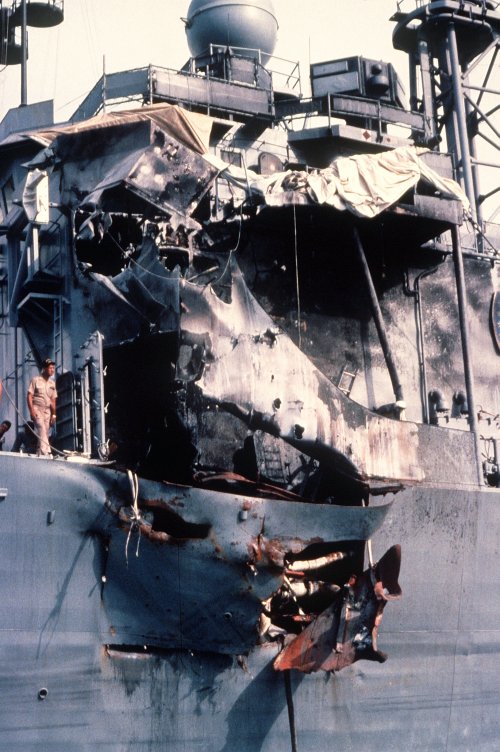
That brings me to the fallacy of damage control with frigates and destroyers. From the experience of the Falklands War, Stark and Cole, highly dense modern warships can easily become immobilized and inoperable despite redundancy and well trained crews. I’d argue that a 35,000 ton hull might have shrugged off a single mine or missile strike and remained operational and underway, albeit with reduced speed. Investing in the survivability of the hull makes sense in a world where a full spectrum of threats will be present in nearly every scenario. Proliferation of threats to non-state proxies like we’ve seen in the Red Sea will make all naval operations more dangerous.

I’d argue that the greatest threat to a “battleship” in Congress is the use of the quartet of Iowa class ships as a historical precedent for overall force numbers. For any warship program to be worthwhile, you need double digits. Period.
 
I’m not sure there’s any actual difference in actual systems costs, just the physical size of the hull. The old adage that “steel is cheap and air is free” may very well be the basis of this design evolution. Personally, I think that adding the near Polaris sized CPS missiles shifted thinking towards an actual capital ship designation instead of a mere escort.
That could be.

I also suspect that the sheer size demonstrated by Zumwalt has made it difficult to sell Congress that these are "destroyers" anymore.


That brings me to the fallacy of damage control with frigates and destroyers. From the experience of the Falklands War, Stark and Cole, highly dense modern warships can easily become immobilized and inoperable despite redundancy and well trained crews. I’d argue that a 35,000 ton hull might have shrugged off a single mine or missile strike and remained operational and underway, albeit with reduced speed. Investing in the survivability of the hull makes sense in a world where a full spectrum of threats will be present in nearly every scenario. Proliferation of threats to non-state proxies like we’ve seen in the Red Sea will make all naval operations more dangerous.
Maybe?

Wasn't Stark nearly blown in half? Or was that one of the ships that hit a mine?


I’d argue that the greatest threat to a “battleship” in Congress is the use of the quartet of Iowa class ships as a historical precedent for overall force numbers. For any warship program to be worthwhile, you need double digits. Period.
Very much agree here. At a bare minimum, one for each carrier. And per the 800 ship navy thread, the old Cold War standard was two cruisers per carrier, plus 2x DDG51s and 2x Sprucans.
 
That could be.

I also suspect that the sheer size demonstrated by Zumwalt has made it difficult to sell Congress that these are "destroyers" anymore.
Maybe?

Wasn't Stark nearly blown in half? Or was that one of the ships that hit a mine?

Very much agree here. At a bare minimum, one for each carrier. And per the 800 ship navy thread, the old Cold War standard was two cruisers per carrier, plus 2x DDG51s and 2x Sprucans.
Sammy Roberts was blown in half (her keel snapped, but they managed to hold her together with some cabling. But her sensors and weapons never went offline. Stark was hit by two exocets (only one warhead fused) in close proximity to the CIC and her crew initially took around 15% dead and 25% total casualties. There were a few issues that led to it, but her crew hadn't been properly maintaining the CIWS and the CIWC/STIR guy was in the head taking a leak during the engagement. The location and nature of her damage (especially the large fuel fires due to the very short range of the engagement) meant she was not capable of combat.

In both cases the ships' crews performed admirably in saving their ships and they were returned to service.

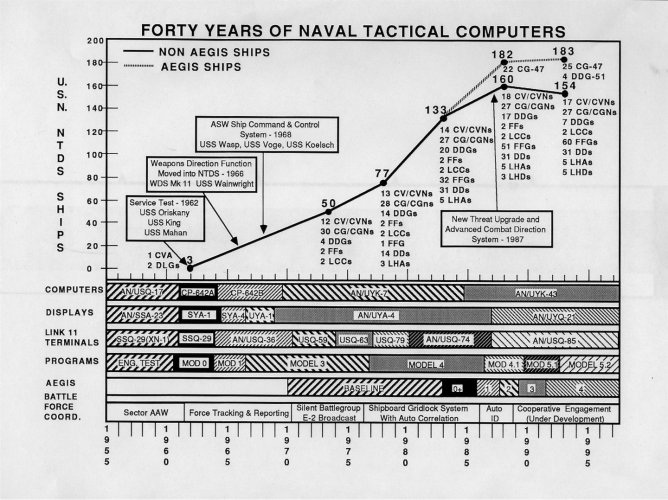
As for the "battleship" commentary and Cold War task force composition... It'd be a neat trick to get a carrier to have two DDG-51s during the Cold War given DDG-52 didn't commission until '92. There was a more-or-less standard of two CG(N) and two DDG (plus ASW ships) during the Cold War, but that had more to do with having a good balance of Tartar/SM-1MR and Terrier/SM-1ER shooters, the general chaos of USN computer equipment in the 1970s, etc.

You can look through https://www.navysite.de/carriers.htm for a decent list if you go to the deployments tab. "2x CG/2x DDG/2xDD" could mean anything from a Belknap, a Mk.13 Adams and a Mk.11 Adams (Kitty Hawk '81 WESTPAC), to two Leahys, two Adams, a Spruance and a pair of Knoxes (Midway WESTPAC '87) to a Tico, Leahy, Belknap, Sprucan, a Mk.13 Adams, two Perrys and a Knox (Ranger, WESTPAC '89), etc. There's a ton of variation, and people (IMO) really forget how much we were using the CFAs until the end of the Cold War. But a fair amount of the time, especially in the early 80s, you had only one CG, and sometimes it was just a single ended ship.
 

Attachments

  • USS_Stark_(FFG-31)_-_external_damage_by_exocet_alternate_view.jpg
    USS_Stark_(FFG-31)_-_external_damage_by_exocet_alternate_view.jpg
    2.2 MB · Views: 35
  • 40_Years_.jpg
    40_Years_.jpg
    573.7 KB · Views: 34
Last edited:
A variety of commentaries.

According to this, the Trump Class makes no sense either as an individual type or doctrinally. It's trying to do too many of the wrong things for one hull and very uneconomically to boot. Lots of number crunching.

View: https://www.youtube.com/watch?v=qvUbx9TvOwk

One point is that from the Zumwalts, the Navy had been too confident about unproven technology such as railguns. This reminds me of the fact that for the B-21, the Air Force had ruled out speculative technology and relied as much as possible on stuff that was off the shelf, with the result that the programme is on time and performing well.

Given the time it takes to actually get a ship in the water and supposing that there is an election in 2028, or if Trump isn't pushing daisies before then, the concept could be whittled back into a viable DDGX.

View: https://www.youtube.com/watch?v=bHEl-dlR_pA


Lots of theatrics in this one, but getting past that, this commentator argues that the railgun is the one significant feature to look at. He believes that its technical problems were solvable - or even solved - and it was the missile mafia that killed it but this could be an opportunity for its comeback.

View: https://www.youtube.com/watch?v=jMR6KnkeCTg


The economics, logistics, and politics of shipbuilding related to this project.

View: https://www.youtube.com/watch?v=eD_qoLXW_fQ

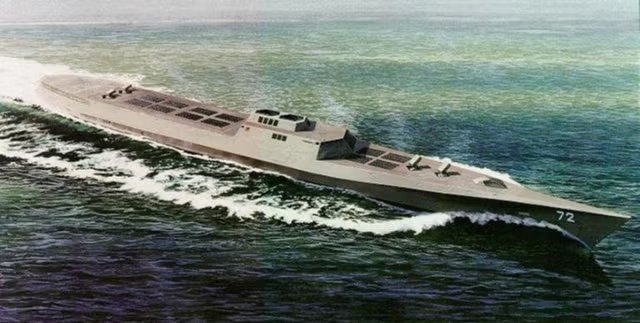
The renders can't be taken seriously of course. Putting the defensive armament in the middle where arcs of fire are limited and the low helideck are clearly wrong. It's an illustration to a menu where the customer has ordered everything in a bucket. There's no way that that this represents an actual design.

My impression is that a best, or least worst case scenario, is that maybe the Navy has been surreptitiously working to use the Trump class as a Trojan Horse to open funding for what it really needs, and although the process will be a fustercluck, it may be a means to enable a real Ticonderoga replacement. However, it's still up to whether Congress allocates funding.

Anyway, lets see what happens with railguns. Japan is still pursuing them, BAE has experience, and General Atomics feels confident.
 
Last edited:
I stand corrected.


The caveat is that the wargame assumes they aren't simply landing assault troops after establishing the blockade, which is probably more likely, since starving out Taiwan is not the most practical strategy given what the PLAN has been building. You don't really need helicopter assault carriers or expeditionary piers for a blockade.

I could see a blockade being the first step, with the threat of invasion hanging over it. If the U.S. doesn’t get involved, win. If the U.S. does get involved, it’s probably better to focus on defeating them rather than stage an invasion that could be incredibly costly and spread the escort force out. If you defeat the US, Taiwan falls into your lap anyway.
 

Not sure if its been posted, but if it has / topic isnt allowed, then do remove.

Basically, the whole article:
During a speech at the Surface Navy Association’s annual conference today, Rear Adm. Derek Trinque ... said ... [the BBG(X) requirements] grew out of the Navy’s DDG(X) program aimed at building a next-generation destroyer to succeed the Arleigh Burke class.

“We found ourselves in a weird situation” where in order to keep its desired number of vertical launch cells on the new destroyer, “we were going to have to make a choice between a gun weapon system and Conventional Prompt Strike,” the Navy’s soon-to-be fielded hypersonic weapon, Trinque said.

The Navy considered making two different variants of DDG(X) — one with a gun system and another able to launch Conventional Prompt Strike missiles — but Trinque added, “I don’t want to put those kind of limits on a fleet commander.

“And so when national leaders announced that they were interested in building a battleship, this was a great opportunity,” he said.

The battleship will have Conventional Prompt Strike, gun weapon systems, a “large number” of vertical launch systems, power for directed energy weapons — an “incredible amount of offensive strike capability” as well as command and control capacity that the Navy does not have in its current fleet, he said.

The Navy currently believes about 700 people will be needed to man the battleship, he added.

 
Last edited:
Everyone who I know who been on US, South Korean, japaneses and European ships all agree that the Asian ones are far closer to US Standards then the Euros.

*Stares at the ITalian Staircase of doom*

Add in the constant attempts to pivot to Asian from Europe who should be able to take care of themselves?

I can see them a South Korean Japanese design working where the Euro one fail.

Big issue is of course the devil details.
The Sejongs look like they have unit construction, given the spacing between the funnels, but I think I read somewhere they don't. Can anyone confirm one way or the other?

The Japanese ships do. I suspect they are very close to USN standards, but that would need more research. I've suggested ASEV before as a Tico replacement.
 
Basically, the whole article:

“We found ourselves in a weird situation” where in order to keep its desired number of vertical launch cells on the new destroyer, “we were going to have to make a choice between a gun weapon system and Conventional Prompt Strike,” the Navy’s soon-to-be fielded hypersonic weapon, Trinque said.

The Navy considered making two different variants of DDG(X) — one with a gun system and another able to launch Conventional Prompt Strike missiles — but Trinque added, “I don’t want to put those kind of limits on a fleet commander.

“And so when national leaders announced that they were interested in building a battleship, this was a great opportunity,” he said.
Huh.

That is not quite how I expected the story to go...
 

Aspects of future battleship originate from DDG(X) requirements, surface warfare director says​


Choices for next destroyer paved way for Navy’s new battleship program​

 
Honestly I'm shocked too.
Seems to be the US Navy top brass liked and supported the idea of the BBG(X).
 
Even on this thread there was talk of the 14.5k DDGx not being BIG enough to fit everything they wanted in and the Range to the standards they wanted.

Probably could if they cut one or the other but not all at once.

And since this is likely going to be the last big surface combatate for the next 30 years?

May as well add enough so we don't have to worry bout another Burke not big enough situation.
 
Even on this thread there was talk of the 14.5k DDGx not being BIG enough to fit everything they wanted in and the Range to the standards they wanted.

Probably could if they cut one or the other but not all at once.

And since this is likely going to be the last big surface combatate for the next 30 years?

May as well add enough so we don't have to worry bout another Burke not big enough situation.
Well, my problem is why the need bigger?
Rear Admiral Derek Trinque note the need to choose between gun and CPS armament.
But the CPS and other missiles simply can be placed a large USV and that's it. If it needed, then attach the necessary armament to the fleet. If won't need, then can be replaced.
The USV can act as close defense ships (put the lasers on them!).
Can act as peripheral defense line.
So you won't need all the fancy thing onboard the main ship.

What I maybe can understand is they need is the command and control capacity (second CiC?).
But even that can be dismissed as the XXI. century warfare is network-based. What the difference if the command element not in the same fleet segment, but for example has it's CiC in Quantico for example?
Really matters? Sub-second response time either way. And if the space infrastructure negated, then the whole thing is blasted anyway as everything is relying on them.
 
Even on this thread there was talk of the 14.5k DDGx not being BIG enough to fit everything they wanted in and the Range to the standards they wanted.

Probably could if they cut one or the other but not all at once.

And since this is likely going to be the last big surface combatate for the next 30 years?

May as well add enough so we don't have to worry bout another Burke not big enough situation.
Consider that for decades the Ticonderoga replacement was to be based on the 16,000 ton DD-21 / DD(X) / Zumwalt, and that was BEFORE CPS cells were a thing. That they would want a ship this large should surprise exactly nobody.
 
USVs can house kinetic effectors and both air and subsurface sensors.

Unfortunately power generation is a real issue for USV and power is non negotiable for most energy based weapons that you’d care about. Perhaps in time this will change, but currently its a very real imposition that helps understand would could, couldn’t and/or should be disaggregated.
 
The US admiralty seems to be favoring a large surface combatant over a distributed approach for a couple reasons. The most obvious issue is, as @Training_Dummy already mentioned, power generation.

USVs with sensors and DEWs need plenty of power, which increases size, which increases cost and complexity in return. Same with missiles, in order to make such a platform viable, you need a certain amount of missiles to make the vessel a worthwhile force multiplier. This means space needs to be dedicated for the missile cells, but also for propulsion, powerful generators as well if you want to put lasers and capable sensor equipment like decent radars on the vessel too. Again, size and cost rise.

Now, you then need many of these USVs, which would have grown and suffered from mission creep. So you need to produce many, untested, not all that cheap ships in the few yards you have left. That's not a great idea, really.

While BBG(X) as a large surface combatant with plenty of missile cells, capable radar, DEWs and flag facilities is essentially the modern day missile cruiser the Navy has wanted for decades now. A proper Ticonderoga replacement for the 21st century, a top of the line surface combatant that doesn't need to hide in an era of ships like the Sejongs, Type 055s, modernized Kirovs or the upcoming Japanese ASEV CGs.

Having a single class of capable large surface combatants with all the goodies makes implementation actually easier, because you'd select one yard to get them into the water, you'd have one standardized armament rather than having multiple different sensor and weapon oriented USVs, you could easier integrate it into current US naval structure and the amount of sheer power and space you can work with is a great opportunity for future improvements.

USVs are supplements, not replacements. And they certainly should not be seen as high end platforms or replace the same. Because that just won't work out. Also UUVs are far more promising imo.
 
The US admiralty seems to be favoring a large surface combatant over a distributed approach for a couple reasons. The most obvious issue is, as @Training_Dummy already mentioned, power generation.

Very much agreed. During Operation Southern Spear (Venezuela), the reporting and footage around what appeared to be a DEW weapon onboard a Burke made the value of the large surface combatant quite clear.
 
I think he's honestly got it backwards. Putting all those capabilities into a single hull handcuffs the commander more, because he will likely find himself wanting those capabilities in different places at the same time. CPS almost certainly has a significant *minimum* range while guns have very limited maximums. Your CPS shooters will need to sit back from their targets, which isn't compatible with many other tasks. Same applies to TBMD, which may require a ship to position itself in a specific place relative to the task force that isn't compatible with using CPS or guns.
 
Honestly I'm shocked too.
Seems to be the US Navy top brass liked and supported the idea of the BBG(X).

I am surprised too, but I suspect they are simply bending to the wind. Witness F47: if stroke the administration’s ego, you get funding. That is exactly why the budget system was never designed to work around the executive branch.

BBGX still dies by 2029 at the latest, if only for purely political reasons.
 
USVs can house kinetic effectors and both air and subsurface sensors.

Unfortunately power generation is a real issue for USV and power is non negotiable for most energy based weapons that you’d care about. Perhaps in time this will change, but currently its a very real imposition that helps understand would could, couldn’t and/or should be disaggregated.

There is no read to base guns or CPS on an ABM air defense platform. They add nothing to the mission other than cost. DDGX should focus on sensors, C&C, power, and sufficient defensive magazine size to support that requirement.
 
I think he's honestly got it backwards. Putting all those capabilities into a single hull handcuffs the commander more, because he will likely find himself wanting those capabilities in different places at the same time. CPS almost certainly has a significant *minimum* range while guns have very limited maximums. Your CPS shooters will need to sit back from their targets, which isn't compatible with many other tasks. Same applies to TBMD, which may require a ship to position itself in a specific place relative to the task force that isn't compatible with using CPS or guns.

This. No one will risk ABM platforms in gun range and a CPS platform has 2000nm of stand off (annd ans noted probably a minimum range measurement in the mid to high hundreds of miles) and does not need to be inside CSG/escort range. Combining these requirements is just amateurish “pew pew pew” thinking. A gun platform or CPS launcher does not have huge sensor, power, or c3 requirements and you can offload that to some other platform, assuming you absolutely need gunfire for some stupid reason.
 
Agree. Their magazines should be for selfdefense and a dozen shots for offensive; should they find themself pushed to the wall or simply having target of opportunity etc..
The main offensive magazine should be moved onto the USV/UUV that also do the ASW sensing/chasing/hunting since this is always short range.
 
Agree. Their magazines should be for selfdefense and a dozen shots for offensive; should they find themself pushed to the wall or simply having target of opportunity etc..
The main offensive magazine should be moved onto the USV/UUV that also do the ASW sensing/chasing/hunting since this is always short range.

No, you are misunderstanding me. The magazines should be optimized for area air defense of a task force - much more than self defense - and the offensive requirements offloaded to some other platform. There’s no reason you could not throw several dozen CPS onto a ~$300 million Alaska class tanker hull (the mobile base platforms), or the new T-AKO hulls. Plenty of space, in production, sufficient speed, low cost, basic self defense accommodated provided though not currently equipped. Bonus: you can blend these in to other USN military traffic, or potentially even small civilian tanker traffic.
 
I think he's honestly got it backwards. Putting all those capabilities into a single hull handcuffs the commander more, because he will likely find himself wanting those capabilities in different places at the same time. CPS almost certainly has a significant *minimum* range while guns have very limited maximums. Your CPS shooters will need to sit back from their targets, which isn't compatible with many other tasks. Same applies to TBMD, which may require a ship to position itself in a specific place relative to the task force that isn't compatible with using CPS or guns.
But then if you stick your CPS cells on their own, lightly armed ships then they'll need escorts too. . .

gallery-1496693296-arsenal-72.jpg
 

Similar threads

Back
Top Bottom