Or just get equivalent guided air defence rounds for the 57mm. If its still possible.Better yet, make the same changes to the 57mm and get 76mm performance in a 57mm. Am I doing this right?

You are using an out of date browser. It may not display this or other websites correctly.
You should upgrade or use an alternative browser.
You should upgrade or use an alternative browser.
DD(X) DDG-1000 Zumwalt-class destroyers
- Thread starter Demon Lord Razgriz
- Start date
This is built on a foundation that demonstrates a lack of understanding of the program at hand. At it's simplest the "exotic guided shell" you mention worked but the production run for just 6 guns was fiscally irresponsible and realistically gun based fire support does not work in the modern threat environment. An 8in gun like MCLWG would be even worse as it's range is much reduced when compared to LRLAP or BLRP. It would behoove you to research the program itself before making such wild claims.If they had been deployed about 20 years sooner there is no AGS or railgun plans and the weapon system matches the era. But to launch them so much changed from the initial version, there was zero hope to be anywhere near bleeding edge. I suspect it coming out with SPY-6 and the latest Standard RIM-174 ERAM then nobody clowns on them. But they eere shoehorned into a bad radar plan and custom Standards with low end of the spectrum capabilities. Would have also been nice to see naval 8-inch guns. But instead they dumped limited funds into exploring hopium railguns and large, exotic guided shell technologies. Even Mark 51 looked capable as a big caliber but then they overpromised smart guidance from an otherwise dumb gun.
A nuclear powerplant was (and is) both practically inefficient and fiscally irresponsible for LSC propulsion based on existing technology according to basically every study conducted since the late 70s. The program is not on "life support", they've just been equipped with some of the most lethal strike weapons in the world and are going to conduct patrols in WESTPAC to hold HVTs at risk.A destroyer nuclear reactor and turbines would have been a pretty nice one-two range booster from the get go. But now the program is on life support. Surely there is a plan to bridge the capability between LCS Independence class and Zumwalt for the future.
They already exist and are in use. A more advanced round to target threats OTH is also in development.Or just get equivalent guided air defence rounds for the 57mm. If its still possible.
As the Navy has indicated, they will not be conducting deployments typical of the rest of the fleet where Mk 45s or 110s would be an asset. If anything RIM-116 might be the better option if any sort of further point defense is judged necessary
ALAMO? Both ALAMO and ORKA appear to be oriented against surface craft, although ORKA is a 3P derivative so should retain the programmed air burst mode that would make it effective against cruise missiles.They already exist and are in use. A more advanced round to target threats OTH is also in development.
Last edited:
iirc Orka sucked so bad that the US decided to build their own equivalent rounds. I've been told that ALaMO is adequate against subsonic AShMs, helicopters, OWA drones, etc. although cannot engage targets OTH which is the point of the new LM programALAMO? Both ALAMO and ORKA appear to be oriented against surface craft, although ORKA is a 3P derivative so should retain the programmed air burst mode that would make it effective against cruise missiles.
Don't know what you're getting at. Yes, Zumwalt was a design driven by FFTS which incorporated many revolutionary technologies. Functionally all of the technologies worked even if some (such as AGS) were obsolete as early as 2003 or were fielded on other platforms (SPY-4 on Ford). However the Zumwalt design has:I am sure you never tire of being right, even when its a misgiven intrinsic. You keep pushing gold-plated ideas that frankly led to an inept frame of progress. Zumwalt class is a niche design. That effectively makes it a dead end for the future. Last I checked the basic gun has been used for more than precision long range strikes, which frankly does not currently deploy. Mark 51, the king of the role, is being ripped out of ships. But the 5 inch remains. Less flashy but still useful. Zumwalt has pretty limited usefulness to be frank.
- Made the Navy a leader in electric warships
- Developed the idea of a unified digital architecture with TSCEI
- Provided the platform for the first deployment of American hypersonic strike weapons
- Developed surface ship stealth characteristics that continue to influence LSC design, including DDG(X)
Additionally Zumwalt is widely acknowledged to be the quietest surface ship afloat, as quiet as a late model 688i.
AGS, as mentioned above, was dead on arrival but the idea that an 8in gun would somehow have solved the problems is patently untrue, as is the idea that DDG-1000 was "betting on railguns".
Notably I never said anything for AGS or against the Mk 45. I am opposed to gunfire as a prompt fire support solution for forces ashore as it increasingly dubious whether ships can ever get close enough to shore to provide accurate and effective fire. The 5in gun is the best balance of shipboard impact and capability available today by most accounts.
The most famous document is the 2006 nuclear power study. There are roughly 4 other studies I have previously accessed on DTIC with similar findings. Here is the CRS summary:And your argument about nuclear hybrid has evolved very little. Frankly, its boring to hear it repeated when you are passing off your opinion as that of the US Navy. We are not in the 1970s anymore, thank you. And you state facts that have never been given a basis other than to trust you.
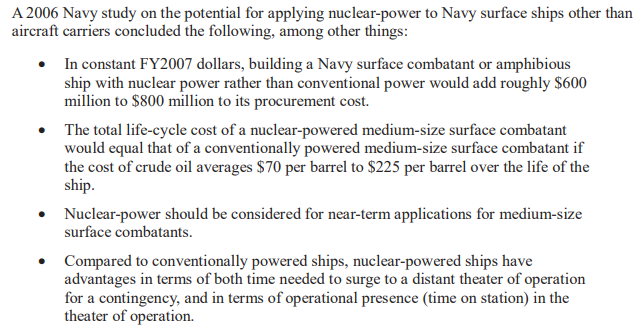
The average cost per barrel since 2000 has remained just under $70 dollars. Alongside this over the past 20 years powerplant efficiency has increased substantially.
It's notable that in 2011 when developing the CG(X) baselines the Navy could not develop a suitable nuclear surface combatant under 20k tons displacement, at least 5k tons more than an equivalent conventionally powered ship according to someone intimately knowledgeable with the program.
I have also previously interrogated the idea that IEP can somehow substantially reduce the size of a powerplant, particularity a nuclear powerplant with the help of a naval architect. As demonstrated in that thread, there is no substantial reason to prove that a hybrid nuclear system provides a substantive benefit that negates the inherent power density problem faced by nuclear powerplants that drive substantially larger vessels than their fossil fueled equivalents.
If you have any technical documentation that says otherwise I would be deeply interested in reading it.
Sorry, in future I'll treat BBGN(X) as a serious ideaPretty sure your whole DDG(X) ban was not about a bias against you by anyone. Maybe check the tone of your posts because they come across as insulting.

- Joined
- 16 April 2008
- Messages
- 10,588
- Reaction score
- 18,127
Or just get equivalent guided air defence rounds for the 57mm. If its still possible.
ALaMO exists and is fielded.
But its not proven for fast/manoeuvring missile threats, certainly not accurate enough for hit-to-kill. Seems to be advertised as intended against fast attack craft. I dont know if it has an airburst mode, but sufficient tungsten pellets to take out a missile?ALaMO exists and is fielded.
The same course correction technology makes the 57 mm, like the 76 mm before it, acceptable for modern missile defense. Neither had a sufficient rate of fire and the precision as a dumb gun to effectively engage anything above transonic targets. 40 mm Bofors were being often retired for radar directed quick-fire 76.2 mm guns in the late 1940s. But once missiles came into the threat matrix they were inadequate as missile speeds reached past subsonic speeds. The course correction technology, and to some extent modern tungsten pellet technology combined with modern fusing, made it worthwhile to reduce barrel pressures as it no longer was purely a kinetic weapon. These modern guns are not the same Oldsmobile of your father's father.
https://www.navalnews.com/naval-news/2026/09/us-navy-2028-spy6-radar-zumwalt-destroyers/
Jen Gauthier, Raytheon’s vice president of Naval Systems & Sustainment confirmed that study activity was examining options to replace the current AN/SPY-3 X-band multifunction radar with AN/SPY-6(V)3 from later this decade, several years earlier than previously planned. Naval News reported earlier this year that AN/SPY-6(V)3 radars originally manufactured for the now cancelled FFG-62 Constellation-class frigate program could now potentially be repurposed for backfit to the DDG-1000 ships.
The US Naval Sea Systems Command began work in 2022 to assess opportunities to improve the long-term supportability and interoperability of the DDG-1000 destroyers through the implementation of a so-called Zumwalt Enterprise Upgrade Solution (ZEUS). The precept of ZEUS is to replace unique-to-type DDG-1000 combat systems and sensors with analogous equipments common to other US Navy surface combatants.
Gauthier told Naval News that the AN/SPY-6(V)3 radar retrofit, as part of ZEUS, had originally been envisaged sometime in the mid-2030s. “But given the availability of hardware, the need for this system, and the fact that it is performing so well at sea today…we’ve been in discussions with the navy about potentially accelerating ZEUS to as early as a 2028 first installation on the first Zumwalt.”
Similar threads
-

-

-

-
Proposed 1980 Update of FRAM Gearing class Destroyers
- Started by Christopher Wang
- Replies: 92
-