Is there any reason restarting the DDG-1000 production lines with some changes such as removing one/both guns for more VLS isn't being considered for DDGX? Yes you would have to qualify all the missiles for the mk57 vls, but that is a much smaller lift than a new ship design.

The kinks have more or less been worked out on the class and it seems to have everything that is wanted for a next gen ship and should have sufficient margin for growth.
The shipyard took apart all the tooling for the Zs when they were ordered to make more Burkes. Repurposed and/or destroyed.

It'd be extremely expensive to rebuild all that. (Compare the cost of the last Burke IIA to that of the first Restart)
 
Yes it would be more than making more burkes. But we can’t keep making burkes forever.

It should still be much cheaper than a new ddgx design and should be a much shorter lead time to start building ships. As you skip most of the design and indecision about what you want steps
 
Last edited:
Yes it would be more than making more burkes. But we can’t keep making burkes forever.

It should still be much cheaper than a new ddgx design and should be a much shorter lead time to start building ships. As you skip most of the design and indecision about what you want steps

The thing is, you'd still have to do a ton of redesign work -- the induction motors that the Zs use aren't available anymore, you probably don't want to use MT30 turbines since LM2500s are the norm for most other USN ships except the Freedom class LCS), the integrated power infrastructure is not ideal for DEWs (despite the hopes when it was designed), and of course the entire combat and ship control system has to get replaced with AEGIS and some sort of new shipboard automation (in the Zs, these are intertwined in ways that no one really likes).

And you probably have to redo the entire superstructure, which was never really a finalized design on the Zs (first two ships have different composite designs and the last ship is steel for cost reasons). And that opens a whole can of worms. On the Zs, the superstructure is monolithic with the expectation that there would be totally integrated emitters, and the only rotating fixtures are a couple of small gun turrets. DDG(X) is clearly being designed around a different paradigm, with less integration and more traditional emitters. It will need space for both guns and RAM launchers, box-launchers for antiship missiles (likely), possibly even trainable illuminators for legacy missiles, etc. That all makes for a really different superstructure and might even drive changes in where the motor-generator sets are placed in the hull because of where the uptakes need to be to make everything fit.

Also, t there may well be different expectations for seakeeping. One feature called out in the early DDG(X) sketches is "arctic" seakeeping, which to me suggests ice strngthening to some degree. The Zs have excellent seakeeping (contra the naysayers) but they aren't ice hardened, AFAIK.

And on top of that, there is real value in designing new hulls for the sake of making sure we know how to do it going forward. Between the surprises in the Zs, the many issues with HM&E systems in both LCS designs, and the struggles with FFG(X), it seems to me that we've lost a lot of basic warship design knowledge, both in the Navy and in industry. And the only way to rebuild that is to make new designs to train new navarchs and engineers. Preferably several in relatively quick succession. Both Korea and Japan are showing the value of rapidly iterating designs as a way of maintaining the warship design knowledge base.
 
The thing is, you'd still have to do a ton of redesign work -- the induction motors that the Zs use aren't available anymore, you probably don't want to use MT30 turbines since LM2500s are the norm for most other USN ships except the Freedom class LCS), the integrated power infrastructure is not ideal for DEWs (despite the hopes when it was designed), and of course the entire combat and ship control system has to get replaced with AEGIS and some sort of new shipboard automation (in the Zs, these are intertwined in ways that no one really likes).

And you probably have to redo the entire superstructure, which was never really a finalized design on the Zs (first two ships have different composite designs and the last ship is steel for cost reasons). And that opens a whole can of worms. On the Zs, the superstructure is monolithic with the expectation that there would be totally integrated emitters, and the only rotating fixtures are a couple of small gun turrets. DDG(X) is clearly being designed around a different paradigm, with less integration and more traditional emitters. It will need space for both guns and RAM launchers, box-launchers for antiship missiles (likely), possibly even trainable illuminators for legacy missiles, etc. That all makes for a really different superstructure and might even drive changes in where the motor-generator sets are placed in the hull because of where the uptakes need to be to make everything fit.

Also, t there may well be different expectations for seakeeping. One feature called out in the early DDG(X) sketches is "arctic" seakeeping, which to me suggests ice strngthening to some degree. The Zs have excellent seakeeping (contra the naysayers) but they aren't ice hardened, AFAIK.

And on top of that, there is real value in designing new hulls for the sake of making sure we know how to do it going forward. Between the surprises in the Zs, the many issues with HM&E systems in both LCS designs, and the struggles with FFG(X), it seems to me that we've lost a lot of basic warship design knowledge, both in the Navy and in industry. And the only way to rebuild that is to make new designs to train new navarchs and engineers. Preferably several in relatively quick succession. Both Korea and Japan are showing the value of rapidly iterating designs as a way of maintaining the warship design knowledge base.
Thanks for the detailed response!

I would say the mt30s are fine to use, as they are common on allot of allied ships and they are newer, more efficient, with likley lower maintenance requirements than the lm2500s. You’d need newly designed motors in a new ship class anyways.

If this is to be a new class with 10s of ships, switching to a new Aegis alternative could be valid. As isn’t the base software and compute backbone for Aegis now antiquated and the system on the Z’s designed to use COTS compute?

Most new build ships use emitters totally integrated with the superstructure. So I don’t see that as much of an issue, as they can also leverage the learnings from the first three ships.

I wouldn’t assume the need for box launchers for harpoon or nsm, as they can just use lrsam or anti ship tomahawks. Ram can be bolt on, with a LO housing made for it similar to the guns.

There’s still FFG and autonomous drone boats to design. So I expect some work for American naval architects in the near term. Though with how FFG is going we should just buy super mogami. If it’s practice they need, they can design new hull without building them to gain some limited experience. At the end of the day, I believe the issue behind is two fold. The Jones act removing any chance of commercial ship building and experience there in addition to fickle political and financial situation.

Regarding ice capability, I believe restarting Z production will be much faster and cheaper than a new design. So is ice capability so important that we should delay building new ships? It could also be a smaller class modification later on to train the engineers. Though I’m uncertain what capability is desire and what would be required to implement it.

At the end of the day, choosing a Z hull with limited and I emphasize limited modifications, will constrain the parameter space and indecision that the Navy seems to have with ship designs in addition to providing a platform with most of the issues solved. This will provide a faster and cheaper solution than a new ship design.
 
The thing is, you'd still have to do a ton of redesign work -- the induction motors that the Zs use aren't available anymore, you probably don't want to use MT30 turbines since LM2500s are the norm for most other USN ships except the Freedom class LCS), the integrated power infrastructure is not ideal for DEWs (despite the hopes when it was designed), and of course the entire combat and ship control system has to get replaced with AEGIS and some sort of new shipboard automation (in the Zs, these are intertwined in ways that no one really likes).

And you probably have to redo the entire superstructure, which was never really a finalized design on the Zs (first two ships have different composite designs and the last ship is steel for cost reasons). And that opens a whole can of worms. On the Zs, the superstructure is monolithic with the expectation that there would be totally integrated emitters, and the only rotating fixtures are a couple of small gun turrets. DDG(X) is clearly being designed around a different paradigm, with less integration and more traditional emitters. It will need space for both guns and RAM launchers, box-launchers for antiship missiles (likely), possibly even trainable illuminators for legacy missiles, etc. That all makes for a really different superstructure and might even drive changes in where the motor-generator sets are placed in the hull because of where the uptakes need to be to make everything fit.

Also, t there may well be different expectations for seakeeping. One feature called out in the early DDG(X) sketches is "arctic" seakeeping, which to me suggests ice strngthening to some degree. The Zs have excellent seakeeping (contra the naysayers) but they aren't ice hardened, AFAIK.

And on top of that, there is real value in designing new hulls for the sake of making sure we know how to do it going forward. Between the surprises in the Zs, the many issues with HM&E systems in both LCS designs, and the struggles with FFG(X), it seems to me that we've lost a lot of basic warship design knowledge, both in the Navy and in industry. And the only way to rebuild that is to make new designs to train new navarchs and engineers. Preferably several in relatively quick succession. Both Korea and Japan are showing the value of rapidly iterating designs as a way of maintaining the warship design knowledge base.
This is the perfect "bow" on the "why don't we make more Zumwalts" question. (As much I'd like to see more. :( )
 
And on top of that, there is real value in designing new hulls for the sake of making sure we know how to do it going forward. Between the surprises in the Zs, the many issues with HM&E systems in both LCS designs, and the struggles with FFG(X), it seems to me that we've lost a lot of basic warship design knowledge, both in the Navy and in industry. And the only way to rebuild that is to make new designs to train new navarchs and engineers. Preferably several in relatively quick succession. Both Korea and Japan are showing the value of rapidly iterating designs as a way of maintaining the warship design knowledge base.
And that's the real kicker.
 
And on top of that, there is real value in designing new hulls for the sake of making sure we know how to do it going forward. Between the surprises in the Zs, the many issues with HM&E systems in both LCS designs, and the struggles with FFG(X), it seems to me that we've lost a lot of basic warship design knowledge, both in the Navy and in industry. And the only way to rebuild that is to make new designs to train new navarchs and engineers.
100% agreed. I think many people underestimate how absolutely detrimental it is for the USN to rewarm the same tired hulls over and over again for decades when fresh designs for the near future bring several benefits albeit at a higher cost. The expertise is crucial for a serious Navy.
 
Makes sense to put them all in the same place.
Absolutely.

Although given that specific location, it sure is...amusing.

Putting all these powerful ships and submarines, one may equate them to modern battleships, into Pearl Harbor, due to rising tensions in the Pacific...I had to smirk reading the article, admittedly.
 
Although given that specific location, it sure is...amusing.

Putting all these powerful ships and submarines, one may equate them to modern battleships, into Pearl Harbor, due to rising tensions in the Pacific...I had to smirk reading the article, admittedly.
Ah, missed that thought.

Yes, that would be a little amusing.
 
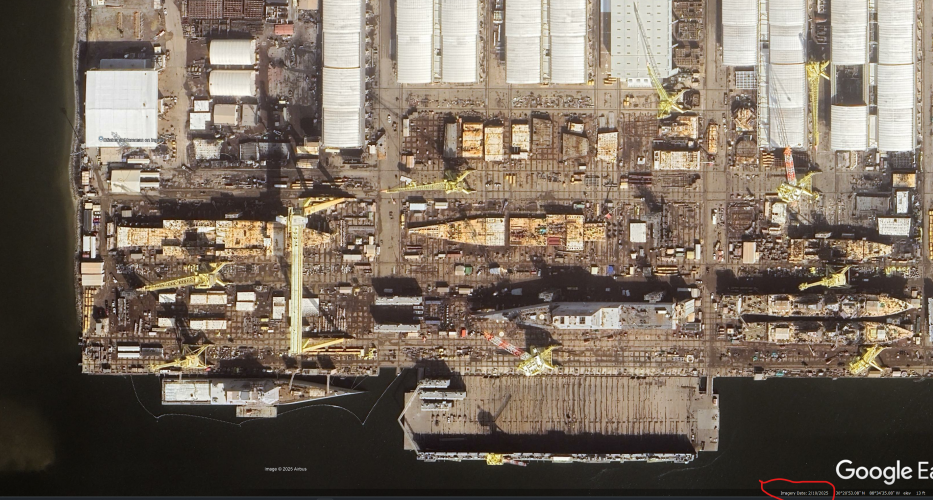
Any idea what is going on here? The Zumwalts were built at Bath Iron Works in Maine. This is Ingalls in Mississippi. And the date.
 

Attachments

  • Screenshot 2025-10-25 082144.png
    Screenshot 2025-10-25 082144.png
    6.3 MB · Views: 167
That's -1000 in the water and -1002 up on land, in case anyone was wondering. DDG-1001 is still on deployment.
 
The bow on an LHA is finer than an LPD, and the middle lane has been used for the flattops recently. I think that's LPD-32 on the left and LHA-9 in the middle.
 
As a hull, is it doable? Fit any propulsion systems you like etc and do an equivalent of the super hornet. Cut down on the bull and, I dare say "go wild and make a decision".

Prevarication is hardly a unique so perhaps create a new trend? Really cut the waste in the system? Not likely tbh but wow, what a concept.
 
As a hull, is it doable? Fit any propulsion systems you like etc and do an equivalent of the super hornet. Cut down on the bull and, I dare say "go wild and make a decision".

Prevarication is hardly a unique so perhaps create a new trend? Really cut the waste in the system? Not likely tbh but wow, what a concept.
I mean Zumwalt mostly was fine. Electronics and radar stuff but also the armament would be more of a challenge (MK.57 Limit integration of weapons for example). But maybe without AGS and instead 1 57 or 127mm and 1 MK.41 this could work. Tho it would take quite some time to do alone to make use of TSCEI
 
The USN definitely planned on these 3 ships as being test beds and technology demonstrators especially with the amount of electrical power they can generate. The tumbleform hull seemed to work well too. As a note, the USN really has to go back to the original formulation of the Haze Gray topcoat paint, the current tofu-based paint makes our ships look like crap with all of the rust and algae.
 
The USN definitely planned on these 3 ships as being test beds and technology demonstrators especially with the amount of electrical power they can generate. The tumbleform hull seemed to work well too. As a note, the USN really has to go back to the original formulation of the Haze Gray topcoat paint, the current tofu-based paint makes our ships look like crap with all of the rust and algae.
No they didnt intented them to be Tech Demonstrators. That power output was original to the design for future proofing for the next century of use since even in the late 90s the Burkes was looking to have power issues in the near future, which it is.
 
I mean Zumwalt mostly was fine.
I'm not sure about that? Zumwalt has not been mostly fine. The government completely failed to fund the program properly which led to a production run of 3. The Navy also dropped their support for the program due to the program being unable to meet it's goals for a variety of reasons. The very best argument is that the Zumwalt class has created an excellent knowledgebase for next generation LSCs that is essentially unparalleled. But even then, that's wont get to the fleet until 2032 at the very earliest
No they didnt intented them to be Tech Demonstrators
I think what he means to say is that they were meant to implement a host of next generation technologies all at once that would ultimately contribute to the long term LSCs of the USN
 
I'm not sure about that? Zumwalt has not been mostly fine. The government completely failed to fund the program properly which led to a production run of 3. The Navy also dropped their support for the program due to the program being unable to meet it's goals for a variety of reasons. The very best argument is that the Zumwalt class has created an excellent knowledgebase for next generation LSCs that is essentially unparalleled. But even then, that's wont get to the fleet until 2032 at the very earliest
They also got stuck in the nightmare of the GWOT eating all the budget, times several budget crises that resulted in "financial savings" all coming out of non-combat operational budgets.
 
They also got stuck in the nightmare of the GWOT eating all the budget, times several budget crises that resulted in "financial savings" all coming out of non-combat operational budgets.
Yeah, total nightmare especially when they're running a program that is meant to be a revolution in warship design and systems
 
I'm not sure about that?
I mean the ships where. Lots of problematic things where already deleted within the development/building process and after that.
Zumwalt has not been mostly fine. The government completely failed to fund the program properly which led to a production run of 3.
The biggest problem the ship had (next to an dying mission).
The Navy also dropped their support for the program due to the program being unable to meet it's goals for a variety of reasons. The very best argument is that the Zumwalt class has created an excellent knowledgebase for next generation LSCs that is essentially unparalleled. But even then, that's wont get to the fleet until 2032 at the very earliest.
Still the Zumwalt hull are mostly fine now and would give atleast some capabilitys needed. While i agree that production would take time one could enter them as a ASW DDG if needed. Replace AGS with some MK.41 or a Bofors 57 and its already an upgrade. Hardest part would be getting an modern software and electronic suite into it.
 
For the Zumwalt it needs to be remember that its two 30mms on the hanger?

Those were to be 57mms.

IRC got cut do to cost with the navy saying that the 30s are JUST as goods as the 57mm, honest.

Mind that was before the guided shot we made for the 57mm so I expect that to change. Plus expect that you can re add the 57mms if wanted.

Which with 5 inch guns getting the HVP shells?

Say replace the bow most 155 with a MK45, throw in the deep mag autoloader from the Type 26 to keep the crew down, add Spy6s with a MK41 or GVLS behind the gun before call it a day. Bout 144 cells, 5 inch with guided shot, two 57mms, modern radar and GOOD LUCK SEEING ME Stealth.

That will give you a very modern destroyer able to do all that a Burke can and keep up for the next 30 years at least.

Like the Zumwalt was design too.

Biggest issue is lack of crew, who want another 100 bodies for 250 over 147, which be an issue but is a do able fix.
 
For the Zumwalt it needs to be remember that its two 30mms on the hanger?

Those were to be 57mms.

IRC got cut do to cost with the navy saying that the 30s are JUST as goods as the 57mm, honest.

Mind that was before the guided shot we made for the 57mm so I expect that to change. Plus expect that you can re add the 57mms if wanted.

Which with 5 inch guns getting the HVP shells?

Say replace the bow most 155 with a MK45, throw in the deep mag autoloader from the Type 26 to keep the crew down, add Spy6s with a MK41 or GVLS behind the gun before call it a day. Bout 144 cells, 5 inch with guided shot, two 57mms, modern radar and GOOD LUCK SEEING ME Stealth.

That will give you a very modern destroyer able to do all that a Burke can and keep up for the next 30 years at least.

Like the Zumwalt was design too.

Biggest issue is lack of crew, who want another 100 bodies for 250 over 147, which be an issue but is a do able fix.
Those 30mm Mk46s are an embarrassment.
 
For the Zumwalt it needs to be remember that its two 30mms on the hanger?

Those were to be 57mms.

IRC got cut do to cost with the navy saying that the 30s are JUST as goods as the 57mm, honest.

Mind that was before the guided shot we made for the 57mm so I expect that to change. Plus expect that you can re add the 57mms if wanted.

Which with 5 inch guns getting the HVP shells?

Say replace the bow most 155 with a MK45, throw in the deep mag autoloader from the Type 26 to keep the crew down, add Spy6s with a MK41 or GVLS behind the gun before call it a day. Bout 144 cells, 5 inch with guided shot, two 57mms, modern radar and GOOD LUCK SEEING ME Stealth.

That will give you a very modern destroyer able to do all that a Burke can and keep up for the next 30 years at least.

Like the Zumwalt was design too.

Biggest issue is lack of crew, who want another 100 bodies for 250 over 147, which be an issue but is a do able fix.
I mentioned this a page or two ago, restarting the Z production line (but keep the MK57 or GVLS for more ABM/hypersonic capability a la ALASM) and remove 1 or both guns (replace one with a normal 155 with the hypersonic projectile) would be the best near term option for the DDG(X) right now. Mid term, see if there's a more powerful turbine that can be used instead of the MT-30 as there's not quite enough power on the Z to go fast and use all the gadgets + future growth margin.

Crew costs are about half the cost of running a AB so I don’t expect them to go for more crew. Also we see that the Japanese are able to make do with a crew of 60 on the Mogami. Also everyone is having recruiting difficulties so a lower crew count is good.
 
Last edited:
Crew costs are about half the cost of running a AB so I don’t expect them to go for more crew. Also we see that the Japanese are able to make do with a crew of 60 on the Mogami. Also everyone is having recruiting difficulties so a lower crew count is good.
Japan can get away with 60 crew cause they go out for a Month basically and return.

The USN stays at sea for over 100 days, hell a Burke broke 270 this past year, without returning.

147 crew is not enough for the Zumwalts, you only have so many man hours in a days, and have far more things to do. Between rest cycles, which been sitting at 4 hours for too long and part of the retention problem, training, doing you jobs and ship maintenance.

There just not enough bodies on the Zumwalts to keep up with what is needed.

That before adding in damcon needs, crew rotations, absence coverage and the like.


All 3 Zumwalt crew agree and been screaming at BIG NAVY to not go below 200 for the next hull cause otherwise you going to start seeing crew members drop from exhaustion once they start doing actual deployments.

Low crew numbers are nice.

But when you have a ship the size of a WW2 era heavy cruiser, you hit a wall HARD at around 200, with 250 being the minumun for a warship expected to be combat capable 24/7 unlike a frieghter which often dont have anyone on the bridge while at sea.
 
Japan can get away with 60 crew cause they go out for a Month basically and return.

The USN stays at sea for over 100 days, hell a Burke broke 270 this past year, without returning.

147 crew is not enough for the Zumwalts, you only have so many man hours in a days, and have far more things to do. Between rest cycles, which been sitting at 4 hours for too long and part of the retention problem, training, doing you jobs and ship maintenance.

There just not enough bodies on the Zumwalts to keep up with what is needed.

That before adding in damcon needs, crew rotations, absence coverage and the like.


All 3 Zumwalt crew agree and been screaming at BIG NAVY to not go below 200 for the next hull cause otherwise you going to start seeing crew members drop from exhaustion once they start doing actual deployments.

Low crew numbers are nice.

But when you have a ship the size of a WW2 era heavy cruiser, you hit a wall HARD at around 200, with 250 being the minumun for a warship expected to be combat capable 24/7 unlike a frieghter which often dont have anyone on the bridge while at sea.
I didn't know that the Zumwalt's didn't have enough crew. Do you have anything to things I could read on modern crewing requirements for ships as this is something I don't know much about?

I saw something stating that you only need a 5 men on watch for the Z. I wonder

Even if the Japanese are only out at sea for a month, I would expect the work load on them to be much much worse. As I wouldn't expect that there's that much additional labor on a larger ship? I would expect propulsion and combat systems should require the same amount of work load between the ships. There will be more ship mass and plumbing that can spring leaks etc, but I wouldn't have expect much maintenance for things like that? Is there some aspect of the Japanese ships being more reliable and or more needless make work on the American side?
 
I didn't know that the Zumwalt's didn't have enough crew. Do you have anything to things I could read on modern crewing requirements for ships as this is something I don't know much about?
Not a written thing, but it breaks down to 1) figure out how many bodies are on watch at one time, and 2) multiply that by at least 4. Then 3) you add the day workers, like cooks, medic, yeomen, and senior officers (CO, XO, department heads).


I saw something stating that you only need a 5 men on watch for the Z. I wonder
That can't be right. One engineer (per engine?), helmsman, officer of the deck, lookout/radar operator, Quartermaster of the Watch, plus the CIC crew.

And it's the CIC crew that has a lot of bodies.

IIRC I pulled this out of a USN site, or maybe Global Security. Didn't write it down, it was for a scifi project I'm working on, so I only needed ideas for what was needed:
Surface ship CIC watches

a. Tactical Action Officer (TAO)- He or she represents the commanding officer on all matters concerning the tactical employment and defense of the ship. Display and decision (D&D) area and must be kept informed of the general tactical situation in order to make the best evaluation of the information available in CIC.

b. CIC Watch Officer (CICWO)- Responsible for the coordination of all CIC functions. He or she coordinates all surface and tactical information, makes recommendations to the evaluator/TAO and to conn, and supervises the collection and display of all available information on surface contacts.

c. Electronic Warfare Supervisor (EWS)- EW watch supervisor is responsible to the CIC watch officer or the TAO, or to the EW watch officer (if assigned), for the following duties:
  • · Evaluating EW data and making required internal and external reports.
    · Supervising the filtering of EW data for display on various plots.
    · Exercising the overall control of the EW watch section, including monitoring intercept search operations; coordinating watch rotation and equipment use; and supervising on-watch training and normal watch routines, such as publication inventory, equipment operational checks, and log keeping.
d. Air Warfare Coordinator (AWC)- He or she will be responsible for the collection of information in their particular warfare area and the dissemination to the force of evaluated information in those areas. Warfare commanders will maintain continuous liaison with each other to ensure timely flow of mutually supporting information and avoid mutual interference. systems which have effective ranges that extend beyond the local area in which the ship is operating. Since warfare commanders are normally assigned authority to employ these weapons, this may cause situations in which one commander has tactical control of a ship and another has control of that ship’s force weapons systems. If firing the weapon does not interfere with the tasking of the ship, there is generally no problem. However, if significant maneuvering is required, coordination between the appropriate warfare commanders is vital in prosecuting the threat.

e. Surface Warfare Coordinator (SUWC)- Responsible for the collection of information in their particular warfare area and the dissemination to the force of evaluated information in those areas. Warfare commanders will maintain continuous liaison with each other to ensure timely flow of mutually supporting information and avoid mutual interference. systems which have effective ranges that extend beyond the local area in which the ship is operating. Since warfare commanders are normally assigned authority to employ these weapons, this may cause situations in which one commander has tactical control of a ship and another has control of that ship’s force weapons systems. If firing the weapon does not interfere with the tasking of the ship, there is generally no problem. However, if significant maneuvering is required, coordination between the appropriate warfare commanders is vital in prosecuting the threat.

f. Undersea Warfare Coordinator (USWC)- He or she is responsible for the collection of information in their particular warfare area and the dissemination to the force of evaluated information in those areas. Warfare commanders will maintain continuous liaison with each other to ensure timely flow of mutually supporting information and avoid mutual interference. systems which have effective ranges that extend beyond the local area in which the ship is operating. Since warfare commanders are normally assigned authority to employ these weapons, this may cause situations in which one commander has tactical control of a ship and another has control of that ship’s force weapons systems. If firing the weapon does not interfere with the tasking of the ship, there is generally no problem. However, if significant maneuvering is required, coordination between the appropriate warfare commanders is vital in prosecuting the threat.

g. Air Controllers (ASTAC/AIC/HDC)- Air intercept controller (AIC) exercise close or advisory control of intercepts and other non-ASW aircraft assigned to own ship. They can vector aircraft on intercepts recommended by the NTDS program or based on their own determination. They are directly responsible to the SWC for the effective intercept of specified targets and for vectoring intercept aircraft to CAP stations. The antisubmarine air controller (ASAC) controls fixed-wing and rotary aircraft engaged in ASW operations. The ASAC is responsible for the flight safety of ASW assets under that officer’s control when operating in a missile engagement zone.

h. CIC Watch Supervisor (CICWS)- He or she has the same duties as the senior Operations Specialist, which are the following:
  • · Brief the watch team on any expected threats.
    · Ensure that personnel are employing proper procedures for assigned watch stations.
    · Supervise the setup and operation of all equipment in CIC.
    · Review all intelligence data.
    · Verify that R/T nets are guarded and that a proper log is maintained, if applicable.
    · Determine the location of the OTC, the CWC, and other warfare coordinators and commanders.
    · Review the message board.
    · Ensure that all status boards are up-to-date.
    · Maintain geographic and strategic plots.
    · Supervise the overall operation of enlisted personnel in CIC.
    · Assist the officer of the deck (OOD) in determining meanings of tactical signals and station assignments and provide maneuvering recommendations to execute those signals and assignments.

i. Radar Operator- Tracks and reports all surface contacts, using proper designations; manipulates the surface search radar controls to maintain the radar in peak operating condition; and reports positions of ASW aircraft and assist ships to the DRT plotter.

j. Shipping Officer- Advises conn of the position, course, speed, and closest point of approach (CPA) of all surface contacts in the area, with particular emphasis on small craft appearing at short range and contacts that have changed course or have erratic courses and speeds.

k. Piloting Officer- He or she supervises the radar navigation team to ensure accurate and prompt fixing of the ship’s position by using all electronic means available. He advises conn of the ship’s position, recommended courses and times to turn, position of geographic and navigational objects in the vicinity of the ship, and any potential navigational hazards. The piloting officer recommends alternate tracks, if available, to the navigator and conn when the primary track is blocked or made hazardous by the presence of shipping or other contacts.

That's at least 13. per watch.


Even if the Japanese are only out at sea for a month, I would expect the work load on them to be much much worse. As I wouldn't expect that there's that much additional labor on a larger ship? I would expect propulsion and combat systems should require the same amount of work load between the ships. There will be more ship mass and plumbing that can spring leaks etc, but I wouldn't have expect much maintenance for things like that? Is there some aspect of the Japanese ships being more reliable and or more needless make work on the American side?
It's not make-work. It's mostly damage control capabilities.
 
@cccgong. The Zumwalt original KPP crew was for 95 and the latest seen in 2019 was 217 (helicopter detachment included).
GAO reported 2019 " Since the software is not as capable and does not enable as much automation as originally planned among other things [assuming software referring to is the Raytheon Total Ship Computing Environment, TSCE,] the Navy has permanently added 31 sailors to the crew compared to initial estimates, increasing life-cycle costs."
 
Absolutely.

Although given that specific location, it sure is...amusing.

Putting all these powerful ships and submarines, one may equate them to modern battleships, into Pearl Harbor, due to rising tensions in the Pacific...I had to smirk reading the article, admittedly.
If we gonna give them a reason to attack first let's make it convincing
 

Similar threads

Back
Top Bottom