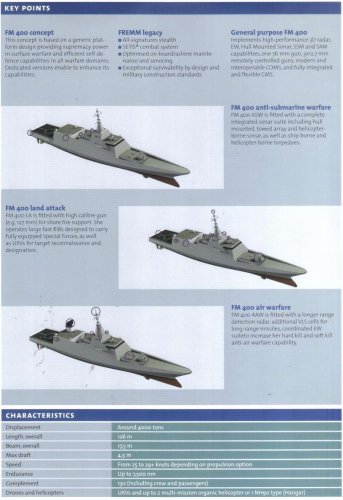
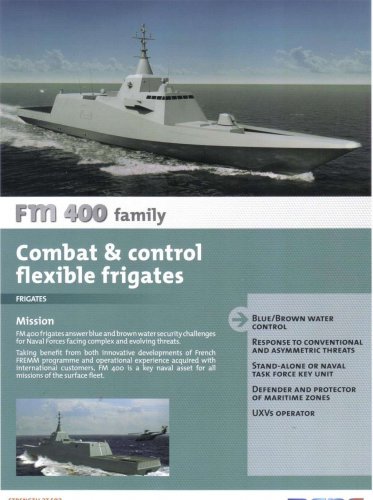
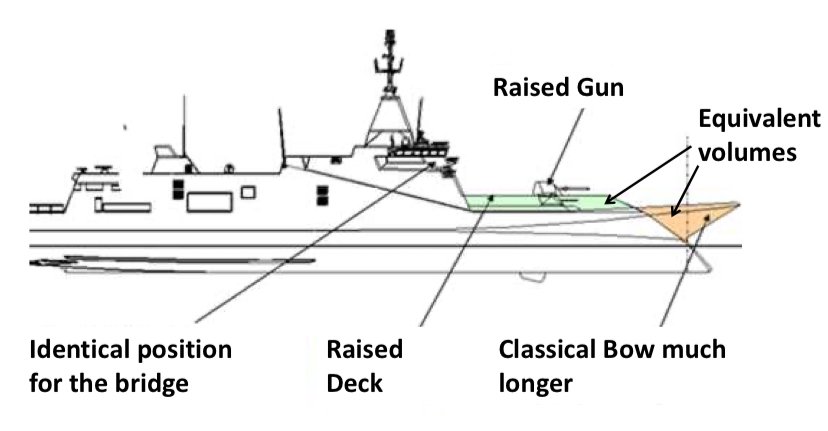
DCNS FM400 frigate sales brochure from Euronaval 2008.
Source:
http://s11.invisionfree.com/shipbucket/ar/t717.htm
Source:
http://s11.invisionfree.com/shipbucket/ar/t717.htm



Hello, is there a PDF file of this frigate?
Here is a working link to the archived article:I believe the proper designation is FM-400.
http://www.meretmarine.com/fr/content/dcns-lance-une-nouvelle-famille-de-fregates-les-fm-400
DCNS launches a new family of frigates: The FM 400
16/09/2008
Today we present to you, as a preview, the brand new family of frigates to emerge from the DCNS design offices. Benefiting from the developments of the FREMM program, the Modular Frigate 400 (FM 400) is dedicated to the export market. Intended to succeed the stealthy light frigates of the La Fayette class, this new product family will occupy the medium tonnage frigate segment, between the Gowind family and the family of multi-mission frigates (FREMM).
The major difference compared to the La Fayette frigates, for which DCNS had developed derivatives of the French platform (Taiwan, Saudi Arabia, Singapore), is that this time the manufacturer has, from the outset, imagined a complete, versatile range, able to adapt to the varied needs of customers who do not necessarily have the same expectations.
126 meters long and 17.5 meters wide, the FM 400 family will be available in four specialized versions, with a displacement of between 3,500 and 4,500 tons. These frigates will be able to easily integrate into an international naval task force, thanks to their interoperable systems, compatible with NATO standards, by providing new and expected capabilities, such as the naval integration of drones, specially designed for this family.
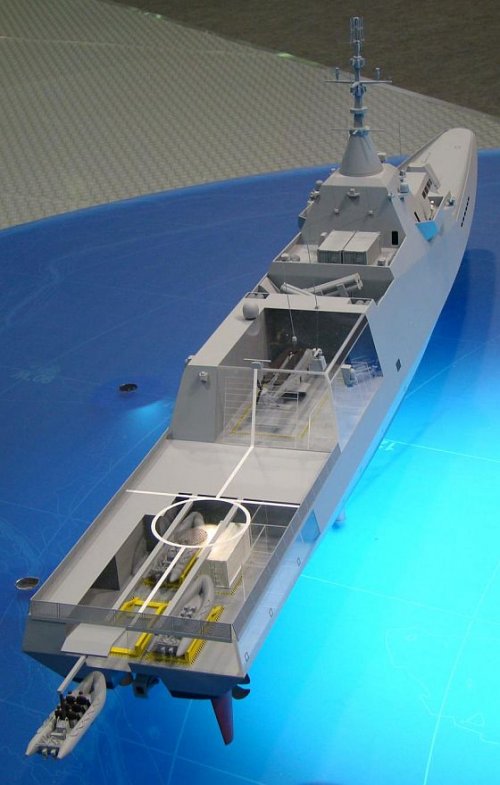
Integrated mast, RIB and drones The so-called General Purpose version is specially designed for the most constrained budgets. This basic version, however, includes increased capabilities compared to the La Fayettes in service with the French Navy. Standard armament includes a 76 mm gun, 8 MM40 Exocet anti-ship missiles and 16 to 32 vertical launch anti-aircraft missiles. The main sensors are integrated into a single mast to ensure maximum visibility from the bridge. A rapid launch and recovery system for light craft (RIB) is planned from the transom (an improved version of the system existing on the La Fayette). The FM 400 has all the aeronautical facilities to deploy a heavy helicopter (NH90 or two light ones (Panther) and, the main new feature, unmanned aerial vehicles (UAV). It will also be possible to embark surface drones and, possibly, underwater drones.
One basic platform, three specialized frigates
Aimed at navies not wishing to acquire a level of comprehensive capabilities and power projection equivalent to that of the FREMM (6,000 tons, 147 meters), the FM 400 cannot, due to its size, have the same potential as its big sister. According to DCNS, its basic equipment nevertheless remains sufficient to ensure excellent self-protection in all areas of combat. And it is then possible to develop certain capabilities in three main areas of combat, to derive specialized versions of the frigate.
Thus, the anti-submarine version of the FM 400 (ASW) is equipped with a towed active-passive sonar and torpedo tubes.
It is also possible to strengthen the anti-aircraft capacity of the basic version. In this AAW configuration, the FM 400 has a longer-range 3D surveillance radar and Aster missiles (15 or 30), with a range of 70 kilometers. The number of munitions can then increase to 32.
A fourth Land Attack variant is finally proposed by DCNS. In this case, the 76 mm gun is replaced by a 127 mm turret, while the capacity of implementation of special forces is increased.
Asymmetric threats From the initial design of the ship, the development of asymmetric threats was taken into account. As the experience of the attack against the destroyer USS Cole demonstrated in 2000, large combat vessels can be put out of action by a simple boat loaded with explosives. However, until then, ocean-going vessels had rather limited means to repel this type of aggression. In terms of surveillance, the integrated mast concept allows, thanks to a 360-degree vision, to tackle this problem, in which IR (infrared) means and JVN (night vision binoculars) also have an important role. In terms of equipment, the installation on the FM 400 of remotely operated cannons at the four corners of the ship (2 mounts at the front and one at the rear), covering 360 degrees, will offer good protection against asymmetric threats. It will also be possible to install non-lethal means, such as water cannons.
Blue water vessel for regional navies
With this product, DCNS is targeting regional navies for whom the French group wanted to design a combat vessel that is both very competitively priced and capable of operating in coastal areas, but also on the high seas. Thanks to its size, the FM 400 will be able to operate outside coastal areas. This "oceanic" frigate has good endurance, being capable of crossing 7,500 nautical miles at operational speed.
Its propulsion, based on diesel engines and/or gas turbines (three shafts), will allow it, depending on the version, to reach a maximum speed of 25 to 29 knots. The FM 400 also has equipment allowing it to operate day and night (infrared surveillance, night vision goggles, helicopter reception in the dark and without light, etc.)
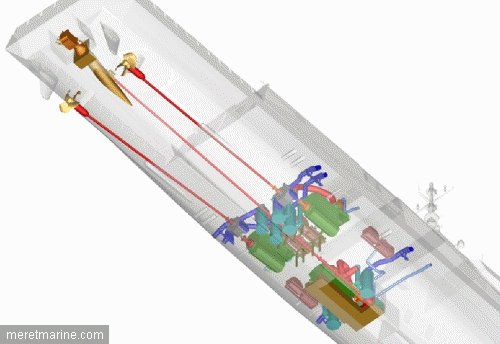
Propulsion: Three shaft lines and a waterjet
DCNS has adopted an innovative propulsion system. Based on three shaft lines, the FM 400 propulsion system is intended to be simple, reliable and economical. The two lateral shaft lines, ending in a propeller, will be driven by a medium-speed diesel engine (instead of a high-speed engine usually used on frigates). Simpler and more robust, this equipment, which is found in the civilian sector, should help reduce the ships' fuel consumption. It will allow the frigate to reach a speed of 23 knots with low consumption. The range will be substantial, with 6,500 nautical miles covered at 15 knots.
The central shaft line offers the best shock resistance and will be used for the most discreet speeds. Equipped not with a propeller but with a waterjet, it is driven either by a fast diesel engine (with a maximum speed of 25 to 26 knots), or by a gas turbine allowing the frigate to travel at 29 knots.
Leveraging FREMM technologies To design this new family of frigates, DCNS relied on the technological developments carried out within the framework of the FREMM program. For example, the vessel is highly automated, which allows for a reduction in its crew (depending on the version, from 80 to 110 people, the accommodation capacity being 130 men) compared to the La Fayette (140 sailors). The FM 400 has a multi-service data exchange network allowing the instantaneous transmission of information from the various systems (combat system, platform management system, etc.) Compared to the La Fayette generation, where there are around twenty on-board networks, the new frigates will only have one. According to the manufacturer, this development improves efficiency and facilitates maintenance.
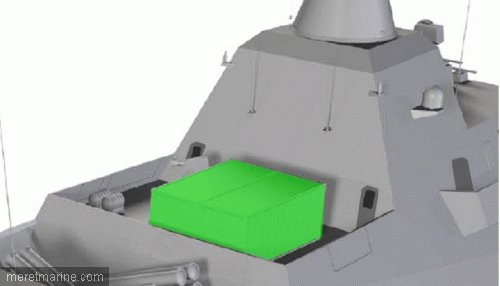
Open architecture The FM 400 also benefits from an "open" architecture, allowing for upgrades during its lifetime thanks to the large available volumes. It is also thanks to these interchangeable volumes that the ship can be available in several versions. Thus, at the stern, the FM 400 can be equipped with RIBs, drones, or a towed sonar, each configuration requiring specific machinery and associated containers.
"We used the feedback from La Fayette and everything we could bring thanks to the development of FREMM. It is a durable boat that has good self-defense in all areas, including against asymmetric threats, and is very adaptable, if the customer wishes to enhance a capacity in a chosen area of combat," explains DCNS. Of course, the FM 400 family is not intended to replace the FREMM, although the two types of frigates share a family resemblance. "To carry more powerful weapons and have the necessary means for electronic warfare, space is needed, particularly to avoid mutual interference (electromagnetic, etc.). A true multi-mission capability requires moving to a 6,000-tonne ship. »

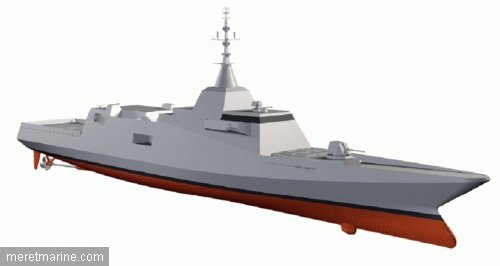

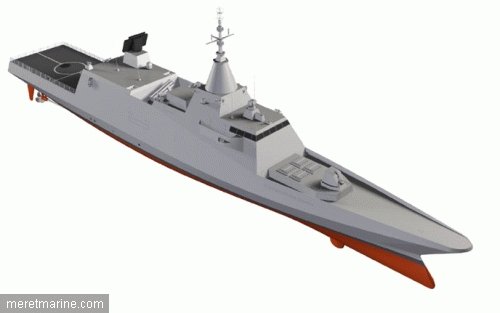
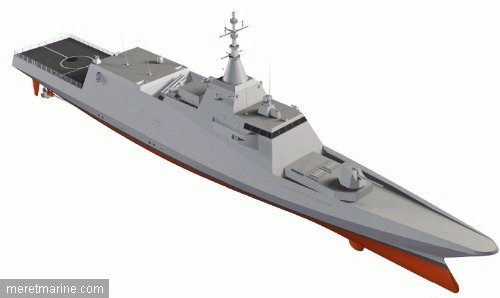
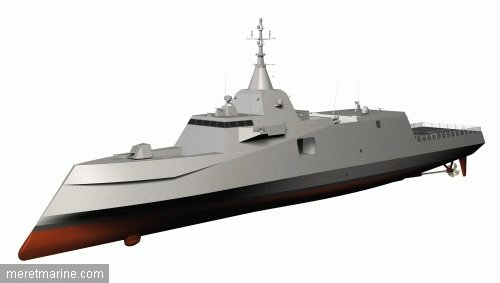
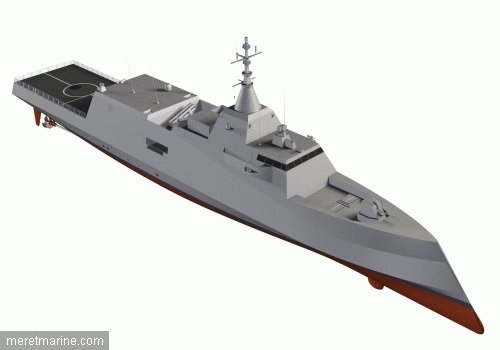
During the development of the FM400, a new range of medium-tonnage frigates, DCNS engineers designed a platform that could have either a conventional bow or an inverted bow. For the customer, this architecture becomes a real option, requiring no modifications to the rest of the boat's architecture and does not generate additional costs compared to a conventional model.
The dimensions, particularly the hull length, are strictly identical. The foredeck, however, is raised by a deck, in order to maintain an equivalent bow volume and avoid sinking into the sea. "For the FM400, the inverted bow is truly an option, requiring no modifications to the rest of the boat's architecture. The raised bow of a deck allows, in the event of heavy weather, to address sailors' fears of seeing the foredeck too often submerged and the potential risk of damaging equipment," explains Philippe Goubault. Concerning the mooring lines, the inverted bow did not allow for an anchor in the axis. The engineers found the solution by integrating the two anchors laterally, on the lower part of the bow.
Better seakeeping
To verify the advantages of this architecture and determine its potential advantages and disadvantages, the engineers not only carried out studies, but also conducted comprehensive campaigns in the hull test tank. Different configurations were thus tested in order to understand the full impacts of the inverted bow and to verify that its adoption would not present a prohibitive problem for a combat vessel. At the end of these tests, the advantages of the concept appear obvious.
« Seakeeping is better. The ship passes better through waves, which reduces the stress on the structure, with gains in resistance to forward movement. This allows for greater speed in rough seas,” explains Philippe Goubault, architect at DCNS Ingénierie. The new design also allows, in certain cases, to reduce “sway slamming.” The tossing movement, that is to say the very strong “slap” encountered in the event of a large wave, affects the bottom of the boat, but also the sway of the bow. However, these very significant pressure peaks generate stress on the structure. With the inverted bow, this impact is reduced.
Substantial gains on radar signature
The second major advantage of the inverted bow is an improvement in the vessel’s signature. In a conventional configuration, the sway reflects radar waves. “With the inverted bow, the gains are substantial and constitute a real advantage for customers wishing to have more efficient vessels in terms of stealth.”
In terms of armament, the design also presents an advantage for the bow guns, which, with the reversed bow, have a better threshing field forward. In terms of fuel consumption, the two models are equivalent in calm seas. However, gains are possible in the event of heavy swell, as the vessel with the reversed bow clears the waves better and therefore presents less resistance.
Overcoming sailors' fears
The tank tests have therefore demonstrated that the inverted bow, in an equivalent situation, did not present any deterioration compared to a conventional hull, while bringing certain very appreciable improvements. The studies carried out should help convince sailors, who traditionally show a certain apprehension when faced with this architecture. Indeed, with a bow plunging into the sea, many instinctively fear that their boat will behave like a "submarine" in the event of strong waves.
"Sailors feel protected by the flared bow in front of them and have difficulty understanding the reversal of the direction of this structure. It is intuitive more than scientific. Hence the need to convince," notes Philippe Goubault. The tank tests, in addition to the experience acquired on civilian vessels, are there for this. "The wetness is equivalent and, in equal situations, the boat even tends to behave better. Indeed, in the most extreme cases, the classic bow enters the sea and the water, on the deck, keeps the ship underwater, which can damage the equipment. With the inverted bow, the boat is relieved more quickly and emerges more quickly. Thanks to the studies carried out, we now know how to demonstrate this in a quantified manner to sailors."