CammNut

ACCESS: Secret
Joined
1 February 2007
Messages
296
Reaction score
92
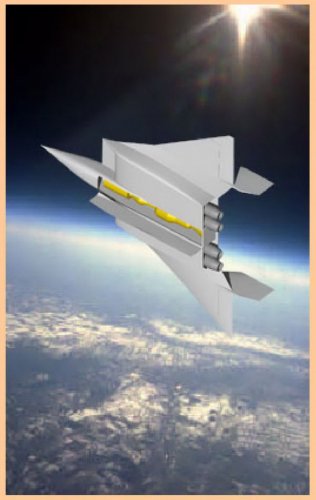
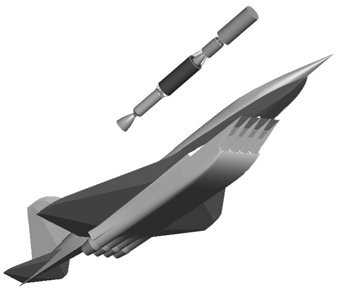
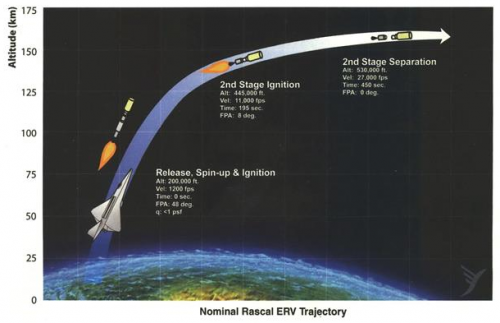
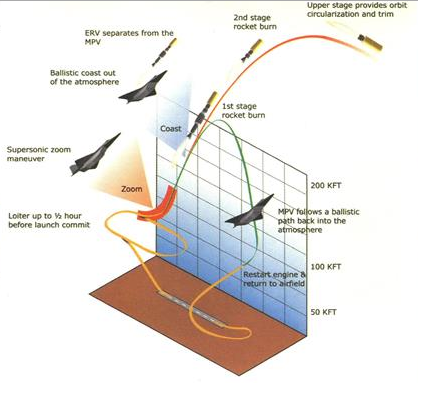
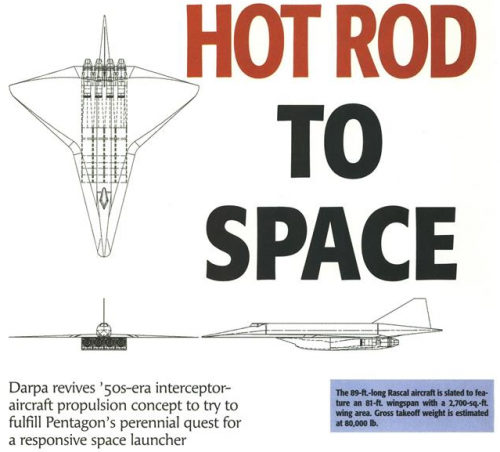
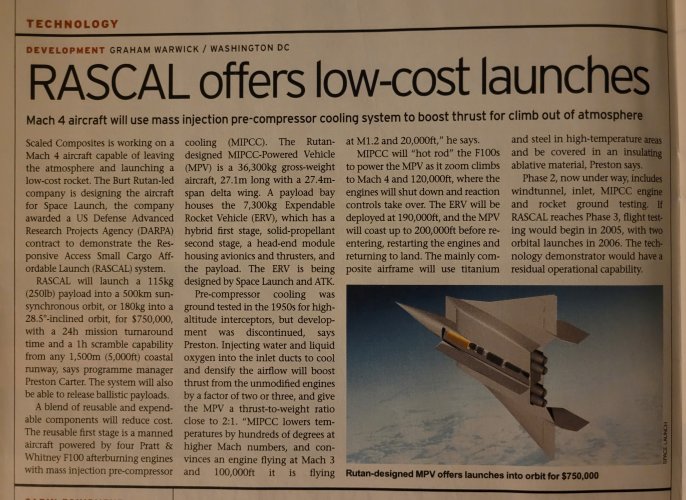
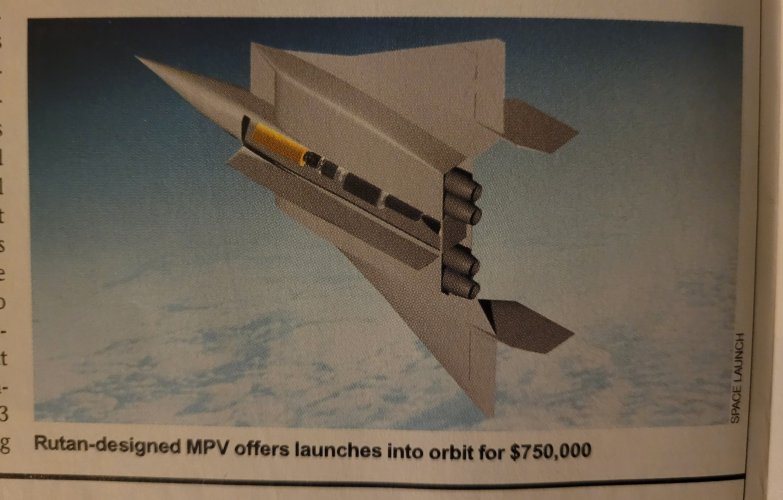
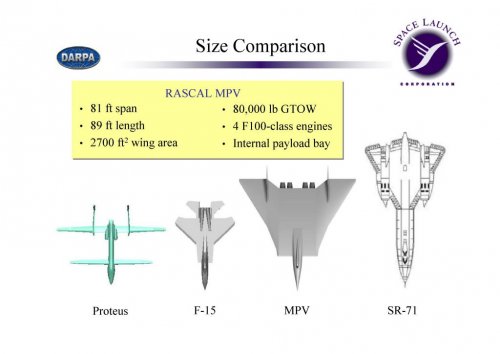
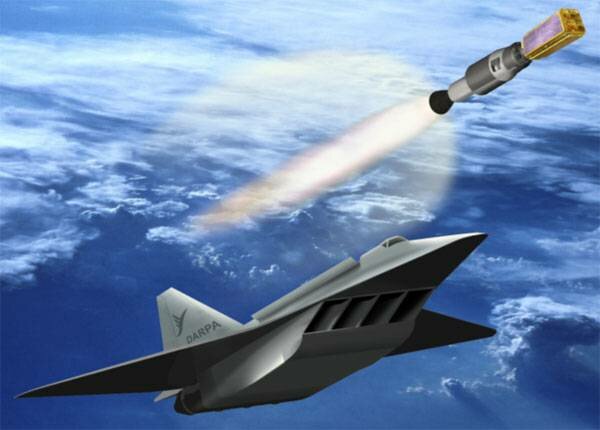
Another one for the "project cancelled" bin - the Mach 4 aircraft Burt Rutan's Scaled Composites was designing for Space Launch under DARPA's RASCAL (Responsive Access, Small Cargo, Affordable Launch) programme. The aircraft was called the MIPCC Powered Vehicle (MPV) because the four F100 engines were to be modified with "mass injection pre-compressor cooling", or MIPCC. This injected water and/or liquid oxygen into the inlet duct to cool the compressor and add massflow, fooling the engine into thinking it was flying at lower altitude in thicker air and maintaining its thrust to higher altitude and Mach number. This was intended to allow the MPV to zoom-climb out of the atmosphere, deploy a rocket-powered upper stage and satellite, and fire its reaction-control motors to turn round and re-enter.

MIPPC was tested on the ground, and worked, but RASCAL proved too "DARPA hard". Space Launch is still trying to get the concept off the ground using a modified F-4 (http://www.spacelaunch.com/products.asp)
 

Attachments
  • RASCAL_01.JPG
    RASCAL_01.JPG
    74.1 KB · Views: 1,120
  • RASCAL_02.JPG
    RASCAL_02.JPG
    86.8 KB · Views: 957
  • SSC03-I-1.pdf
    799.3 KB · Views: 19
Last edited by a moderator:
Wow,
Thanks for the update on RASCAL CammNut. I was wondering what happened to that program. I had no idea the design had changed so much from the version originally shown in Aviation Week.
 
http://www.responsivespace.com/Papers/RS2%5CSESSION%20PAPERS%5CSESSION%208%5CLOPATA%5C8004P.pdf

Here's an AIAA paper on RASCAL

And GA Tech's spin on the matter:
http://www.ssdl.gatech.edu/Papers/Masters/YoungMasters.pdf


Moonbat
 
Hi,

http://archive.aviationweek.com/image/spread/20030922/25/2
http://archive.aviationweek.com/image/spread/20030922/26/2
http://archive.aviationweek.com/image/spread/20030922/27/2
 

Attachments

  • 3.png
    3.png
    209 KB · Views: 194
  • 2.png
    2.png
    159.5 KB · Views: 336
  • 1.png
    1.png
    258.7 KB · Views: 357
TomS said:
This is RASCAL, which has a thread, here:

http://www.secretprojects.co.uk/forum/index.php/topic,2561.msg123213.html

I wanted that to succeed so bad. Bet it could have shattered the higher altitude time-to-climb records.
 
Interestingly while doing some historic research/searches for MIPCC work I found that there was a lot of prior research in the 40s and 50s on "injecting" stuff into the exhaust and/or intake to improve the performance of early jet engines. One aspect I found was work done by NACA on "injection" being used to 'shape' the intake air in various ways that could act like a mechanically variable intake system.

Randy
 
Jacketed thrust interests me--zip propellants surrounded by "cooler" exhaust.

RASCAL sounds like it would be big enough, say, to carry long range munitions that could be stealthy--so the plane itself wouldn't need to be.
 
Jacketed thrust interests me--zip propellants surrounded by "cooler" exhaust.

RASCAL sounds like it would be big enough, say, to carry long range munitions that could be stealthy--so the plane itself wouldn't need to be.
Problem is, boron-rich ZIP fuels don't get along with turbine engines. They work a lot better with ramjets or afterburners.
 
Interestingly while doing some historic research/searches for MIPCC work I found that there was a lot of prior research in the 40s and 50s on "injecting" stuff into the exhaust and/or intake to improve the performance of early jet engines. One aspect I found was work done by NACA on "injection" being used to 'shape' the intake air in various ways that could act like a mechanically variable intake system.

Randy

Using Google books I found a 1959 paper discussing MIPCC for the Northrop N-156F, pushing its top speed to Mach 2.
 
I was involved with RASCAL beginning in 2004. Space Launch Corp. was the prime, Scaled designed the vehicle, BAE Systems the vehicle subsystems. MIPCC was also tested by the Russian (MIPCC Mig-21) and the Israelis (MIPCC F-4). MIPCC uses spray bars to inject water and LOX in the inlet forward of the engine fan. For RASCAL, this was to get maximum engine performance at 150KFT then zoom up to the apogee of 200KFT then deploy the payload. We got the thumbs up from DARPA to build the vehicle but the propulsion test results were lagging. Ultimately, propulsion performance met predictions but the program got cancelled. ATK-GASL was responsible for propulsion/MIPCC. They called their MIPCC approach Oxy-Boost which sounded like a laundry detergent. Actually, performance was met without LOX, just water.
 
I was involved with RASCAL beginning in 2004. Space Launch Corp. was the prime, Scaled designed the vehicle, BAE Systems the vehicle subsystems. MIPCC was also tested by the Russian (MIPCC Mig-21) and the Israelis (MIPCC F-4). MIPCC uses spray bars to inject water and LOX in the inlet forward of the engine fan. For RASCAL, this was to get maximum engine performance at 150KFT then zoom up to the apogee of 200KFT then deploy the payload. We got the thumbs up from DARPA to build the vehicle but the propulsion test results were lagging. Ultimately, propulsion performance met predictions but the program got cancelled. ATK-GASL was responsible for propulsion/MIPCC. They called their MIPCC approach Oxy-Boost which sounded like a laundry detergent. Actually, performance was met without LOX, just water.
How was this different than what McDonnell Douglas did on the F-4 Skyburner and the Soviets did to the MiG-25 that grabbed the 123k altitude record?
 
How was this different than what McDonnell Douglas did on the F-4 Skyburner and the Soviets did to the MiG-25 that grabbed the 123k altitude record?
Did not know about the F-4 Skyburner and what the MiG-25 did. I don't know what you mean by different. RASCAL was never built but I assume the MIPCC systems were similar. I know the ATK-GASL lead engineer was a Russian guy by the name of Vladimir which I think possibly could have worked the MiG programs, didn't know much about him.
 
Did not know about the F-4 Skyburner and what the MiG-25 did. I don't know what you mean by different. RASCAL was never built but I assume the MIPCC systems were similar. I know the ATK-GASL lead engineer was a Russian guy by the name of Vladimir which I think possibly could have worked the MiG programs, didn't know much about him.
Ah. Skimmed it the first time and got the impression you worked on the propulsion system. Sounds like Hermeus is trying the same thing now, with the same engine (F100) as RASCAL did.


Wish I still had the book where I first read about it back in the day. They had photos of the modifications (spray bars in the intakes). As mentioned in the link the 1.606 mph speed record was the average of two runs. What they didn't say was that on the second run the aircraft was still accelerating at completion but the pilot was worried what might happen if the water/methanol ran out so he throttled back.
 
Last edited:
Ah. Skimmed it the first time and got the impression you worked on the propulsion system. Sounds like Hermeus is trying the same thing now, with the same engine (F100) as RASCAL did.


Wish I still had the book where I first read about it back in the day. They had photos of the modifications (spray bars in the intakes). As mentioned in the link the 1.606 mph speed record was the average of two runs. What they didn't say was that on the second run the aircraft was still accelerating at completion but the pilot was worried what might happen if the water/methanol ran out so he throttled back.
I didn't work propulsion, I was involved in subsystems (fuel, hydro, gear, flight controls). RASCAL wanted sea-level engine performance at 150KFT then zoom the additional 50KFT to launch the payload at 200KFT. After deployment, we were to close the payload bay then re-light the four F100s at around 35KFT. Aux power at altitude was based upon a X-15 hydrogen peroxide-type system. Maximum mach number was M3.5.
 
@Hydroman Did you heard about an engineer with the name Preston H. Carter ? I think he was involved with RASCAL.
 
I didn't work propulsion, I was involved in subsystems (fuel, hydro, gear, flight controls). RASCAL wanted sea-level engine performance at 150KFT then zoom the additional 50KFT to launch the payload at 200KFT. After deployment, we were to close the payload bay then re-light the four F100s at around 35KFT. Aux power at altitude was based upon a X-15 hydrogen peroxide-type system. Maximum mach number was M3.5.
That sounds like a technically-challenging flight path to me, mostly in terms of getting the payload bay closed in time before the craft nosed over and ripped the doors off.

And the engineering challenge in thermal stresses "gliding" from 200kft down to 35k in something with the glide ratio of a fighter.
 
That sounds like a technically-challenging flight path to me, mostly in terms of getting the payload bay closed in time before the craft nosed over and ripped the doors off.

And the engineering challenge in thermal stresses "gliding" from 200kft down to 35k in something with the glide ratio of a fighter.
Disengaging the 4 F100s, going into aux power then back into main propulsion was a challenge, trying to locate an off the shelf gearbox to do the job was tough.
 
For flight controls, planned to use F-18E/F aileron FBW actuator and an F-18C/D horizontal tail actuator in the FBW mode, manual input function was isolated. Athena was to provide the flight control computers.
 
I liked that concept, notably the MIPCC which is a very clever hack to make stock turbofans going Mach 4+ (kinda chemical precooler, hence simpler than the Skylon SABRE and its precooler gizmo).
But MIPCC never got its RLV chance. Hopefully Hermeus will change that.

By the way @Hydroman, what is MIPCC upper velocity limit ? can it make it past Mach 5, or no chance at all ?
 
@Hydroman Did you heard about an engineer with the name Preston H. Carter ? I think he was involved with RASCAL.
He was the DARPA RASCAL program manager. Back in the days, on march 20th, 2013, Terry Spath, Propulsion test engineer and corporate pilot who reported directly to Preston, endorsed Preston on linkedin. "Preston was the PM of the most exciting aerospace engineering program that I had the privilege of being involved in; the DARPA RASCAL vehicle." Not sure what vehicle refers to. Any idea which actual test articles were developped, back in the days?

Cheers. A.
 
I liked that concept, notably the MIPCC which is a very clever hack to make stock turbofans going Mach 4+ (kinda chemical precooler, hence simpler than the Skylon SABRE and its precooler gizmo).
But MIPCC never got its RLV chance. Hopefully Hermeus will change that.

By the way @Hydroman, what is MIPCC upper velocity limit ? can it make it past Mach 5, or no chance at all ?
For the RASCAL mission and using MIPCC, the limit was M3.5.
 
He was the DARPA RASCAL program manager. Back in the days, on march 20th, 2013, Terry Spath, Propulsion test engineer and corporate pilot who reported directly to Preston, endorsed Preston on linkedin. "Preston was the PM of the most exciting aerospace engineering program that I had the privilege of being involved in; the DARPA RASCAL vehicle." Not sure what vehicle refers to. Any idea which actual test articles were developped, back in the days?

Cheers. A.
The final vehicle configuration is one Sferrin posted. There was a ground MIPCC/Propulsion test facility located in Mojave, CA. When testing the F100 MIPCC configuration, the test cell a J79 to pull the air from the cell to simulate the various altitude conditions. If the program had moved beyond PDR, more than likely I would have led the development of the hydraulics and flight controls iron bird test rig, I was really looking forward to that.
 

Similar threads

Back
Top Bottom