
You are using an out of date browser. It may not display this or other websites correctly.
You should upgrade or use an alternative browser.
You should upgrade or use an alternative browser.
DARPA / Aurora Flight Sciences / GA-ASI Liberty Lifter WIG

- Joined
- 2 August 2006
- Messages
- 3,335
- Reaction score
- 1,847
However, if you read the specs, it's more likely to resemble a typical "flying boat" design, due to being required to fly over weather. However, it will need systems so that it can cruise in ground effect when not requiring to clear objects and weather. It isn't going to look anything like an Ekranoplane based on the requirements atm.

- Joined
- 4 July 2010
- Messages
- 2,689
- Reaction score
- 3,748
Sounds like Pelican
However, if you read the specs, it's more likely to resemble a typical "flying boat" design, due to being required to fly over weather. However, it will need systems so that it can cruise in ground effect when not requiring to clear objects and weather. It isn't going to look anything like an Ekranoplane based on the requirements atm.

Brett Davidson
ACCESS: Top Secret
- Joined
- 26 September 2006
- Messages
- 4,438
- Reaction score
- 12,820
I notice that 'long duration arctic patrol flights' appears on the list - despite warming, large expanses of sea ice will still exist and they'll be fine for a WiG. 'Arctic' is probably going to be obligatory in every specification for anything from now on anyway.
However, if you read the specs, it's more likely to resemble a typical "flying boat" design, due to being required to fly over weather. However, it will need systems so that it can cruise in ground effect when not requiring to clear objects and weather. It isn't going to look anything like an Ekranoplane based on the requirements atm.

X-39
To post or not to post, that is the question
- Joined
- 20 February 2021
- Messages
- 382
- Reaction score
- 954
https://defbrief.com/2022/05/18/video-darpa-details-its-liberty-lifter-seaplane-concept/Video: DARPA details its Liberty Lifter seaplane concept
By Defense Brief Editorial
-May 18, 2022

DARPA illustration of the Liberty Lifter seaplane
The US Defense Advanced Research Projects Agency (DARPA) revealed that its project to develop an ekranoplan-inspired seaplane concept would be named Liberty Lifter.
The name was announced after the agency released a request for information (RFI) in August last year, seeking ideas that could demonstrate a leap in operational logistics capabilities by designing, building, and flying a long-range, low-cost X-plane capable of seaborne strategic and tactical lift.
Leveraging the wing-in-ground effect, DARPA’s project will be similar to the ekranoplan concept that was embraced by the Soviet and Russian navies in the 1980s and 90s.
The envisioned plane will combine fast and flexible strategic lift of very large, heavy loads with the ability to take off/land in water. Its structure will enable both highly controlled flight close to turbulent water surfaces and sustained flight at mid-altitudes. In addition, the plane will be built with a low-cost design and construction philosophy.
Although current sealift is very efficient in transporting large amounts of payload, it is vulnerable to threats, requires functional ports, and results in long transit times. Traditional airlift is much faster, but has limited ability to support maritime operations. Additionally, today, such aircraft suffer payload limitations or require long runways.
There is a history of attempting to develop aircraft created to fly with “wing-in-ground effect,” which means the aircraft is flying no more than the length of its wingspan above ground or water. The most well-known examples are the Soviet “ekranoplans.” These vehicles were high speed and runway- independent, but were restricted to calm waters and had limited maneuverability.
“This first phase of the Liberty Lifter program will define the unique seaplane’s range, payloads, and other parameters,” said Alexander Walan, a program manager in DARPA’s Tactical Technology Office. “Innovative advances envisioned by this new DARPA program will showcase an X-plane demonstrator that offers warfighters new capabilities during extended maritime operations.”
To address the shortcomings of existing vehicles and operational concepts, the Liberty Lifter program focuses on addressing three main challenges.
The first one is extended maritime operations, which will place emphasis on operating in turbulent sea states by creating high-lift abilities at low speeds to reduce wave impact load during takeoff/landing, and innovative design solutions to absorb wave forces. In addition, the project will address risks of vehicle collision during high-speed operation in congested environments. Finally, the aim is for the vehicle to operate at sea for weeks at a time without land-based maintenance activities.
The second challenge will be full-scale affordable production, with the aim of prioritizing low-cost, easy-to-fabricate designs over exquisite, low-weight concepts. Materials should be more affordable than those in traditional aircraft manufacturing and available to be purchased in large quantities.
The final challenge will be the development of advanced sensors and control schemes to avoid large waves and to handle aero/hydro-dynamic interactions during takeoff/landing.
In the RFI from August 2021, DARPA also said the plane should have a large operational payload (over 100 tons) and the capability of carrying multiple amphibious vehicles.
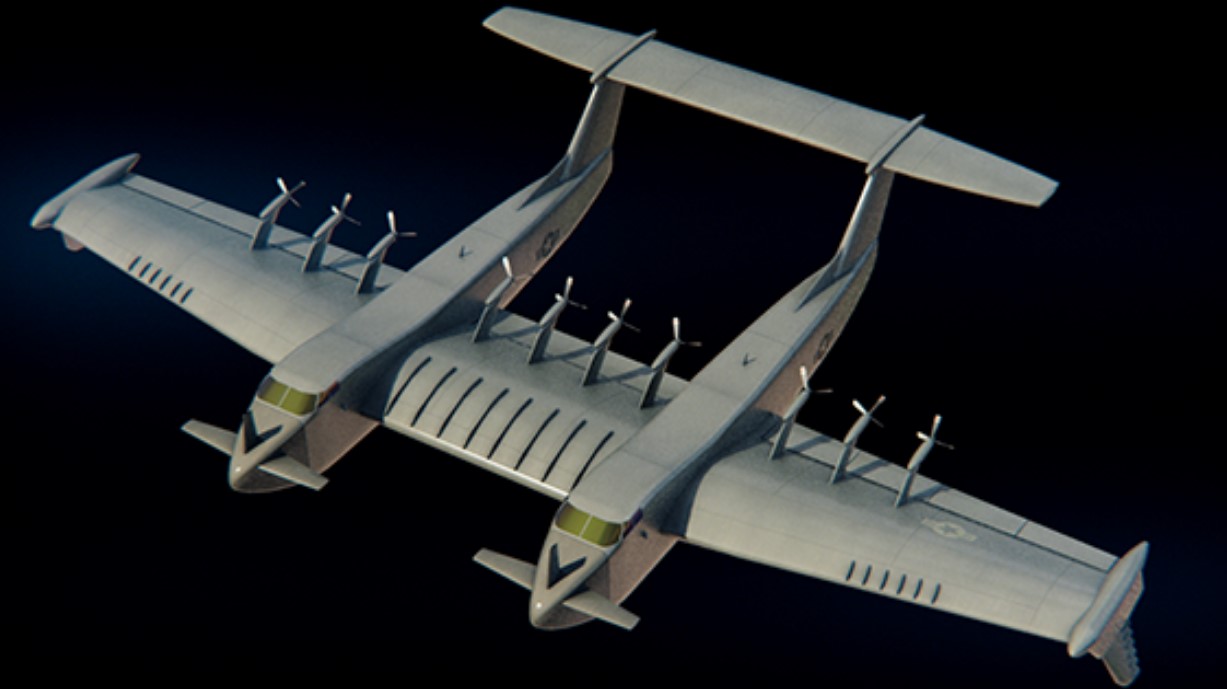
Not what i had in mind, but interesting nonetheless.

Normally when i think of DARPA, I think something along the lines of "near-magical sci-fi technologies." Now I'll have to think of "1990's-level half-assed CGI."
Last edited by a moderator:
gabrielorosco
I really should change my personal text
- Joined
- 10 December 2016
- Messages
- 202
- Reaction score
- 258
The concept is interesting, but it is very unlikely that such vehicle can operate in open sea, dealing with storms. It is also in the opposite direction of modern WIG design.
Last edited by a moderator:
Last edited:

- Joined
- 26 May 2006
- Messages
- 38,253
- Reaction score
- 20,391
Normally when i think of DARPA, I think something along the lines of "near-magical sci-fi technologies." Now I'll have to think of "1990's-level half-assed CGI."
I felt that at first sight.

- Joined
- 4 May 2008
- Messages
- 2,445
- Reaction score
- 827
If you read "Soviet and Russian Ekranoplans" by Kommisarov and Gordon, or the "Wingship Report" (on dtic) you will see that Ekranoplans have never operated in open ocean environments, and never flown above ~100m. This limitation is inherent in the "classic" Ekranoplan formula (low Aspect ratio stubby wing). In the Pacific you need to handle Sea state five to operate 85% of the time. Hence something that looks more like a seaplane, specifically a large version of the late Convair and Martin open ocean seaplanes. STOL performance and deeply sculpted hulls with lots of deadrise, like a ShinMaywa US-2 on steroids.
Turns out price is a technology and I wouldn't sleep on the boundary layer control either.
Normally when i think of DARPA, I think something along the lines of "near-magical sci-fi technologies." Now I'll have to think of "1990's-level half-assed CGI."

- Joined
- 21 April 2009
- Messages
- 14,351
- Reaction score
- 9,436
aonestudio
I really should change my personal text
- Joined
- 11 March 2018
- Messages
- 3,377
- Reaction score
- 9,218
https://www.ga-asi.com/ga-asi-selected-by-darpa-to-support-liberty-lifter-programhttps://www.darpa.mil/news-events/2023-02-01
The General Atomics team has selected a twin-hull, mid-wing design to optimize on-water stability and seakeeping. It employs distributed propulsion using twelve turboshaft engines.


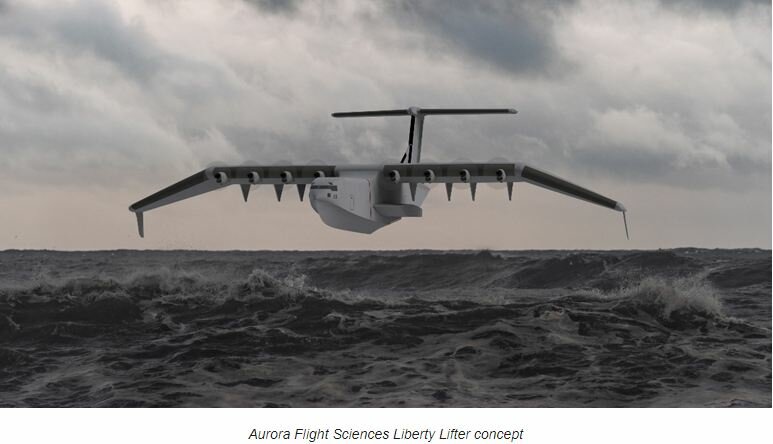
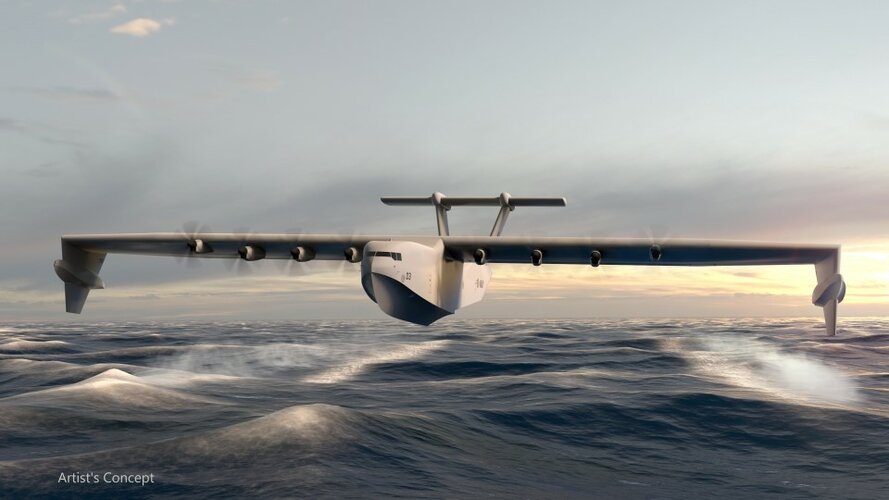
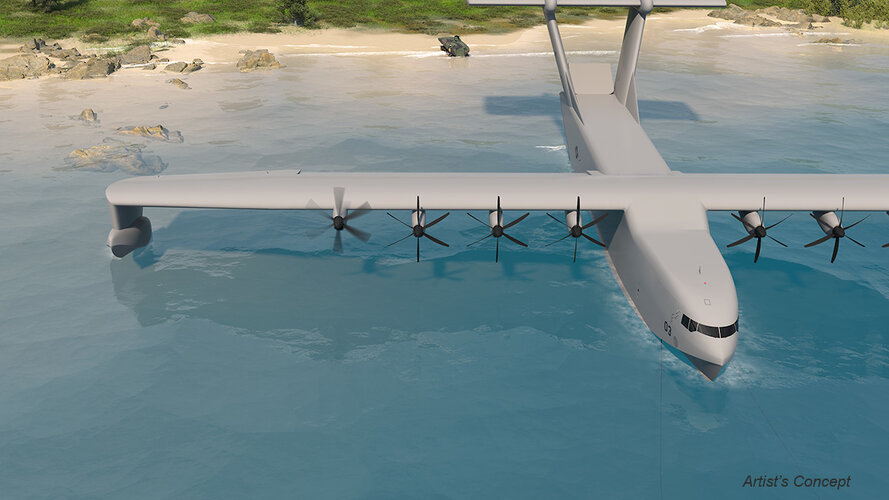
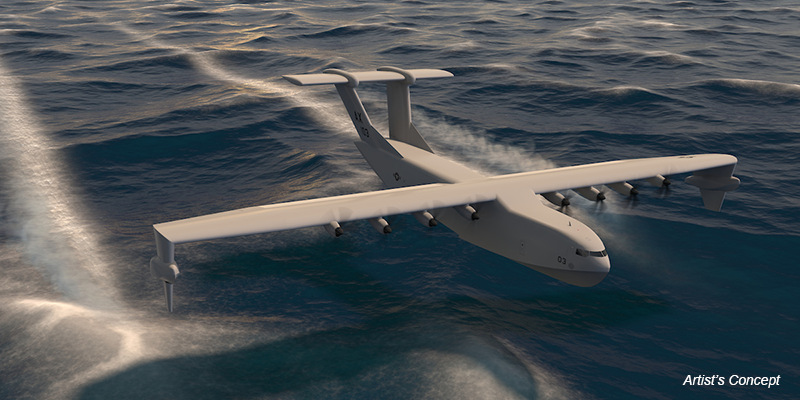
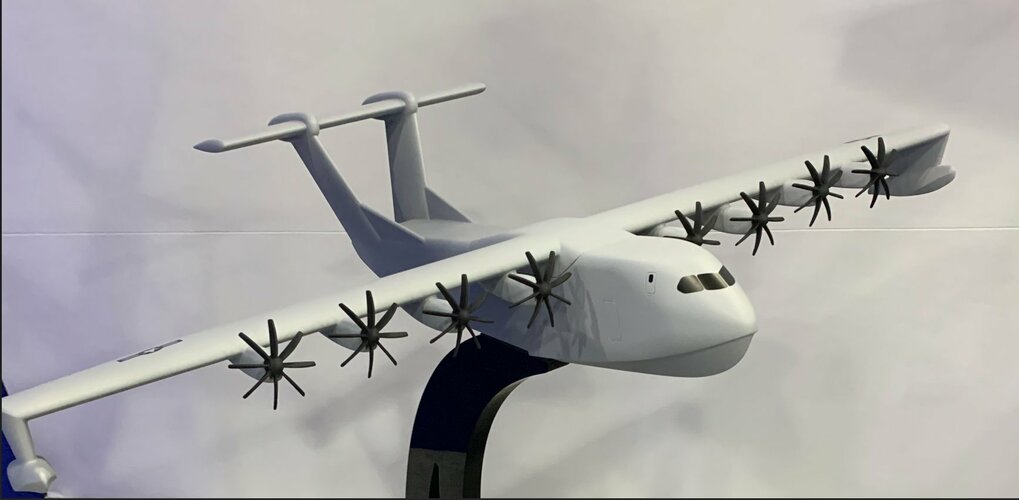
Aurora Flight Sciences point-of-departure design more closely resembles a traditional flying boat, with a single hull, high wing and eight turboprops for primary propulsion.

The planned Liberty Lifter demonstrator will be a large flying boat similar in size and capacity to the C-17 Globemaster III transport aircraft. Goals include takeoff and land in Sea State 4, sustained on-water operation up to Sea State 5, and extended flight close to the water in ground effect with the capability to fly out of ground effect at altitudes up to 10,000 feet above sea level.
During Phase 1, DARPA will work with both performer teams and Department of Defense stakeholders to refine the Liberty Lifter designs with particular attention to operational needs and operating concepts. The Phase 1 contract awards are for an 18-month period of performance with six months of conceptual design work and nine months of design maturation culminating in a preliminary design review. There will be an additional three months for manufacturing planning and test/demonstration planning reviews.
As scheduled, Phase 1 will transition into Phase 2 in mid-2024 with continued detailed design, manufacturing, and demonstration of a full-scale Liberty Lifter X-Plane. DARPA anticipates teaming with one or more DoD Service and international partners for those activities and further development of the Liberty Lifter concept into an operational vehicle.
The General Atomics team has selected a twin-hull, mid-wing design to optimize on-water stability and seakeeping. It employs distributed propulsion using twelve turboshaft engines.
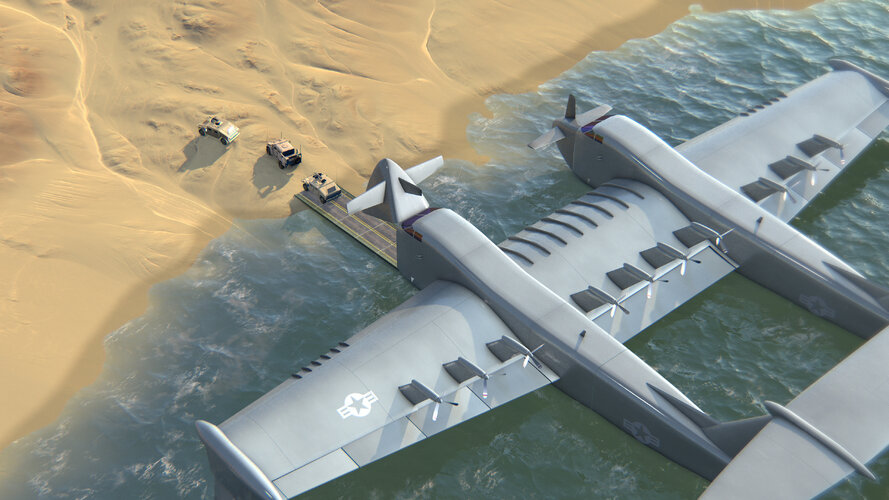
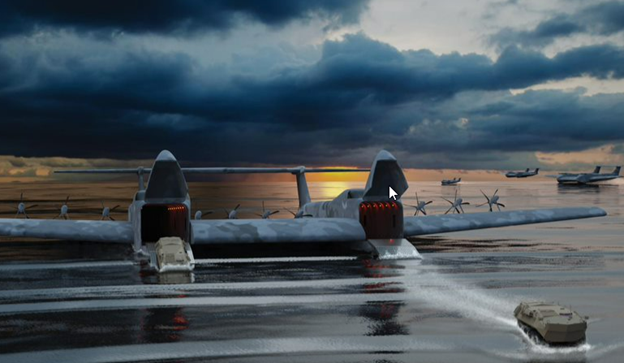
Aurora Flight Sciences point-of-departure design more closely resembles a traditional flying boat, with a single hull, high wing and eight turboprops for primary propulsion.
Last edited:

- Joined
- 18 October 2006
- Messages
- 4,776
- Reaction score
- 6,837
Howard Hughes would be proud!https://www.ga-asi.com/ga-asi-selected-by-darpa-to-support-liberty-lifter-programhttps://www.darpa.mil/news-events/2023-02-01The planned Liberty Lifter demonstrator will be a large flying boat similar in size and capacity to the C-17 Globemaster III transport aircraft. Goals include takeoff and land in Sea State 4, sustained on-water operation up to Sea State 5, and extended flight close to the water in ground effect with the capability to fly out of ground effect at altitudes up to 10,000 feet above sea level.
During Phase 1, DARPA will work with both performer teams and Department of Defense stakeholders to refine the Liberty Lifter designs with particular attention to operational needs and operating concepts. The Phase 1 contract awards are for an 18-month period of performance with six months of conceptual design work and nine months of design maturation culminating in a preliminary design review. There will be an additional three months for manufacturing planning and test/demonstration planning reviews.
As scheduled, Phase 1 will transition into Phase 2 in mid-2024 with continued detailed design, manufacturing, and demonstration of a full-scale Liberty Lifter X-Plane. DARPA anticipates teaming with one or more DoD Service and international partners for those activities and further development of the Liberty Lifter concept into an operational vehicle.
Aurora Flight Sciences point-of-departure design more closely resembles a traditional flying boat, with a single hull, high wing and eight turboprops for primary propulsion.
View attachment 692456
- Joined
- 4 July 2010
- Messages
- 2,689
- Reaction score
- 3,748
TWZ piece on this award:
https://www.thedrive.com/the-war-zone/huge-ekranoplan-like-airlifter-design-teams-selected-by-darpa
The GA plane is going to get most of the attention forever, but Aurora's plane intrigues me.
https://www.thedrive.com/the-war-zone/huge-ekranoplan-like-airlifter-design-teams-selected-by-darpa
The GA plane is going to get most of the attention forever, but Aurora's plane intrigues me.

X-39
To post or not to post, that is the question
- Joined
- 20 February 2021
- Messages
- 382
- Reaction score
- 954
https://www.flightglobal.com/fixed-...rs-with-another-40m-in-funding/154348.article
General Atomics-Aeronautical Systems and Aurora Flight Sciences on 27 July each received contracts valued around $20 million to fund continued development efforts for the Liberty Lifter – a wing-in-ground-effect seaplane meant to carry loads of 90,000kg (200,000lb) or greater.
The 27 July contract announcement significantly raised DARPA’s commitment to the Liberty Lifter project, as the agency exercised options on both companies’ initial proposals. General Atomics will receive $21.5 million to fund additional work, while Aurora’s additional share is $19.5 million.
DARPA hopes to begin the next phase of the programme in mid-2024, which will include detailed design, manufacturing and flight demonstration of full-scale Liberty Lifter craft.
martinbayer
ACCESS: Above Top Secret
- Joined
- 6 January 2009
- Messages
- 5,062
- Reaction score
- 6,967
Looks just like a dual fuselage iteration of the original Boeing Pelican concept, see https://en.wikipedia.org/wiki/Boeing_Pelican, to me.
Last edited:
Attachments

- Joined
- 17 October 2006
- Messages
- 2,400
- Reaction score
- 1,293
The twin-hull monster has been whacked.
https://www.defensenews.com/air/202...twitter&utm_medium=social&utm_campaign=tw_dfn
Which is amusing, since that design - originating with a small watercraft company who knew James Poop about airplanes - was what got DARPA started on LibertyLifter. It had two things wrong with it. It was a nasty ekranoplan design with all manner of things wrong with it, and the user requirement called for a large seaplane. Note the way that Pelican features have vanished from the Aurora design...
DARPA at the bleeding edge once again. Muppets.
https://www.defensenews.com/air/202...twitter&utm_medium=social&utm_campaign=tw_dfn
Which is amusing, since that design - originating with a small watercraft company who knew James Poop about airplanes - was what got DARPA started on LibertyLifter. It had two things wrong with it. It was a nasty ekranoplan design with all manner of things wrong with it, and the user requirement called for a large seaplane. Note the way that Pelican features have vanished from the Aurora design...
DARPA at the bleeding edge once again. Muppets.
Attachments



- Joined
- 18 October 2006
- Messages
- 4,776
- Reaction score
- 6,837
Why go for a 69 Jeep Wagoneer, when you can get a shiny new touring bus!Now we know why SOCOM ditched the C-130 floatplane idea.
Attachments
Scott Kenny
ACCESS: USAP
- Joined
- 15 May 2023
- Messages
- 19,517
- Reaction score
- 27,966
When the Hughes H4 and an Orlyonok love each other very much...

Grey Havoc
ACCESS: USAP
- Joined
- 9 October 2009
- Messages
- 24,500
- Reaction score
- 18,172
From back in February of 2023:
https://www.defensenews.com/air/2023/02/02/darpa-wants-a-heavy-cargo-plane-that-can-land-at-sea/
From May of last year:
https://aviationweek.com/defense/mu...seaplane-proposals-charting-different-courses
https://www.defensenews.com/air/2023/02/02/darpa-wants-a-heavy-cargo-plane-that-can-land-at-sea/
From May of last year:
https://aviationweek.com/defense/mu...seaplane-proposals-charting-different-courses

Forest Green
ACCESS: USAP
- Joined
- 11 June 2019
- Messages
- 14,512
- Reaction score
- 31,542

Meanwhile Howard Hughes rotting corpse is screaming from the grave "I told you I had it right with the spruce goose"!

red admiral
ACCESS: Top Secret
- Joined
- 16 September 2006
- Messages
- 2,192
- Reaction score
- 3,446
Designing and Building a large flying boat hasn't seemed like a "DARPA Hard" problem for some time...
Pretty crazy that they spent about $70m on this
Last edited:
Grey Havoc
ACCESS: USAP
- Joined
- 9 October 2009
- Messages
- 24,500
- Reaction score
- 18,172
Defense News story on the program termination:
https://www.defensenews.com/air/2025/07/09/darpa-ends-cargo-seaplane-program-eyes-new-uses-for-tech/
I think it is safe to say that the contractors are not going to be happy with DARPA's conduct in this matter. Neither are the likely end-users.
https://www.defensenews.com/air/2025/07/09/darpa-ends-cargo-seaplane-program-eyes-new-uses-for-tech/
From the article:Designing and Building a large flying boat hasn't seemed like a "DARPA Hard" problem for some time...
???!!!DARPA also said more work needs to be done to blend maritime construction with aircraft certification.
I think it is safe to say that the contractors are not going to be happy with DARPA's conduct in this matter. Neither are the likely end-users.
Last edited:
martinbayer
ACCESS: Above Top Secret
- Joined
- 6 January 2009
- Messages
- 5,062
- Reaction score
- 6,967
Classic DARPA - notch up one more for the trail of broken projects... Failure seems to be a feature and not a bug in that agency.
Last edited:
red admiral
ACCESS: Top Secret
- Joined
- 16 September 2006
- Messages
- 2,192
- Reaction score
- 3,446
One element on the program was to use maritime construction methods to make big aeroplanes cheaper.DARPA also said more work needs to be done to blend maritime construction with aircraft certification.
That is entirely the point. DARPA programs are meant to fail. Low risk programs should be done by other organisations.Classic DARPA - notch up one more for the trail of broken projects... Failure seems to be a feature and not a bug in that agency.
The issue here is not starting low benefit programs rather than it stopping. Various companies have built large flying boats before. There was no real technology risk.
martinbayer
ACCESS: Above Top Secret
- Joined
- 6 January 2009
- Messages
- 5,062
- Reaction score
- 6,967
If you plan to start an actual hardware system program just in order to identify technology risks, you are clearly doing it completely wrong. Projects should be started with the intent to succeed, not to fail just to find out how NOT to do it. Abandoning halfway built prototypes and then telling the taxpayer "we meant to do that" is not just utterly fiscally irresponsible, but borderline offensive. For example, XSP held real promise (otherwise it wouldn't even have been started, right?), and to just shut it down halfway through before actually testing it to gain real life operational data because "we found it's too easy for us to do" would squarely fall under financial waste, fraud, and abuse.One element on the program was to use maritime construction methods to make big aeroplanes cheaper.
That is entirely the point. DARPA programs are meant to fail. Low risk programs should be done by other organisations.
The issue here is not starting low benefit programs rather than it stopping. Various companies have built large flying boats before. There was no real technology risk.
red admiral
ACCESS: Top Secret
- Joined
- 16 September 2006
- Messages
- 2,192
- Reaction score
- 3,446
Say in that example, if the risk was found to be low, then the model is to transition out of DARPA at the end of a phase of work and get someone else to pay for continued development. It's not DARPA's role actually do system development to product phase. In this case, no one else was interested enough to actually pay for further XSP development.For example, XSP held real promise (otherwise it wouldn't even have been started, right?), and to just shut it down halfway through before actually testing it to gain real life operational data because "we found it's too easy for us to do" would squarely fall under financial waste, fraud, and abuse.
It's a "waste" of money, but so is failing to do programs that turn out to be technically impossible. You can't pick the winners at the start. It still generates value from learning, and gives another route for US Gov to fund the defence industrial base.

- Joined
- 9 March 2021
- Messages
- 169
- Reaction score
- 752
Fortunately DARPA sheparded the LRASM anti-ship derivative of the Air Force JASSM through development and into flight test. The Navy had to be pulled by the nose, with a minimal $$ contribution, until the Air Force conducted flight demonstrations with a B-1B. Without the push by DARPA, the Navy would still be looking to continue the evolution of the Harpoon and SLAM-ER.Say in that example, if the risk was found to be low, then the model is to transition out of DARPA at the end of a phase of work and get someone else to pay for continued development. It's not DARPA's role actually do system development to product phase. In this case, no one else was interested enough to actually pay for further XSP development.
Similar threads
-

-
 Naval Surface Warfare Center/NAVAIR Battleforce Seaplane designs
- Started by Stargazer
- Replies: 2
-

-
