Dark Moon Rising: Archibald space TL

"My dear audience,” Michel Ardan went on, “if we're to believe certain narrow-minded people —that's the appropriate adjective for them — the human race is condemned to stagnate on this globe without ever being able to shoot into interplanetary space !

"That isn't the case at all ! You're about to go to the moon, you'll go to the planets, you'll go to the stars just as easily, quickly, and safely as you now go from Liverpool to New York, and we'll soon cross the celestial ocean as well as the lunar oceans !"

Jules Verne - From the Earth to the Moon (1865)
...
"I have thought about an elegant way of conquering the solar system; very straightforward. Fundamentally: lava tubes as a common denominator. The reason ? Whatever the rocky body, planet or asteroid, they have some very interesting common traits. For a start: no dust, no more radiation; and broadly similar temperatures.

And this is fascinating, because it means we could create a standardized blueprint for lava tube bases; and apply it all across the solar system. It starts at the Moon, then Mars, followed by asteroids and the gas giant moons. In the specific case of Moon and Mars, having the lava tubes as a standard denominator of colonization radically stops the decade-long bickering between their devoted supporters.

Let's be honest: that old NASA idea of using Moon as Mars training grounds just cannot work on their very difference surfaces. But their lava tubes ? they have a lot in common."
 
The great maskirovka (1967-1974)
1- LOK & Zond fused and merged into just a single lunar Soyuz, disclosed after Apollo 13
2-The LK lander is "hidden" amid the Ye-8-5 robotic probes... of similar weight, 5700 kg
3-All the above is "sold" as a "scouting, distributed architecture" to explore more spots cheaper.
4-Zond-LOK from orbit, LK-scooper-lunokhod on the lunar surface
5-Eventually, their Proton & N-11 launchers can grow "downwards" into superboosters
6-Proof on the pudding: the RD-270 engine matching the F-1
7-This helps masking the N1 shameful failure, plus the N-11 help its reliability;
8-Before striking the final blow: a complete (but unmanned) N1-L3 landing, circa 1974
 
Fun little idea I had like an evidence a few days ago. It started with a comment on a forum and then snowballed into this.
https://lithub.com/elon-musk-just-doesnt-understand-the-sci-fi-visions-of-iain-m-banks/
Of course Iain Banks isn't there anymore to put the record straight with the ketamine nazi...

1998

"Unfortunately we never got the opportunity to fly Heinlein, Asimov, O'Neill and Sagan. Well Asimov actually was affraid of flying, so going into space never was an option. Whatever, the last sci-fi titan still alive is Arthur Clarke. Do you think we could get him out of his beloved Sri Lanka, for a ride in orbit ?"
...
After some freak health incidents during early commercial ROLS flights, by 1997 the FAA had imposed reinforced medical checkouts for participants – and wouldn't budge from there. This had very unexpected ramifications; starting with science-fictions authors, as they ranked high on the lists of orbital passengers.
As usual, fate rolled the dices its own cruel way. While Kim Stanley Robinson and Stephen Baxter were in very good health, pre-flight medical screening found that Douglas Adams had high blood pressure; and as such was on the brink of an heart attack. Hence his spaceflight medical screening saved him. Fate was more cruel for Terry Pratchett and Ian Banks: dementia and cancer, respectively. A meagre consolation was that as these illnesses were taken early enough treatments were more efficients and as such they got some additional years of living and writting, too.
...
"And this is only a beginning. We are identifying specific groups of people that truly deserve an orbital ride. It starts with the Mercury 13 and obviously, with the Apollo astronauts by large: surviving Mercury 7 included, up to Skylab. But Apollo 400,000 workforce featured managers and geologists that never got a chance to fly in space. Think of Gene Shoemaker, who had to pass the torch to Harrison Schmitt because he has Addison disease."
 
Fun little idea I had like an evidence a few days ago. It started with a comment on a forum and then snowballed into this.
https://lithub.com/elon-musk-just-doesnt-understand-the-sci-fi-visions-of-iain-m-banks/
This is linked to in the text:
https://www.theguardian.com/books/booksblog/2018/jun/19/elon-musk-iain-banks-culture-novels
[...]
the Culture’s machinations. They intervene, they assassinate, they hide. Special Circumstances is a tiny variation on the old question for politics students: how far can a liberal society go in defence of liberalism?

The cold answer in these novels is: to any extent. When I interviewed Banks, just before his untimely death in 2013 at the age of 59, we talked about why the Culture did not sublime like other species. He was adamantine: the Culture would stay until everything else in the universe was like them. Not exactly utopian, not exactly anarchist.

So it is worrying that a tech entrepreneur thinks that a totalitarian, interventionist monolith is a role model. If there is an afterlife, Banks must be laughing his cotton socks off.
 
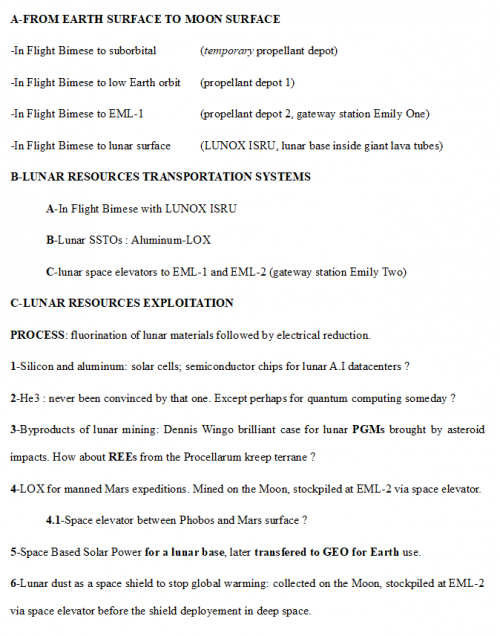
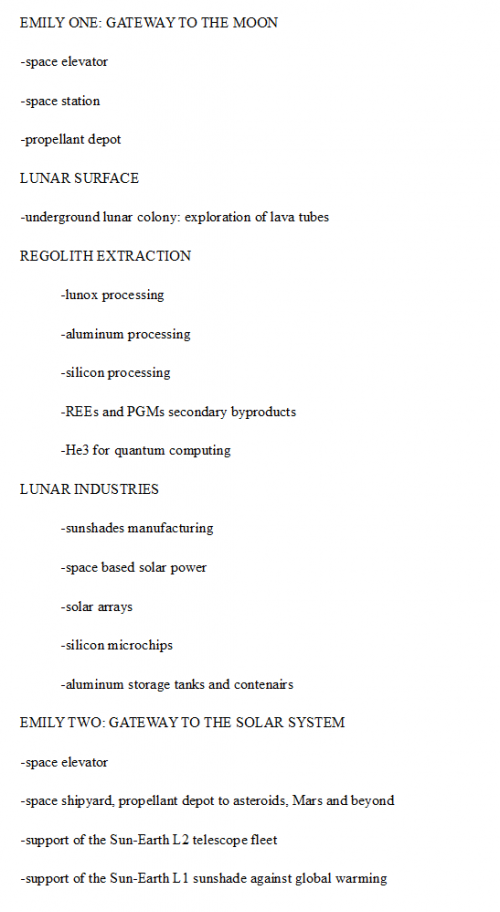
One of my favorite space blogger has started a series about lunar ISRU and resources. https://selenianboondocks.com/author/kfsorensen/
It fits my own little lunar architecture like a glove; almost too good to be true. I integrated this into my TL roadmap of lunar resource exploitation.
I've never been a fan of space elevators, yet the case of space elevators to EML-1 and EML-2 is almost too good to be true. Unbelievable.

ROADMAP .png
 
Remember that the Earth-Moon Lagrange point between the Earth and Moon (EML1?) is not stable, Earth's gravity is strong enough to try to steal anything there.
 
It's a perennial and complex debate. Station keeping requirements are reasonable, a propellant depot could tap into its own fuel supply to stay on station. No such problem for a space elevator, by the way.
 
It's a perennial and complex debate. Station keeping requirements are reasonable, a propellant depot could tap into its own fuel supply to stay on station. No such problem for a space elevator, by the way.
An orbital elevator on the Moon is a very weird case. Moon's rotation is so slow that IIRC the selenostationary orbit above one point on the surface is deep into Earth's gravity well. Brave AI says it's some 88,400km above Luna, but that's 28,000km into Earth's gravity well. And then the counterweight for said orbital elevator (assuming standard design) is another 88,000km further in towards Earth. That's more than 1/4 the way from the Earth to the Moon!
 
One of my favorite space blogger has started a series about lunar ISRU and resources.
Fluorination of lunar materials?

Where's the fluorine coming from? Some lunatic loading rockets full of fluorine here on earth and launching them?
 
January 1962

"HORIZON and LUNEX won't happen, but it could be a secret military mission for Apollo" Shoemaker told Teller. "Emplacing a listening station on the Moon to pin down the most powerful radars inside the Soviet Union - SPOON REST, FAN SONG, HEN HOUSE and TALL KING. We need that data to protect the A-12 and SR-71 penetrating USSR borders. As it happens those radars are so powerful, their beams reach as far as the Moon then bounce off: back down to Earth. But the signals are weak while the emitter, Moon and receiver have to line up very precisely. Putting a listening antenna on the Moon would simplify the problem."

(this thread is so cool - https://forum.nasaspaceflight.com/index.php?topic=65329.msg2800929)
 
Folks - I'm treading uncharted waters. And I need your opinion. Check this link, for a start.

https://www.sciencedirect.com/science/article/abs/pii/S0094576522006762?via=ihub

---------------

"Alex, you have to understand that the space sunshade concept is really just a bone we threw to opponents of global warming mitigation. We keep them happy and busy with that theoretical technological fix, which makes a powerful argument for manned spaceflight. It helps save the world! So basically, we're building a moon colony to get a bunch of regolith for the sunshade.

"The ambiguity of the whole thing is illustrated by none other than Edward Teller. He and his colleagues from Livermore support the sunshade, of course. But he insists that we make the shield as small as possible, considering its colossal size and cost. This means we still have to curb CO2 emissions. Make no mistake: That last point doesn't make Teller a true ecologist by a long shot! To him, it's just a matter of technological practicality.

"And that's where we presently stand. We have managed to avoid widespread global warming denial, but only at the cost of a Faustian bargain. Yes, we will build that sunshade as soon as possible, but don't forget: its insane size and cost mean we have to keep it as small as possible. The temperature required to be dropped by the sunshade is directly related to the amount of CO2: the less CO2, the less global warming, and the smaller the temperature drop. That's the precarious deal."

---------------

What is your opinion ? do you think that deal stands any political chance, in 1990s USA ?
 
A quick introduction: the shorter, the better. What do you think ? Would you read a novel like that ?
----
In 1954, the U.S. military began developing the first spy satellite, known as WS-117L. The U-2 spyplane was also under development.

By 1964, the National Reconnaissance Program (NRP) had been established, and its fleet of spy satellites had stabilized around CORONA for broad coverage and GAMBIT for high-resolution imaging. Spyplanes and drones were also developed as complementary tools because they were not chained to an orbit and could be deployed faster during the Cold War crisis.

By 1974, spyplanes and drones had been removed from the NRP portfolio as spysats kept evolving.

This is the story of two brothers involvement with the National Reconnaissance Program.
 
Edwards AFB

"Skybolt had a limited range, and it required a B-52. The B-52, in turn, required the giant runways of the Strategic Air Command: 15,000-foot-long targets. At first glance, 'dash on warning' is similar to Skybolt in that it involves ballistic missiles launched from large aircraft. However, there are some major differences related to the carrier planes. They try to hide from SAC bases by dispersing in the countryside at remote airfields. Replacing B-52s with 747s or C-5s is not very clever in terms of runways. However, the HS.681 changes this for the better. Another difference is the use of Minuteman instead of Skybolt, a true intercontinental missile that is already in service but considered vulnerable in its silos. Dash on warning would get the Minuteman out of its silos and make it mobile at the speed of a plane.

"Now, how does this concern us and HIGH TOWN Mk.1?

"Well, for starters, a B-52 carrying HIGH TOWN Mk.1 is essentially Skybolt reborn. Replace the bomber with an HS.681 cargo plane, and you have that 'dash on warning' I mentioned. It is being explored for ICBMs and crisis reconnaissance spysat like our very own HIGH TOWN Mk.1. It uses a Minuteman ICBM as a booster for its Agena. So, things come full circle. "
...
The buzzword was 'dash on warning.' Intercontinental ballistic missiles (ICBMs) would be loaded onto subsonic aircraft and dispersed across remote airfields throughout the United States. In the event of a nuclear World War III, the aircraft in alert would take off and attack the Soviets. These aircraft could be C-5As or 747s, but they required large airfields and were vulnerable targets. A better alternative would be VSTOL cargo planes; and the HS.681 was almost perfect for the job.

Shoemaker was aware of these missile basing studies when he realized something important: if the B-52 were replaced by an HS.681, the cargo plane could be dispersed with the missile inside, effectively testing dash on warning. The only difference would be an Agena and a spy satellite instead of a nuclear warhead, but that would not matter. The important thing was to validate launching a missile from a dispersed cargo plane at a remote airfield.

By 1968, two HS.681 prototypes had flown in the US, rebranded as C-6A. They began an astonishing flight test program that far exceeded HIGH TOWN. The BS.100s were so powerful that C-6As could take off vertically if they sacrificed part of their fuel load; however, they could recover it through aerial refueling by a KC-135 or a Skywarrior.

Thus, the Navy was able to launch a C-6A from aircraft carriers and even from the much smaller Iwo Jima assault helicopter ships. The transport plane carried a Polaris-Agena missile on a pallet; the entire assembly parachuted from the cargo bay. The Navy was interested in using this system to launch Transit, GRAB, and POPPY satellites.

The Air Force flew a similar mission from a remote airfield and, later, from a helipad. They carried a HIGH TOWN Mk.1 inside the cargo bay. The Minuteman-Agena-spysat was also on a pallet and parachuted out before firing to orbit.
...
The Marine Corps has procured 110 Harriers called AV-8A, a major success for the British aircraft industry. In 1964 the Americans also rescued the HS.681 cargo plane and married it with the P.1154 BS.100 turbojet. Saving that engine was deemed essential for future supersonic VSTOL fighters; and now the time has come.

The US and British just got a new agreement. The Americans will develop a BS.100 supersonic VSTOL fighter; as for the British, they will put a big wing on existing Harriers - Marines and RAF, but also a new variant for the Royal Navy called the Sea Harrier.
 
Back
Top Bottom