From old site on Net,
in 1936, the Czechoslovak Ministry of National Defence (MNO) formulated detailed tactical and technical requirements for a new, high-performance, twin-engine medium bomber aircraft, known as the "Type IV Bombardér," and sent them to several major aircraft manufacturers. Based on these, work began at the Letov plant on the Š-43 design, at Aero on the A-300 design , based on the earlier A-206, at ČKD-Praga on the E-48 design, and at the Avia plant, two design teams began work: those led by Frantisek Novotný and Robert Nebesář.
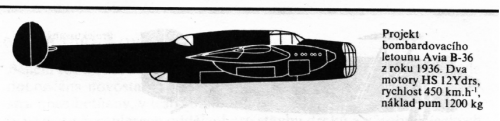
Engineer Novotny—known for his design of the B-534 and B-35 fighter aircraft—developed a preliminary design for a sleek, twin-engine mid-wing aircraft with a slender fuselage, twin vertical stabilizers, and retractable landing gear, designated the B-36. It was to be powered by French Hispano-Suiza 12Ydrs inline engines. At the time, Avia was finalizing a license-produced agreement for these engines, which were to become the standard power source for newly built Czechoslovak military aircraft. With these engines, the B-36 was expected to reach a top speed of 450 km/h and a bomb load of 1,200 kg.
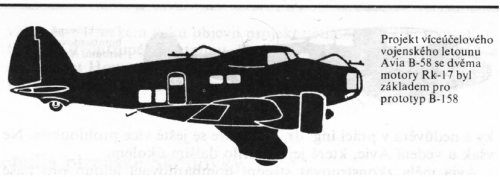
At the same time, engineer Dr. Nebesář presented his design for an aircraft designated the B-158 , developed in May 1936 based on an earlier design for a light multi-role bomber, the B-58. It was a twin-engine, low-wing, all-metal cantilever monoplane, also intended to be powered by HS-12Ydrs engines. A top speed of 482 km/h was expected.
Avia's management, likely tempted by the anticipated improved performance, decided to proceed with the B-158 project. Construction of the first prototype, designated tactical S28, began in late 1936, and it first flew a year later, on November 11, 1937. Unfortunately, the aircraft completely disappointed its creators' expectations: its empty weight exceeded the target by a staggering 640 kg, and the maximum speed achieved during trials was a mere 435 km/h! Prototype trials continued until the dissolution of Czechoslovakia in March 1939, but even then, it was already clear that the competitive Aero A-300 proved to be the definitive "Type IV bomber." Unfortunately, both aircraft were constructed too late to enter series production and enter service with the Czechoslovak Air Force.
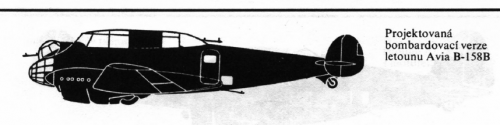
The B-158 prototype was built as a reconnaissance variant, featuring features such as a four-man crew, the ability to carry 10 illuminating bombs and mount cameras, and slightly more powerful defensive armament. The planned B-158B bomber version was to have a three-man crew, a forward gun turret, and a fuselage bomb bay for 500 kg of bombs. External bomb racks could also accommodate additional bombs: one 500 kg bomb or two 200 kg bombs each. However, the B-158B never progressed beyond the design stage.
After occupying Czechoslovakia, the Germans subjected captured weapons to flight tests, including the prototype B-158. After a series of trials, it was scrapped.
On the margin of this story, it can be added that engineer R. Nebesář left for the United States shortly before the German occupation of Czechoslovakia, where he worked for some time at the Howard Aircraft Company.