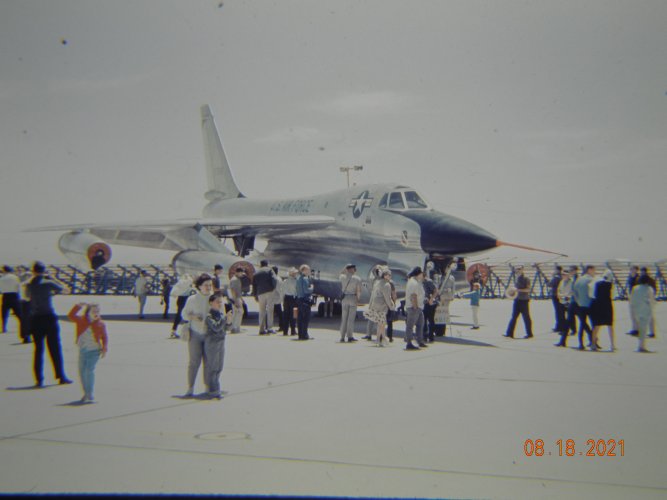
Oh, of course not.
Where does it state they would be "perfect' at the task?

Oh, of course not.

Okay, fair. But "ideally suited" is close enough.Where does it state they would be "perfect' at the task?
Can't say that either. it never performed the task so your point was never validated. Was the A-12 "ideally suited" as mothership?Okay, fair. But "ideally suited" is close enough.
Given the B-58 was designed to carry large payloads externally, deploy them from high altitude and supersonic speed, and actually launched several successfully, I'd argue the facts are on my side. With other aircraft would do it better?Can't say that either. it never performed the task so your point was never validated. Was the A-12 "ideally suited" as mothership?
The supersonic capability of the B-58 offers no real advantage as a carrier for hypersonic vehicles over others like the B-52, KC-135, etc.Given the B-58 was designed to carry large payloads externally, deploy them from high altitude and supersonic speed, and actually launched several successfully, I'd argue the facts are on my side. With other aircraft would do it better?
The supersonic capability of the B-58 offers no real advantage as a carrier for hypersonic vehicles over others like the B-52, KC-135, etc.
The B-52 is a proven hypersonic vehicle carrier.
A little, but shock impingement and interactions cause problems.Of course it does. A missile launched at Mach 2 and 60,000 feet will travel far further/faster than the same missile launched from subsonic speed.
Not a poor flyer, but one that required the pilots undivided attention or the plane would slap the pilot upside the head for not paying attention.Had never heard that it was a poor flyer.
@Archibald where do you come up with 130,000 lbs for the BUFF? The stock BUFF is 20-25,000 lbs for the under-wing pylons, Balls 8 was specially modified for X-15 with lots of structural reinforcements, Balls 25 wasn't, and IIRC couldn't do more than 25,000 lbs.I would say that B-58 big pod and tall undercarriage might have been of interest to drop big rockets and missiles. Been there, done that in my aerospace uchronia: B-58 meets again Bell LR-81, once on its powered pod, later gone to the Agena. I bring them together again.
BUT - to be honest: nothing beat a B-52 and its wing pylon. Even twice as fast, the B-58 (from TOWN HALL documents I'll link) is too small: it was limited to a maximum of 71 000 pounds on its belly pylon.
Compare that to the 130 000 pounds ISINGLASS concept, carried X-15 style.
Of course the XB-70 bury both, and not only because it flies at Mach 3. According to Dennis Jenkins, a XB-70 could have carried up to 200 000 pounds on a belly fairing. But air dropping at Mach 3 might be hair raising...
Of the three, the B-52 wing pylon carrying 130 000 pounds sounds the best bargain.
I have checked air-launch "boost" numbers from varied papers (Burnside Clapp, Sarigul-Klijn and a couple others).
Broadly
- dropping from a B-52: 40 000 ft, 30 degree AoA carves 1100 m/s out of an ascent to orbit 9000 m/s.
- dropping from a B-58: 40 000 ft, 30 degree AoA carves 1600 m/s out of an ascent to orbit 9000 m/s.
- dropping from a B-70: 40 000 ft, 30 degree AoA carves 2000 m/s out of an ascent to orbit 9000 m/s.
So by orbit standard, the supersonic carriers don't make that much of a difference.
This was the weight mooted for the Model 192 RHEINBERRY vehicle, pre-drop. The LH2 and LOX would have been carried in a tank under the opposite wing, and the vehicle fueled in flight before launch.@Archibald where do you come up with 130,000 lbs for the BUFF? The stock BUFF is 20-25,000 lbs for the under-wing pylons, Balls 8 was specially modified for X-15 with lots of structural reinforcements, Balls 25 wasn't, and IIRC couldn't do more than 25,000 lbs.
Thanks, again 130,000 lbs isn't happening without a big-time structural update.This was the weight mooted for the Model 192 RHEINBERRY vehicle, pre-drop. The LH2 and LOX would have been carried in a tank under the opposite wing, and the vehicle fueled in flight before launch.
To be honest, it’s one of the more squirrelly parts of the Model 192 conops.
Thanks, again 130,000 lbs isn't happening without a big-time structural update.
It's well within the total load capacity of a BUFF. BUFFs regularly haul ~70klbs of boom and over 300klbs of fuel in total. (That fuel fraction is more appropriate for a freaking rocket than an airplane!)Thanks, again 130,000 lbs isn't happening without a big-time structural update.

By way of comparison, assuming an effective exhaust velocity of 4.5 km/s, you could get the following weights into orbit:So by orbit standard, the supersonic carriers don't make that much of a difference.
Snce you're crunching numbers, how does Stratolaunch compare?By way of comparison, assuming an effective exhaust velocity of 4.5 km/s, you could get the following weights into orbit:
The first figure is gross, second figure is net of stage weight assumed at 10% of total fuel weight, all rounded down to the next lowest 5 lb. Figures for a 3 km/s effective exhaust velocity and 6% stage weight are... underwhelming. But generally, the lower the rocket stage performance, the bigger the advantage of a higher performance airbreather.
- B-52 - 22,465 lb / 11,710 lb
- B-58 - 13,710 lb / 7,980 lb
- B-70 - 42,215 lb / 26,435 lb
I think it's fair to say that any heavy space launch derivative of a bomber would require significant structural alterations. If it stays within the overall weight limits of the aircraft, those should be limited to more-or-less local redesign.
Noted at the time. From the Isinglass FOIA file on NRO.gov:Thanks, again 130,000 lbs isn't happening without a big-time structural update.
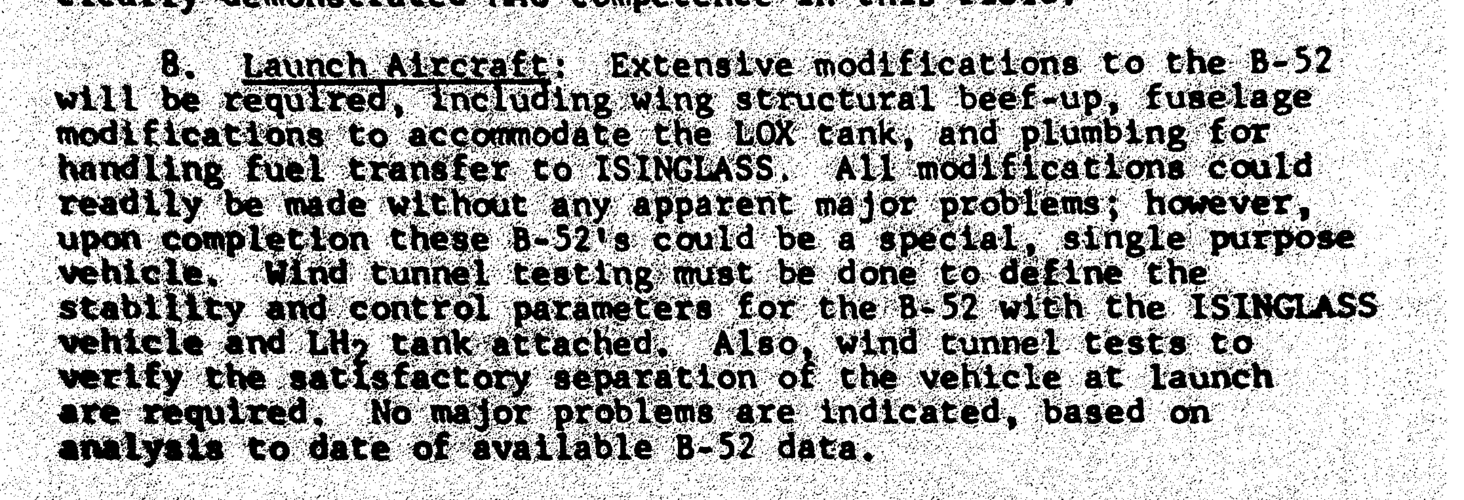
Snce you're crunching numbers, how does Stratolaunch compare?
Enjoty the Day! Mark
The jet cannot takeoff legally with full tanks, much less with a max payload and full tanks. The empty weight is about 185,000 lbs, max gas is 312,000 lbs and max gross is 488,000 lbs. You'll be almost 10,000 lbs over with full tanks. The most I ever saw was 260-280,000 lbs when we flew from ED to EG to shoot a MALD. We had two HSAB's, a MALD and was just about grossed out. We took off at 0600 from 04R (15,000 ft) and it was the longest, slowest takeoff roll I ever experienced. The 70 knot time was long. We had an hour at the range and then took 60,000 lbs of gas to get home.It's well within the total load capacity of a BUFF. BUFFs regularly haul ~70klbs of boom and over 300klbs of fuel in total. (That fuel fraction is more appropriate for a freaking rocket than an airplane!)
The question is really how much lift the RHEINBERRY airframe makes at ~400mph. If RHEINBERRY empty is ~25,000lbs, you then add ~70klbs of hydrogen and 35klbs of oxygen to the bird once in the air and it's providing lift... That's 70klbs of LH2 in an absolutely enormous pod under one wing (~490,000 liters capacity!), LOx in a tank in the bomb bay.
Probably have to run both wings more or less empty of jet fuel to have the overall weight acceptable, but then you can pump 100klbs of jet fuel out of the fuselage tanks and into the wing where the hydrogen pod is to keep the balance within limits. I'm pretty sure a B52 won't particularly notice ~25klbs out of balance on the wing pylon. Rebalancing after the drop is likely to be scary, though. I'm sure a B52 will not be happy about ~100klbs out of balance on the wing.
Right, the way I see it, the plane would take off with about 150k in jet fuel and ~105k in rocket fuel and oxidizer, and use 100klbs of jet fuel as ballast. You can stick some 100klbs of fuel into one wing, right?The jet cannot takeoff legally with full tanks, much less with a max payload and full tanks. The empty weight is about 185,000 lbs, max gas is 312,000 lbs and max gross is 488,000 lbs. You'll be almost 10,000 lbs over with full tanks. The most I ever saw was 260-280,000 lbs when we flew from ED to EG to shoot a MALD. We had two HSAB's, a MALD and was just about grossed out. We took off at 0600 from 04R (15,000 ft) and it was the longest, slowest takeoff roll I ever experienced. The 70 knot time was long. We had an hour at the range and then took 60,000 lbs of gas to get home.
I don't even want to think about the weight and balance problem, it wouldn't be pretty.
I'd have to look in the -1 and I don't mine handy ATM. That amount of imbalance wouldn't be good, heck it's more likely than not prohibited, but as I said I don't have my -1 handy.Right, the way I see it, the plane would take off with about 150k in jet fuel and ~105k in rocket fuel and oxidizer, and use 100klbs of jet fuel as ballast. You can stick some 100klbs of fuel into one wing, right?
Ironically, the reinforcement would need to be on the hydrogen side most of all, since you're packing ~70klbs of hydrogen and
oops, completely messed up on the chemical equation balances!
*facepalm*
Oxygen is 16x more massive than hydrogen per mole, so 2lbs of LH2+16lbs of LOx for stoichiometric combustion. That greatly helps the weights/volumes. 100klbs of fuel and oxidizer divided by 18 is 5,556, 16 x 5,556 = ~88,900lbs LOX and 11,100lbs of LH2 out under the other pylon. ~70,500 liter tank for the LH2 plus insulation volume. 35,500L tank for the LOx.
So the LH2 tank wouldn't be any heavier than 12x ALCM on the pylon. I'd hate flying with ~90klbs of LOx in the belly.
Sitting on the ramp, RHEINBERRY would weigh ~25-35klbs under the wing. The question is how much lift would it generate at 400mph as you fuel the beast? Obviously, at whatever design cruise speed was it'd lift at least 75klbs. But if it generates more or less 25klbs of lift at 400mph the pylon only needs to be rated for ~100k. Which is a hell of a lot, but better than having 135klbs sitting there static.
President Carter spent a boatload of Classified money on Nuclear programs and the R and D for the nascent Stealth B-2--****** And money for the development of the F-117 Nighthawk-- PRESIDENT Jimmy Carter was a pro-defense guy who got lost listening to too many DEMS who hated Advanced DOD projects.Sec defs come and go and the usaf wanted the amsa and not the fb111. The usaf was able to keep amsa alive despite the sec def. Eventually the fb111 was bought as an interim until the b1 was ready... A paltry 76. But of course we all know Jimmy Carter. But the usaf still managed to keep the amsa now the b1 going with additional test flights. I find it interesting that to be an aviation enthusiast means also needing to be a political expert!
Seems there is something of an airframe that survived the times:
View: https://youtube.com/shorts/pIIr3Q-AxMc?si=Ow0l233IbglSKovz
Wonder where that was filmed
I don´t remember exactly what was the video, but reading the following comment by Archi, I guess it was something like this one:You will want to re-upload that YT video as it's now listed as private.
With the installation of the “Triple Redundant Yaw Damper” system, crews were once again allowed to fly at Mach 2. Colonel Al Dugard, an Instructor pilot in the B-58 would normally cut an outboard engine at Mach-2 to show the student pilot that it was a safe operation.
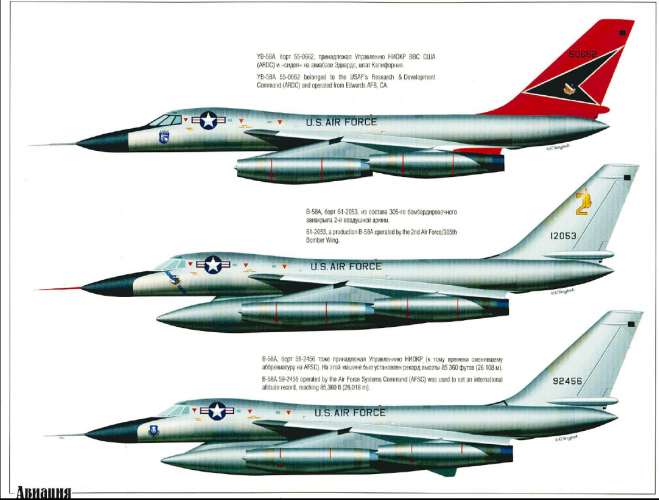
Yes it was - the B-58B at least.Now since the B-58A was used as a launch aircraft for the High Virgo air-launched rocket which helped pave the way for the Douglas AGM-48 Skybolt ALBM it made me wonder if the Hustler was considered as a carrier for the Skybolt?


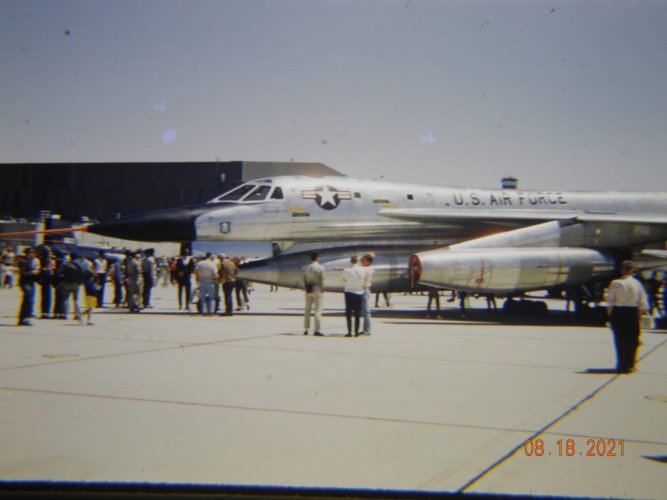
Video:Paul Stewart said:Inside the Convair B-58 Hustler!
Join me in this walkaround tour of a Convair B-58 Hustler on display at the Strategic Air Command and Aerospace Museum in Ashfield, Nebraska. This cold war mach 2 capable strategic bomber was in service from 1960 until 1970 before being replaced in that role by the Boeing B-52 Stratofortress.
https://www.youtube.com/watch?v=GpE6IJveAW4Not directly related to the B-58, but the B-1 uses the two small canards near the cockpit and lower rudder section to control fuselage flex as part of its Structural Mode Control System to reduce fatigue stress and improve the crew ride. Quite possible this was a lesson learned from the B-58 experience.Several of my professors in college were aero engineers who had been caught in the drawdown of the mid-1960s and turned to teaching to make ends meet. One of them had been involved with the B-58 and he said that the pilots used to comment on how smooth the ride was at supersonic speeds, but in fact the airframe was trying to shake itself to pieces. It just happened that the cockpit sat at the node of the major vibration frequency, where the motions had the lowest amplitude. I've never heard that from any other source, but it's not the kind of thing he would have just made up.
If you haven't seen it, NB-52E, a CCV version of the B-52 with three canards/fins to damp structural flex.Not directly related to the B-58, but the B-1 uses the two small canards near the cockpit and lower rudder section to control fuselage flex as part of its Structural Mode Control System to reduce fatigue stress and improve the crew ride. Quite possible this was a lesson learned from the B-58 experience.