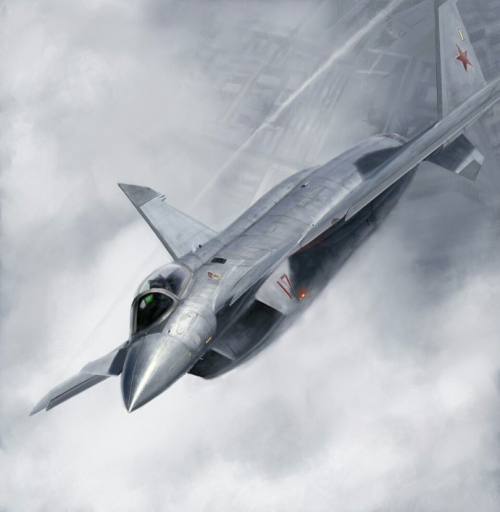
Come take a look at my historical fiction

Suslova

ACCESS: Restricted
Joined
9 November 2021
Messages
28
Reaction score
65
Well, since English isn't my first language, this text comes from a later translation. I've made my own adjustments to the translation, which hopefully have improved it.
It's a story told from the perspective of a fictional "I", narrating 'how the OKB MIG might have developed if the USSR had continued to exist.

-Comrade, manager, friend-

In July 1995, when Pyotr Zeynegin came to see us, the OKB had not yet emerged from its setbacks. After the OKB was consolidated into MAPO (the Moscow Aviation Production Association), Belyakov had always harbored resentment toward the decision: he did not want to see the OKB’s work and decision-making be influenced by the commercial behavior of an enterprise, even if it was technically a state-owned one.

But the bigger problem was obvious: without money, there was nothing. Not only the projects we were still pushing forward, but also the basic operation of the OKB—everything required funding. And under the circumstances of the 1990s, only the enterprise could fill the gap left by the shrinking state budget. The production association promised to allocate the revenue from MiG export sales to support our development projects, and for a time, this became almost our only hope of survival.

There were no special arrangements made for Zeynegin’s visit—aside from a formal reception, everything was kept simple. We all knew that his arrival was unlikely to bring us any good news, yet everyone was still willing to hold onto some small hope. We were all working hard to bring everything back on track and keep moving forward—everyone could see this. But this time, things were different.

“Moscow hopes that the first stage of development can be completed as soon as possible, in order to restore confidence in the aviation industry.” This was not exactly bad news, but given our circumstances, it was difficult to call it good news either.

Accompanying Zeynegin was the general manager of MAPO, Vladimir Kuzmin. Compared to Zeynegin, who had come from the Air Force, Kuzmin seemed more like the person we were actually supposed to work with — but where one could be called a “comrade,” the other was clearly a “manager.” That gap alone felt enormous, as if the entire world had subtly changed.

Nevertheless, that afternoon, we sat down with Kuzmin in a conference room and talked for a long time — of course, about the further development of Izdeliye 1.42. Even though we had independently completed the assembly of the second and third prototypes and successfully sent them into the sky, the overall progress of the project was still facing many difficulties. To make the explanation clearer, I turned to face the blackboard.
“In July 1993, to ensure that the first demonstrator aircraft could safely complete its planned flight life, and to install new testing equipment, Izdeliye 1.44 was returned to the factory for modification. Meanwhile, the design drawings for the second stage finally arrived at the experimental plant, where our colleagues had already prepared four partially-built prototypes. The next two aircraft were completed in January and May of 1994. And as for what came after…”

When I stopped writing, I realized that I was not good at delivering reports. The blackboard was filled with messy, fragmented words—ironically, they accurately reflected my fragmented life and work.
Silence hung in the room for several seconds before Kuzmin finally broke it:
“To complete this project, what else do you need?”
Sitting beside us, Aleksandr Velovich glanced at me. Just a few months earlier, he had interviewed Kuzmin about the delay of the 1.42 program. And now, the roles had reversed entirely. The tension had circled right back to us.

Velovich stood up, poured Kuzmin a glass of water, and handed it to him. I was busy grinding a piece of chalk between my fingers, trying to condense all of our difficulties into a single sentence.
The documents Velovich had prepared never came into use. But this was, in a sense, an inevitable outcome — and afterward, this scene would repeat itself countless times.
“Well... what we need now is coordination from the manufacturers involved in the project,” I finally said, almost sighing it out toward the pale sky outside the window.
“We plan to begin testing the avionics and electronic systems within the year,” Velovich added hesitantly. “If coordination with the other units can be arranged.”
He knew exactly what kind of obstacles we had run into. Two years earlier, we had already discussed the feasibility of installing a radar system on the second prototype with the Tikhomirov Instrument Research Institute. The answer had, of course, been no — just like every similar question. Even a simplified radar prototype could not be delivered before 1995, and the lower-risk RLSU-30 was the current priority — but that had nothing to do with us.
Everyone preferred to work on projects that could generate revenue. Who wouldn’t?

Kuzmin stood up and left the conference room, leaving behind only a brief “I understand.”
“Thanks.”
Still believing that any Beautiful Distance must exist somewhere in this world, I instinctively used that phrase to bid him farewell.
Whether he heard me, I will never know. And in all the days that came after, I never again had the chance to speak with Kuzmin alone.

But not everyone was like us. As former colleagues and now competitors, the OKB Sukhoi had clearly gone much further in commercialization. With export restrictions lifted, their heavy fighters were performing quite well on the international market. At the time, we heard that the Indians were negotiating with Sukhoi to purchase a multi-role fighter that, officially speaking, did not even exist.

On April 2, 1996, Sukhoi’s T10-M-11 — also called Su-37 — made its maiden flight. Inside our bureau, the news caused barely a ripple. It did not surprise us in the least. After all, in facing the 21st century, we already had our own final answer— something that had been settled long ago.
But the media did not see it that way.
I'm hoping to make it all feel close to reality. I'm really looking forward to everyone's feedback.
Whenever I'm done with a new part, I'll drop an update right here. ;)
 
Last edited:
-Now, future, back to the past-

In July 1996, Moscow was gradually warming. As usual, I bought a copy of Moskovskaya Pravda and leaned against the newsstand on the street.

With the “Terminator” appearing at the Farnborough Air Show, the media reported the news with unprecedented enthusiasm, hailing it as a symbol of the revival of the aviation industry — as if this aircraft would overturn all the disadvantages that had existed since the first flight of the YF-22 in 1990.
I could understand that enthusiasm, of course, but passion alone could not change reality. I skimmed through the article and almost felt the urge to hand the newspaper back.

Fortunately, most things were returning to the right track by then. Under the financial shelter of MAPO, aircraft No. 04 and No. 05 of Izdeliye 1.42 had been successfully assembled, while No. 03 had been transferred to Voronezh. At the Marshalov Air Force Base, TsNII-2 (the Second Central Scientific Research Institute) had already begun radar cross-section evaluation tests.

Not long before, the Indians had come to see us as well. Air Marshal Anil Chopra of the Indian Air Force arrived at 6 Leningrad Highway, where our bureau was located. He was responsible for the MiG-21 upgrade program, known as “Bison.”

“Founded in 1932, the Gorky ‘Falcon’ Aircraft Plant was originally named Factory No. 21. Over 45 years, nearly 13,500 aircraft were produced here,” Pankov, the plant director, tirelessly recited the glorious history of the factory as we accompanied our guest. “Once the final drawings from the design bureau arrive, we can begin work immediately.”

In truth, the Indian guests had no interest in historical achievements. They simply walked with their hands behind their backs, examining the MiG aircraft on the production line with an almost critical eye.

After the state finances collapsed, our production output was nearly destroyed with it. At its peak, this factory could produce nearly 200 aircraft a year. Now, in 1996, Gorky’s Falcon was left with only a few dozen MiGs to refurbish.

Yet for this important visit, our workers still exerted every effort to make everything appear orderly — just like it once was in memory.

“Two MiG-29 orders would be enough to keep the entire factory running — including wages. Ah… do you know the MiG-31?”
Pankov brought up the MiG-31. Moscow had long hoped to sell MiG-31s to India; technical documentation had already been provided to both the Indian government and the Air Force, but no official response ever came.

Through the faint warmth of the teacup, Chopra’s gaze settled on Pankov’s hands — his coarse fingertips resting naturally on the rim of the cup, his head slightly inclined toward the expensive coffee.
“May I take a look?”

Pankov paused for a moment and then looked up — just in time to meet my eyes.
I simply blinked at him, pressing the corner of my mouth down.
He narrowed his eyes, his hands stirred a moment, then returned to his pockets. He said nothing.
“We will need Moscow’s decision…”
Chopra’s appreciative expression collapsed into a cold smile. He merely shrugged and raised his coffee cup.
“Thank you.”

Making friends with the Indians is like a long fermentation. They prefer to guide relationships with the wisdom they believe in, while you must peel the gauze away slowly, carefully.
Before the 1990s, foreign clients had to procure through the State Committee for Foreign Economic Relations (GKES), specifically via the Main Engineering Directorate (GIU) and the Main Technical Directorate (GTU). In 1993, these agencies were reorganized into the new arms export intermediary, Rosvooruzhenie. Although the principles of military export supply continued, inflated margins gradually became the norm. Some component and subsystem suppliers tried to survive independently, but the newly decentralized military export permissions could not save everyone. Only an indifferent fate slowly dragged us out of the 1990s.

While waiting for the final drawings to arrive, Pankov introduced Chopra to the factory’s core technical staff. In the 1960s, they had built the aerospace factory in Nasik — something that remained a point of pride for the Indians, and Chopra had not forgotten it.
Thirty years of memories folded tightly together; the frozen camaraderie wrapped around Chopra. At the same time, he took pride in the fact that our comrades still remembered the Indian monk’s rum — and promised he would bring some from India next time.
Such is the fermentation: time solves the problem; peeling away the gauze is only the final gesture.

In short, the contracts with Malaysia and India briefly allowed us to believe that another reality existed on the other side.
But what that other side could provide us — was only that.

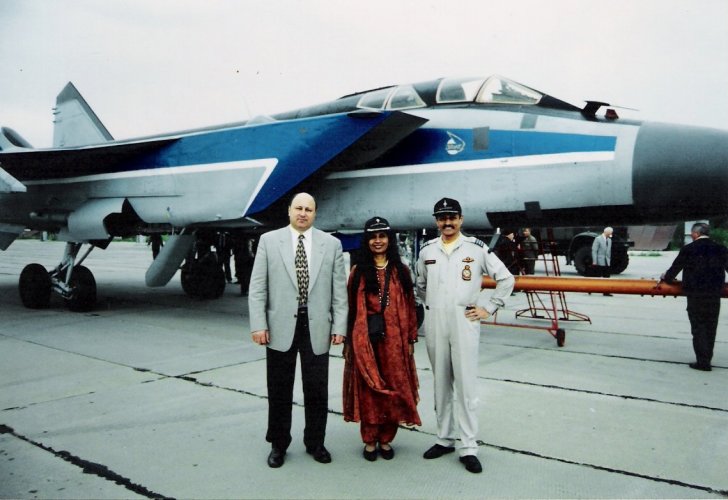
Chopra boarded the MiG-31 on May 28, 1999, at the Sormovo General Airfield. On the same day, Gorky’s Falcon received another guest: Ms. Nirupama Rao of the Indian Embassy in Moscow.
Before takeoff, my colleague gave Chopra a detailed explanation of the aircraft’s design and features, followed by the pilot’s pre-flight briefing.
“With the data link, four MiG-31s can cover an airspace nearly 900 kilometers across… and of course, radar data can also be transmitted to MiG-29s and Su-30s.”
For the Indians, the MiG-31 had clear lineage from the MiG-25 they knew so well. But for this 22-ton industrial artwork, its true leap forward was hidden beneath the titanium skin.
Pilot Aleksandr Konovalov pressed his lips together, quietly waiting for this single minute of glory...

1762522990243.jpeg
 
Last edited:
This is a "side story"... I haven't finished all the ideas yet...

After the conflict with Kovashnin, old Anatoly simply returned to his life; we all knew it wasn’t because of age, but for far more complicated reasons.
In September of 2003, though his pact with the Motherland had ended two years prior, out of professional inertia—or perhaps something deeper—Anatoly kept moving within the industry, carried by the weight of all he had built.

“F-22. The Raptor—I'd like to hear your thoughts.”
Anatoly asked softly, wearing that familiar, modest half-smile.
His gaze was pressing down on me, though I could no longer make out the gray-blue of his eyes.
The question was so simple that it was impossible to answer correctly.
I offered him a beggar’s smile, the kind one gives just to buy a moment to think.

“They won't be an eternal legend.”
I almost laughed at myself as I said it—
and in that moment, a silent hope drove a sharp blade straight into my own face.
 
Pilot Aleksandr Konovalov pressed his lips together, quietly waiting for this single minute of glory...
Following the previous ;)
Chopra ducked under the wing and reached up, giving the rack a pat. On the original MiG-31 platform, this station was typically used for mounting R-40 or R-60 missiles. After the modernization upgrades, it could now carry the R-77, an advanced active radar-guided missile.

Another detail that caught Chopra's eye was the unique design of the MiG-31's landing gear. The main gear was reinforced, with the wheels paired in a side-by-side, tandem arrangement. Before retracting into the fuselage, the entire assembly would twist forward a full turn—a true art of mechanical design. We demonstrated this entire process specifically for Chopra.

Before he entered the cockpit, Aleksandr Georgiyevich Konovalov briefed him on several important points, especially the strict "no photography" rule. This wasn't a case of double standards for foreign clients, but rather a case of belatedly enforced secrecy protocols. During the brief thaw in relations with the West, our confidentiality regulations had largely become a dead letter. But by 1999, a subtle shift had begun: just like now, everything was returning to the way it was before.

Of course, all that transpired in the skies above would come later. In the final months of 1996, a long-dormant duty settled heavily upon us—we still had important work to do.At the Znamya Truda factory in Lukhovitsy, we spent several days conducting a simple mobilization meeting for the workers.
That day, whatever hope we had for the future lay buried under the dust of history, coated in the grime of everything we had once possessed.
Everything is going according to plan. The 1990s had excavated the very essence of work and labor, laying it bare before us. The principle was simple enough—but the waiting was interminable, unsettling in its length.

"I—zde—li—ye 9.13S." Velovich leaned his entire upper body against the railing, drawing out each syllable as though announcing a perfect score on his exam. Then, almost in the same breath, he hurried through: "Sm?"
"All of them? The whole batch?"
His brow lowered. He straightened himself, and his quiet sigh was swallowed by a heavy exhale.
Then came a brief silence.
Waiting eyes turned upward.
 
Last edited:
-Two days a week-

Even by the standards of the time, the decision to opt for the 9.13S was overly conservative: the modified 404 and 405—9.13Sm aircraft—had already demonstrated multirole capability for a southern neighbor’s customer, and the evaluation reports were highly favorable.
Though the sudden economic crisis and its cascading troubles eventually turned the future into the past, the 9.13Sm was, by and large, sufficiently developed to be viable.
Technology always leaves behind voids, drafty spaces where life seeps through—yet no way forward.

“Keep waiting,” the waiter said, wiping down the counter as if taking out his frustration. “Or try your luck at McDonald’s across the street.”
Skuratov stood at the counter like a bewildered penguin, newly arrived in Moscow.
“I...Just rubles…”
He spread his arms in near-complaint, turned, and trudged back to the table. With effort, he flipped open a carton of Marlboros, offered me one, and after a moment’s hesitation, lit one for himself.
Just shuting. Nothing more.
“They… the Malaysians,” Skuratov said, not yet drawing on his cigarette, watching the thin blue smoke curl upward. “I still don’t understand how they ended up just like us…”
“This—they gave it to me. I’ve kept it all this time.”
He held it carefully, cradling it, meeting my gaze like a child seeing an airplane fly overhead for the first time.
I am not much of a smoker. I held my breath, awkwardly sealed my lips around the filter, and drew in hard.
The harsh smoke scraped through my nasal passages, rolling up everything I’d been thinking, yanking at my throat—and with my breath, kicked it all out.

When Skuratov straightened up from rummaging in his car trunk, a red thermos lay quietly nestled in the embrace of an old blanket.
He held it out to me with evident pride, admiring the flask.
“Made in China,” he murmured, lowering his voice. “Serving the Soviet motherland.”
“Comrades, Yeah?”
He winked.
“See? Very sturdy.”
His coarse, thick hand patted the red plastic casing gently, as if embracing an old friend long reunited.
“You really should throw out that Spam can,” I said, carefully taking the thermos from him. “Still using it as a pen holder?”
“That one’s American-made.”
He brushed it off with a sly, self-satisfied grin.
“Right?”

Shortly after returning to No. 6 Leningradsky Prospekt, work once again consumed Skuratov: although the center of gravity had shifted toward “more promising” projects, MiG-29 testing continued.
At Zhukovsky, the sixth prototype of Izdeliye 1.42 had just completed its tenth test flight. On the second of those flights, we conducted the first supersonic weapons deployment from the internal bay. The air-to-air missiles separated cleanly from their launchers, ejected from the bay; finally, at a range of 80 kilometers, they struck the target drone with precision.
On the other side, after a long silence, Skuratov was at last able to present their roadmap: the MiG-29 would soon be equipped with anti-radiation missiles like the Kh-31.
The market likes Swiss Army knives. We tried to build them, too. Even the meeting minutes turned out that way.

Earlier, in discussions chaired by old Anatoly and First Deputy Minister Kokoshin, the Phazotron Research Institute had already submitted a development report on fifth-generation avionics systems.
“Avionics of the fifth generation, represented by active phased-array antennas, are the primary direction at present.”
But not long after Izdeliye 1.42 was launched, we quickly realized that developing active phased arrays was far more difficult than anticipated. Thus, we were forced to find a workable compromise—and even that experienced several delays.
After Korzhuyev took over as general director, the corporation began allocating more resources to the avionics of Izdeliye 1.42. We planned to equip the seventh prototype with a full targeting and navigation suite.
In the Moscow office, we could not hear the roar of the flight line. Still, we looked forward to that conclusion—as beautiful as art itself.

On September 8, 1997, Moscow time, the Raptor EMD prototype made its maiden flight.
In the office, it received no praise. No one cheered for it. Even the newspapers carried only a brief notice from the U.S. Air Force; the clipping was taped to a file cabinet.
He would never be a friend. That explanation sufficed.
But this reality also steeled the Defense Ministry’s resolve: Izdeliye 1.42 would be handed over to the Air Force for state flight trials the following month.
This completely upended our original work schedule. Yuri Vorotnikov was furious. You could hear his rage over the phone from almost anywhere on the floor.
He was not a stubborn or hot-tempered man. But to him, a plan was a plan—not to be mistaken, and certainly not to be tampered with.
At the same time, another serious problem emerged: the carbon-fiber honeycomb composite. To meet the required performance, before the third aircraft was sent to Voronezh for ground tests, we replaced the imported American material with an emergency substitute. The task of developing a domestic analogue with comparable characteristics was entrusted to the Technology Association in Obninsk.
But once again, Obninsk delayed the order.
This came as no surprise. By late September, even Vorotnikov had to consult with Sedov on a temporary solution: modifying the aircraft’s radome and other structures, removing the canards from the third aircraft, and installing them on the seventh.
This state of affairs continued until early November. Only then did Vorotnikov finally sit down and take the call from Obninsk.

On December 12, in the workshop of the Sokol plant in Nizhny Novgorod, the fully assembled seventh prototype underwent its final adjustments.
Sunlight filtered through the red banners, bringing a faint warmth to the shop floor.
“What a beautiful airplane!”
A voice deep within me roused my dulled senses. Wracked by a heavy cold, I made no attempt to draw closer. I simply stood at the edge of the aisle, hesitating, quietly waiting for the moment.
In the early months of 1994, we had made a significant revision to the technical and tactical requirements issued in 1986—a task that should have been completed in 1991. But now, it seemed, the cost of punctuality might have been too high.
Regardless, here it was: the seventh aircraft. This would be the starting point of the second phase.
“Truly beautiful.”
I rubbed my sleeve cuff between my fingers and exhaled softly, relieved.
I deliberately avoided recalling what had happened a month earlier. After all, soon, everything would begin anew.
Just as it had in April 1994.
 

Similar threads

Back
Top Bottom