Also from old site on the Net,
one of the most significant figures in the history of Australian aviation was Lawrence J. Wackett. During World War I, he served as an officer in the Australian Flying Corps, and from 1924, he commanded the Royal Australian Air Force Experimental Station (RAAF) at Randwick, near Sydney. During this time, he designed the first indigenously designed military aircraft – the multi-role amphibian "Widgeon" and the trainer and fighter "Warrigal," two examples of each built. The latter was the first all-metal aircraft built in Australia.
After leaving the RAAF, Wackett became head and chief designer of the aviation department of the Cockatoo Dockyard & Engineering Co. Ltd. (Codock) in Sydney, established in 1932. There, he designed a light, seven-seat, twin-engine transport aircraft called the Codock LJW-6 (the LJW designation came from the designer's initials). The aircraft was a cantilever, high-wing monoplane of mixed construction, with a steel-tube truss fuselage and all-wooden wings. It was powered by two four-cylinder in-line Napier "Javelin" engines, each producing 122 kW (166 hp). However, Codock soon discontinued aircraft production, and Wackett himself left the factory. The only Codock LJW-6 built was purchased by Kingsford Smith Aviation.
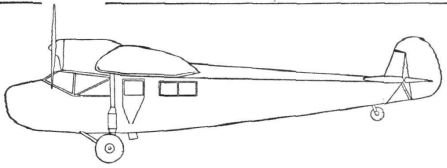
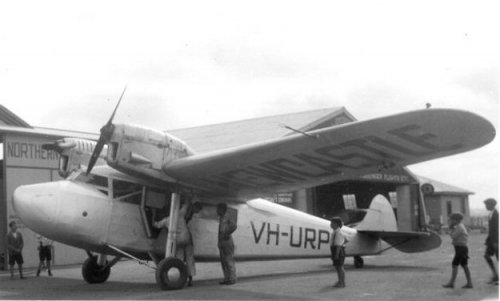
Meanwhile, in 1934, a new aircraft factory, Tugan Aircraft Co. Ltd., was established at Mascot Airport near Sydney, replacing the defunct General Aircraft Co. (Genairco) factory. Funding for the new plant came from, among others, the trading company W.R. Carpenter & Co., and Lawrence J. Wackett became the company's director and chief designer. While at Tugan, Wackett developed several aircraft designs, but ultimately only one type went into production – a light twin-engine transport aircraft designated the LJW-7 "Gannet," an improved development of the earlier LJW-6. Like its predecessor, the LJW-7 was a sleek, high-wing cantilever monoplane of mixed metal and wood construction, equipped with fixed tricycle landing gear supported by struts attached to the fuselage and wings. The main landing gear was covered with fairings, but production aircraft usually flew without them. The main difference from the LJW-6 was the extended forward fuselage and increased engine spacing. The new aircraft was powered by more powerful six-cylinder DeHavilland "Gipsy Six" inline engines, each producing 147 kW (200 hp), housed in wing nacelles. The spacious fuselage cabin could accommodate the pilot and six passengers.
In the mid-1930s, a short series of 8 (according to other sources 9) LJW-7 aircraft were built, two of which were purchased by the Australian government for medical service, and several flew for a short time in the colours of small local airlines WASP Airlines and Broken Hill Pty. The Gannet became the first Australian-built aircraft to fly outside the Australian continent, performing a charter flight to New Guinea.
In June 1936, at the initiative of the Australian government, a large aviation corporation, Commonwealth Aircraft Corporation Pty., Ltd. (CAC), was established. Initial capital was provided by both the government and private industrial firms. The Tugan factory also became part of the new corporation in late 1936, thus ending its short-lived existence after only two years. Consequently, from 1937 onward, the Tugan LJW-7 aircraft were more commonly known as the Wackett "Gannet ." It is worth noting that Lawrence J. Wackett also joined the newly established CAC plant.
The Australian RAAF also became interested in the LJW-7, receiving its first aircraft in November 1935. Before the outbreak of World War II, the RAAF purchased several more Gannets from civilian users , bringing the total number of Gannets in service to six. They bore RAAF serial numbers A14-1 to A14-7 (one of the aircraft, likely after being refurbished, received a new number). Initially, they were used for photographic reconnaissance and transport duties, and during the war, mainly as ambulance aircraft for the 2nd Air Ambulance Unit. Two LJW-7s (numbers A14-3 and A14-7) survived the war and were withdrawn from service in February 1946.
In 1940, one of the "Gannet" aircraft (number A14-7) had its "Gipsy Six" engines temporarily replaced with American Menasco B65s, and the aircraft thus rebuilt is sometimes called the LJW-7A . After some time, the original powerplant was restored.