
You are using an out of date browser. It may not display this or other websites correctly.
You should upgrade or use an alternative browser.
You should upgrade or use an alternative browser.
British flying wing / BWB airliner projects
- Thread starter flateric
- Start date


Cranfield BWB studies (BW'11) and sub scale demonstrator (X.48)
https://www.youtube.com/watch?v=UfD0CIAscOI
https://www.youtube.com/watch?v=UfD0CIAscOI

- Joined
- 19 October 2012
- Messages
- 2,053
- Reaction score
- 2,142
Every man and his dog has had a flying wing/blended wing design/concept in their portfolio post war, yet no customer has shown more than passing interest in them for either military of civil use and those that have flown were little more than proof of concept aircraft. So either the designers were and are failing to make their case or the customers were and are indifferent to the advantages. Discuss 

- Joined
- 19 October 2012
- Messages
- 2,053
- Reaction score
- 2,142
It would, or rather they would, as Miles kept pushing the idea for around ten years with several variations on the theme. They generated little interest and all remained on paper except for the flying scale-model M.30 'X' Minor.
- Joined
- 19 October 2012
- Messages
- 2,053
- Reaction score
- 2,142
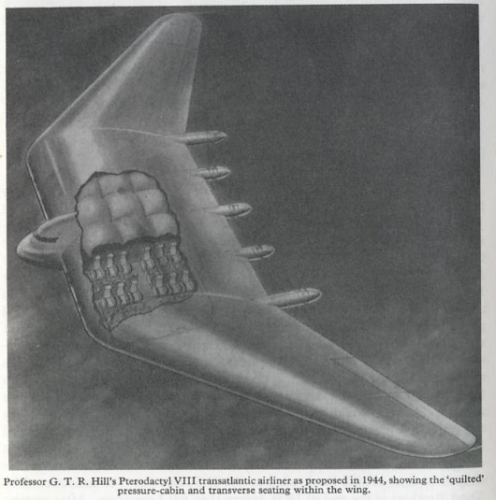
I wonder whether we should consider the Mk VIII to be Canadian as Hill had the basic wind tunnel research carried out at the NRC facilities in Ottawa

- Joined
- 27 December 2005
- Messages
- 18,714
- Reaction score
- 33,052
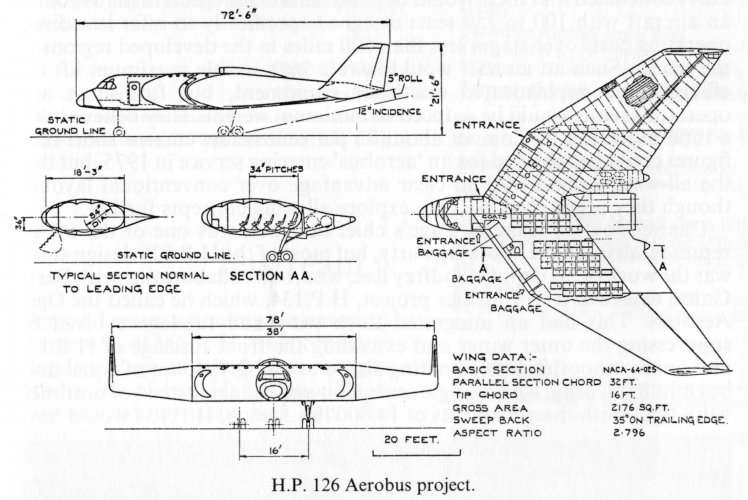
HP 126's rival designs were the Bristol All-Wing Aircraft in the link above by hesham (104 seater and 260 seater designs) and a non-flying datum design by Whitworth-Gloster.
Handley-Page designed a slewed wing SST following NASA research.
HP.119 was a scaled prototype for HP.117 laminar flow flying wing.
HP.109 SST is kind of flying wing / delta wing hybrid.
Handley-Page designed a slewed wing SST following NASA research.
HP.119 was a scaled prototype for HP.117 laminar flow flying wing.
HP.109 SST is kind of flying wing / delta wing hybrid.
- Joined
- 19 October 2012
- Messages
- 2,053
- Reaction score
- 2,142
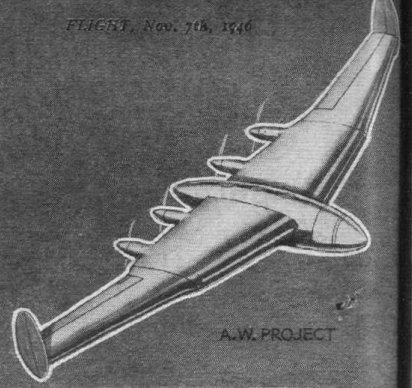
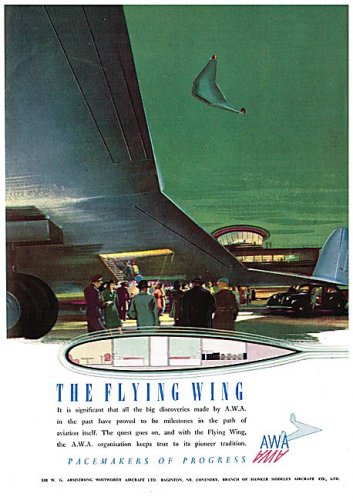
Although not strictly a flying wing, as it is better described as tailless, Armstrong Whitworth had an un-numbered project design for a civil airliner in 1946 (There is a 3-view in Air Enthusiast but I haven't scanned that)
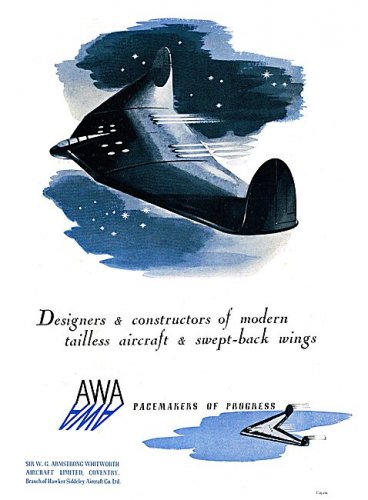
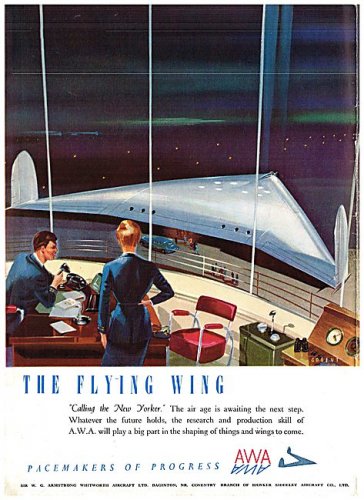
Then in 1947 and 1948 AW advertising featured a couple of speculative flying wing airliners that are probably based on concept design work undertaken in parallel with the AW52 and AW56 bomber projects.
Then in 1947 and 1948 AW advertising featured a couple of speculative flying wing airliners that are probably based on concept design work undertaken in parallel with the AW52 and AW56 bomber projects.
Attachments
FG. Miles flying wing patent design
Armstrong Whitworth various flying wing design concepts and prototypes
Baynes 'carrier wing' and sub scale prototype
GAL. flying wing design concept and sub scale prototypes
Handley Page laminar flow flying wing studies
Armstrong Whitworth various flying wing design concepts and prototypes
Baynes 'carrier wing' and sub scale prototype
GAL. flying wing design concept and sub scale prototypes
Handley Page laminar flow flying wing studies

- Joined
- 13 August 2007
- Messages
- 9,828
- Reaction score
- 16,265
1939 "Perodactyl" bomber by Geoffrey Hill
1938 Baynes Bat
1956 Rolls-Royce Flying Wing VTOL
1962 Aerobus by Davidson
Armstrong Whitworth
AW.50
AW.52G
AW.32 Jet
AW.56
AW.171
AVRO 1944 early Vulcan studies
De Havilland - DH.108 Swallow (TG283, VW120, TG306)
Handley Page Manx aka H.0222 what became H.75 Manx
HP.117
Hawker Siddeley PJD.144 and P.1077
Gal gliders
Vickers Swallow studies by barnes Wallis
Westland PJD.144
Source:
Secrets Projects: Flying wings and Tailless Aircraft
By bill Rose
Midland edition 2010
1938 Baynes Bat
1956 Rolls-Royce Flying Wing VTOL
1962 Aerobus by Davidson
Armstrong Whitworth
AW.50
AW.52G
AW.32 Jet
AW.56
AW.171
AVRO 1944 early Vulcan studies
De Havilland - DH.108 Swallow (TG283, VW120, TG306)
Handley Page Manx aka H.0222 what became H.75 Manx
HP.117
Hawker Siddeley PJD.144 and P.1077
Gal gliders
Vickers Swallow studies by barnes Wallis
Westland PJD.144
Source:
Secrets Projects: Flying wings and Tailless Aircraft
By bill Rose
Midland edition 2010
- Joined
- 19 October 2012
- Messages
- 2,053
- Reaction score
- 2,142
A conceptual design by Roy Fedden in 1944
Last edited by a moderator:
- Joined
- 13 August 2007
- Messages
- 9,828
- Reaction score
- 16,265
flateric said:Key word was 'airliners', Michel
ups Sorry
Overlook that
but there some airliners on my list.
1956 Rolls-Royce Flying Wing VTOL
1962 Aerobus by Davidson
Vickers Swallow studies by barnes Wallis, i think there were also a airliner study on that concept.

- Joined
- 26 May 2006
- Messages
- 37,557
- Reaction score
- 19,598
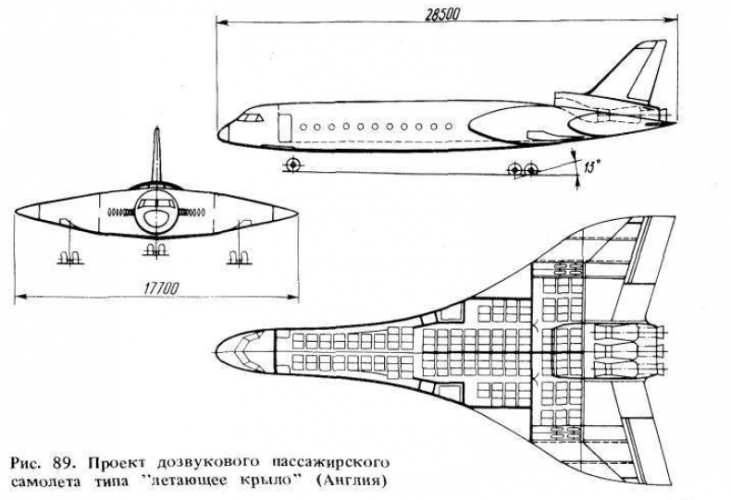
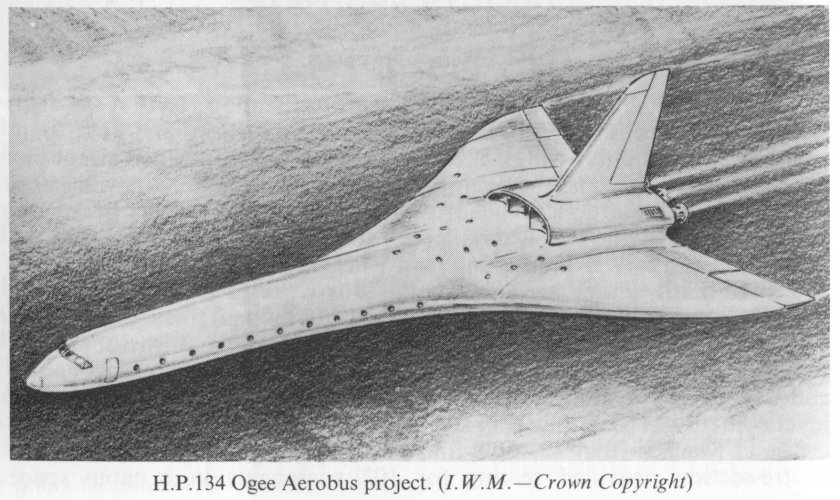
HP 134
From this book.
Attachments

- Joined
- 6 November 2010
- Messages
- 6,019
- Reaction score
- 7,571
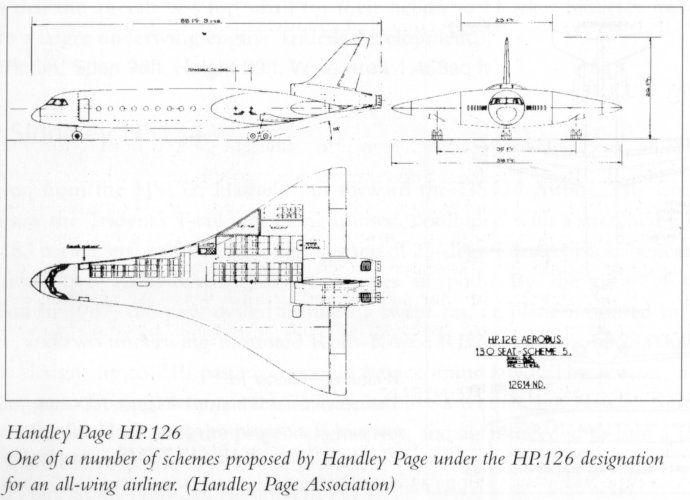
Image hp126-1 from Stuck on the Drawing Board - Unbuilt British Commercial Aircraft since 1945 by Richard Payne, Tempus 2004.
Images hp126-2 and hp134 from Handley Page Aircraft since 1907 by C H Barnes, Putnam 1987.
Image hp126-2 from Barnes matches the HP.126 description as given by Payne.
I think the caption of image hp126-1 is in error, I believe the image shows the HP.134.
Images hp126-2 and hp134 from Handley Page Aircraft since 1907 by C H Barnes, Putnam 1987.
Image hp126-2 from Barnes matches the HP.126 description as given by Payne.
Images hp126-1 and hp134 might show the same design - HP.134? These images match the HP.134 description as given by Payne.The basic design featured a compound swept wing with a 35-degree sweep constant chord centre section housing the passengers, and a more highly swept outer wing for stability with wing tips. A forward stub fuselage would house the flight deck plus two passenger doors. Two further entry doors were provided in the wing-leading edge, which also held passengers' baggage. The cabin could house up to 102 passengers across the inner half of the span, and consisted of a shell made up of intersecting circular cylinders which ran parallel to the leading edge. Power was originally to be provided by four NGTF Type 'F' engines mounted at the rear, with intakes on the wing upper surface.
The text descriptions by Barnes of HP.126 and HP.134 match the text descriptions by Payne.the 154-seater HP/134 Ogee Aerobus, with an integrated thick wing single central fin and rudder, powered by three turbojet engines
I think the caption of image hp126-1 is in error, I believe the image shows the HP.134.
Attachments
Last edited:
Similar threads
-

-
Aeroprogress / ROKS-Aero / Khrunichev projects
- Started by hesham
- Replies: 15
-
-
Crescent and shallow compound-delta wings
- Started by steelpillow
- Replies: 2
-
British Unknown Flying Wing Airliner Project
- Started by hesham
- Replies: 10