British Anti-Ship Missiles

Siberia

ACCESS: Confidential
Joined
24 August 2012
Messages
153
Reaction score
138
Could anyone point me towards any sources, either published or official files, which could give some information on Green Cheese and Fairey Sea Skimmer? Prompted by wondering if an air-launched AShM similar in size to the Soviet Kh-22 Storm might have worked as an alternative to surface vessels and nuclear-armed Buccaneers – or at least as a complement – for countering the Sverdlov-class I'm curious what sort of progress, if any, was made with these two programmes.
 
Could anyone point me towards any sources, either published or official files, which could give some information on Green Cheese and Fairey Sea Skimmer? Prompted by wondering if an air-launched AShM similar in size to the Soviet Kh-22 Storm might have worked as an alternative to surface vessels and nuclear-armed Buccaneers – or at least as a complement – for countering the Sverdlov-class I'm curious what sort of progress, if any, was made with these two programmes.
Kh-22 was a product of about two decades of air-launched anti-ship missiles development in USSR. Britain in 1950s (when countering "Sverdlov"-class was actual goal, no matter how detached from reality) simply did not have experience to design and deploy anything comparable. Something more like KS-1 "Kometa" (the first Soviet air-launched ASM) is more likely.
 
You also have to consider what carries it. At 12,800 lbs the KH-22 is an absolute unit of a missile, limiting it entirely to the RAF's Vulcan and Victor bombers, which are at the time necessary for Britain's nuclear deterrent and could not be spared ranging out over the Atlantic to hunt cruisers. And after, well, the UK never even contemplated another bomber that could carry a weapon that big.

Green Cheese, I should note, was a significantly smaller weapon intended to fit in the Buccaneer's bomb bay.
 
You also have to consider what carries it.
Well, Avro Shackleton clearly. As main maritime patrol aircraft of UK, its obvious that any kind of standoff anti-ship missile in 1950s (when Sverdlov scare was actual) would be designed for Shackleton carrier.

My IMHO, the most practical way would be a joint project with Australia to adapt the GAF Jindivik drone for anti-ship functions. Its subsonic, yes, but high subsonic speed would be enough for 1950s air defenses. And Britain have enough know-how to design a radar seeker (to simplify things, a semi-active one would suffice)
 
Well, Avro Shackleton clearly. As main maritime patrol aircraft of UK, its obvious that any kind of standoff anti-ship missile in 1950s (when Sverdlov scare was actual) would be designed for Shackleton carrier.
Agreed here. The Shack is going to carry these. 10,000lb max load and the Shack has the Lancaster-sized bomb bay to go with.

10klbs isn't quite enough for a Kh-22 clone, but it is enough for 3x Jindiviks.


My IMHO, the most practical way would be a joint project with Australia to adapt the GAF Jindivik drone for anti-ship functions. Its subsonic, yes, but high subsonic speed would be enough for 1950s air defenses.
If you can make it a sea-skimmer it's even better as a high-subsonic.


And Britain have enough know-how to design a radar seeker (to simplify things, a semi-active one would suffice)
I am not a fan of SARH antiship missiles, because something has to be close enough to illuminate the target for them. And that something is going to get shot to pieces.

IMO the only time SARH antiship works is when it's the secondary mode of a high-supersonic antiaircraft missile with a flight time measured in seconds.

I would greatly suggest active radar homing with a datalink for midcourse guidance updates. The "target drone" flies a course and altitude for a while, gets updated every few minutes, then the ~21" radar antenna that a Jindivik can carry lights up for terminal guidance.
 
If you can make it a sea-skimmer it's even better as a high-subsonic.
Well, it depend on how good radar altimeters Britain could produce - and how good the missile control system could handle low-altitude flight. Generally it seems that standard Mk.5/Mk.6A from Buckaneer could suffice for about 15-20 meters of altitude. Not exactly sea-skimming, sure. But would put missile below most of 1960s SAM's and make it very hard target for cannons.

I am not a fan of SARH antiship missiles, because something has to be close enough to illuminate the target for them. And that something is going to get shot to pieces.
Well, ships are rather big targets, so they could be locked on from sufficient distance. But you could simplify the problem by using combined guidance. For example, Soviet KS-1 "Kometa" used beam-riding guidance on midcourse and semi-active on terminal - both from the same beam, projected by carrier plane. It have a max range about 90 km.

I would greatly suggest active radar homing with a datalink for midcourse guidance updates. The "target drone" flies a course and altitude for a while, gets updated every few minutes, then the ~21" radar antenna that a Jindivik can carry lights up for terminal guidance.
Generally I agree, but must point that 1950s-esque seekers won't be very smart. With semi-active system its compensated by the man sitting behind operator console. Who could manually hold the beam on required target, ensuring that missile won't sway aside.
 
Well, ships are rather big targets, so they could be locked on from sufficient distance. But you could simplify the problem by using combined guidance. For example, Soviet KS-1 "Kometa" used beam-riding guidance on midcourse and semi-active on terminal - both from the same beam, projected by carrier plane. It have a max range about 90 km.
I think this was mentioned during the discussion on use of Sea Slug in anti-surface mode.
 
I think this was mentioned during the discussion on use of Sea Slug in anti-surface mode.
Sea Slug lacked terminal seeker, and beam-riding on long distances became increasingly inaccurate. It's not a problem for a surface-to-surface shot (since the enemy would be within the horizon anyway, so relatively close), but for air-to-surface shot it won't allow for good standoff range. The beam at 50+ km diameter would be too wide for the missile to reliably hit the warship. So terminal guidance would be required.
 
Fairey Sea Skimmer.

Anti-ship version of Seaslug was Blue Slug, a rather substantially different weapon to Seaslug that fit the launcher and magazine system.
Using an ARH culled out of the Red Dean AAM program.
 
Using an ARH culled out of the Red Dean AAM program.
ARH on anti-ship missiles is much simpler than on AAM's. Especially on big 1950s ASM's, with larger diameter dishes and excessive power. The warship on sea surface is highly contrasting target, and its own dynamic have little influence on the engagement.
 
I would greatly suggest active radar homing with a datalink for midcourse guidance updates. The "target drone" flies a course and altitude for a while, gets updated every few minutes, then the ~21" radar antenna that a Jindivik can carry lights up for terminal guidance.
You know, I checked data about UK compact search radar, and I think it may be possible to make a hardpoint lock-on (like on KS-2 and later Soviet missiles, that locked on target before launch) with EKCO ASV Mark 21 derivative. This helicopter search radar looks compact enough to fit - with reduced by half antenna size - into Jindivik drone. Of course, the range would suffer, but it still would be standoff, and operator would be able to manually lock seeker on target before launch.
 
While it's easy to justify the Soviets building huge AShMs for a world lousy with NATO/Western Aircraft Carriers, Commando Carriers and cruisers does 13 WW2 era gun cruisers warrant the same effort on Britain's part? While the Soviet Navy became a problem from the late 60s the Sverdlovs were followed by what was essentially an overload DLG, and only 4 of them at that.
 
does 13 WW2 era gun cruisers warrant the same effort on Britain's part?
Well, it's a bit complicated there. Essentially Royal Navy deliberatedly overblown the Sverdlov's threat to justify the RN traditional roles like convoy protection and raider hunting - even in nuclear age. The Royal Navy was concerned that their value for Britain is diminishing; in short, decisive nuclear warfare, the main role would be played by RAF and Army, while Navy traditional roles would be of little importance. So they invented the doctrine of "broken-backed warfare" - postulated that nuclear exchange would not be decisive by itself, and after nuclear stockpiles would be exhausted, a prolonged period of conventional warfare would follow. In such "post-nuclear" warfare, the role of navy would, of course, be much greater, since maintaining trade and supplies would be vital for nations survival.

And to reinforce such position, the Royal Navy invented the idea that Sverdlov's are build as ocean radiers, that they are more powerful than "pocket battleships", that they would surge against British communications and they must be countered. The whole concept was a pure fantasy (and admirals likely knew about it): Soviet naval doctrine never put any emphasis on surface raiders, they were considered of very dubious importance and submarines were considered much more efficient in trade interdiction roles. But reality didn't concenred Royal Navy as much as getting more money - even for totally useless ideas.
 
While the Soviet Navy became a problem from the late 60s the Sverdlovs were followed by what was essentially an overload DLG, and only 4 of them at that.

You forgot the Project 56-EM and Project 57 destroyers. Of course, they weren't as impressive as Project 58 cruisers, but even old KsSH could easily kill any British warship in range.
 
The answer was Buccaneer, and this being inherently more flexible than an Anti-ship missile, was not only funded but utilised in a variety of non-war situations. Where a missile would guarantee the situation moves to warfare.
 
The answer was Buccaneer, and this being inherently more flexible than an Anti-ship missile, was not only funded but utilised in a variety of non-war situations. Where a missile would guarantee the situation moves to warfare.
The Buccaneer have a problem - it required a carrier. And carriers were costly. Granted, it wasn't a problem from Navy point of view, but rather big from government point of view.
 
Only were it couldn't fly from coastal airfields.

The real flaw was the lack of a stand-off missile system.
 
Only were it couldn't fly from coastal airfields.
But there was the catch - Royal Navy claimed that they need Buccaneers to fight Sverdlov's across Atlantic and Pacific. Basically, Buccaneers were a way to keep carrier fleet from reduction (as a result it backfired, because poorly thought-out and expensive modifications of old wartime carriers drained the money and eventually destroyed support for carrier fleet).

The real flaw was the lack of a stand-off missile system.
You can't fit sensible standoff missile system on Buccaneer in 1950s. The technology limitations are too severe.

Moreover, if you are going to use standoff missiles, then why do you need Buccaneer at all? The whole gimmick of Buccaneer was a low-altitude attack; Royal Navy claimed that Sverdlov-class air defenses are so formidable (and would be increased even more with SAM's), that existing attack planes stood no chance, and light carrier air wing would be expended without against Sverdlov guaranteed mission kill. The Buccaneer idea was to approach at low altitude (preferrably with nuclear bomb) and make attack with as little warning time as possible, below the minimal engagement altitude for heavy AA's and SAM's. Standoff weapon simply doesn't fit into this doctrine.

P.S. By the way, Sverdlov's air defenses were rather formidable. Six modern dual 100-mm mounts with advanced radar controls, proximity fuzed shells and automatic stabilization in horizontal plane could easily shred old-type attack planes to ribbons.
 
But there was the catch - Royal Navy claimed that they need Buccaneers to fight Sverdlov's across Atlantic and Pacific. Basically, Buccaneers were a way to keep carrier fleet from reduction (as a result it backfired, because poorly thought-out and expensive modifications of old wartime carriers drained the money and eventually destroyed support for carrier fleet).

The idea of Sverdlov's raiding distant trade routes was a fraction of what the Royal Navy thought they were for. In the early 1950s the UK, and NATO in general, assumed that the Soviets would use combined submarine, surface and air forces to attack the NATO striking fleet and allied convoys.

The RN component of the Striking Fleet would have operated in the North Sea and East of the GIUK line (Greenland Sea, Norwegian Sea, Barents Sea), its missions included supporting the land battle in North West Europe, attacking Soviet naval bases ('attack at source') and theatre attacks against targets within the Soviet Union, Warsaw Pact and parts of Western Europe they might overrun during a war. Effectively it was a mobile striking force that would be used to support the wider allied war effort in Europe. The NA.39 was to operate from these carriers (Eagle, Victorious, Ark Royal).

The RN trade protection carriers would have operated in the Western Approaches and the Western Mediterranean, certainly not in the Pacific nor even in the Western Atlantic. Initially they were to get a new Gannet variant (see here) for Green Cheese. The decision to operate NA.39 from Hermes came very late (1958/9 IIRC) and was unrelated to Sverdlovs. UK intelligence assessments concluded in 1955 that the Sverdlov's were unlikely to be used against convoys at all.

The Sverdlov's expected to appear outside the European theatre were those units that might be on overseas trips at the outbreak of war and, potentially, a small number sent out on diversionary operations. Effectively missions to divert NATO forces from their operations in European waters. Note that all the ships intended to carry early UK anti-ship missiles (carriers and Seaslug ships) had significant air-defence capabilities, this was because their wartime roles were expected to be within range of Soviet Naval Aviation bombers - not on some exotic trade route on the other side of the planet.

Post-WW2, with some very rare exceptions, there was never any support for the RN carrier fleet. It only continued as long as it did because the RN was able to keep it going within its 25% of the defence budget allocation and the perceived political embarrassment that would arise from the Board of Admiralty resigning whilst HMG openly disagreed with the US about how to fight WW3. The view across the entire non-naval British Defence establishment, civilian and military, was that land based aircraft could perform all the missions expected of the Strike carriers at a lower overall cost. The carrier modernisations were a symptom, not the cause.
 
Last edited:
The idea of Sverdlov's raiding distant trade routes was a fraction of what the Royal Navy thought they were for. In the early 1950s the UK, and NATO in general, assumed that the Soviets would use combined submarine, surface and air forces to attack the NATO striking fleet and allied convoys.
Thanks for clarification!
 
Scary thought: What if the Sverdlovs got a rebuild comparable to an Albany-class? Replace two pairs of 6" guns with heavy AShMs, replace the last pair of 6" guns with heavy SAMs, replace the 21" torpedo tubes with heavy AShMs, replace at least 1 of the 100mm guns per side with a short-range SAM with good sized magazine (akin to US Mk11/Mk13, 40 rounds per launcher)
 
Scary thought: What if the Sverdlovs got a rebuild comparable to an Albany-class? Replace two pairs of 6" guns with heavy AShMs, replace the last pair of 6" guns with heavy SAMs, replace the 21" torpedo tubes with heavy AShMs, replace at least 1 of the 100mm guns per side with a short-range SAM with good sized magazine (akin to US Mk11/Mk13, 40 rounds per launcher)
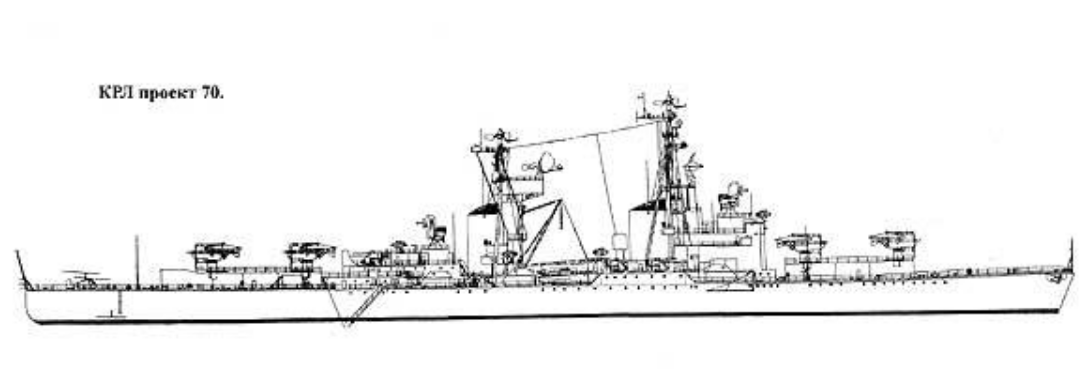
Well, there were such ideas:

1781976189477.png

(sorry for poor quality, can't find better image)

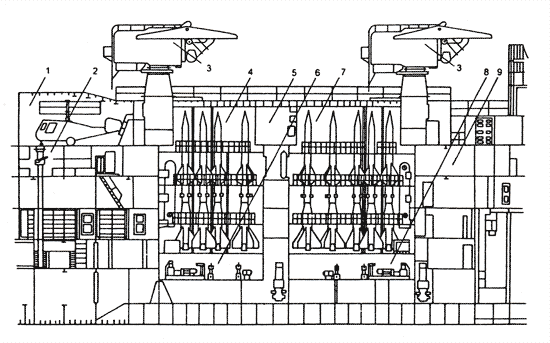
There was a project to rebuild Sverdlov's as two-ended missile cruisers in late 1950s. They were supposed to carry two M-2 "Volkhov-M" medium-range SAM's - a navalized version of land-based S-75M "Volkhov". One system would be installed on bow, one on stern. Each system would consist of its own fire control station (capable of guiding up to three missiles at single target) and a pair of two-arm missile launchers, being reloaded from under-deck vertical drum magazines (about 11 missiles per drum).

1781976417504.png

As a proof of concept, one Project 68bis cruiser - a "Dzerjinsky" - was provided with a simplified "Volkhov-M" system, with just a single launcher replacing her X turret. The system worked... but liquid-fueled missiles, adapted from land-based system, were considered dangerous and inefficient for shipborne use.

Navy thought about adapting a different type of missiles - there were, for example, several ramjet-powered missiles, that were tested for land-based S-75, and even some solid-fuel ramjet ones - but eventually decided that it would be simpler and cheaper to just develope the new system, that would provide same performance without headaches and compromizes. And so M-11 "Shtorm" was created instead.
 
Scary thought: What if the Sverdlovs got a rebuild comparable to an Albany-class? Replace two pairs of 6" guns with heavy AShMs, replace the last pair of 6" guns with heavy SAMs, replace the 21" torpedo tubes with heavy AShMs, replace at least 1 of the 100mm guns per side with a short-range SAM with good sized magazine (akin to US Mk11/Mk13, 40 rounds per launcher)
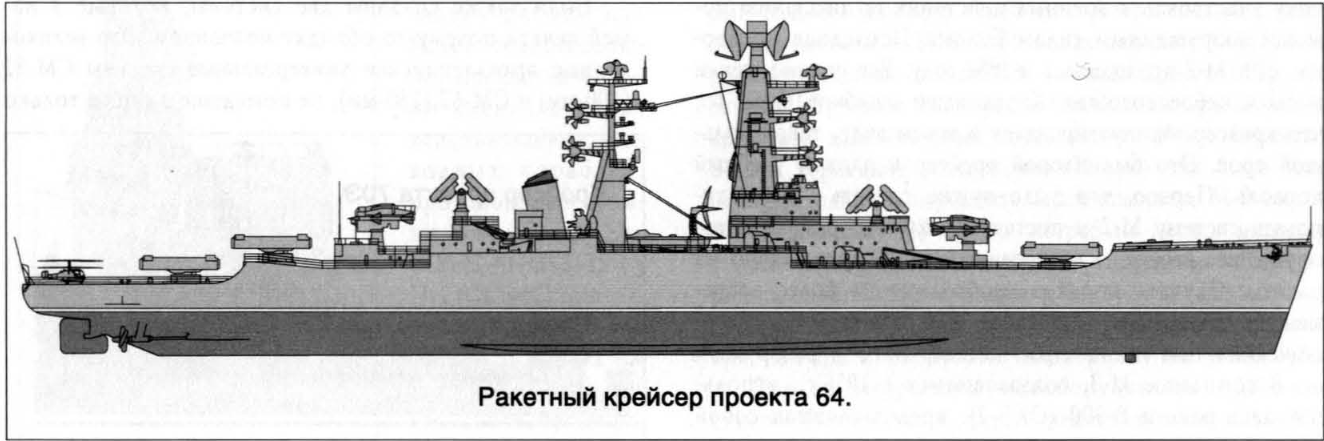
Ah, and there was Project 64 - a proposal to turn the hulls of incomplete Sverdlov-class cruisers (constructions of several units were cancelled by Khrushev) into missile cruisers:

1781977061085.png

They were supposed to carry P-35 heavy ASM's (three four-tube launchers and at least one full reload for each), a pair of M-3 medium/long range SAM, a pair of M-1 "Volna-M" short-range SAM, and four 76-mm dual turrets.

Basically what you asked for)
 
Post-WW2, with some very rare exceptions, there was never any support for the RN carrier fleet. It only continued as long as it did because the RN was able to keep it going within its 25% of the defence budget allocation and the perceived political embarrassment that would arise from the Board of Admiralty resigning whilst HMG openly disagreed with the US about how to fight WW3. The view across the entire non-naval British Defence establishment, civilian and military, was that land based aircraft could perform all the missions expected of the Strike carriers at a lower overall cost.

The 1963 study done by scientists certainly plays of the Carriers off against the land based aircraft, using the 'island bases'. Does the development of serveral generations of naval aircraft, all the way to the Phantom, fit within this paradigm? What about the Invincibles, how do they fit within this paradigm?
 
They were envisioned as convoy escorts for the oceans, i.e. performing the role that land-based aviation could not. They weren't strike carriers.

Yes, ASW Command cruisers in the mould of the early 60s Escort Cruiser and the interim Tiger and Blake ASW cruiser conversions which were done in large part for their command facilities, something that saved HMS Bristol of cancellation. However they were very expensive and quickly gained Harrier capability, which moves them out of reliance on land based aircraft.

Hang on, I think I've just answered by own question? They were ordered and laid down as reliant on land based aircraft, but once they were safely under construction the extra capability started creeping in.
 
It's very funny how much nato twisted itself into knots about a second battle of the Atlantic when the red navy saw how that didn't work the 2 times Germany tried so focused all its efforts at bastion defense.
 
It's very funny how much nato twisted itself into knots about a second battle of the Atlantic when the red navy saw how that didn't work the 2 times Germany tried so focused all its efforts at bastion defense.
Except that the UK knew it did almost work, twice. IIRC the UK was 3 weeks from serious starvation at one point in WW2.

The Germans needed to maul 3 more convoys than they had.
 
Kh-22 was a product of about two decades of air-launched anti-ship missiles development in USSR. Britain in 1950s (when countering "Sverdlov"-class was actual goal, no matter how detached from reality) simply did not have experience to design and deploy anything comparable. Something more like KS-1 "Kometa" (the first Soviet air-launched ASM) is more likely.
There is, perhaps, a world in which the UK forms the view in the 1940s that it should focus its efforts on Europe and the North Atlantic. This would require significant changes in outlook, however...

In this world, we might well imagine a substantially earlier shift in favour of land-based air power as a counter to Soviet shipping, drawing on WW2 experience. There was some interest in using Tallboys delivered by V-bombers against SVERDLOVs, see here, but the numbers of weapons needed were prohibitive.

If this were seen as a cost-effective alternative to aircraft carriers, though, one could easily see Blue Boar as a starting point. If it was made to work as planned, the number of bombs required to seriously damage a SVERDLOV goes from 52 to 4. Still requires overflight, but now we can start talking about standoff - and helpfully for the future, Blue Boar gets the RAF used to the idea of datalinks from the outset.

The next step is probably Green Cheese. Still not brilliant, the range is unimpressive, but it can be dropped though cloud cover thanks to radar guidance and does at least give some standoff. And a scaled version for V-Bomber carriage can pack a pretty respectable amount of 'bang'.

Whether a Kh-22-class weapon comes along directly or via a K-10S equivalent I'm not sure. Either could make sense; borrowing the Blue Steel work would get an airframe with the right kind of performance, and in this scenario we can imagine the seeker and datalink work from Blue Boar and Green Cheese being applied to create a useful weapon.

A suitable number of Vulcans or Victors for Coastal Command is a bit of a challenge - but really, three squadrons is probably adequate, and we can use the resources diverted from carrierborne aircraft to provide them. And wouldn't a Vulcan look spiffy in Coastal Command grey?

Meanwhile, the Fairey Sea Skimmer is definitely in the KS-1 class; I'm not clear on the timelines, but one can certainly imagine it forming part of this evolution. It does seem, at least from this perspective, that the KS-1 - KSR-2 - KSR-5 line of Soviet missiles was semi-independent of the K-10S - Kh-22 line. This, of course, would certainly be carried on Shackletons, Bristol 175MRs, or something of that nature.
My IMHO, the most practical way would be a joint project with Australia to adapt the GAF Jindivik drone for anti-ship functions. Its subsonic, yes, but high subsonic speed would be enough for 1950s air defenses. And Britain have enough know-how to design a radar seeker (to simplify things, a semi-active one would suffice)
Rather later than the discussion here, but the semi-mythical 'Womba' anti-ship derivative of Ikara by way of the Turana target drone is interesting.
The RN component of the Striking Fleet would have operated in the North Sea and East of the GIUK line (Greenland Sea, Norwegian Sea, Barents Sea), its missions included supporting the land battle in North West Europe, attacking Soviet naval bases ('attack at source') and theatre attacks against targets within the Soviet Union, Warsaw Pact and parts of Western Europe they might overrun during a war. Effectively it was a mobile striking force that would be used to support the wider allied war effort in Europe. The NA.39 was to operate from these carriers (Eagle, Victorious, Ark Royal).
I've thought for a while that this was an interesting comparison with the 1980s 'Maritime Strategy' - you can view the latter as a reversion to the way that the US/NATO always wanted to fight the war at sea, with the 1960s/1970s focus on the North Atlantic convoy battle as a deviation forced by inadequate funds, the development of Soviet A2/AD capabilities, and a misunderstanding of Soviet doctrine.
It's very funny how much nato twisted itself into knots about a second battle of the Atlantic when the red navy saw how that didn't work the 2 times Germany tried so focused all its efforts at bastion defense.
The UK, being a maritime power, and the US, being dependent on the seas for power projection, quite reasonably considered that if they lost control of the sea lanes they'd lose the war. You can have all the ships you like in the Barents Sea; if Soviet tanks are in Brittany and American tanks are in Boston, it's entirely irrelevant.

In the 1950s, they thought they could do convoy protection and a good offence to use maritime power against the USSR. But when it was a choice, the former had to take priority.

 
There is, perhaps, a world in which the UK forms the view in the 1940s that it should focus its efforts on Europe and the North Atlantic. This would require significant changes in outlook, however...
The main problem is, that Sverdlov-class cruisers simply can't justify a large-scale weapon program. You need a much more active Soviet surface shipbuilding in late 1950s - carriers, missile cruiser refits - to justify such efforts.

Rather later than the discussion here, but the semi-mythical 'Womba' anti-ship derivative of Ikara by way of the Turana target drone is interesting.
Its much later effort, and I'm not sue it would be very impressive. Basically it would be a P-15 Termit analogue; relatively heavy subsonic missile with moderatedly low flight altitude.
 
Given the nature of the threat and the capability of NATO navies of the era the arrival of the first generation of tactical AShMs arrived at about the right time in the early 70s, although of course they might have been adopted a bit earlier and faster. I think the real problem for the British in terms of AShMs is their adoption of both types of Martel, the early Exocet, the Sea Eagle, and all 3 versions of the Harpoon. Surely there is scope for a complete family of AShMs and a prolonged evolution and upgrade program, the proposals certainly existed.
 
Except that the UK knew it did almost work, twice. IIRC the UK was 3 weeks from serious starvation at one point in WW2.

The Germans needed to maul 3 more convoys than they had.
Especially in ww1, even just being forced to use convoys dam near crippled the uk economy there.

But that kind of data even today is hard to find, so as far as it looked to the people making the red navy doctrine, the german interdiction campaigns were failers and never really considered trying the same.
The UK, being a maritime power, and the US, being dependent on the seas for power projection, quite reasonably considered that if they lost control of the sea lanes they'd lose the war. You can have all the ships you like in the Barents Sea; if Soviet tanks are in Brittany and American tanks are in Boston, it's entirely irrelevant.

In the 1950s, they thought they could do convoy protection and a good offence to use maritime power against the USSR. But when it was a choice, the former had to take priority.

That would be fine, if there was ever a threat to the sea lines, but both countries at anypoint never understood what the red navys strategy was so pored a ton of money into convoy defenses that the red navy had already decided weren't going to be attacked as not worth it. The naval leadership of these countries looked at what the ussr was building and used that to conform what they thought the ussr would do (that same as Germany in the last two wars apparently) insted of understanding what the ussr was actually trying to do, wich is a huge intelligence failure in my opinion.
 
That would be fine, if there was ever a threat to the sea lines, but both countries at anypoint never understood what the red navys strategy was so pored a ton of money into convoy defenses that the red navy had already decided weren't going to be attacked as not worth it. The naval leadership of these countries looked at what the ussr was building and used that to conform what they thought the ussr would do (that same as Germany in the last two wars apparently) insted of understanding what the ussr was actually trying to do, wich is a huge intelligence failure in my opinion.

I think it was Mike Tyson who say everyone has a plan until they get punched in the face.

How would the Politburo react when WW3 in the late 60s the non-nuclear phase starts to drag into week 3 and the Red Navy is sitting in bastions doing nothing, the Red Army and Air Force are suffering severe attrition on the central front and NATO navies go on the offensive as they aren't busy protecting convoys?

How does the US-Soviet naval confrontation during the 1973 Yom Kippur War play into NATO assumptions on Soviet intentions?
 
Especially in ww1, even just being forced to use convoys dam near crippled the uk economy there.

But that kind of data even today is hard to find, so as far as it looked to the people making the red navy doctrine, the german interdiction campaigns were failers and never really considered trying the same.
If the KGB (or Imperial Russian intelligence) and/or Ministry of Foreign Affairs couldn't figure that out, that is a separate issue entirely.
 
How would the Politburo react when WW3 in the late 60s the non-nuclear phase starts to drag into week 3 and the Red Navy is sitting in bastions doing nothing, the Red Army and Air Force are suffering severe attrition on the central front and NATO navies go on the offensive as they aren't busy protecting convoys?
It does sound like a bit of a strange scenario. And IIRC, the Soviet doctrine was to go nuclear at a very early stage.
 
The main problem is, that Sverdlov-class cruisers simply can't justify a large-scale weapon program. You need a much more active Soviet surface shipbuilding in late 1950s - carriers, missile cruiser refits - to justify such efforts.
Sverdlovs were a kind of a scarecrow - the "cruiser-destroyer" was touted as a special project build to counter them for some reason, but before Suez I am not sure USSR was the only potential adversary considered by Britain, was it? I don't remember exactly when peer-to-peer conflict with France was taken completely off the planning table, for instance.
 
If the KGB (or Imperial Russian intelligence) and/or Ministry of Foreign Affairs couldn't figure that out, that is a separate issue entirely.
Well the British government did do a lot to hide how successful the German interdiction campaigns were, to this day historians publish bad data based on what they find in the uk government documents only to find they were deliberately doctored. One would have to go ship by ship on the registry inorder to figure out how many ships the uk actually lost in either world war.
 
How would the Politburo react when WW3 in the late 60s the non-nuclear phase starts to drag into week 3 and the Red Navy is sitting in bastions doing nothing, the Red Army and Air Force are suffering severe attrition on the central front and NATO navies go on the offensive as they aren't busy protecting convoys?
In the late 1960s, in non-nuclear scenario, the NATO forces in Europe would get steamrolled by week three, and NATO would face a dillema: either go nuclear (already losing the ground war in Europe) or suing for peace on Soviet terms (which likely would not be too harsh, and mainly include demilitarization of unified Germany and removal of US forces from continental Europe).
 
Well the British government did do a lot to hide how successful the German interdiction campaigns were, to this day historians publish bad data based on what they find in the uk government documents only to find they were deliberately doctored. One would have to go ship by ship on the registry inorder to figure out how many ships the uk actually lost in either world war.
FFS Tom Clancy was publishing that in the 1980s.
 

Similar threads

Back
Top Bottom