They already ruled out a larger squad complement with the prior iteration of the program because they say weight crept up to unacceptable levels. Last I checked they also still want to fit two vehicles inside a C-17 so that is a consideration.
As stated, weight would easily be reduced w/ evolving material science. As you know w/ the new procurement system throws previous requirements et al out the window? Two in C-17 wont be an issue.
ich A few different turrets have been put on the AMPV, that's the benefit of many of those unmanned turret designs. Stuff like a SHORAD variant is entirely in-line with what the hull can be used for. But for the role of MICV aka IFV, it's still not going to be as capable as something designed around that mission.
Designed around what mission? The mission is to carry more troops (8+) & more equipment ie a GCV sized vehicle tied to the reduced cost of AMPV infrastructure. Lynx is simply too small and Griffin only carries 6 troops.
APS is a requirement and directed-energy solutions generally aren't mature enough besides for soft-kill items like jammers. I believe both competitors have hybrid-electric drives which AMPV does not. We don't know exact protection requirements for either, but one can assume AMPV is equivalent to the latest M2A4 while XM30's requirements might be more demanding. A few of the unmanned turrets showcased on the AMPV had the 30mm XM813 but I don't recall any with the 50mm XM913.
DE is quite early but the drone threat has made anything deployed w/ legacy APS obsolete on arrival. The Israelis seem to moving right along on AFV fitting DE.
Folks seem to forget the full 30mm turrets being presented, by contractors these days are all made for retrofit to 30mm, 40mm, and 50mm Chain Guns as it the anticipate state of the art. Bradley tests w/ these turrets are old hat now, and BAE is not bold enough to display a 50mm as that would be an unmistakable threat to their customer's (Army's) intent.
The AMPV based GCV prototype was/is hybrid...

To do it right you'd have to spend a whole lot of money changing the AMPV to better fit requem all preirements and whatever cost savings you are imagining probably aren't going to be worthwhile once all is said and done. There are a few XM30 requirements I find pointless like the "optionally manned" stuff but a lot of the other things make sense.
As of this year unmanning a vehicle is no great shakes.
BAE knows all this and has likely prepared to just stay below the radar and mission expand the AMPV until there is no XM-30 requirement left.
 
Last edited:
I think there has been enough advances in propulsion and material science to warrant a modern Bradley replacement, but in the other hand I highly doubt that new IFVs/APCs really have much impact on a modern battlefield defined by drone, loitering munitions, and guided artillery strikes. The benefits are pretty marginal compared to investment more in those technologies or defending against them. Any armored box can deliver troops, and almost all of them will catch fire if an opponent system puts enough focus on the issue.

I only see a new IFV/APC as especially relevant if it comes with some kind of defensive features against the above threats that cannot be readily backfit to existing platforms.
 
in the age of digital design one can be confident that the AMPV and even the latest Bradley designs are such that new configurations are no great shake
 
AMPV makes sense for an interim design that could be inducted in the next 5 years. Thermals and elevated optics are so capable today that Johnson's Criteria is no longer among the top considerations in doctrine engineering. AMPV is just a big box in form, you can hang Strikeshield APS panels around the armour belt and purchase an existing unmanned turret qualified for Iron Fist (or DIY with any combinations available).

There's really no need for a new IFV, yet. It's like NGSW, pandering and arguing about some supreme commander's wet dream. Throwback?
 
I think there has been enough advances in propulsion and material science to warrant a modern Bradley replacement, but in the other hand I highly doubt that new IFVs/APCs really have much impact on a modern battlefield defined by drone, loitering munitions, and guided artillery strikes. The benefits are pretty marginal compared to investment more in those technologies or defending against them. Any armored box can deliver troops, and almost all of them will catch fire if an opponent system puts enough focus on the issue.

I only see a new IFV/APC as especially relevant if it comes with some kind of defensive features against the above threats that cannot be readily backfit to existing platforms.
When you say "defending against them", what is being defended?

There is an abundance of stand-off munitions. An APC, a tank, an infantryman, and many other elements of the ground maneuvering force, are the stand-in element.

You cannot fight doing only stand-off because someone or something needs to capture territory, establish presence, exploit. You cannot fight doing only stand-in because you'll be disadvantaged.

They all have impact. Millions of years of warfare and thousands of ways of killing someone later, the infantryman still exists. And he needs to move.
 
As you are well aware, Bradley upgrades are continual, plus there is the evolution of the Bradley based AMPV especially turret mounts and overall mission capability enhancements. AMPV is a program of record w/ an ever growing logistical infrastructure. All this seems to be arguing for the return of AMPV based GCV by default. If subcomponents (hybrid propulsor, band tracks et al) weight can be brought down this higher number troop compartment beast will make a return for BAE. in a slow progression from Bradley.

Agreement on the CUCVs. ..used to drive those things.. Allegedly they have much better engine/transmission. Hope so. standoff engagement takes on whole new meaning.:}
The ISV is a Hendrick tuned Chevy Colorado. Apparently there are doors and a roof, but only for export customers!
 
I think there has been enough advances in propulsion and material science to warrant a modern Bradley replacement, but in the other hand I highly doubt that new IFVs/APCs really have much impact on a modern battlefield defined by drone, loitering munitions, and guided artillery strikes. The benefits are pretty marginal compared to investment more in those technologies or defending against them. Any armored box can deliver troops, and almost all of them will catch fire if an opponent system puts enough focus on the issue.

I only see a new IFV/APC as especially relevant if it comes with some kind of defensive features against the above threats that cannot be readily backfit to existing platforms.
In my view it comes down to how much focus they have to put on the issue. Focus is not unlimited and there are some quite promising APS out there (Strikeshield is very interesting!)
 
When you say "defending against them", what is being defended?

There is an abundance of stand-off munitions. An APC, a tank, an infantryman, and many other elements of the ground maneuvering force, are the stand-in element.

You cannot fight doing only stand-off because someone or something needs to capture territory, establish presence, exploit. You cannot fight doing only stand-in because you'll be disadvantaged.

They all have impact. Millions of years of warfare and thousands of ways of killing someone later, the infantryman still exists. And he needs to move.
There's been some good analysis floating around about the criticality of infantry even in these environments. I have to ask how much the centrality of drones and fires is due to a lack of infantry and force density, not the cause of it.
 
There's been some good analysis floating around about the criticality of infantry even in these environments. I have to ask how much the centrality of drones and fires is due to a lack of infantry and force density, not the cause of it.
Drones are central only in Ukraine. And infantry is also uniquely scarce there. The war in Ukraine quickly manifested as a drone race because the front was too long to be properly manned by any side, and because both sides failed to develop and acquire precision fires before the war and are now playing catch-up.

The article correctly assesses that both sides are mishandling manpower and are unable to generate new forces in both quantity and quality.
 
There's been some good analysis floating around about the criticality of infantry even in these environments. I have to ask how much the centrality of drones and fires is due to a lack of infantry and force density, not the cause of it.
The lack of force density is primarily driven by the threat of UAV directed artillery. Any observed concentration of vehicles is engaged before they even make it to the FLOT.
 
As stated, weight would easily be reduced w/ evolving material science. As you know w/ the new procurement system throws previous requirements et al out the window? Two in C-17 wont be an issue.

Designed around what mission? The mission is to carry more troops (8+) & more equipment ie a GCV sized vehicle tied to the reduced cost of AMPV infrastructure. Lynx is simply too small and Griffin only carries 6 troops.

DE is quite early but the drone threat has made anything deployed w/ legacy APS obsolete on arrival. The Israelis seem to moving right along on AFV fitting DE.
Folks seem to forget the full 30mm turrets being presented, by contractors these days are all made for retrofit to 30mm, 40mm, and 50mm Chain Guns as it the anticipate state of the art. Bradley tests w/ these turrets are old hat now, and BAE is not bold enough to display a 50mm as that would be an unmistakable threat to their customer's (Army's) intent.
The AMPV based GCV prototype was/is hybrid...


As of this year unmanning a vehicle is no great shakes.
BAE knows all this and has likely prepared to just stay below the radar and mission expand the AMPV until there is no XM-30 requirement left.
I believe two per C-17 is still specified for both AMPVs and the XM30 MICV unless something has changed very recently. Material science can reduce weight for sure but at the end of the day you're talking about vehicles that necessarily need to be carry a lot of things internally and that requires a lot of protected volume.

The mission is the underlying one of an infantry fighting vehicle. If all that matters is moving troops and their equipment an armored personal carrier with minimal armament will suffice. AMPV has always been firstly about the many "secondary" roles the M113 has fulfilled for half a century. Armored ambulance, mortar carrier, command vehicle, etc. The Army could have specified 8 dismounts since the parent KF-41 Lynx design can carry that many, I imagine the Griffin design could have been adapted from the start to carry as many too. But the Army seemed intent on having 2 crew and 6 dismounts. I personally am doubtful of all of these AI solutions that are supposed to enable a crew of 2 to be as effective as 3.

Even with unmanned turrets a bigger gun means a bigger turret especially if you want a decent amount of ready ammunition. Plus, you're going to want to stow enough ammo for it in the vehicle as well, and ATGMs if the design has any. Once you've accounted for that and the better seating accommodations, I doubt you're going to fit more than 8 dismounts in an AMPV adapted for the role. They've demonstrated a hybrid-electric drive on M2 prototypes and are working on a AMPV version, but the current AMPVs being produced don't have it. Hopefully an "A1" variant of the AMPV family will include one.

Disagree about APS, you're still going to need kinetic hard-kill capability for many threats like high-performance ATGMs for the foreseeable future. Of course, such systems need to continue to evolve with the threat, and the ideal system should have an array of different soft-kill and hard-kill countermeasures.

Where is the XM30 requirement going to go? Something filling the role of IFV/MICV is still needed. I just don't see abandoning the current effort to adapt the AMPV into the role as a good choice.
 
I believe two per C-17 is still specified for both AMPVs and the XM30 MICV unless something has changed very recently. Material science can reduce weight for sure but at the end of the day you're talking about vehicles that necessarily need to be carry a lot of things internally and that requires a lot of protected volume.
The large space is exactly what a AMPV provides over the two currently suggested.. Again under the aquist. regime will seriously question either soon or as time moves along.
The mission is the underlying one of an infantry fighting vehicle. If all that matters is moving troops and their equipment an armored personal carrier with minimal armament will suffice. AMPV has always been firstly about the many "secondary" roles the M113 has fulfilled for half a century. Armored ambulance, mortar carrier, command vehicle, etc. The Army could have specified 8 dismounts since the parent KF-41 Lynx design can carry that many, I imagine the Griffin design could have been adapted from the start to carry as many too. But the Army seemed intent on having 2 crew and 6 dismounts. I personally am doubtful of all of these AI solutions that are supposed to enable a crew of 2 to be as effective as 3.
Again the Infantry squad paradigm may well change given the Ukraine war lessons. The USMC new larger squad model may become closer to final goal.. As stated repeatedly on this and other threads the demand for more equipment and troops in a squad formation is clear. Army studies have put a good number @ ~15. Posted about this quite sometime ago. Missions may be broken down like drone team carrier, counter drone team carrier/SHORAD. The amount of drone dedicated personal in each Ukrainian BN & below formations is large, even the idea of IFV may not encompass an evolved vehicle requirement.
Even with unmanned turrets a bigger gun means a bigger turret especially if you want a decent amount of ready ammunition. Plus, you're going to want to stow enough ammo for it in the vehicle as well, and ATGMs if the design has any.
Contractor turret designs are already large and above 30mm is currently in vogue so the bigger vehicles like GCV/AMPV makes more sense.
Once you've accounted for that and the better seating accommodations, I doubt you're going to fit more than 8 dismounts in an AMPV adapted for the role.
More than Lynx, are you are arguing for a vehicle larger than GCV? GCV carries 9. That may be the future fire team.
They've demonstrated a hybrid-electric drive on M2 prototypes and are working on a AMPV version, but the current AMPVs being produced don't have it. Hopefully an "A1" variant of the AMPV family will include one.
Again in the digital design and now sped marketing world, hybrids will be Line replaceable units (LRUs), and possibly even distributed on the vehicle, no great shakes.
Disagree about APS, you're still going to need kinetic hard-kill capability for many threats like high-performance ATGMs for the foreseeable future. Of course, such systems need to continue to evolve with the threat, and the ideal system should have an array of different soft-kill and hard-kill countermeasures.
Never said KK would be replaced by DE it will be in addition to. APFSDS rds must be at least slowed via KK. Soft kill is what most Ukrainians are relying on so will never go away.
Where is the XM30 requirement going to go? Something filling the role of IFV/MICV is still needed. I just don't see abandoning the current effort to adapt the AMPV into the role as a good choice.
See above reference on a long term requirement. The new 2-3 star Procurement Acquisition Executive (PAE) for close combat vehicles..or whatever the title will have realize their old requirement is just that.
 
The lack of force density is primarily driven by the threat of UAV directed artillery. Any observed concentration of vehicles is engaged before they even make it to the FLOT.
At the tactical level, perhaps, but the Russians and Ukrainians (for various reasons) are just not fielding large enough forces to reach historical densities.
 
Even with unmanned turrets a bigger gun means a bigger turret especially if you want a decent amount of ready ammunition. Plus, you're going to want to stow enough ammo for it in the vehicle as well, and ATGMs if the design has any. Once you've accounted for that and the better seating accommodations, I doubt you're going to fit more than 8 dismounts in an AMPV adapted for the role
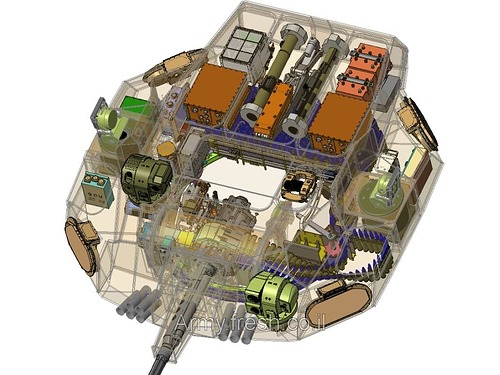
Overhead turrets, i.e. with no penetration into the hull, can carry a sufficient amount of ammo.
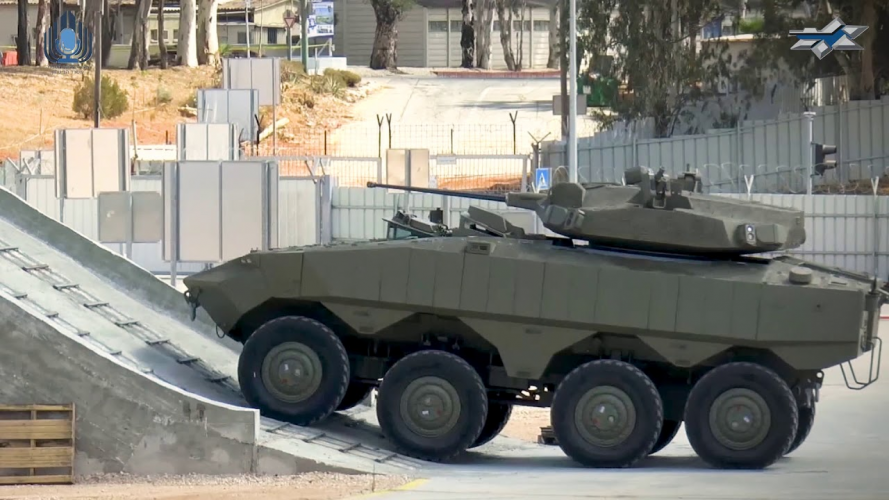
Got 400 rds of 30mm and 2 ATGMs on the Eitan/Namer MATE 30 turret. Very good capacity, and both fit 9 troops and 3 crewmen.

Some of the proposed AMPV variants also have such turrets.
 
Overhead turrets, i.e. with no penetration into the hull, can carry a sufficient amount of ammo.
Got 400 rds of 30mm and 2 ATGMs on the Eitan/Namer MATE 30 turret. Very good capacity, and both fit 9 troops and 3 crewmen.

Some of the proposed AMPV variants also have such turrets.
They are quite large though!
 
Stryker Dragoons have 30mm with 156 ready shots plus 7.62 coax and 9 dismounts while being basically a slightly taller version of the Stryker. Also able to reload from in the hull with extra ammo.
 
Stryker Dragoons have 30mm with 156 ready shots plus 7.62 coax and 9 dismounts while being basically a slightly taller version of the Stryker. Also able to reload from in the hull with extra ammo.
returning to larger 9-10 troop vehicles is the reason very good APS & armor as well as standoff ie large chain guns, transparent battlefield ISR are so important
 
In this day and age, does vehicle profile matter? It used to be that vehicle height directly impacted visual identification in the line of sight, but in the age of prolific, persistent ISR, why would that matter? If your vehicle can make it to the point of direct line of sight observation, it’s fucking doing better than expected.
 
In this day and age, does vehicle profile matter? It used to be that vehicle height directly impacted visual identification in the line of sight, but in the age of prolific, persistent ISR, why would that matter? If your vehicle can make it to the point of direct line of sight observation, it’s fucking doing better than expected.

It matters for all observation still. It's not clear what numerical factors will help vehicles survive drone observation, though, that is true. For example: being under 2.5 meters height is great for a tank being engaged by a direct fire weapon between 1,000 to 3,000 meters of range of observation. Nobody knows at what heights, widths, or whatever will help with drones. It may be that they're becoming like warships, where the clouds of dust generated by the vehicle are its primary detection measure, in which case current heights (like the M1A1) are optimal because they're still optimized for direct fire weapon engagements.
 
In this day and age, does vehicle profile matter? It used to be that vehicle height directly impacted visual identification in the line of sight, but in the age of prolific, persistent ISR, why would that matter? If your vehicle can make it to the point of direct line of sight observation, it’s fucking doing better than expected.
An excessively tall vehicle still has a high center of mass which negatively impacts mobility and risks accidents, and limits transportation capability.
As far as utility in combat, I bet a smaller profile is still desirable but no longer at the cost of other important things.
 
Soviet Tank & BMP low profile designs are clearly showing the benefits of low profile vehicles in Ukraine...NOT. Ukrainians want the towering Bradley beasts.

Bradley contains contemporary humans & their bulky equipment & with sufficient resiliency for landmines, medium caliber hits & even RPG warheads on quads or just direct fired RPGs. Ukrainians overwhelmingly have praise for Bradley and nothing but disparagement for Soviet low profile designs.
 
Last edited:
In this day and age, does vehicle profile matter? It used to be that vehicle height directly impacted visual identification in the line of sight, but in the age of prolific, persistent ISR, why would that matter? If your vehicle can make it to the point of direct line of sight observation, it’s fucking doing better than expected.
Loading gauges and tunnel/bridge heights are an issue. Bridge weights have been an issue since the 80s. It's one of the advantages of a 45-50t tank vs a 60-70t tank.
 
Loading gauges and tunnel/bridge heights are an issue. Bridge weights have been an issue since the 80s. It's one of the advantages of a 45-50t tank vs a 60-70t tank.
That boat sailed a long time ago. None's going back to 50t. Next gen designs envision an initial 50t target but that's just for the first couple years. Weight's supposed to pile up fast enough that it's logistically irrelevant.
 
That boat sailed a long time ago. None's going back to 50t. Next gen designs envision an initial 50t target but that's just for the first couple years. Weight's supposed to pile up fast enough that it's logistically irrelevant.
The Russians never left the 50t class, and if they can do it then it should be possible, especially if you don't need a meat loader and design around APS from the start.
 
Nobody knows at what heights, widths, or whatever will help with drones.
Oh, we know what would help with drones, and that is MAXIMIZE!

Do anyone care that ships are too big and not stealthy with regard to visual observation? No. Do people return to gun fire resisting design concepts for ships after the mass adaption of missiles? No.

Frankly I'm see M113 like volume maximizing metal boxes (relative to dimension/mass), and turrets that also covers the ENTIRE hull front/real like MBT-70 but extended into flat boxes to get max volume in like a Maus.

Not everything under the solid volume needs to be of importance, but extra storage aside, one can stuff it with very low density armor materials with dense armor behind it. Add some internal compartmentalization and armor become ship like complications.

The real question is whether one wants to consciously expand volume beyond that in various cages and likes.
 
Bustle autoloaders aren't the only viable solution for a compartmentalized design that separates humans from ammo. In fact, a bustle loader designed for 130/140mm rounds will carry a pitiful amount of munitions. That is a big problem.
Not a MICV comment, IHO the lack of 140mm ammo dilemma is refuted by the emerging artillery deliberate raid & retreat tactics practiced in the current war. The number of assisting/defending Abrams still in service supporting the new Decisive Lethality (tank) would be legion and largely share logistics. A new SPH will likely be wheeled and not risk being too far forward, meanwhile in certain circumstances the 140mm out ranges the 155mm so would be a powerful counter battery capability.
 
Not a MICV comment, IHO the lack of 140mm ammo dilemma is refuted by the emerging artillery deliberate raid & retreat tactics practiced in the current war. The number of assisting/defending Abrams still in service supporting the new Decisive Lethality (tank) would be legion and largely share logistics. A new SPH will likely be wheeled and not risk being too far forward, meanwhile in certain circumstances the 140mm out ranges the 155mm so would be a powerful counter battery capability.
Assigning MBTs an artillery task when they're just now starting to cope with C-UAS tasks, and while engineers are thinking how to allow 2 people work like 4, is a recipe for disaster.
If improved counter-battery is necessary, it's probably best to look how we can evolve artillery to do that.
Their tasks are already more limited than those of a stand-in force.
 
If your AFV crew doesn't have autonomous means to deal w drone threats ie an APS your Afv mission is already compromised/ lost.
 
If emerging 120mm munition/missile can deliver our to 20km+ and with sufficient effect. Per round cost for missiles is higher than a well delivered rd BLOS.
 
Mixing an ATGM vehicle w/ a tank has never been planners vision, however old, ATGMs stop offensives, while tanks make breakthroughs. Mixing is a mess.

Long range loitering missions need be yet another separate vehicle crew etc, (artillery)
 
Mixing an ATGM vehicle w/ a tank has never been planners vision, however old, ATGMs stop offensives, while tanks make breakthroughs. Mixing is a mess.

Long range loitering missions need be yet another separate vehicle crew etc, (artillery)
IMO, long range loitering munitions should get mounted on the IFVs.
 
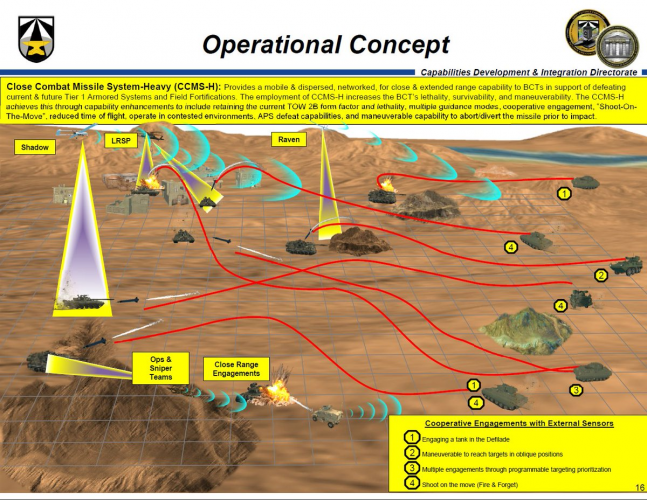
The Army has had at least a BLOS vision, & Bradleys have test fired Coyote missiles as interceptors and likely other variants 1763938344711.png
 
That's artillery task. An IFV needs to deploy infantry and support them in the stand-in fight.
Loitering munitions are also scouting elements, which is an infantry or Cav Scout task.

Using Bradleys as an example, you'd have LMs loaded in the launcher and the ATGMs as reloads.
 
Loitering munitions are also scouting elements, which is an infantry or Cav Scout task.

Using Bradleys as an example, you'd have LMs loaded in the launcher and the ATGMs as reloads.
The Hero 120, and any member of the Uvision Hero family, is a one way system, with a large warhead. Not in the price, endurance, or size category you want for observation.

For observation I'd go either tethered, a capturing system, or if those aren't available then just something very small.

View: https://youtu.be/glrBKzIN8Po?si=OVAqG1g6XbA62PfX
 
Some sort of UAV as an automated (determines a potential threat area on its own) as pre-emptive component of an APS... (just not a quadrotor fan--a single ringed prop w/airfoil balanced flight.) plus
An offensive loitering drone which might need be fixed wing & returnable w/ its mission planned by a cdr. Posted a PLA tank proposal which had 3x separate fixed & rotor UAS types in the Asian tank thread
 
Here is a new take:

Infantry is functionally landmines/demining forces: A kind of off route mine that jumps out of and into holes. IFV/Tanks are basically engineering vehicles for clearing a particular form of meat mines.

Back when infantry was the firepower arm, massed musket fire won the field. Back when tank was the firepower arm, massed tanks punched through defenses.

In the current era, the killing is done by artillery, missiles and drones and massing short ranged forces just increases the number of targets without increasing actual firepower to suppress the opponent. You wouldn't expect masses of engineering forces to oppose firepower and you wouldn't mount powerful weapons on them either as no weapon or defenses can reverse their tactical position of being extremely exposed and shot at by theater worth of fires if the enemy can allocate it.

Some other vehicle will do the artillery thing, others do the CRAM and others do drones. The stand in force can be just cheap and cheerful and die in numbers when supporting forces don't overmatch enough.

Did people try to but 50,000ton ships for mine warfare "because the enemy artillery could be shelling at the minefield, remember the Dardanelles campaign!" Alternatively, there was no 50,000ton landing craft that is designed to survive 1ton aerial torpedo spam, naval mines and counterfire pop up artillery. The survivability onion is "let combined arms kill the other side first."

The idea of the 10+ men infantry squad that is based on machinegun suppress and flank tactics is also very outdated in a drone spam smart explosive throwing era. Given the sheer dominance of aerial observation, stand in forces is really needed to clear urban/forest forces that is mostly underground where the MG is irrelevant, its not like infantry can survive effective anti-drone firepower and hiding is the only solution.
 
The idea of the 10+ men infantry squad that is based on machinegun suppress and flank tactics is also very outdated in a drone spam smart explosive throwing era. Given the sheer dominance of aerial observation, stand in forces is really needed to clear urban/forest forces that is mostly underground where the MG is irrelevant, its not like infantry can survive effective anti-drone firepower and hiding is the only solution.
Individual village properties on the current front can have as many four basements which need to be cleared for safe occupation. Thinkin a hella amount of dismounts or a hella amount of robotics or more likely a hella amount of dismounts & robotics is necessary. UAS becomes nearly irrelevant in retaking villages. Threatening drones will need to be continually swept by accompanying vehicle Finding a squad that rejects a MG would be odd.
 

Similar threads

Back
Top Bottom