Grey Havoc
ACCESS: USAP
- Joined
- 9 October 2009
- Messages
- 24,511
- Reaction score
- 18,192



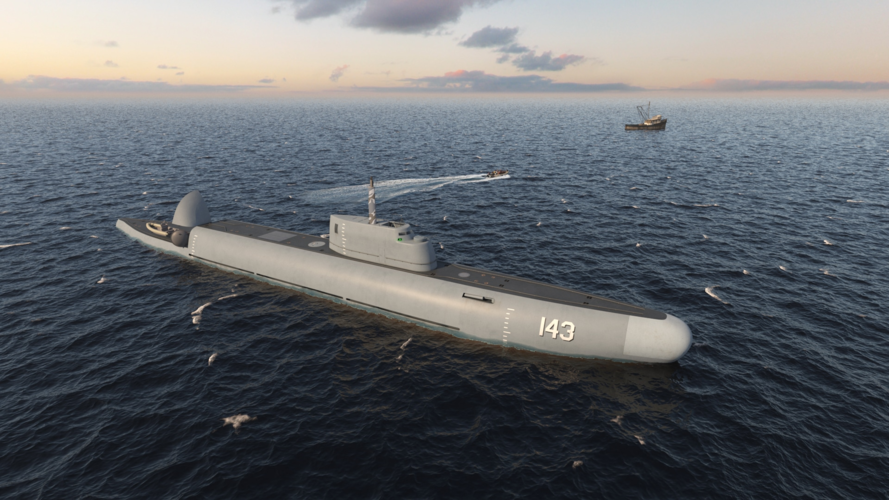
I'm particularly amused that they can lead with "Offshore patrol vessels are relatively inexpensive" and then propose turning one into a submarine.
It's effectively combining OPV and SSK to get the advantages of neither and the disadvantages of both.
No, it is not a warship. It is a OPV with SOME ability to hide underwater. The idea is, that it would therefore be next to invisible for usual kind of problems (naval border trespassers, smugglers, poachers) and could catch them completely unaware. After all, smugglers and poachers rarely equip themselves with anti-submarine sonars, so even the very-very mediocre submersible could sneak on them.So basically a modern version of the coastal submarine of WW1 / WW2?

Albeit a poor man's version.So it CAN actually be used like a coastal sub!

All of which a conventional OPV can do using a low-end UAV.No, it is not a warship. It is a OPV with SOME ability to hide underwater. The idea is, that it would therefore be next to invisible for usual kind of problems (naval border trespassers, smugglers, poachers) and could catch them completely unaware. After all, smugglers and poachers rarely equip themselves with anti-submarine sonars, so even the very-very mediocre submersible could sneak on them.So basically a modern version of the coastal submarine of WW1 / WW2?

All of which a conventional OPV can do using a low-end UAV.No, it is not a warship. It is a OPV with SOME ability to hide underwater. The idea is, that it would therefore be next to invisible for usual kind of problems (naval border trespassers, smugglers, poachers) and could catch them completely unaware. After all, smugglers and poachers rarely equip themselves with anti-submarine sonars, so even the very-very mediocre submersible could sneak on them.So basically a modern version of the coastal submarine of WW1 / WW2?
It's a ridiculously over-engineered solution to the problem and even a minimal submerged capability will add massively to construction costs. Not only do you need a water and pressure-proofed hull, but a separate powertrain for submerged use and a second set of sensors for use when submerged.
To be fair though, UAVs haven't been quite as successful in supporting Fishery protection & EEZ patrols as they were envisioned to be back in the 2000s & 2010s. You still need boots on the ground, so to speak.All of which a conventional OPV can do using a low-end UAV.
Essentially it could do both. It could either patrol on surface, serving as visual deterrent, or sneak underwater, catching the misbehaving ones unaware. Useful, for example, for catching smugglers who may have friends tracking your OPV's; much harder to track underwater one.I may be stupid but I thought the whole point of an OPV was to be a visual deterrent against criminals and errant fishermen? This seems more designed to sneak up on any intruders (unless it fouls the trawler's nets, then you just look like Keystone cops) for the ultimate 'gotcha' moment. Being reliant on sonar and periscope for observation seems rather limiting too for the patrol role.
UAV could not made an inspection or arrest.All of which a conventional OPV can do using a low-end UAV.
But the OPV it came from could. Inspection and arrest are the bits that come after observing illegal activityUAV could not made an inspection or arrest.All of which a conventional OPV can do using a low-end UAV.
Maybe North Korea will buy some.
But the OPV it came from could.
Maybe North Korea will buy some.
It would actually suit North Korea's habit of occasionally attacking the South Korean fishing fleet claiming it is violating their territorial waters. But I don't see NK having the money for it - Kim Jong Un just warned the party cadres a few days ago that they're in for another 'arduous march', which is the term they used for the 1990s famine.
The other potential customer I could see is Venezuela, which needs a new OPV after one of theirs sunk itself a year or so back (the moral of the story being don't ram ice-hardened liners in international waters).
But the OPV it came from could.
Problem is, that OPV could be tracked. If the operation is lucrative enough - like smuggling - they could afford "purely accidental" perfectly legal yacht cruising nearby and tracking the OPV, relying the data to other boats.
And even if it doesn't have a full heli-deck it probably has space to launch and recover a UAV. Following an single OPV isn't difficult when most will have AIS transponders, but ensuring a smuggling vessel can evade multiple law enforcement assets, all moving, is much more difficult.
But the OPV it came from could.
Problem is, that OPV could be tracked. If the operation is lucrative enough - like smuggling - they could afford "purely accidental" perfectly legal yacht cruising nearby and tracking the OPV, relying the data to other boats.
This is why the average OPV of around this size has a helicopter deck. Look at the Castles, the WMECs, and the Aegirs for what a OPV typically is. Lacking a helicopter spot is very rare, although it was more common in the 1960's I suppose, but that was a long, long time ago.
Because they're on by default and some shipping lanes are too busy not to have them on. And because the IMO mandates it under SOLAS:Why would any OPV on a mission against smugglers operate its AIS transponder?
And even if it doesn't have a full heli-deck it probably has space to launch and recover a UAV. Following an single OPV isn't difficult when most will have AIS transponders, but ensuring a smuggling vessel can evade multiple law enforcement assets, all moving, is much more difficult.
But the OPV it came from could.
Problem is, that OPV could be tracked. If the operation is lucrative enough - like smuggling - they could afford "purely accidental" perfectly legal yacht cruising nearby and tracking the OPV, relying the data to other boats.
This is why the average OPV of around this size has a helicopter deck. Look at the Castles, the WMECs, and the Aegirs for what a OPV typically is. Lacking a helicopter spot is very rare, although it was more common in the 1960's I suppose, but that was a long, long time ago.
Could be that they are planning to use partial supercavitation or some such for situations where it will need to make tracks fast on the surface.All the same, it looks like it would be very compromised for surface running by that bow and an OPV submersible would presumably need to be able to achieve a reasonable speed on the surface.

North Korea already produces for decades semi-submersible torpedo boats and they also make very slender vessel fast attack boats.
Maybe North Korea will buy some.
It would actually suit North Korea's habit of occasionally attacking the South Korean fishing fleet claiming it is violating their territorial waters. But I don't see NK having the money for it - Kim Jong Un just warned the party cadres a few days ago that they're in for another 'arduous march', which is the term they used for the 1990s famine.
The other potential customer I could see is Venezuela, which needs a new OPV after one of theirs sunk itself a year or so back (the moral of the story being don't ram ice-hardened liners in international waters).
Ironically, the situation now three years later might mean they would be able to procure the design for domestic production, but also that they may be wanting to use the renewed Russian assistance to go straight for higher end combatants instead, if the current reports that the North Korean SSN program is moving ahead again are accurate.I don't see NK having the money for it - Kim Jong Un just warned the party cadres a few days ago that they're in for another 'arduous march',