First, every new plane got their hangars newly build in the US. It has always been part of the procurement cost.
The HAS requirement is purely fore European deployment. They are mostly from the mid 60's to early 80's.
New ones are being contructed in some places, especialy new bases in France. New ones for Germany's F35 etc.
Some might get replaced. So I don't think it's as much an issue as in the past.

But heck with it, what's the length limits on the European HAS?
1st gen 1968: 14.6 x 30.5m
2nd gen 1975 with F111.: 25 x 37.8m
3rd gen.~1977 with A10: 21.6 x 36.6m
 
First, every new plane got their hangars newly build in the US. It has always been part of the procurement cost.
The HAS requirement is purely fore European deployment. They are mostly from the mid 60's to early 80's.
New ones are being contructed in some places, especialy new bases in France. New ones for Germany's F35 etc.
Some might get replaced. So I don't think it's as much an issue as in the past.


1st gen 1968: 14.6 x 30.5m
2nd gen 1975 with F111.: 25 x 37.8m
3rd gen.~1977 with A10: 21.6 x 36.6m
Those seem to be the overall exterior dimensions. The ATF requirement was for 1st Gen shelters, at 100.8 feet long, the YF-23 was only 67 feet long.

"USAFE TAB VEE; 24-feet radius semicircular arch, 48 feet wide by 100.8 feet long, front closure prow shaped, vertically hinged, recessed door.

First Generation Aircraft Shelter (TAB VEE Modified); 24-feet radius semicircular arch, 48 feet wide by 100.8 feet long, front closure prow shaped, laterally opening, external flush door.

Second Generation Aircraft Shelter; 29.4-feet double-radius, pseudo-elliptical arch, 82 feet wide by 124 feet long, vertical reinforced concrete panel, laterally opening, sliding, external flush door.

Third Generation Aircraft Shelter; 27.4-feet double-radius, pseudo-elliptical arch, 70.8 feet wide by 120 feet long, vertical reinforced concrete panel, laterally opening, sliding, external flush door. Personnel door at one side with barricade.

Korean TAB VEE; 24-feet radius semicircular arch, 48 feet wide by 100.8 feet long, open front. Exhaust port in rear wall protected only by a blast deflector barricade (otherwise identical to USAFE TAB VEE). When hardened doors are installed, consider these shelters as TAB VEE Modified.

Korean Flow-Through; Constructed from third generation drawing but omits front door, back wall, and personnel door, 70.8 feet wide by 120 feet long, 27.4-feet double-radius, pseudo-elliptical arch."

https://nukecompendium.com/tab-vee/
 
Last edited:
No, they are interior dimension.
Exterior would be
1st. gen W16.3m
2nd gen W27m
3rd gen W23.5m
https://www.robdebie.nl/models/tabvee.htm


Internal dimensions

External dimensions @
Features
1st generation (unmodified)
length 100' / 30.5m *
width 48' / 14.6m
door width 42' or 43'​
length
width ~53.4' / ~16.3m​
* internal length with doors closed appr. 90'
Clamshell doors inside the shelter
Personnel entrance through door in left-side clamshell door
Patch on the exterior
I think different types of exhaust deflectors were used, maybe even on one air base
1st generation (modified)
length ~100' / ~30.5m
width 48' / 14.6m​
length
width ~53.4' / ~16.3m​
Single sliding door, made from repurposed clamshell doors
Personnel entrance through sliding front door, left side
Usually no patch on the exterior
I think different types of exhaust deflectors were used, maybe even on one air base.
2nd generation
length 124' / 37.8m
width 82' / 25.0m​
length
width ~88' / 27m​
Personnel door on the right side
Inverted J type ventilation tubes on top of shelter, usually alternating left and right
Concrete apron for ground equipment on the right side, with possibly a lead-through in the shelter wall
Partial front wall, since the doors are smaller than the shelter
3rd generation
length 120' / 36.6m
width 71' / 21.6m​
length
width ~77' / ~23.5 m​
Personnel door on the right side
Inverted J type ventilation tubes on top of shelter, usually alternating left and right
Upward-pointing 'wings' on the exhaust deflector
Concrete apron for ground equipment on the right side, with possibly a lead-through in the shelter wall
However, ground equipment is often seen inside the shelter too
 
I realize what caused the F-35 length issue. But the HAS requirement caused the ATF restrictions. If you keep those restrictions but increase the weight another 10k. . . Fat Amy 2.0. If it's not a requirement then no problem, they can make it as long as they need to.
After reading what's in the public domain (wikipedia, reddit, etc.) I thought I'd clarify what determined the F-22A basic dimensions.
Wingspan: F-22A 44.5 ft, YF-22 43.0 ft, F-15A 42.83 ft.
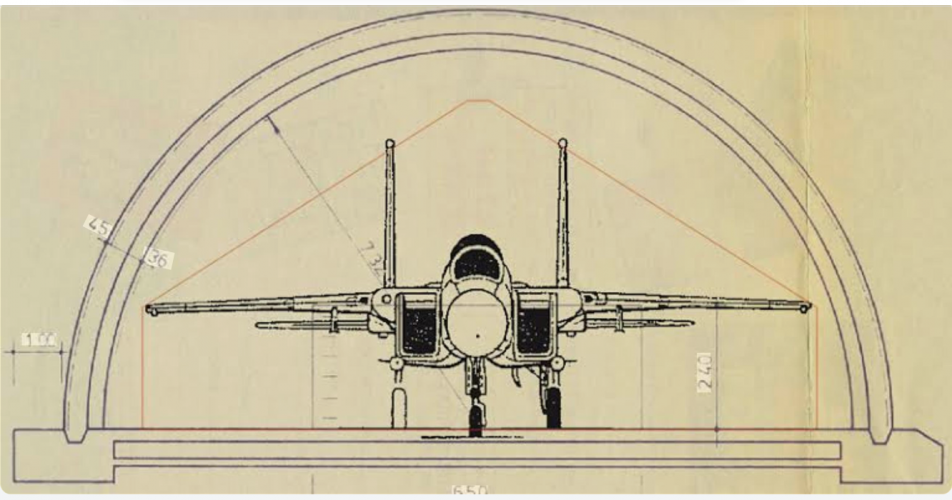
The ATF requirement was the Gen 1 HAS, aka TABVEE, with its 24-ft inner radius (48-ft width at ground level). The F-22A proposal configuration increased the wingspan over the YF-22 and the F-15A via two unique features: 3.2-deg of wing anhedral, and a shorter landing gear. Internet buzz speculates that the anhedral was incorporated for reduced lateral-axis stability and hence snappier roll performance -- these kind of flying qualities improvements, if any, were a fallout. The combination of anhedral and a squat undercarriage enabled the 1.5-ft span increase, which provided improved aerodynamic efficiency in cruise and maneuver. The shorter landing gear also reduced weight-empty.
Length: F-22A 62.08 ft, YF-22 64.17 ft, F-15A 63.75 ft.
Due to its highly efficient caret inlet, relatively thin wing, and other design refinements, the F-22A proposal configuration was able to decrease the overall length by about 2 ft. As a general rule of thumb, fighter aircraft weight-empty grows by (length)^2.5. Even with a lower fineness ratio, the F-22A has superior supersonic performance.
 

Attachments

  • TABVEE gen1.png
    TABVEE gen1.png
    956.3 KB · Views: 159
So functionally the F-47 could have about the same wingspan as the F-15 or F-22, depends on how high the wingtip ends up. And the gull wing with a long inner dihedral with a short outer anhedral does NOT help us here. Assuming that the plane is designed around Gen 1 or Gen 1 Mod HAS.

That said, how many Gen 1 HAS are still in service?

If there aren't many Gen 1 or Gen 1 Mod HAS still in service, I'd expect that the F-47 would be designed around the Gen 3 HAS with a wingspan limit of around 68 ft.
 
I think it's that the MTOW hasn't really changed but for the F-22 it only reaches MTOW with 4x 600gal fuel tanks under the wings while F-47 is ~85klbs without external tanks.
IMO that internal takeoff weight is excessive and unnecessary, many here have pointed out you don’t need such massive internal fuel if you keep empty weight under control to have good fuel fraction.
 
IMO that internal takeoff weight is excessive and unnecessary, many here have pointed out you don’t need such massive internal fuel if you keep empty weight under control to have good fuel fraction.
So, you really think that the F-47 has a significantly lighter empty weight than an F-22 (43klbs empty), and may be as light as an F-35A (30,000) is empty?

You really think that the F-47 is flying over 4000nmi one way with an MTOW of ~65,000lbs?

If I'm running the calculator correctly, the best I'm getting is about 3300nmi one way, which puts the combat radius around 1100nmi.
  • Assumptions: 650kts, L/D of 10:1, TSFC for two engines of 1.2lbs/lbthrust/hr, 65000lb MTOW, 35,000lb "empty" with weapons.
  • Reasoning: TSFC for an F119 I'm seeing reported as 0.68, and I'd the historical step size for each generation has been about 0.08 less fuel at MIL for XA102/103 TSFC of about 0.6, while full AB/wet is ~2.0 regardless of generation. And I went with a worse L/D than the F-106.


Can someone with more practice using the Breuget Equation run a sanity check, please?
 
You shouldn’t double the TSFC for two engines, unless you are only using the thrust for one engine. Not sure where the 0.68 SFC number for the F119 is coming from l, never been publicly released, and I’m pretty sure that number is a product of imagination. However, 0.6 might be a good guess for the NGAP engines in cruise mode. F119 is less than 2 at Max, but not a terrible guess for NGAP. I’ve seen max AB SFC from 1.7 for low bypass engines, up to near 3 for higher bypass like TF30 and F101

I’m not sure how the Breuget equation deals with jet engine fuel flows at altitude cruise. At subsonic cruise at 35-40k, Mil power thrust is only about 1/4-1/3 the rated sea level thrust, so cruise thrust and fuel flow is on 1/4 of sea level Mil fuel flow. SFC tends to be worse at altitude cruise, but not enough to offset the reduction in air density.
 
Not sure where the 0.68 SFC number for the F119 is coming from l, never been publicly released, and I’m pretty sure that number is a product of imagination. However, 0.6 might be a good guess for the NGAP engines in cruise mode. F119 is less than 2 at Max, but not a terrible guess for NGAP. I’ve seen max AB SFC from 1.7 for low bypass engines, up to near 3 for higher bypass like TF30 and F101
M88-2 - 0.3 bypass ratio - SFC 0.782/1.663
EJ200 - 0.4 bypass ratio - SFC 0.74/1.66

I wouldn't expect F119 to beat these given its design requirements, but NGAP engines, perhaps yes.
 
here i am, toiling away under the assumption that perhaps the sine qua non of an adaptive cycle three stream engine was the ability to functionally operate at a higher BPR than a fixed bypass engine like those mentioned in this thread.

As for the non engine bits and bobs - mass and drag reduction from deleting stabilizers, other aero improvements both from a planform and trim/control effector perspective, weight reductions from more modern materials and processes, moving away from legacy hydro based plumbing to more electric based, etc can be a self reinforcing spiral - powerful virtuous one if stakeholders keep laser focused and avoid performance creep. We remember the weight/death spiral that has hit many US a/c like the A-12 Avenger most famously, but forget an opposite or anti polar spiral is possible, however improbable.
 
Last edited:
You shouldn’t double the TSFC for two engines, unless you are only using the thrust for one engine. Not sure where the 0.68 SFC number for the F119 is coming from l, never been publicly released, and I’m pretty sure that number is a product of imagination.
F-22
With a fuel consumption of 0.61 kg/kgf·h, the flight range is 2500 km without external tanks and 3350 km with two external tanks.The English language is in the AZ column: eger_tab
 
Engine thrust doesn't actually enter into the equation at all. At least not in the calculator I used.

I guess it shouldn’t, nor should aircraft weight/mass. We are looking at the cumulative “work” being done by the overall airframe as defined as range at its ideal cruise profile, with its efficiency (aero and propulsive) as constants, as the variable fuel, which defines mass at these conditions, goes from full bag to oh shit.

At least that’s how an idiot like me thinks about it.
 
Last edited:
F-22
With a fuel consumption of 0.61 kg/kgf·h, the flight range is 2500 km without external tanks and 3350 km with two external tanks.The English language is in the AZ column: eger_tab

We calculate SFC in Fuel/Thrust/Time, but we don't know at what throttle % or thrust, altitude & subsonic speed, is the best mileage. I guess Mach 0.7-0.8
 
So, you really think that the F-47 has a significantly lighter empty weight than an F-22 (43klbs empty), and may be as light as an F-35A (30,000) is empty?

You really think that the F-47 is flying over 4000nmi one way with an MTOW of ~65,000lbs?

If I'm running the calculator correctly, the best I'm getting is about 3300nmi one way, which puts the combat radius around 1100nmi.
  • Assumptions: 650kts, L/D of 10:1, TSFC for two engines of 1.2lbs/lbthrust/hr, 65000lb MTOW, 35,000lb "empty" with weapons.
  • Reasoning: TSFC for an F119 I'm seeing reported as 0.68, and I'd the historical step size for each generation has been about 0.08 less fuel at MIL for XA102/103 TSFC of about 0.6, while full AB/wet is ~2.0 regardless of generation. And I went with a worse L/D than the F-106.


Can someone with more practice using the Breuget Equation run a sanity check, please?
Where did over 4,000nmi range come from? AFAIK F-47 has combat radius 1,000+nmi so don’t see why that kind of range is necessary. Your TSFC also seems like you’re averaging mil power and afterburner? Not sure why you doubled your TSFC.

And normal takeoff weight at full internal fuel isn’t necessarily MTOW especially if F-47 can carry external stores.

And yes I recall others here saying that F-47 manages to have significant empty weight savings over F-22 to greatly increase fuel fraction while have similar normal takeoff weight.
 
I'm sure most of you folks have seen the iceman fox1 page on YouTube, very good stuff.
 
Until we know the thrust in afterburner, the maximum takeoff weight is unknown. Until this is known, it is unclear what volume of weapon loads can be expected.

Currently, there are two options: the full‑fledged XA102/XA103 with afterburner thrust of 2 × 21,320 kgf and maximum thrust of 2 × 14,515 kgf; or a non‑afterburner engine variant with thrust of 2 × 14,515 kgf–15,810 kgf. In the first case, the maximum takeoff weight of the aircraft is 42,638 kg, and the weapon bay capacity is no more than 11.5 m³; in the second case, it is no more than 35,000 kg, and the weapon bay capacity is no more than 9.45 m³.

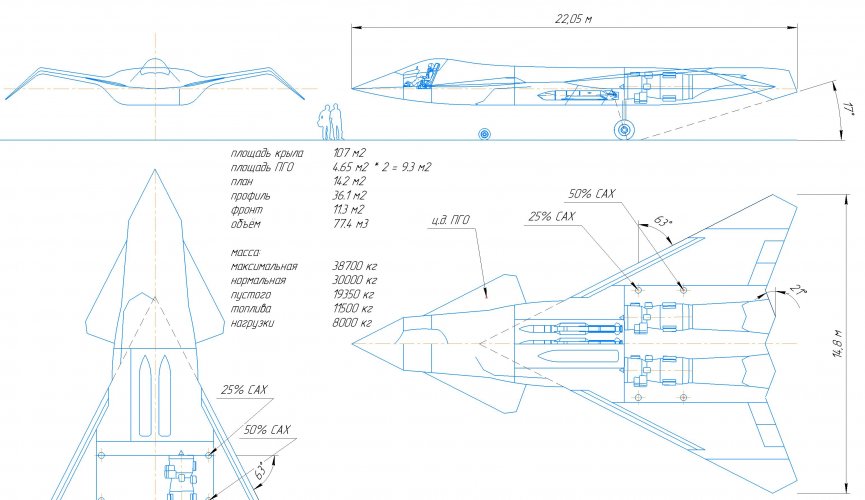
Wing area: 107 m²
forward horizontal tail area: 4.65 m² × 2 = 9.3 m²
plan area: 142 m²
profile area: 36.1 m²
front area: 11.3 m²
volume: 77.4 m³

mass:
maximum: 38,700 kg
normal: 30,000 kg
empty: 19,350 kg
fuel: 11,500 kg
payload: 8,000 kg

maximum and cruising speed: Mach 2.0 (2124 km/h)
 

Attachments

  • 47_4.JPG
    47_4.JPG
    423.2 KB · Views: 166
Last edited:
Could you share the source of this image? Is this a bay designed for the AIM-174B? I think making it larger than the AIM120/260 form factor is a good idea, but making it too large, even for air-to-ground munitions, seems pointless to me on an air superiority fighter. If any extravagant munitions are needed, there is the B-21, the F-15 or CCA.
 
Could you share the source of this image? Is this a bay designed for the AIM-174B? I think making it larger than the AIM120/260 form factor is a good idea, but making it too large, even for air-to-ground munitions, seems pointless to me on an air superiority fighter. If any extravagant munitions are needed, there is the B-21, the F-15 or CCA.
Paralay makes those images himself, usually based upon reasonable extrapolations of available evidence, or as a way of visualizing assumptions.
 
If we know the maximum takeoff weight, we will know the aircraft’s volume. Knowing the volume, we can estimate the dimensions of the weapon bays.

The relative volume of the weapon bays for the F‑22 is 10.3% / 6.73 m³, and for the F‑35A — 13.5% / 6.7 m³
I think 9.45 m³ is a realistically achievable volume for such an aircraft.
 
What is the length of the ERAM with the booster?
None of them are ideal for IWB or even fit into IWB.
AGM-189 doesn't need a booster when airlaunched but with it... it looks about ~16.63' or ~5.07 m so it's more than even the navy's 15 ft requirement.
 
We reduce the IR signature, RCS and increase the range
At the expense of survivability and responsiveness though. Without afterburning engines, it wouldnt be able to do half the missions an air superiority fighter should be doing and it would make surviving missiles that much harder. Relying solely on stealth, EW and positioning to survive missile shots and being unable or less able to have the speed to create space and bleed energy of an incoming missile is extremely uncomfortable for an exquisite asset.

You can choose to fly a stealthy profile, but when push comes to shove, you need that speed to fight and live.
 
If the required thrust‑to‑weight ratio is achieved without afterburner, why not do without it?
That is true but how can we know / assume that NGAP has much more thrust in all flgiht profiles across the board? And how can we just asume NGAP is going to achieve that without afterburner? Sorry maybe Im missing something.
 
If the required thrust‑to‑weight ratio is achieved without afterburner, why not do without it?
If you could meet the required thrust range (as in lowest power to highest), sure. Pretty sure nobody wants to be trying to fly the pattern with the gear down while the engines are blowing 60k of thrust. Never seen a fighter engine that could do that before.
 
Where did over 4,000nmi range come from? AFAIK F-47 has combat radius 1,000+nmi so don’t see why that kind of range is necessary.
The usual comparison of ferry range to combat radius is about 1/3 ferry range. Especially for aircraft without notable external tankage.

At best you're going to have a ferry range of 2x your combat radius, because you gotta go there and back. But 2x assumes you don't maneuver or really even change thrust settings while over the target area.


Your TSFC also seems like you’re averaging mil power and afterburner? Not sure why you doubled your TSFC.
I doubled TSFC because there were two engines. Not paying attention to the fact that TSFC doesn't care how many engines you have.

Looking at what the equation is doing, I should not have doubled TSFC. It's also why I asked for a review from someone who has worked with the equations a lot more than literally my first ever time messing with it.


At the expense of survivability and responsiveness though. Without afterburning engines, it wouldnt be able to do half the missions an air superiority fighter should be doing and it would make surviving missiles that much harder. Relying solely on stealth, EW and positioning to survive missile shots and being unable or less able to have the speed to create space and bleed energy of an incoming missile is extremely uncomfortable for an exquisite asset.
Just pointing out that one of the best dogfighters was the Harrier, because of how much sheer thrust it had due to the VTOL requirement.

I do still think that the F-47 is going to have afterburners, but that's a separate discussion from "could you build a modern fighter without afterburners"
 
The usual comparison of ferry range to combat radius is about 1/3 ferry range. Especially for aircraft without notable external tankage.

At best you're going to have a ferry range of 2x your combat radius, because you gotta go there and back. But 2x assumes you don't maneuver or really even change thrust settings while over the target area.


I doubled TSFC because there were two engines. Not paying attention to the fact that TSFC doesn't care how many engines you have.

Looking at what the equation is doing, I should not have doubled TSFC. It's also why I asked for a review from someone who has worked with the equations a lot more than literally my first ever time messing with it.


Just pointing out that one of the best dogfighters was the Harrier, because of how much sheer thrust it had due to the VTOL requirement.
Was a subsonic aircraft though. And was it really one of the best dogfighters or just by comparison to the Mirage?
 
Just pointing out that one of the best dogfighters was the Harrier, because of how much sheer thrust it had due to the VTOL requirement.
I think if you can meet that thrust requirement without an afterburner then why not. But thus far Im not sure there is evidence that adaptive cycling engines can reach rhat thrust without afterburner. Was there some research done about it? Some expert opinion? I probably missed it if there really was.
 
I think if you can meet that thrust requirement without an afterburner then why not. But thus far Im not sure there is evidence that adaptive cycling engines can reach rhat thrust without afterburner. Was there some research done about it? Some expert opinion? I probably missed it if there really was.
I'm not aware of any such research, but I'm getting pretty much all my military news from here.
 
The calculated characteristics of the layout presented above, engines with an afterburner, column AH
English language in the column BA

eger-tab

Masses:
maximum: 40,700 kg
normal: 26,000 kg
empty: 20,500 kg
fuel: 12,000 kg
combat load: 8,000 kg

Maximum speed: 2,160 km/h
Cruising speed: 1,780 km/h

Supersonic flight range: 1940 km.
Flight range without an additional tank: 3105 km.
Flight range with an additional tank in the weapon bay: 4300 km.

Operating radius: 1100–1500 km (without external tanks).
 
Last edited:
Currently, there are two options: the full‑fledged XA102/XA103 with afterburner thrust of 2 × 21,320 kgf and maximum thrust of 2 × 14,515 kgf; or a non‑afterburner engine variant with thrust of 2 × 14,515 kgf–15,810 kgf.
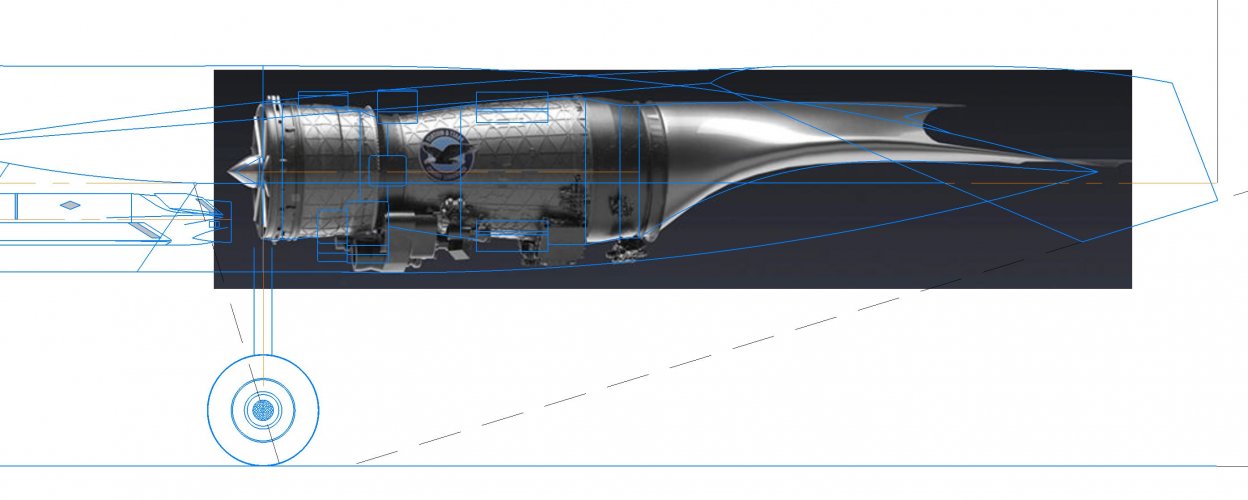
Is such high thrust achievable today for engines the size of the F-110?
 
I also have a number of questions for experts in jet engines. What advantages can be gained by abandoning afterburning? How much weight can be saved without a afterburner, and is it possible to do without an adjustable nozzle?
 
I think if you can meet that thrust requirement without an afterburner then why not. But thus far Im not sure there is evidence that adaptive cycling engines can reach rhat thrust without afterburner. Was there some research done about it? Some expert opinion? I probably missed it if there really was.
The YF119 variant for the X-32 produced 34k dry but it was huge. Also, keep in mind exhaust velocity is going to limit your top speed and the higher your bypass ratio the lower your overall exhaust velocity is going to be.
  • Maybe the 2nd stream in a 3-stream engine can be diverted through the combustion chamber.
  • Maybe the 3rd (outer) stream is a duct-burner for extra oomph.
  • Maybe it has fluidic TVC.
That said, I'd be surprised if either the F-47 or F/A-XX didn't have afteburning engines. And I would think they would have TVC if only to aid in yaw control with no verticals.
 
Last edited:

Similar threads

Back
Top Bottom