well, and what stop USN from attacking these ship, fighters or SAM on island?.
All these things are massively more expensive than decoys like MALD
Nothing, but with aspirational goal of 185 core airrframes, that may not go very far
Point of that is designing a plane for geography in stasis isn't exactly smart, when battlespace is movable. And while battlespace is movable, american allies in the region aren't.
 
I think people sometimes forget the fact that the China could use similar tactics to use against the US's naval blockade except the fact that they have more resources at their disposal due to SCS being in their backyard.
I mean that's to be expected. My point is there's no one on either side that can avoid an air war turning out like a football match. It'll be a lot of pushing and shoving as plays more often than not get countered and go nowhere. There will be no silver bullet solution for either side.

Regarding the YFQ-44 CCA - I highly doubt that whoever approved this contract didn't consider whether or not the plane has internal stores or not. Why would you buy a stealthy CCA without internal stores unless ... it had other uses besides just shooting missiles? Unless we've moved on from the "sensor and shooter" CCAs being separate, I don't see why YFQ-44 can't be a solid sensor CCA. I'm pretty sure it's been pointed out by quellish somewhere in this or a related thread before that we aren't just limited to sensor and shooter CCAs. There's plenty of room here for EW, decoys and what not.

We are also sorely off topic though so I'll just leave it at this.
 
Last edited:
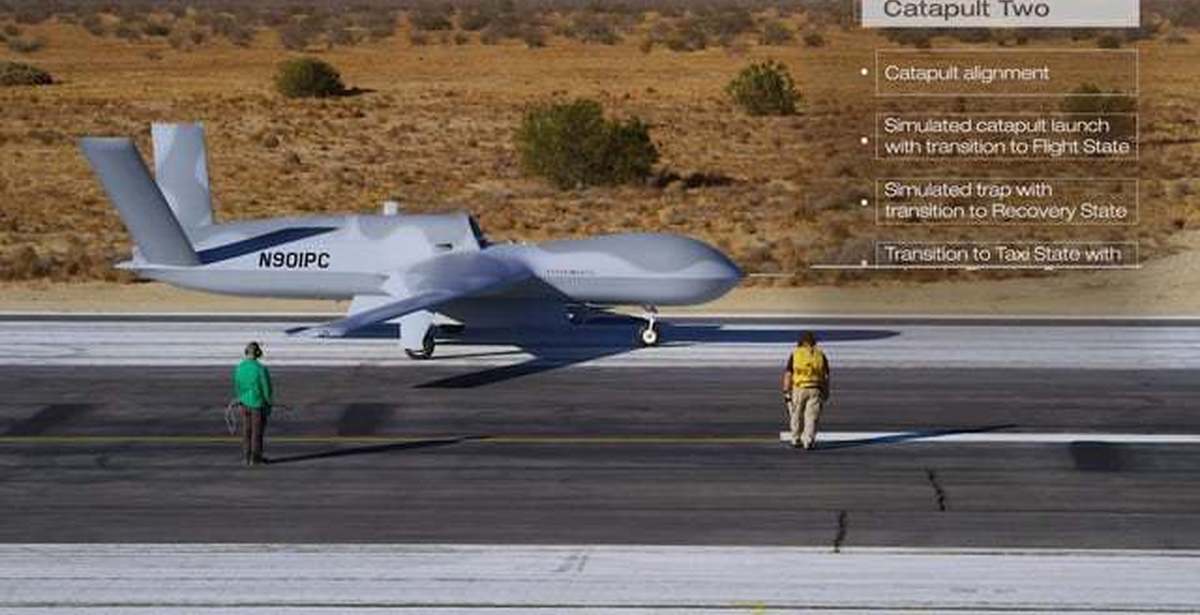
The closest analogue of the existing ones General Atomics MQ-20 Avenger

og_og_1524034990332394985.jpg
Unfortunately, no buyers for this platform.
 
I mean that's to be expected. My point is there's no one on either side that can avoid an air war turning out like a football match. It'll be a lot of pushing and shoving as plays more often than not get countered and go nowhere. There will be no silver bullet solution for either side.

Regarding the YFQ-44 CCA - I highly doubt that whoever approved this contract didn't consider whether or not the plane has internal stores or not. Why would you buy a stealthy CCA without internal stores unless ... it had other uses besides just shooting missiles? Unless we've moved on from the "sensor and shooter" CCAs being separate, I don't see why YFQ-44 can't be a solid sensor CCA. I'm pretty sure it's been pointed out by quellish somewhere in this or a related thread before that we aren't just limited to sensor and shooter CCAs. There's plenty of room here for EW, decoys and what not.

We are also sorely off topic though so I'll just leave it at this.
I bet the USAF will purchase both the -42 and -44 and they will be involved in different-type missions. Buy two different aircraft at twice the cost!
 
Nothing, but with aspirational goal of 185 core airrframes, that may not go very far
Point of that is designing a plane for geography in stasis isn't exactly smart, when battlespace is movable. And while battlespace is movable, american allies in the region aren't.

Endurance is still a useful asset in most any scenario.
 
I bet the USAF will purchase both the -42 and -44 and they will be involved in different-type missions. Buy two different aircraft at twice the cost!
Maybe I'm just uninformed then lol. Are they suppose to be competing for the same acquisition? If so, I think general atomics would definitely be better fit not because of internal bays or not but because the potential of a concept like gambit.
 
I bet the USAF will purchase both the -42 and -44 and they will be involved in different-type missions. Buy two different aircraft at twice the cost!

It would not surprise me. Having two hot production lines could be useful and these aircraft will not need maintenance in the traditional sense.
 
and it seems quite reasonable to me that the F-47 will be more stealthy than any of the other jets.
It better be lol. Otherwise it'll be a tough sell and I'd wonder where decades of technological progress, development and billions of dollars went.

I surely understand that they wanted to highlight it being an across the board improvement. However an alternative could have been "improved stealth".

"Stealth+" and "Stealth++" are nothing burgers and sound like a subscription service tbh. "Sign up for Stealth++ and KJ-3000s won't see your signature!"
 
Coming back to the F-47 proper, do we know anything about the helmet yet? Or has there been radio silence on that bit? I wouldn't be surprised if it's fundamentally just an evolution of the one used in the F-35.
 
Of course it does not have the same level of "stealth" as a F-35. Again this is a PR document not a technical document. I can't image they're interested in dealing with any of the bullshit that would happen if they put something more accurate like "stealth -" or "semi-stealth" or anything that They'd be inundated with stupid questions asking "how can it compete against China if isn't stealth!" "why are we buying this if it isn't stealth!? You've said for years that if it isn't stealth it can't survive on the modern battlefield!" (This also ignores the fact that these first iterations of CCAs are not earmarked for combat ops anyway last I heard.)

Stealth has always been a nebulous term to begin with. Tons of room for interpretation and I am certainly not loosing any sleep over any description about stealth capabilities described in that document. This includes my own comment about the F-22 vs F-35 signature. I suspect the only thing that is fairly accurate are the range numbers and it seems quite reasonable to me that the F-47 will be more stealthy than any of the other jets.

I just find the presentation quality to be lacking for something that comes directly from the horse’s mouth.
 
Endurance is still a useful asset in most any scenario.
Certainly useful, but i just fail to see such fighter as a decisive asset.
It's building a plane 5 years into the future, for a war that didn't happen 10 years ago.

Long range escort fighters certainly can be decisive (case points: Zero, Mustang), but those still came at numbers, making margins work.
Heck, F-15 and F-22 came in numbers, relying on margins, not thinking that peer opponent won't be able to shot down a single one.

I.e. planned procurement lacks one zero somewhere in that number.
 
I.e. planned procurement lacks one zero somewhere in that number.
Not that I disagree with this, but why do I feel like the plan was to re-compete the program after an initial number of buys and then procure more of whatever comes of that? Or is that off the table already?
 
Certainly useful, but i just fail to see such fighter as a decisive asset.
It's building a plane 5 years into the future, for a war that didn't happen 10 years ago.

Long range escort fighters certainly can be decisive (case points: Zero, Mustang), but those still came at numbers, making margins work.
Heck, F-15 and F-22 came in numbers, relying on margins, not thinking that peer opponent won't be able to shot down a single one.

I.e. planned procurement lacks one zero somewhere in that number.

CCAs can help compensate for that.
 
Not that I disagree with this, but why do I feel like the plan was to re-compete the program after an initial number of buys and then procure more of whatever comes of that? Or is that off the table already?

The plan is to near-constant compete almost every aspect/component of the program.
 
Certainly useful, but i just fail to see such fighter as a decisive asset.
It's building a plane 5 years into the future, for a war that didn't happen 10 years ago.

Long range escort fighters certainly can be decisive (case points: Zero, Mustang), but those still came at numbers, making margins work.
Heck, F-15 and F-22 came in numbers, relying on margins, not thinking that peer opponent won't be able to shot down a single one.

I.e. planned procurement lacks one zero somewhere in that number.

The 185 number exactly matches F-22 inventory, and as such I would not assume that number is set in stone. That just sounds like an arbitrary 1:1 replacement. But to the extent there are supposed to be large numbers of disposable aircraft, the USAF seems to pin its hopes on CCA and other unmanned NGAD adjacent projects.
 
Maybe I'm just uninformed then lol. Are they suppose to be competing for the same acquisition? If so, I think general atomics would definitely be better fit not because of internal bays or not but because the potential of a concept like gambit.
Remember at the beginning of CCA Increment I, the USAF/USG stated even the loser may win because of the multiple missions defined for CCA especially if the platform costs are reasonable. This could also apply to CCA Increment II for the big three since the I2 platforms may be larger in size.
 
Remember at the beginning of CCA Increment I, the USAF/USG stated even the loser may win because of the multiple missions defined for CCA especially if the platform costs are reasonable. This could also apply to CCA Increment II for the big three since the I2 platforms may be larger in size.

No one in the USAF has explicitly stated this, but I think the long term plan is to develop the UCAV industry across numerous contractors to increase competition and production capacity. I think they may very well end up purchasing a disparate inventory of CCAs, because the overhead for maintenance is far less demanding than manned aircraft. At a minimum, no basic training flights are necessary, and high hour airframes can simply be semi retired and used as a war time high risk reserve. Box it up and when a conflict starts, fly it until it gets shot down or has a critical failure, whichever comes first.

If the US had several active CCA production lines, it could easily produce several hundred airframes a year or more. Fly away costs might be little pricey at those buy rates, but year over year ownership costs would be marginal compared to manned aircraft for most of them not explicitly used for large scale exercises and experimentation/integration.

ETA: I think the way the SDA handles its prolific satellite constellation contracts is informating the USAF buys. Even the language and time schedules - a new “incr” every two years - seems copied from the SDA playbook to diversify innovation and production lines.
 
CCAs can help compensate for that.
CCA, at least for now, is not a fighter in full sense, especially in complex scenarios. They are certainly factor, but as a reason to curtail normal procurement - it smells British defense review.

And right now it seems that Chinese CCA numbers will come on top of normal procurement, not instead.
 
If the US had several active CCA production lines, it could easily produce several hundred airframes a year or more. Fly away costs might be little pricey at those buy rates, but year over year ownership costs would be marginal compared to manned aircraft for most of them not explicitly used for large scale exercises and experimentation/integration.

That could well be the plan say in the back half of the 2030's and 2040s. Current CCA efforts seem to be focused on the very baslc elementary level stuff like man on the loop and ground based or airborne human controller inputs. These current increment 1 systems won't even have extensive sense and avoid capability so will require quite a bit of human intervention to control and direct. The 'box them up and use them as needed' logistical concept also needs to be fully vetted and tested. There are certainly lots of really innovative ideas out there but the AF will have to test these out before committing billions towards active production and inventory.

I can well see them spending half a decade to a decade refining this to a level where they will have the sort of vetted and well tested capability ready to field a program of record that fields a very large (hundreds per year - thousands overall) heterogeneous fleet. It is too early to predict whether this level of simplicity will still offer utility in the 2040 timeframe so we won't know of that until we get much closer..Some of this can be sped up via infusion of additional funding into the effort now. But a lot of it is probably going to take time and loads of airman input especially when scaling.
 
Last edited:
im so tired of the glibness surrounding this airplane. will fly, but not operationally, so basically emd prototype by 2028. they just refuse to outright say that no, we don't have an actual airplane yet, and allow wishful thinkers to continue misinterpreting "technology demonstrators" as "emd prototype". are we being sneaky now because we have nothing more to be proud of?
 
im so tired of the glibness surrounding this airplane. will fly, but not operationally, so basically emd prototype by 2028. they just refuse to outright say that no, we don't have an actual airplane yet, and allow wishful thinkers to continue misinterpreting "technology demonstrators" as "emd prototype". are we being sneaky now because we have nothing more to be proud of?

Well it's a bizarre situation. Boeing has clearly demonstrated the ability to rapidly design, build and fly sixth gen airframes and if NGAD is anything like Raider, will have lifted as many subsystems as possible from other platforms except for a few key subsystems. One of these subsystems is of course XA102/103. Putting aside (1) how a VCE might need unique interfaces with the rest of a sixth gen aircraft to maximize harnessing power generation and cooling capabilities of the third stream and (2) USAF and industry studies have linked maximizing the control effector promise of conformal fluidic nozzles to a VCE, unless MBSE and digital twins have some magical compressive effect on timelines, I can't see any F-47 flying with a production A102 until the upper end of the 2025-2029 range on that slide. I will let @F119Doctor opine on the what the likely *realistic* timelines are for the two programs, now that DDR is behind them.

If the reality is that F-47 can fly its mission without VCE, which doesn't seem unreasonable, then I can see F-47 flying in 2027, which *should* allow time for Boeing's Advanced Combat Aircraft Center in St Louis to complete - currently the language is "by 2026" so putting that through the reality reinforcement field, means fall 2026 to me, which puts first flight off the line ~ late summer 2027.

 
Well it's a bizarre situation. Boeing has clearly demonstrated the ability to rapidly design, build and fly sixth gen airframes and if NGAD is anything like Raider, will have lifted as many subsystems as possible from other platforms except for a few key subsystems. One of these subsystems is of course XA102/103. Putting aside (1) how a VCE might need unique interfaces with the rest of a sixth gen aircraft to maximize harnessing power generation and cooling capabilities of the third stream and (2) USAF and industry studies have linked maximizing the control effector promise of conformal fluidic nozzles to a VCE, unless MBSE and digital twins have some magical compressive effect on timelines, I can't see any F-47 flying with a production A102 until the upper end of the 2025-2029 range on that slide. I will let @F119Doctor opine on the what the likely *realistic* timelines are for the two programs, now that DDR is behind them.

If the reality is that F-47 can fly its mission without VCE, which doesn't seem unreasonable, then I can see F-47 flying in 2027, which *should* allow time for Boeing's Advanced Combat Aircraft Center in St Louis to complete - currently the language is "by 2026" so putting that through the reality reinforcement field, means fall 2026 to me, which puts first flight off the line ~ late summer 2027.
The factory they're going to build it in isn't even complete yet. I can't recall if it's scheduled to be completed this year or next. We'll be lucky to see an F-47 flying by 2028, if not 2029.
 
The factory they're going to build it in isn't even complete yet. I can't recall if it's scheduled to be completed this year or next. We'll be lucky to see an F-47 flying by 2028, if not 2029.
The “by 2026” for ACAC was from Boeing but as you are probably aware someone up thread posted some recent sat images that were, how you say, not promising.
 
Well it's a bizarre situation. Boeing has clearly demonstrated the ability to rapidly design, build and fly sixth gen airframes and if NGAD is anything like Raider, will have lifted as many subsystems as possible from other platforms except for a few key subsystems. One of these subsystems is of course XA102/103. Putting aside (1) how a VCE might need unique interfaces with the rest of a sixth gen aircraft to maximize harnessing power generation and cooling capabilities of the third stream and (2) USAF and industry studies have linked maximizing the control effector promise of conformal fluidic nozzles to a VCE, unless MBSE and digital twins have some magical compressive effect on timelines, I can't see any F-47 flying with a production A102 until the upper end of the 2025-2029 range on that slide. I will let @F119Doctor opine on the what the likely *realistic* timelines are for the two programs, now that DDR is behind
It is still likely 5 years before flight ready XA102 / XA103 are available. Unless the USAF has been funding long lead hardware based on PDR hardware design, it is usually 12-18 months for rotating disk forgings to be available, then machining time to the DDR drawings, engine assembly for ground test engines (including heavily instrumented test engines for stress verification), redesign with hardware procurement & manufacture for things that don’t go right from the PDR design, then Initial Flight Release (IFR) to begin flight test, Initial Service Release to continue flight test, and finally Production Representative engines at the end of EMD before series production. Some of these steps can be run somewhat in parallel, but engine development is hard.

Based on the size engine described for the F-47 with the XA102 / 103 being smaller than the F-35 sized XA100 / 101, I wouldn’t be surprised to see the first F-47 flying with modified F119 engines. They just need to ensure that the F-14 “interim TF30” scenario doesn’t repeat…
 
Last edited:
Amazing thank you @F119Doctor - your notional “modified” F119 might be good for an “F-22 Super” or even F/A-XX if “modified” might bring enhanced efficiency, thrust and/or power & cooling….

Then of course when 102/103 is ready you integrate that powerplant in any of F-22 Super, F-47 or F/A-XX depending on money and need.
 
Last edited:
Don't shoot the messenger. Trump wants to build a F-55, a twin engined F-35 in addition to an 'F-22 Super'. Is it serious? Despite it all, he's the President of the United States, the most powerful and influential person in the world, and for that reason alone we NEED to take it seriously.


A few direct quotes from the president:

“We’re going to do an F-55, and I think — if we get the right price, we have to get the right price — that’ll be two engines and a super upgrade on the F-35,” he said at the event.

“Then we’re going to do the F-22. I think the most beautiful fighter jet in the world is the F-22, but we’re going to do an F-22 Super, and it’ll be a very modern version of the F-22 fighter jet,” he added.

“I don’t like single engines. Even this man, he is the best in the world in engines,” Trump said, referring to Culp. “But on occasion, I know you won’t admit this, if an engine goes out, it’s nice to have two, three or four. That’s why, I like the 747, it’s got four. … They tell me the engine will never go out. Well, I think it goes out on occasion, pretty rarely.”

“You’re going to design an ugly plane for stealth reasons, and then six months later, they’re going to figure out this, and then you’re stuck with the plane,” he said.
 
So this all seems positive on balance: F/A-XX will be called the F(/A?)-55 and ofc will be twin engined, and he is either talking about rolling out the current known F-22 upgrades (eg IRDS) or perhaps even more exotic things. The fact that he saying F-55 apparently wrt F/A-XX is to my mind a big positive sign for the program, which is a relief!
 
“We’re going to do an F-55, and I think — if we get the right price, we have to get the right price — that’ll be two engines and a super upgrade on the F-35,” he said at the event.

"F-55" = F/A-XX.
"super upgrade on the F-35" = "this is an improvement over the F-35" i.e. this is not a twin engine F-35, this is a new aircraft that is better than the F-35

“Then we’re going to do the F-22. I think the most beautiful fighter jet in the world is the F-22, but we’re going to do an F-22 Super, and it’ll be a very modern version of the F-22 fighter jet,” he added.

"F-22 Super" = F-22 modernization program(s)

"F-35 upgrade" = F-35 Block 4 / TR3 / whatever.

These are all current programs of record.

I have gotten all the above but the "F-55" designation confirmed by [redacted] today.
 
Last edited:
So this all seems positive on balance: F/A-XX will be called the F(/A?)-55 and ofc will be twin engined, and he is either talking about rolling out the current known F-22 upgrades (eg IRDS) or perhaps even more exotic things. The fact that he saying F-55 apparently wrt F/A-XX is to my mind a big positive sign for the program, which is a relief!
How can F/A-XX be a twin engined F-35 when lockheed martin was knocked out of the competition already?
 

Similar threads

Back
Top Bottom