The F135 is rated at 43K lbs thrust at Max AB, and the XA100 / 101 were quoted at 10% higher thrust = 47-48K, while being more fuel efficient during subsonic cruise. For a twin engine fighter, you are at 90K+ thrust.

The public USAF statements are that the XA100 / 101 were too large for NGAD, with the XA102 / 103 being scaled down while using the same technology. My guess is that puts the thrust in the 35-40K range. Much bigger than any current F100 or F110, but in the same ballpark at the F119. If a fat diameter fan duct 3 stream engine will fit in the engine bay, the F119 should easily fit. It would likely provide sufficient thrust to get the new airframe into the air for initial flight test and envelope expansion, while falling short of the subsonic fuel efficiency targets of the XA102 / 103.

As to the source of these interim F119s for the F-47. While the engine is out of production, the major hardware is still being produced as spare parts for depot overhaul. Spare engines could be drawn down from the F-22 supply, and as others have pointed out the F-22 Block 20 retirement would free up spare F119 engines (FYI - all production F119 engines are 99% identical and are used interchangeably throughout the F-22 fleet, no difference in age or configuration for the Block 20 aircraft)

Of course, this is all speculation on my part, and I don’t have any insider knowledge on the F-47 program.
 
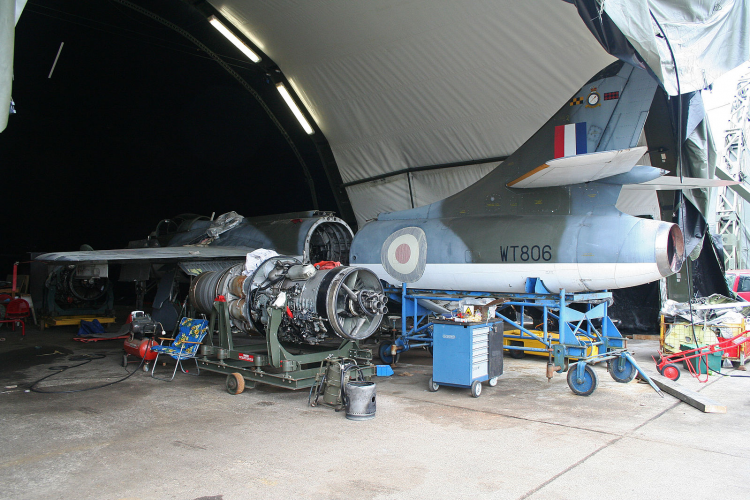
Yes, the engines should be as near the ground as possible. 1950s jets with mid-mounted jet engines for balance reasons often had to detach the rear fuselage to get to the engine.

1747445400183.png

Modern fighters always locate the engines at the rear side by side with large doors on the bottom for access.
 
F-55 Lightning II + II

Makes me wonder why there are so few twin engine aircraft with a vertical engine arrangement.
A friend (one Mr. George Robert Bagshaw) of my father’s here in Florida was an older gentleman from the UK who had been a maintainer for No. 11 Squadron, I think it was. I distinctly recall he and dad talking about the engine orientation one day and he stated, and I quote “they was like broke teef when they went. A right fookin’ pain. Ya pull one, ya had ta pull t’other”.

He then went on to tell us that in terms of ease of maintenance, the early F-5s “was so simple a boy yer age (I was 9) could do most of it.”

I suspect the old boy would have been in awe of what is flying today. He would have definitely had some opinions. “Oogly aeroplanes ought not be allowed t’ use up good air!”
 
Would you say the XA102/103 are more fuel efficient than XA100/101 while sacrificing some thrust? Or do they have similar fuel efficiency with the latter pair being smaller with less thrust?
I would expect the XA102/103 to have similar fuel efficiency as the XA100/101, but lower airflow, physical size, and fuel flow due to lower thrust target. Fuel efficiency improvement would be greater vs the F119 than vs the F135 (which is better than the F119).
 
I would expect the XA102/103 to have similar fuel efficiency as the XA100/101, but lower airflow, physical size, and fuel flow due to lower thrust target. Fuel efficiency improvement would be greater vs the F119 than vs the F135 (which is better than the F119).
Do you expect to see higher thrust than the F119 or about the same? I think what im asking is whether to expect this plane to have an overall higher kinematic performance and speed than the F-22 (not maneuverability)... or is that not as important anymore?

Sorry for the amateurish question I'm pretty new to this.
 
Last edited:
I don’t know. As you may know, F119 thrust ratings have never been publicly released, other than “35K Thrust Class”. My guess for the XA102/103 would be in the 30-40K range, depending on just how heavy the airframe is and the intended mission. The variable bypass capability may reduce the mission impact on the engine design, but will still impact the various capability trade offs.
 
would expect the XA102/103 to have similar fuel efficiency as the XA100/101, but lower airflow, physical size, and fuel flow due to lower thrust target.
Why do you think they gave up thrust for similar fuel efficiency? Just for smaller size?
 
Specific fuel consumption (I.e. fuel efficiency) should be similar, but actual fuel consumption will scale down with the reduction in engine size and thrust.
So you’re not seeing F22 thrust/weight ratios assuming this plane will be as heavy as expected? The needed trade off for more stealth and range?
 
So you’re not seeing F22 thrust/weight ratios assuming this plane will be as heavy as expected? The needed trade off for more stealth and range?
I didn’t say that. Engine thrust and size are chosen for a variety of mission requirements and there are always design trade offs necessary. We don’t know the size and weight of the F-47, only that the XA102/103 are being designed as smaller / lower thrust in a two engine design than the XA100/101 that were intended for the F-35 single engine application.
 
There is wealth of information on F119, F135, AETP, NGAP and even more advanced F110 designs in the Propulsion subforum. Worth perusing when you have a couple dozen hours you’d like to kill.

In my ignorant view, I see NGAP having three key deliverables: higher cruise efficiency, huge amounts of power and cooling for other systems and at a minimum a F119 like performance envelope, as baseline. TBD how much A102/103 weighs in relative to F119, so another consideration.
 
I get that NGAP’s SFC gains revolves primarily around the third stream for the subsonic regime but has there has been any indication for any improvements in the supersonic regime? Or are there only marginal gains possible?
 
I get that NGAP’s SFC gains revolves primarily around the third stream for the subsonic regime but has there has been any indication for any improvements in the supersonic regime? Or are there only marginal gains possible?

It would be reasonable to assume that SFC at high military thrust and supersonic speeds is a priority.
 
I can’t help but wonder if by “F-35 with two engines”, DJT was simply exposing his lack of understanding of the adaptive cycle engines under development? The “F-22 Super” seems to be a reference to the recent upgrades to the Raptors and this “F-55” strikes me as a goofy way of referring to the Lockheed proposal to use the F-35 chassis for technology that they created and used for their NGAD proposal.
 
Last edited:
Maybe F/A-XX is more similiar to F-35 than i tought. Now a twin F-135 fighter does seems unlikely but maybe the explained it like that. Cutting cost by reusing a lot of F-35 hardware (Radar, EW suite, EOTS or DAS from Block 4 for example). I know what ever agent orange says often is quite from the reality but maybe its just his last brain cells (or whats left from them) trying to make it understandable for him.


This is what I also believe, I don’t think it’s even possible to just put an extra engine on the F-35 without a complete redesign. Some components like canopy, or avionics or even wings can probably be repurposed with some changes.

I just don’t see a purpose as the F-47 will probably be twin engine and long range air superiority. Then there is the F-35 as a single engine multirole fighter and the B-21 as a long range heavy strategic bomber. Plus 178 F-22 that won’t retire until the early 2030s and that is if they don’t do another refit and push their service longer, plus five squadrons of new F-15EXs and modern F-18 and F-16 variants.
 
Is it wrong to assume that the adaptive motor is what will help keep a good pace ahead of PLAAF aircraft development?
I wouldn't bet on that keeping a good pace ahead maybe slightly ahead for engine, China has been working on VCE for a while and from the little official hints/leaks ie. stuff like LuoYang produced bearings used on 5th generation aeroengine. Plus a few weeks back a WS-35 designation was found in official documents and also that the "WS-35" already has a prototype built. Now we don't know if WS-35 is China's 5th generation engine or supposedly a military version of the CJ-2000 but it's made by the same company that makes WS-15. There are also not official but rumors from PLA watchers with a credible track record that in late 2023 the "next generation engine" was put through high altitude tests.
 
Last edited:

Similar threads

Back
Top Bottom