The manned fighters needing to do fleet defense and offense by themselves. They simply dont need a dedicated fleet defender. There are CCAs F-35s etc.
The point of my original post on Trimble's comments. We r into circulars now
Focusing on a single plane taken out of its operational context to fulfill some theory of yours that has neither evidence nor logic - despite numerous people telling you otherwise with factual or at least supported information
There are either necessary capabilites or there are not.
You dont have to agree with nayone, but being unwilling to entertain presentedbfacts and continually pushing a theory around is ....

Insidersource-like
Always entertaining counters...havent heard one.
 
Where is the "A" in this F/A-XX. Why not be honest & go back to the F-X moniker Admitting this craft is for carrier defense is to admit the USN is transforming into a self licking ice-cream cone. As has been previously pointed out.
'why is ur carrier primarily full of self defense fighters. We have to protect the carrier.' What is carrier's mission again? We have to protect the carrier."

A fighter driver wet dream which no military can afford.

Only a follow on to the A-12 like the once proposed NG mini-B-2 has ever made any sense for the primary carrier plane in terms of cost effectiveness What is the purpose of the carrier if it doesn't deliver maximum theater effects? Primarly protecting itself defines a self licking ice-cream cone.

The idea, that in today's world one should develop an exportable carrier F/A is patently absurd. If USN wants to remain relevant it must invest in all aspect stealth Penetrating Counter Air et al w non-exportable, maximum high tech like the AF or get out of the game.
So wait, are you anti-fighters and you want a follow-on to the A-12 because carriers need to deliver theater effects, or are you anti-strike fighters and you want a navalized F-47 because the USN needs to stay relevant?
 
Which is precisely my point. It's not a process whose advantage is rooted in subcontractors outperforming Boeing, but in comparing different technologies. Apply the same technology in Boeing's production flow as opposed to the supply chains and you will see the same improvement.

The question then becomes why is it advantageous to Boeing to apply that technology in their supply chain, but not on their own shop floor?
I'm assuming you don't work in the industry because you seem to be missing some fundamental knowledge about how the machining/manufacturing and assembly process works. The whole concept of drill on assembly vs. FSDA is not unique to Boeing.

In legacy programs (pretty much anything developed F-35 and prior) they all used drill on assembly. As the aircraft was being assembled and bolted together, holes would have to be drilled by hand for brackets, components, bulkhead fittings, substructure, etc. None of the companies have CNC jigs to bolt up every single piece of structure and re-machine pieces of structure. That would be way too much money, resources, and time to re-jig every single component and drill all the holes. This is why you have the sub contracted companies do it while its already being CNC'd.

Not to mention, you cannot just remount an entire keel or frame on a jig and drill the holes and expect it to be dead on. During the CNC process materials expand and contract. The suppliers' machines are calibrated to compensate for all varying factors during the CNC process.

And at the base of it all, machining large keels and frames are not the expertise of companies like Boeing, LM, or NG. They design airframes and put them together. They definitely don't do everything in between that.

It's the same reason car companies buy Brembo brakes instead of making them in house. There's companies out there that just are better suited and more knowledgeable at making certain things.
 
Last edited:
What am I missing? Can someone on this forum tell me what jsport's point is?

Because if thats the evidence you are citing for:


What youve listed - big AESA, EW, internal carriage - is now par for course - for all fighters for any role. It means literally nothing, let alone the absurd point you keep trying to make.
As JoshN points out (it is great when neither can read or listen). Pods cause drag and slow. EW must be accomplished from internal AESAs. The FA-XX specifically points out replacing the Growler.
For strike fighters to do their job now, you need multirole fighters either capable of self escort or a fleet air arm consisting of air to air fighters. You need big AESAs to increase detection range, mapping resolution and GMTI accuracy. You need jamming for ground based detection systems of many kinds. You need AEW because your strikers and escorts need to preposition to ensure your strike package gets thru. You need internal carriage because you arent getting any where close to launch range if you hange muntions externally.
Is the above a self tutorial?
What am I missing? Do you think internal carriage, jammers and AESA radars are only applicable for air to air or something?

Maybe I just dont get what you think is evidence for your argument. Are we even talking about the same ice cream cone?
As from the beginning post was responding to Trimble's statement, that the FA-XX is not to perform PCA, and its primarily mission is fleet defense along w/ long range strike. The argument remains no genuine long range strike w/o PCA . ie FA-XX is primarily a fleet defense fighter essentially an interceptor. Filling a carrier w/ interceptors which primarily protect the carrier is a self licking ice cream cone.
 
Last edited:
I honestly thought NG would win it, due to their performance on the B-21, but I guess that didn't really count for much.
As did I.


Now after Boeing has won we can go to the important part. Will the use the McDonnell Douglas name for this fighter, i sure hope so.
Wraith/Phantom/Demon etc?


What the Navy needs and what the Navy wants are two different things. To their credit in more recent years that gap has closed significantly. Right now what they want and how to get there quickly is a problem.
Finally NAVAIR has internalized how stealth worked. And/or had their heads removed from their ass, whichever.


@quellish's point about the logistics chain is certainly valid but I think that could be alleviated by having a "high-low" mix of carriers with F/A-XX and F-35C respectively so that the carriers only need to be resupplied with F-110 and F-414 OR F-135 and F-414, instead of all 3 together.
You've got that backwards, boss.

F110 (FAXX) and F135 (F-35C) or F414 (Super Bug) and F135 (F-35C).


None of the Lockheed ATF proposals looked like those renderings. None had a canard for example. Those renderings fed into the expectations of the time. The perception it would be a canard-equipped, twin-tail, TVC aircraft was almost universal.
Agreed, the shock that they'd figured out how to stealth a supersonic fighter was pretty palpabable.


You can get one for the low-low price of $499. :eek:
So, not that different from current specialty law books then.

But definitely no longer something that the interested layman would be buying.


I had ruled out a single F-135 as an option, but maybe if you were not too concerned with acceleration and time to altitude, F-135 would be enough? For a strike platform, it would not necessarily be that underpowered, and there would be huge cost and logistical advantages.
A single F135 would give the notional fighter a takeoff TWR of about 0.5, and a combat (50% fuel) TWR of about 0.75. Which is about what the F-4 had in 1965.


I realize multiple people who are better informed are saying F110 (presumably two). Even if that is the case, just curious what other engine installations would be practical.
Twin F135s would make sense for something in the J36/F-111 weight class. 105,000lbs+ MTOW, and something around 90,000lbs at 50% fuel.

Twin F414s are a little wimpy for something with a 66,000lb MTOW, nevermind something with an ~80,000lb MTOW. Even the F414 EPEs that made 26,500lbs thrust. (USN decided they'd rather take the higher-temp-tolerant EPE turbines and install them in the standard F414 to make the Enhanced Durability Engines, instead of keeping the short time between overhauls but make more power.) Twin M88s or EJ2x0s have the same wimpy problem as F414s.

Twin late F110s (or F119s) would be about right for something in the ~80-90klb MTOW range, which is about the maximum size you can operate off a carrier.

F100s are a little weaker than F110s but are better than F414s.


The question then becomes why is it advantageous to Boeing to apply that technology in their supply chain, but not on their own shop floor?
Because it would involve (expensive) highly-trained machinists setting up the parts in fixtures to drill some holes using a stupid-expensive CNC machine that Boeing would have to buy.

While Boeing's suppliers already have said machines and machinists and are doing the parts setups anyway for the rest of the machining of those parts.
 
The argument remain,s no genuine long range strike w/o PCA capabilty . ie FA-XX is primarily a fleet defense fighter essentially an interceptor.

Have standoff munitions stopped existing since I last checked or what ? Cause your aircraft doesn't need to penetrate an enemies air defence network to engage targets within it anymore, that's the point of having long range cruise missiles and the like
 
As JoshN points out (it is great when neither can read or listen). Pods cause drag and slow. EW must be accomplished from internal AESAs. The FA-XX specifically points out replacing the Growler.
No. Not at all. If a nose mounted AESA can do the job, what the hell do we need pods for? and so what if its replacing the growler? Growlers dont just do fleet defense.
Is the above a self tutorial?
No. Its because your posts are literally all over the damn place that it sounds like word salad.
As from the beginning post was responding to Trimble's statement, that the FA-XX is not to perform PCA, and its primarily mission is fleet defense along w/ long range strike. The argument remains no genuine long range strike w/o PCA.
Lol because in your ice cream cone world a carrier born fighter must do some sort of air to air only? It doesnt have to PCA because it does penetrating strike as its main role with air to air as a tacit capability.

Do you actually know what you're talking about?
ie FA-XX is primarily a fleet defense fighter essentially an interceptor.
No it isnt. It was not. Still isnt. Never was. Never will be.

Again - cold war mindset that a plane whose main purpose is A cant possibly do B.
Filling a carrier w/ interceptors which primarily protect the carrier is a self licking ice cream cone.
And it is not an interceptor.

It. Is. A. Long range. Penetrating. Strike. Fighter

Strike

Fighter

Strike

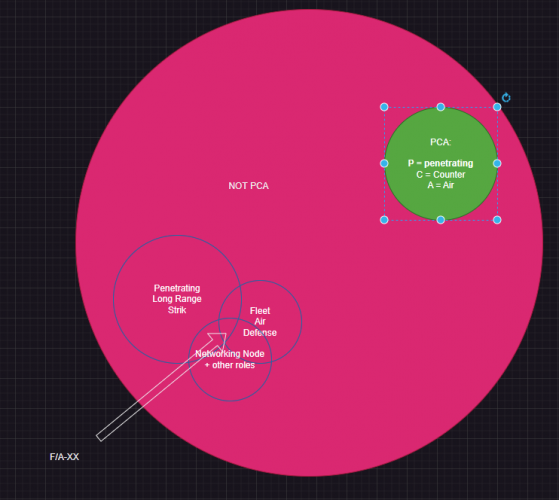
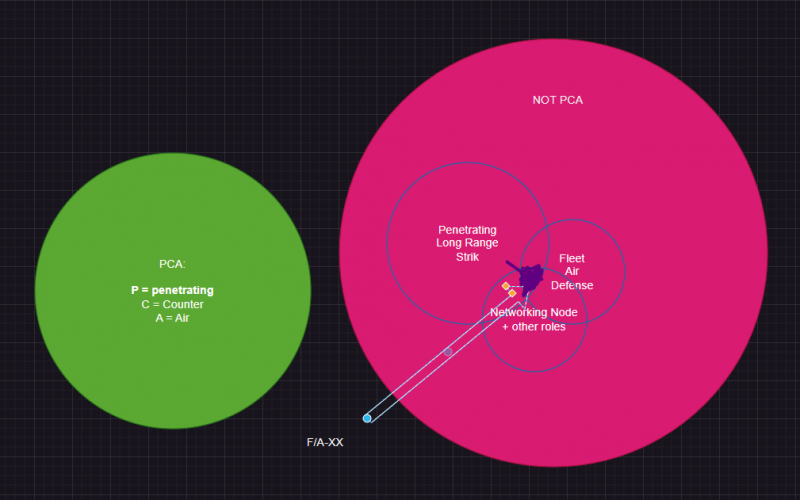
"not PCA" = not Pentrating Counter Air.

"Everything else that is not PCA" != fleet defense fighter.

Would it help if I drew a venn diagram?
image (1).png
Or maybe a logically stupid version?

diagram.png
 
Last edited:
Have standoff munitions stopped existing since I last checked or what ? Cause your aircraft doesn't need to penetrate an enemies air defence network to engage targets within it anymore, that's the point of having long range cruise missiles and the like
Maybe, fair point, ...could actually support probably classifed so don know. why does the AF NGAD stil have a PCA requiremnet. then? Why would PCA even be discussed if there was no requirement? Thes missiles would need to arrive from extreme distances or be carried internally by a mini-carrier borne B-21....
 
Maybe, fair point, ...could actually support probably classifed so don know. why does the AF NGAD stil have a PCA requiremnet. then? Why would PCA even be discussed if there was no requirement? Thes missiles would need to arrive from extreme distances or be carried internally by a mini-carrier borne B-21....
This is partially a valid point, but PCA as a requirement is tangential to this conversation.

PCA exists to send a manned fighter to be the eyes ears and occasionally, the shooter against air targets. Its a requirement for the F-47 because it is the door kicker for the rest of everything that follows behind - be it B21s, strike fighters, hypersonic weapons etc. This requirement is established to secure temporary air superiority or to degrade the enemys aerial formations from within.

The penetrating requirement (a superset of PCA) if you can even call it a requirement doesnt just apply to the F-47. There are numerous other systems meant to do that as well. A penetrating system can sit inside the area denial zone and loiter to provide targeting or actually enegaging high value targets themselves. That can mean ground targets or air targets (which is what PCA does as a subset of penetration type requirments). F/A-XX is not doing PCA but it can still be a penetrating fighter that can sit in pr near enemy networksband attack / acquire ground targets.

Again - PCA = penetrating counter air. Its
to fight stuff in the air. Its got not a whole lot to do with strike. Something that is not PCA fulfilling can still be penetrating.
 
Modern EW requires more like a forward EA-37B w/ large arrays & onboard EWOs.
Lol. Modern stand in EW has been offloaded to CCAs.

And what exactly is the connection between this and a carrier defense fighter again
If you cant do DEAD ur dead...for the millioth time.
lmao.

Strike fighter. Strike fighters do DEAD.
what is all this too much caffine?
No. You cant read.

Actually thats not it. You neither read well, nor write well.
 
This is partially a valid point, but PCA as a requirement is tangential to this conversation.

PCA exists to send a manned fighter to be the eyes ears and occasionally, the shooter against air targets. Its a requirement for the F-47 because it is the door kicker for the rest of everything that follows behind - be it B21s, strike fighters, hypersonic weapons etc.
In order to remain relevant the carrier must have their own Penetrating Counter Air -DEAD/SEAD to insure the survivability of their carrier based craft. SAMs & airfields/interceptors are equal threats. Anyone who understands Joint Ops knows there is no such thing as Joint Ops. The carrier must protect it's own w/ its own assets. If you dont have the high end capability to accomplish PCA for ur long range strikers then you r not successful in deep strikes. The AF really only has B-21 for PCA currently. All others r questonable and there can be no dependance on long rg missiles for prosecution of Critcal Mobile tgts (CMTs) according to Epic Fury results. No DEAD/SEAD & other CMT prosecution then no success.
 
Last edited:
Lol. Modern stand in EW has been offloaded to CCAs.
Until I see the classified and wont soon. That is laughable statement.
And what exactly is the connection between this and a carrier defense fighter again
Magic doesnt just happen from strike fighter. Minus dedicated stores & antennas and manning no real DEAD/SEAD.
FA-XX is essentially an inteceptor..This has become way more than tiring.
.
lmao.

Strike fighter. Strike fighters do DEAD.

No. You cant read.

Actually thats not it. You neither read well, nor write well.
Thank you for insults. You neither read well, nor depict well.
 
Maybe the fundamental carrier strategy is changing because the threat landscape is moving back from asymmetric carrier usage in the GWoT to the peer-conflict expectations of the Cold War—you know, the last time the USN had a optimized fleet defense fighter in the F-14?

Remember how they ran all those simulated wargames around Taiwan and China where the carriers kept getting iced?

Second paragraph of the USN press release: “F/A-XX will dominate contested airspace”

I look at everything around F/A-XX and I see Tomcat II with the belated strike capability package pre-installed.
 
Modern EW requires more like a forward EA-37B w/ large arrays & onboard EWOs.

No, it absolutely does not.

"onboard EWOs" have been replaced with *software*. EW is a problem that software is very well suited for.
Standoff EW is being de-emphasized, with "stand-in" jammers becoming more important. The range equation works to the advantage here. Lots of small, very smart and semi-disposable EW platforms that operate closer to the target rather than larger platforms with "large arrays" and "onboard EWOs".
 
No, it absolutely does not.

"onboard EWOs" have been replaced with *software*. EW is a problem that software is very well suited for.
Standoff EW is being de-emphasized, with "stand-in" jammers becoming more important. The range equation works to the advantage here. Lots of small, very smart and semi-disposable EW platforms that operate closer to the target rather than larger platforms with "large arrays" and "onboard EWOs".
Will just restate even a Google search will explain how proximity matters in the world of digitization so will not mentioned personal profesional experience.

"Small, very smart and semi-disposable EW platforms that operate closer to the target rather than larger platforms with "large arrays" and "onboard EWOs"." are complementory but do not solve for all the magic that is really required.
 
1622805b4aa6884f82677b8d3ea81568.jpg

@jsport I respect that you have your experiences that you rely on more than the words of strangers who may or may not be in the know.

Rest in magic king. Im out. No use wasting time on someone who didnt come here to be convinced. Im glad at least the MIC isnt filled with people like you making decisions. Otherwise we'd be speaking chinese by now.
 
I'm assuming you don't work in the industry because you seem to be missing some fundamental knowledge about how the machining/manufacturing and assembly process works. The whole concept of drill on assembly vs. FSDA is not unique to Boeing.

In legacy programs (pretty much anything developed F-35 and prior) they all used drill on assembly. As the aircraft was being assembled and bolted together, holes would have to be drilled by hand for brackets, components, bulkhead fittings, substructure, etc. None of the companies have CNC jigs to bolt up every single piece of structure and re-machine pieces of structure. That would be way too much money, resources, and time to re-jig every single component and drill all the holes. This is why you have the sub contracted companies do it while its already being CNC'd.
Even now there is a ton of drill on assembly. Applied drill plates, tool-mounted drill plates, powerfeed drills, etc. You can't get robots everywhere. You CNC as much as you can get away with at the part level but if you tried to drill every hole on a CNC and pray they all come together. . .never going to happen. Five parts coming together with a hole tolerance of a couple thousands of an inch on a twenty foot part? Show me this magic.
 
Okay. Ill respond in good faith this time.


DEAD/SEAD against ground targets is already doable with F-35s, CCAs and distributed/ stand in jamming. That capability didnt just go away. F/A-XX is not replacing the F-35 too.
Every thing is doable on some level that carries a store.. That is not the point. Carriers will still need particular DEAD/SEAD ie PCA particular capabilites which Trimble says the USN states the FA-XX will not have.
Penetration for PCA is also a gradient in the sense that you only need to penetrate as far as it takes for weapons release if theres other assets doing the targeting - which there is.
Theatre support requires max range for SEAD, carrier wings can not depend on external assets doing anything.
F-47s, in theater drones (already demonstrated with an F-35 and a quad copter), satellites. Literally examples everywhere.e
As stated anyone who knowsJoint Ops knows there is no such thing when it counts. The USN will need to prepare to be on its own. ie needs PCA
@quellish has talked about distributed jamming at length elsewhere. The navy has as well. They arent even classified. It just takes some careful reading and listening.
Jamming is junior high in the realm of digitization based information warfare
This is.... wild. Tell that to the increasingly integrated networks that are being built for this very purpose. Tell that to the systems of systems warfare thats being developed on both sides of the pond. It isnt 2005 anymore.
If one is smart one sure doesnt live in 2005 anymore. The fear is those talking about jamming are in the 90s. Real IO requires beyond junior jamming jokes. Speed is life,and the speed of digits on RF (and we know what that speed is) matter.
 
Will just restate even a Google search will explain how proximity matters in the world of digitization so will not mentioned personal profesional experience.

"Small, very smart and semi-disposable EW platforms that operate closer to the target rather than larger platforms with "large arrays" and "onboard EWOs"." are complementory but do not solve for all the magic that is really required.

The difference here is that I am stating what the services are actually implementing, not creating fan fiction like most of this thread.

Wishing that a platform is a 21st century Tomcat (but bigger!) or a standoff jammer is useless when the services are clearly not doing those things.
 
Even now there is a ton of drill on assembly. Applied drill plates, tool-mounted drill plates, powerfeed drills, etc. You can't get robots everywhere. You CNC as much as you can get away with at the part level but if you tried to drill every hole on a CNC and pray they all come together. . .never going to happen. Five parts coming together with a hole tolerance of a couple thousands of an inch on a twenty foot part? Show me this magic.
I've seen it happen. I assure you it is possible at the levels of accuracy that is claimed by both Boeing and LM. CNC machinery can get everywhere when its implemented into the machining/producibility guidelines from the start. And that's exactly how its been done on new design programs.

You can still implement FSDA to an extent on legacy programs, as LM is doing with F-35 and Boeing with F-15 EX, but there's just some parts or holes that cannot be FSDA'd since they weren't designed with those parameters in mind from the beginning.

98+% accuracy definitely seems too good to be true, but I'm happy to say it isn't.
 
JASSM is just one such weapon for the F/A-XX and there will be many more to come.

USN does not employ AGM-158 outside of the LRASM model, but there MACE, JDAM-LR, and likely soon others. I cannot imagine the USN would be uninterested in RAACM-ER.
 
Nobody is arguing that this will have a variable sweep wing, be intercepting squadrons of Backfires over the Atlantic, and will being buzzing the carrier's island while "Danzer Zone" is playing so loudly that the guys in the engineering spaces can hear it. But the roles this will have to perform do require a very serious air-to-air capability, likely including being able to use whatever that follow-on to the AIM-174 is.

The Navy isn't the Air Force with their historical aversion to the "A for attack" designator, if this was mostly a ground attack aircraft with the air-to-air component tacked on it would have an "A" or "A/F" designation.

"Strike fighter" is a very open term. This isn't a Tomcat II, but I think you're forgetting that the F-14D could be considered a strike fighter, and there were a few advanced "Strike Tomcat" proposals. Just because this isn't a Tomcat II doesn't mean it won't provide some of the same capabilities to the fleet. After all, a strike fighter that can't fight its way to the target is pretty useless, and the enemy aircraft this could have to face someday are beyond what the F/A-18 and perhaps even the F-35C could regularly defeat.
 
I've seen it happen. I assure you it is possible at the levels of accuracy that is claimed by both Boeing and LM. CNC machinery can get everywhere when its implemented into the machining/producibility guidelines from the start. And that's exactly how its been done on new design programs.
I would be curious what kind of hole size and position tolerances they need to pull off FSDA and how that translates when you have Ti, Al, C in the same stack with multiple part material combinations. Not to mention composite bag-side surfaces on your interfaces moving things around. I'd expect FSDA is limited to particular conditions.
 
If the F-22 had a larger bomb bay, it could do everything except be cheap. The only question would be is if something fatter could have the same kinematic and aerodynamic performance. The gap between an air superiority fighter and a striker is much smaller and more a question of degree than it was when your options were the F-14 and the A-6. It's not impossible that the F/A-XX could come close to a do-everything plane that can reach Mach 2 or supercruise while carrying 4 Mk 84s internally.

As a term, Penetrating Counter Air incorporates all of the actions necessary to attack an enemy IADS at close range and establish air superiority and eventually air dominance. That includes air-to-air capability as well as the ability to attack aircraft, airbases, and air defense sites on the ground. We think of the F-47 as specifically a replacement for the F-22 and the F-22 as specifically an air superiority fighter like the F-15A, but the PCA terminology gives a lot more latitude to incorporate ground attack capability. That being said, the ground attack capability may be offloaded to other platforms like CCAs or standoff missiles and drones.

What similarities and differences would we expect between the F-47 and the F/A-XX now that Boeing has both contracts? Would the different engine selections require different airframes? If the airframes are different, I would presume that, if the F/A-XX is definitively more focused on air-to-ground than the F-47, it would have a larger IWB to carry more weapons and a larger wing to reduce landing speed. Are there other physical differences besides the adaptations for carrier operations like heavier landing gear and a tailhook? Specific shaping of the wingtips, wings, or canards for carrier use? The F-47 and F/A-XX might share radars, sensors, cockpits, and a substantial amount of software. They could also have similar supply chains for smaller parts and subassemblies, which could lower the cost to Boeing and make sustainment easier in the long-term.

Are there thoughts on how many the Navy is going to buy? I've seen numbers as low as 200 and as high as 800, though I don't consider anything over 400 credible. My guess is 250 - 300 airframes, and I hope the Air Force ends up with at least that many F-47s.
 
You will have F/A-XX's flying Combat Air Patrols (CAP) similar to the F-14 in conjunction with the surface vessels and the E-2s for fleet defense along with XX's flying strike missions with the F-35s, I don't think the USN is going to drastically change how they operate the carrier battle group, if in a conflict with China, they have fighters too which would want to attack the CBG. CAP makes sense for defending against CCAs as well.
 
So wait, are you anti-fighters and you want a follow-on to the A-12 because carriers need to deliver theater effects, or are you anti-strike fighters and you want a navalized F-47 because the USN needs to stay relevant?
Blended Wing Bodies or near BWBs have inherent high reynolds numbers, lift to weight ratios & high dynamic maneuver so make good fighters if they r not too large. Bays can carry these large AAMs or even a drones carrying AAMs.
How many Gs humans can withstand is the issue as always.
 
Since there has been so much talk about the Aviation Week podcast but only a video has been posted here, I had it transcribed at my own expense.

Breaking Down Boeing's Big F⧸A-XX Win | Check 6 Podcast

[00:00:06:15] Robert Wall: Welcome to check six for another emergency episode. The long wait for the fax decision is finally over. We have our winner. And the question around Boeing is definitely no longer does the company have a fighter business. It's really. Now, can it pull off all that business that it has? So join me for the conversation about FX and the downs, like and all that. And their first impressions are Pentagon editor Brian Eberstein, senior editor Steve Trimble, and of course, the Oracle. Graham Warwick, our executive editor for technology. I'm Robert Wall, your host for today and Aviation Week's executive editor for Defense and Space. Brian, let's kick it off with you. Why don't we you tell us what we learned from the Pentagon announcement and what we really still don't know about F/A-XX. Yeah.

[00:00:55:15] Brian Eberstein: So as all of us really know, we've been waiting on this moment for quite a while, probably about a year and a half or so since we first started hearing about the Navy wanting to make their downselect and the Navy made their choice a while back. They've been wanting this announcement for a while and moved up the E ring, waiting for the Pentagon's approval. Looks like we finally got that right before the end of the fiscal year. With the announcement of Boeing and Boeing getting its clean sweep of the sixth generation NGAD programs after building starting the F-47. Now they got the F/A-XX fitting out Northrop Grumman. So the announcement kind of. It gives us some new new information, but a lot of things we do not know. The Navy put out the number of 20 billion for this program to start replacing F/A-18 and EA-18 in the 2030s to fly alongside the F-35C, we didn't get any big promises like we did on F-47 of first flight within this administration. It was really, really remarkable how subdued this announcement really was. We had a press release after COB, we didn't have the Oval Office treatment.

[00:01:55:11] Brian Eberstein: We didn't have a full Pentagon press conference like the last few big announcements that we had, but we do have an F, a X, A winner. And as I alluded to, the Navy has been waiting for this for a long time. Uh, about two months ago or so now, a month and a half ago, I was out at the Tailhook convention talking to a lot of naval aviation folks, talking to Admiral Cottle, the CNO, who has been he thought they were going to have that announcement in August. And he, um, could tell some frustration a little bit, a little exasperation that they've been waiting for this down select for so long. It's starting to have impacts on the rest of the enterprise. It's going to have a lot more impacts on keeping FAA teams flying. Um, going to have a lot more pressure on Lockheed's F-35 to deliver better, to perform better for naval aviation. So we do finally have a Downselect. But now I think the hard work is ready to ready to begin.

[00:02:42:27] Robert Wall: Yeah. Uh, I mean, it totally makes sense given how long we've had to wait here. Um, Steve, what do you think from your perspective, what does what does this soundslike mean for the Navy and Naval aviation in particular? You've talked about that a lot in prior podcasts. Now, how do you see it now that we actually have a, uh, a, uh, an answer to who is behind F/A-XX?

[00:03:04:24] Steve Trimble: Yeah. So just to kind of put a finer point on how long we've been waiting, I went back into my Google Drive to try to find this, but, um, the RFI from the Navy for an FAX was published on April 17th, 2012. So this process got started about 14 years ago, 14.5 years ago really, and, uh, has finally come to fruition. That's how long it took just to get to the contract award. You know, now we still have to wait to get into production and all that, but it's a big deal, right? Because we're talking about the remaking of naval aviation and carrier based naval aviation for long range, you know, strike for long range air to air, you know, basically turning that carrier into a long range killing machine, right? The, the knock on carriers for the last couple of decades has been, yeah, it's got a lot of firepower on it, but not very long range. You know, you're limited to those tactical aircraft and just how far they can go. Now, with F/A-XX officially in development, they are looking at acquiring an aircraft to get it on a carrier deck. And if you arm that aircraft, that F/A-XX with something like an AIM four, two, four. Now you've got the ability to hit targets beyond 1000 nautical miles from the carrier without being refueled. Right? Plus, they have MQ 25 to take it even further. It's important because we have some adversaries out there. Great example. Uh, China has got the H6K. When that thing is armed with a DF 21 D, it can get to a launch point within about a 800 nautical miles of a carrier. Launch that missile at the carrier. And they've got a problem. But now they've got a weapon and a platform to get to that H6K before it gets to that launch point for that missile, so that there's a lot more to it than that.

[00:04:57:28] Steve Trimble: But that's a big part of this. And when you combine it with some of the other, um, investments they're making in carrier based and sea based, uh, long range strike that includes the collaborative combat aircraft, which are just now sort of evolving. Uh, and we're seeing the requirements for it, very large aircraft that they've put out specs for that can carry us for £2,500 weapons. You know, think of those as anti-ship missiles, most likely. Uh, and then this other thing that we're still just trying to get our heads around because it's, it's, it's, um, uh, unfolding kind of before our eyes is this Rimes program that they also have. It's the runway independent maritime Expeditionary strike or system. Uh, r I'm e s uh, that looks like it's heading towards the shield ai x bat. And so you could have a carrier based or even destroyer based or expeditionary sea base based, um, expat that could take off vertically. It could go a thousand nautical miles, drop a couple of munitions, come back and land vertically on a ship. Now you've got long range strike in several different ways. Uh, you turn the Navy back into this long range killing threat that they haven't been for quite a while. So, uh, now, you know, got to execute on all these things, right? You know, this is not a guarantee that this is all going to happen now. But now you can kind of see, get your hand, your head around where they're going and how they're transforming that carrier and making it relevant again, especially in this specific environment where the distances are so vast and the threats are becoming more sophisticated and, uh, lethal.

[00:06:39:29] Robert Wall: Yeah, great. I mean, and, and kind of playing on that, uh, Boeing released a new rendering of FAX on a carrier in, uh, well, it looks like steam. Maybe if, uh, to to appease the white House. There's some steam there. Or maybe it's just. They'll just change it to fog if there's a new administration. But anyway, uh, it is shrouding the aircraft. It is, uh, it looks, you know, like a beast. It looks huge. And with the caveat, of course, we have no idea how accurate it is to what Boeing is actually looking to build. I throw it over maybe to to Graham, your first impressions of what you saw, what you thought was, was particularly, uh, interesting. Noteworthy.

[00:07:23:28] Graham Warwick: Yeah. So, so it kind of looks like we expected it to look like it's, it's big. Um, it's tailless. Um, it's stealthy. Um, you know, you, we've seen previous, uh, artist's impressions showing a sort of a, um, tailless kind of modified delta shape and this kind of fits that you can't tell really. You can see the flaps are deployed on this one because it's being set up for takeoff, but you can't really tell whether or not there's a Lambda wing shape in there, which is kind of the bowing thing or not. But, but the but the flaps start quite a way out from the center of the aircraft. So there may be some sort of a W shape at the back there. It's got big heavy landing gear, very similar looking landing gear to the F-35c. Uh, just bigger, uh, very broad flat fuselage underneath. You can actually sort of see the inlets. The steam doesn't totally, um, obscure the inlets, which on the, uh, on the Boeing on the F-47. It's been very hard to work out what's going on on the inlets, but you can see the inlets tucked in under the wing leading edge up against the fuselage. They're pretty big. Uh, they're sort of angled at the outside to the, to the, to the, to the fuselage side. It looks to me when I first looked at it, it looked like it's kind of like a channel there, like the there was on the a 12 I don't know, it might make sense.

[00:08:47:09] Graham Warwick: The year 12 was General Dynamics and McDonnell Douglas. So maybe there's some history there. Um, the, uh, the thing that struck me, of course, first and foremost is it's not an F30F47. It's not a maritime derivative of the f 47. There's no canards. Even that very broad duckbill that we see on the F 47 doesn't appear to be as, as, uh, emphasized here. There is obviously some sort of a duckbill, but it doesn't look anywhere near as broad as it does on the F 47. And that might be from, um, uh, you know, carrier approach, uh, visibility requirements, although, you know, this thing is probably going to be highly automated when it comes to carrier operations, but I suspect that the canard and the duckbill are kind of not there because of the carrier landing thing, single seat in this, uh, in the impression that we've got, obviously it's replacing the two seat, um, F and growler as well. But of course, by the time this thing enters service, they may have convinced themselves that AI agents can do what the electronic warfare officer can do in the growler today, and the electronic warfare officer and Growler can do what two of them did in in the prowler before that. So you expect some progress there. So so yeah, so, so kind of what we expected, but it is a big looking beast.

[00:10:00:10] Robert Wall: Steve, what do you think anything struck you?

[00:10:02:18] Steve Trimble: Well, there's, uh, some some additional metadata, I guess we have, uh, about the aircraft, I think is interesting. Probably the biggest being that GE released a statement, uh, you know, uh, not saying that we won, uh, the, the propulsion system for this, but just saying, hey, congrats to the Navy. Congrats to Boeing. That's great. Um, weirdly, we've gotten into this, um, you know, the setup where, uh, that's how they're, that's how they're announcing the engine supplier, uh, for, for, uh, for F-47 and for F/A-XX. It seems Pratt Whitney has not released a statement in either of those programs. Um, so it does appear that, um, sorry, that GE is the engine supplier. And we know that the Navy has told us a couple of years ago that the plan was to select a commercial or sorry, a derivative of an existing engine, a existing military engine, not going with the adaptive propulsion systems that are still in development. Uh, that leads you if it's GE to a F414 or F110, uh, you know, we were talking about this yesterday, but I think it's got to be an F110, something of that size. Super Hornet was already a bit underpowered with F414 at least in my opinion. But you know, um, now I think they have to move to an F110. Uh, you know, or, you know, I can't imagine anything else that GE has off the shelf that they can offer. Um, we do believe that there's an F110 derivative, uh, on the F-47.

[00:11:34:08] Steve Trimble: So maybe there's some commonality there. I'm interested in finding out more about how much, um, uh, other things, how many other things are shared? Uh, you know, with the F-47, uh, for example, radar and other mission systems like the electronic warfare system, especially this one, it's going to be really interesting to see how that, you know, where that, um, uh, you know, how that sizes up for this. Uh, so the radar Boeing, you know, has always gone with Raytheon radars, you know, and all their fighters for some reason, it just works out there. They're going with radar with Raytheon. That doesn't mean that has to continue in this case. Right. But you know that that is, uh, what we've seen in the past, uh, the electronic warfare system, especially for the defensive type systems, you know, that has gone all to buy in recent years, you know, with the F-15ex, with the F-35, with the F-22, and potentially with the B-21. Right? Be is one of the seven named subsystem suppliers to Northrop on the B-21. And the kind of thing that you'd think be would offer most there is e w so there's, uh, you know, so, but, but we don't know that and we're going to going to find that out. But mainly it's important to remember the whole idea between the F-47 and the F/A-XX. And the acquisition strategy was to, um, keep this really open architecture to a level we've never seen before.

[00:12:57:28] Steve Trimble: That gives the government the rights and the, the ability to take the program away, even the airframe and the systems integration from Boeing, if they don't perform and give it to somebody else or, you know, get a second supplier for final assembly or something like that. Now, I don't know if we'll actually see that play out in in reality that it seems very complicated to me. We've never seen anything like that happen before, although, I mean, you could in a way you could argue that happened with the Hornet. You know, I mean, Northrop won the Hornet. That was their design, uh, with the original F/A-18. Uh, and, uh, because of the Navy's, uh, lack of comfort with Northrop and a carrier based aircraft. They gave the systems integration to McDonnell Douglas back in the mid 70s, with the idea that Northrop could still market the Hornet, uh, you know, internationally as their own fighter. And then somehow that didn't happen. So, so McDonnell Douglas got got to keep the Hornet, even though they never even designed it. Um, you know, but so the second time actually is kind of interesting that, uh, Boeing and McDonnell Douglas previously has blocked Northrop from winning a carrier based fighter, which is kind of interesting. Um, but, uh, but that open architecture is, is really important to think of when we think about the future of this program and how it's how it's organized. So, uh, yeah, but those are the things I'm, I'm looking at it.

[00:14:24:13] Robert Wall: Yeah. Just since you mentioned Northrop, maybe back to Brian. Uh, so I mean, the loser, obviously Northrop in this competition, um, what do you think? What what do they say? Do we think they're leaving themselves open the window for protesting?

[00:14:41:26] Brian Eberstein: They did put out a statement pretty quickly. Um, kind of not necessarily committing or not committing to a protest, but saying that they look forward to receiving additional information about the Navy's selection, saying that they did offer a highly survivable, digitally advanced sixth generation fighter for the competition. Um, so for the company, bottom line, that sort of thing, I'll leave a lot to the analysts, but I, I think there are a couple of things to remember here. Um, we are, have been awaiting really all year, um, where the Air force is going to go on a big B-21 production increase. So I think that's going to be, I don't know if we'll shed a lot of tears for a lot of their aero bottom line. When that does come out we're looking I mean possibly doubling that program. That's going to be a lot more money coming their way. I will be curious. It'll be curious to see what happens to their Melbourne, Florida site. Um, ahead of this announcement they announced. They explained how they were doing a pretty big production space increase. Uh, they had the fun name of project Daisy for that to give some more engineering space. For advanced advanced aircraft design. Once the E-2 line down there does run out, which we are seeing in the next couple of years. So it'll be interesting to see where the company does pivot. I mean, as I mentioned, there's a lot of B-21 work there going pretty, uh, pretty hard on Ka with Talon Blue. They should be flying that right about now. I think we've been waiting for that flight. First flight right about now. Um, there are a lot of opportunities down the road, but, um, the company was really quite helpful on this.

[00:16:02:16] Steve Trimble: Well, I just to add to that, they do have that teaming relationship with, um, jet zero, uh, for a future tanker or Airlifter. Um, maybe that rises up the priority for them. Um, you know, you know, after if since they don't have F/A-XX, you know, in terms of future growth opportunities, maybe that becomes more important.

[00:16:26:18] Robert Wall: Just want to also talk briefly what this means for Boeing. Now obviously, uh, kind of it was interesting a few minutes before they, uh, they um, you know, announced FAX and you spotted this in the contract. Steve uh, there's money. There was money in the Pentagon contracts to start planning the shutdown for the, uh, the Super Hornet line and the growler line. So that was kind of funny. Um, then again, the Air Force was, is buying more F-15s. Uh, so, you know, it's a bit lots coming in a bit going out, but, um.

[00:17:00:04] Steve Trimble: Well, no, I was going to say, I mean, one of the big issues, uh, coming into this, uh, competition and really in the extension of this process of just making the decision and then announcing it were these concerns about the capacity of the industrial base. Um, you know, and given that Boeing was working on F-15ex and then had F-47, uh, not to mention MQ-25 and T-7 and KC-46 and B-52, uh, modernization, all a lot of these things that they're actually struggling with, uh, to keep on schedule and certainly under their own costs, especially for those fixed price programs. Um, you know, so there, there were concerns about that from the Navy. Uh, it may be specifically focused on the, on the prospect that Boeing was going to win even a year and a half ago. Um, uh, and then, uh, on top of that, um, we had, uh, general Dale white, uh, with the Air Force, uh, really kind of spreading the message at APhA, uh, both privately and publicly, uh, you know, to people that he, he doesn't want anybody, uh, to distract Boeing from delivering his airplane, the F-47, uh, which seemed to be kind of a message to the Navy like, hey, you know, don't put another thing on Boeing's plate. You know, just as I'm trying to get them to get give me my airplane.

[00:18:17:21] Robert Wall: That's what tipped in Boeing's favor. The Air Force told the Navy, don't take Boeing's. So of course they had to.

[00:18:23:16] Steve Trimble: Well, I did wonder at the time, like you could read that two ways. As you know, Dale white basically shutting the door on the idea of Boeing winning and making sure that Northrop wins, or Dale white being so concerned that Boeing was going to win this thing, that he took the unusual step of basically inserting himself into a decision making process for another services aircraft, even though he didn't do that explicitly. But I mean, to me, the message wasn't that, uh, you know, unclear, I guess.

[00:18:52:01] Robert Wall: I mean, uh, you know, Brian also, I mean, it was striking really how, how Boeing in its statement about winning, really focused on that issue, right? It wasn't just, it was repeatedly, but, um, I find striking.

[00:19:07:21] Brian Eberstein: It's I mean, we've talked to Steve Parker for the past year and a half. He said the same thing every single time. We built both of our offers to execute at the same time. The company really got ahead with a lot of capital investment, building up its Saint Louis plant to get ready for this sort of work. I mean, but now they have to execute. I mean, that's kind of been the line for Boeing for the past several years, and they really need to execute.

[00:19:31:14] Steve Trimble: My sense going into this program, both for F-47 and for F/A-XX, is that Boeing wanted this so much more, uh, than the other companies. And they were willing, even at a point where they were, uh, kind of falling apart as a business on the commercial side. I mean, just really struggling with 737MAX and seven, eight, 7777 X. Um, you know, those programs are kind of floundering, I think is a fair term for what was going on at that time. Um, and then their, their defense programs were just a mess. They were just in shambles. They've lost billions of dollars on all of them. Um, and, and yet even as that was happening, they were committing enormous resources internally, uh, to work on this next generation of air dominance aircraft to kind of, you know, take the place of the F-15 and the F/A-18 and, you know, so we, they got the initial prototype for the F 47. They flew that, um, as early as September of 2021. Um, we don't know if they got a prototype for the Navy, even though there was money allegedly for both Air Force and Navy prototypes in the Aerospace Innovation Initiative that was passed in 2016 and got started. And that's what led to the F-47 prototype. Um, but, um, that is one really interesting element of all this is that they've had five years to fly a six generation prototype, um, which, you know, is a rare and unexpected luxury in this business. Usually you get just one year with a prototype before they want to move on to MD. Thankfully, because of the series of delays to both F/A-XX, and F-47, both of which were delayed but F/A-XX even more.

[00:21:16:27] Steve Trimble: It was supposed to come before the F-47, right? They got started in 2012. Air force didn't get started in F-47. What became F-47 for a few years later. So, you know, this was a, uh, you know, this was a huge commitment. We already know that they have this, uh, development going on in Saint Louis where they're building, uh, out phase one, uh, of their new assembly line. Uh, to support the F-47. They had, uh, documents because you can look them up in the Saint Louis. They were trying to get some tax breaks from the city of Saint Louis. And so they've released all this information about their plans for phase two. Um, you know, which adds another assembly line. I always assume that would be for FAX. If they want it now, they can, uh, you know, push forward on that as well, as well as their advanced composites facility in Mesa, Arizona, which was also stood up to support these programs. So, you know, that is a, that's a, that's a really interesting part of that. I hope one day we get the full story of what happened in this competition. Um, you know, I think this was the turnaround for Boeing here is, is extraordinary. I mean, just from being where they were five, six years ago to now. Uh, you know, you know, you could not have anticipated that, uh, they still have to execute on these programs. Um, but to, to go, to go from, from there to here is, is extraordinary.

[00:22:42:08] Robert Wall: Well, and on that point, I do want to kind of circle back to, uh, Graham mentioned the, A-12, uh, obviously, and, uh, you know, an epic problem for McDonnell Douglas and, uh, clearly, uh, really, to some extent, I think started a decline really for, for the McDonnell Douglas on the fighters side. I mean, they got Super Hornet, right? But then at first they lost on, on JSF or Jast. Anyway, um, my point is I'd like each of you to kind of reflect on what, given where we are now, what do you see as some of the programmatic risks going forward? So either from an aircraft perspective, programmatic perspective, wherever you think. What are some of the things you'll be watching for? To make sure to see, give you any indication whether this program is being executed or, frankly, the two programs are being executed as Boeing says they can. And where you see the biggest risks. So, Graham, why don't we kick it off with you?

[00:23:41:07] Graham Warwick: I'm a I'm a little surprised. Uh, you know, I thought we've just had two decades of learning not to put all your eggs in one basket and all of the lessons we've learned on F-35. So they've just put their eggs in two different sides of the basket and, and hope that they won't rub against each other and break each other. Um, you have to hope that, um, that there is enough commonality between the programs to, to benefit the end customer in terms of, of getting things done, solving problems, fixing them once and then not having, not having to fix them again, uh, that there's enough, um, stagger between the programs so that the experts on one can move over onto the other so that we don't have issues that we had on F-35 with just lack of resources because they just couldn't get everything done at the same time. Um, but I also, I feel sorry for Boeing. I'm not sure whether I feel sorry for Boeing, the company, Boeing, the, the engineers at Boeing, the PR people, because the way that we run defense programs now, the way the visibility we have into, into aircraft defense programs, the fact that aircraft programs never go the way they're supposed to go. I think that Boeing's in for a very difficult ten, 15 years ahead of it as it tries to get these these aircraft going. We have just got to hope we've learned some lessons from the last ten, 15, 20 years.

[00:25:04:12] Brian Eberstein: Well, I, I think my concern is just to see the commitment within the building and within the white House to the Navy, uh, progressing on this. I mean, it is I mentioned it before, but it is really striking to see the difference between the F-47 announcement and F/A-XX. I mean, you had President Trump I'm just announcing himself and throwing so much of his weight behind the program, whereas the Navy really had to drag OSD to to this announcement. I mean, it was trickled out in a press release two days before the end of the fiscal year, when the funding was set to run out, Congress had to prod and prod and prod the Pentagon to get to this point. So I'm I want to see when the next budget comes around, if we'll see this commitment long term in the palm for where the department wants to go, or if there will be kind of continued underfunding, as they've tried to do in the past three years.

[00:25:49:15] Steve Trimble: That's exactly it. I mean, the the resources for this program have not been delivered by the administration or the previous administration. Really, for the last several years, it's been basically Congress stepping in and interceding on the Navy's behalf, because the military wing of the Navy said said that we have to have this. Um, you know, they're going to have to, you know, resource this thing now. And so we're going to see if that actually, you know, um, takes place. There's a lot of other pressure, a lot of other priorities. Um, we talk about all those autonomous systems, you know, between rhymes and commas and, uh, a lot of these other concepts out there. And this kind of runs against the grain of all those. Um, so, you know, uh, but, but the, the potential here is, is extraordinary. I mean, I do think the numbers and the, the actual units that would be delivered, uh, you know, for F/A-XX, if you know, it goes as planned are going to dwarf that of F-47, you know, um, you got to fill the decks on those ten, 11 carriers, however many, they actually end up with the time. And, um, that's a big part of it, but also, um, the opportunity for export on F/A-XX, I think is way higher, uh, because it's going to probably be a cheaper aircraft and more exportable in a lot of different ways. It doesn't have the penetrating counter-air mission of the F-47. It's got an anti anti surface uh anti uh air. Uh, you know it's a long range strike and fleet defense fighter. So you know um it's got a different role and I think it's more suited to a lot of what international militaries are looking for.

[00:27:34:06] Robert Wall: Well I think we'll leave it there. Uh, thanks all three of you for, uh, for that. I'm so glad we finally have a, uh, no longer asking. I don't have to ask you every day. When are we getting this announcement? We we have white smoke, quite literally, if you look at the renderings. So, uh, so that's great. Um. Thanks, Steve. Thanks, Graham. Thanks, Brian. Uh. Thanks, guy. Our producer for this. And as always, thanks to our audience for checking out check six. And maybe we'll get a go a week without an emergency podcast. But anyway, we'll be back pretty soon in your feed. Thanks very much.


ProTip: Time spent listening to podcasts is time better spent doing "research".
 
There are currently 9 CVWs. If these ratios are correct (or applicable in this specific case):

18 VFAs: 216 (if 12 aircraft per deployed squadron)
2 FRSs: 54 (25% of VFAs)
VXs: 11 (add 5% of VFAs)
Depot: 28 (10% of total fleet)
Total: 309

That number would be premised on having 9 CVWs for 11 CVNs. If the number falls to 8 CVWs for 10 CVNs in the 2030s (due to BBGN construction, for example), that would require 275 airframes.

Im going to expect the F-47 to fly faster, to shoot missiles further, to have superb air to air command and control performance as well as targeting. Im also going to expect it to have enough air to ground functionality to use standoff missiles like AARGM-ER.

Conversely, I expect F/A-XX to be highly capable in hauling around strike sized munitions and hitting ground targets but I also expect it to have a sensor suite that can be the command and control node for CCAs in against aerial targets too while shooting missiles on its own. But hittig ground targets is what it will excel at.
Maybe it's the Navy's focus on extreme range AAMs - the AIM-174B and now the AIM-424 - that is creating the impression that the Navy is focused on an interceptor concept. Until they show up with the LREW and demonstrate that it isn't just going to be an F-15EX weapon, the Air Force's longest range missile is the AIM-260, which is clearly in the AMRAAM class and not the Phoenix class. Like the F-111B, a long-range striker could also be a good FAD platform even if it lacks air superiority performance.

The Navy is also way behind the Air Force on CCAs and the RFI they just put out is for something that can carry 10,000 lbs of external ordnance, which is like carrying 2 Anduril CCAs as baggage. Something that size would probably be around the A-4 or Gripen in size (the C13s may not be able to shoot anything under 10,000 lbs or so), but the cost limit of $30 million implies (at least to me) a subsonic rather than supersonic platform and therefore a focus on strike more than air-to-air. Considering the air-to-air capabilities of the Super Hornet and F-35C, it looks like the F/A-XX could be the Navy's only option for a significant level of air superiority focus within the CVWs, though it still sounds like there would be more focus on strike capability than the F-47.
 
Last edited:
Since there has been so much talk about the Aviation Week podcast but only a video has been posted here, I had it transcribed at my own expense.
I'm not sure what transcription service you're paying for, but you can usually get a transcript from youtube and run it through your favorite AI to clean up and remove the filler words.

Robert Wall: Welcome to Check 6 for another emergency episode. The long wait for the F/A-XX decision is finally over. We have our winner, and the question around Boeing is definitely no longer whether the company has a fighter business. It's really now whether it can pull off all the business that it has. So join me for a conversation about F/A-XX, the downside, and all that. Giving their first impressions are Pentagon editor Brian Everstine, senior defense editor Steve Trimble, and of course Graham Warwick, our executive editor for technology. I'm Robert Wall, your host for today and Aviation Week's executive editor for Defense and Space. Brian, let's kick it off with you. What did we learn from the Pentagon announcement, and what do we still not know about F/A-XX?

Brian Everstine: As all of us know, we've been waiting on this moment for quite a while, probably about a year and a half since we first started hearing about the Navy wanting to make its down-select. The Navy made its choice a while back and has been wanting this announcement for a long time. It moved up to the E-Ring, waiting for the Pentagon's approval. It looks like we finally got that right before the end of the fiscal year, with the announcement of Boeing. Boeing now gets a clean sweep of the sixth-generation NGAD programs: after building the F-47, it now has the F/A-XX, beating out Northrop Grumman.

The announcement gives us some new information, but there's a lot we still don't know. The Navy put out a number of $20 billion for this program, to start replacing F/A-18s and EA-18s in the 2030s and fly alongside the F-35C. We didn't get any big promises like we did on the F-47, such as a first flight within this administration. It was really remarkable how subdued this announcement was. We had a press release after close of business. We didn't have the Oval Office treatment, and we didn't have a full Pentagon press conference like the last few big announcements. But we do have an F/A-XX winner.

As I alluded to, the Navy has been waiting for this a long time. About a month and a half ago, I was at the Tailhook convention talking to a lot of naval aviation folks, including Admiral Caudle, the CNO. He thought they were going to have the announcement in August, and I could tell he felt some frustration and exasperation at waiting so long for this down-select. It's starting to have impacts on the rest of the enterprise. It's going to mean a lot more effort keeping F/A-18s flying, and a lot more pressure on Lockheed's F-35 to perform better for naval aviation. So we finally have a down-select, but now I think the hard work is ready to begin.

Robert Wall: That totally makes sense given how long we've had to wait. Steve, what does this down-select mean for the Navy and naval aviation in particular? You've talked about that a lot in prior podcasts. How do you see it now that we actually have an answer?

Steve Trimble: To put a finer point on how long we've been waiting, I went back into my Google Drive to find this: the Navy's RFI for an F/A-XX was published on April 17th, 2012. So this process started about 14 and a half years ago, and that's how long it took just to get to the contract award. We still have to wait to get into production. But it's a big deal, because we're talking about the remaking of carrier-based naval aviation for long-range strike and long-range air-to-air. Basically it turns the carrier into a long-range killing machine. The knock on carriers for the last couple of decades has been that they have a lot of firepower but not very long range. You're limited to those tactical aircraft and how far they can go.

Now, with F/A-XX officially in development, they are acquiring an aircraft to put on a carrier deck. If you arm it with something like an AIM-424, you've got the ability to hit targets beyond 1,000 nautical miles from the carrier without being refueled, and they have MQ-25s to take it even further. That's important because we have some adversaries out there. China, for example, has the H-6K. When it's armed with a DF-21D, it can get to a launch point within about 800 nautical miles of a carrier, launch that missile at the carrier, and the carrier has a problem. But now the Navy has a weapon and a platform to get to that H-6K before it reaches the launch point.

There's a lot more to it than that, but that's a big part of it. And when you combine it with the other investments they're making in carrier-based and sea-based long-range strike, that includes the collaborative combat aircraft, which are just now evolving and whose requirements we're starting to see. They've put out specs for a very large aircraft that can carry four 2,500-pound weapons, which you can think of as anti-ship missiles most likely. And then there's another program we're still trying to get our heads around because it's unfolding before our eyes: RIME, the Runway-Independent Maritime Expeditionary striker system. It looks like it's heading toward the Shield AI X-BAT. So you could have a carrier-based, destroyer-based, or expeditionary sea-base-based X-BAT that takes off vertically, goes a thousand nautical miles, drops a couple of munitions, and comes back and lands vertically on a ship. Now you've got long-range strike in several different ways, and you turn the Navy back into the long-range killing threat it hasn't been for quite a while.

They have to execute on all of these things, and it's not guaranteed any of this will happen. But now you can get your head around where they're going and how they're transforming the carrier and making it relevant again, especially in the Pacific, where the distances are so vast and the threats are becoming more sophisticated and lethal.

Robert Wall: Great. Playing on that, Boeing released a new rendering of F/A-XX on a carrier, in steam, maybe to appease the White House. Or maybe they'll just change it to fog if there's a new administration. Anyway, it shrouds the aircraft, and it looks like a beast. It looks huge. The caveat, of course, is that we have no idea how accurate it is to what Boeing is actually looking to build. Graham, what were your first impressions? What did you find particularly interesting or noteworthy?

Graham Warwick: It looks like we expected it to look. It's big, it's tailless, and it's stealthy. We've seen previous impressions showing a tailless, modified delta shape, and this fits that. You can see the flaps are deployed on this one because it's being set up for takeoff. You can't really tell whether there's a lambda wing shape in there, which is kind of the Boeing thing, but the flaps start quite a way out from the center of the aircraft, so there may be some sort of W shape at the back. It has big, heavy landing gear, very similar to the F-35C's but bigger, and a very broad, flat fuselage underneath.

You can actually see the inlets. The steam doesn't totally obscure them, whereas on the F-47 it's been very hard to work out what's going on with the inlets. You can see the inlets tucked in under the wing leading edge, up against the fuselage. They're pretty big, and they're angled on the outside toward the fuselage side. When I first looked at it, it looked like there was a channel there, like there was on the A-12. The A-12 was General Dynamics and McDonnell Douglas, so maybe there's some history there.

What struck me first and foremost is that it's not an F-47. It's not a maritime derivative of the F-47. There are no canards. Even the very broad duckbill we see on the F-47 doesn't appear to be as emphasized here. There is obviously some sort of duckbill, but it doesn't look anywhere near as broad. That might be because of carrier approach visibility requirements, although this thing is probably going to be highly automated for carrier operations. I suspect the canard and the duckbill are not there because of the carrier landing.

It's a single seat in the impression we've got. Obviously it's replacing the two-seat F/A-18F and the Growler as well. But by the time this thing enters service, they may have convinced themselves that AI agents can do what the electronic warfare officer can do in the Growler today, just as the Growler's EWO can do what two of them did in the Prowler before that. So you'd expect some progress there. It's kind of what we expected, but it's a big-looking beast.

Robert Wall: Steve, what do you think? Did anything strike you?

Steve Trimble: There's some additional metadata about the aircraft that I find interesting. Probably the biggest is that GE released a statement, not saying that it won the propulsion system for this, but just saying, "Congrats to the Navy, congrats to Boeing, that's great." Weirdly, we've gotten into a setup where that's how they're announcing the engine supplier for the F-47 and for F/A-XX. It seems Pratt & Whitney has not released a statement on either program. So it does appear that GE is the engine supplier. And the Navy told us a couple of years ago that the plan was to select a derivative of an existing military engine, not the adaptive propulsion systems that are still in development. If it's GE, that leads you to the F414 or the F110. We were talking about this yesterday, and I think it has to be an F110, something of that size. The Super Hornet was already a bit underpowered with the F414, at least in my opinion. I can't imagine anything else GE has off the shelf that it can offer. We do believe there's an F110 derivative on the F-47, so maybe there's some commonality there.

I'm interested in finding out how many other things are shared with the F-47, for example radar and other mission systems like the electronic warfare system. It's going to be really interesting to see how that sizes up for this one. Boeing has always gone with Raytheon radars on all its fighters; for some reason it just works out that way. That doesn't mean it has to continue in this case, but it's what we've seen in the past. On electronic warfare, especially the defensive systems, that has all gone to BAE in recent years, on the F-15EX, the F-35, the F-22, and potentially the B-21. BAE is one of the seven named subsystem suppliers to Northrop on the B-21, and EW is the kind of thing you'd think BAE would offer most. But we don't know that, and we're going to find out.

Mainly it's important to remember that the whole idea behind the F-47 and the F/A-XX acquisition strategy was to keep an open architecture to a level we've never seen before. That gives the government the rights and the ability to take the program away from Boeing, even the airframe and the systems integration, if it doesn't perform, and give it to somebody else, or get a second supplier for final assembly or something like that. I don't know if we'll actually see that play out in reality. It seems very complicated to me, and we've never seen anything like it. Although in a way you could argue it happened with the Hornet. Northrop won the Hornet competition with its design for the original F/A-18. Then, because of the Navy's lack of comfort with Northrop on a carrier-based aircraft, it gave the systems integration to McDonnell Douglas in the mid-70s, with the idea that Northrop could still market the Hornet internationally as its own fighter, and then somehow that didn't happen. So McDonnell Douglas got to keep the Hornet even though it never designed it. This second time is kind of interesting, because Boeing, which absorbed McDonnell Douglas, has again blocked Northrop from winning the carrier-based fighter. But that open architecture is really important to think about for the future of this program and how it's organized. Those are the things I'm looking at.

Robert Wall: Since you mentioned Northrop, let's go back to Brian. Northrop is obviously the loser in this competition. Do we think they're leaving the window open for a protest? They put out a statement pretty quickly, not committing or non-committing to a protest, but saying they look forward to receiving additional information about the Navy's selection and that they offered a highly survivable, digitally advanced sixth-generation fighter.

Brian Everstine: For the company's bottom line, I'll leave a lot of that to the analysts, but there are a couple of things to remember here. We've been awaiting all year where the Air Force is going to go on a big B-21 production increase. I don't know that we'll shed a lot of tears for their aero bottom line. When that does come out, we're looking at possibly doubling that program, which is a lot more money coming their way. I'll be curious to see what happens to their Melbourne, Florida site. Ahead of this announcement, they explained a pretty big production space increase, under the fun name Project Daisy, to give more engineering space for advanced aircraft design once the E-2 line down there runs out, which we're going to see in the next couple of years. So it'll be interesting to see where the company pivots. As I mentioned, there's going to be a lot of B-21 work. They're also going pretty hard on CCA with Talon Blue. They should be flying that right about now; I think we've been waiting for that first flight. There are a lot of opportunities down the road, but the company was really quite hopeful on this one.

Robert Wall: I'd add that they have that teaming relationship with Jet Zero for a future tanker or airlifter. Maybe that rises up the priority list for them, since they don't have F/A-XX in terms of future growth opportunities. I also want to talk briefly about what this means for Boeing. It was interesting that a few minutes before they announced F/A-XX, you spotted something in the Pentagon contract announcements: there was money to start planning the shutdown of the Super Hornet line and the Growler line. That was kind of funny. Then again, the Air Force is buying more F-15s, so it's a bit of lots coming in and a bit going out.

Steve Trimble: One of the big issues coming into this competition, and really in the extension of this process of making the decision and announcing it, was concern about the capacity of the industrial base. Boeing was working on the F-15EX and then had the F-47, not to mention MQ-25, T-7, KC-46, and B-52 modernization. A lot of these are things it's actually struggling to keep on schedule and certainly under its own costs, especially the fixed-price programs. So the Navy had concerns about that, maybe specifically about the prospect that Boeing was going to win, even a year and a half ago. On top of that, Dale White of the Air Force was spreading the message at AFA, both privately and publicly, that he doesn't want anybody distracting Boeing from delivering his airplane, the F-47. That seemed to be a message to the Navy: don't put another thing on Boeing's plate just as I'm trying to get them to give me my airplane.

Robert Wall: So that's what tipped it in Boeing's favor. The Air Force told the Navy, "Don't pick Boeing," so of course they had to.

Steve Trimble: I did wonder at the time. You could read it two ways: Dale White basically shutting the door on the idea of Boeing winning and making sure Northrop wins, or Dale White being so concerned that Boeing was going to win that he took the unusual step of inserting himself into the decision-making process for another service's aircraft, even though he didn't do that explicitly. To me the message wasn't unclear.

Robert Wall: It was striking how Boeing, in its statement about winning, focused on that issue repeatedly. Brian?

Brian Everstine: It is striking. If you've talked to Steve Parker for the past year and a half, he's said the same thing every single time: we built both of our offers to execute at the same time. The company really got ahead with a lot of capital investment, building up the St. Louis plant to get ready for this sort of work. But now they have to execute. That's been the line for Boeing for the past several years.

Steve Trimble: (speaker uncertain; this may be a continuation of Brian) My sense going into this program, both for the F-47 and F/A-XX, is that Boeing wanted this so much more than the other companies. They were willing to commit to it even at a point where they were falling apart as a business on the commercial side. They were really struggling with the 737 MAX and 777X, and those programs were floundering, I think that's a fair term for what was going on at the time. Their defense programs were a mess, in shambles. They've lost billions of dollars on all of them. And yet even as that was happening, they were committing enormous resources internally to work on this next generation of air dominance aircraft to take the place of the F-15 and the F/A-18. They got the initial prototype for the F-47 and flew it as early as September of 2021. We don't know whether they got a prototype for the Navy, even though there was allegedly money for both Air Force and Navy prototypes in the Aerospace Innovation Initiative, which was passed in 2016 and got started. That's what led to the F-47 prototype.

One really interesting element of all this is that they've had five years to fly a sixth-generation prototype, which is a rare and unexpected luxury in this business. Usually you get just one year with a prototype before they want to move on to EMD. Thankfully, because of the series of delays to both F/A-XX and the F-47, with F/A-XX delayed even more, they've had that time. F/A-XX was supposed to come before the F-47, right? It got started in 2012, and the Air Force didn't get started on what became the F-47 until a few years later. So this was a huge commitment. We already know they have a development going on in St. Louis where they're building out phase one of their new assembly line to support the F-47. They were trying to get some tax breaks from the city of St. Louis, so they've released a lot of information about their plans for a phase two, which adds another assembly line. I always assumed that would be for F/A-XX if they won it. Now they can push forward on that, as well as their advanced composites facility in Mesa, Arizona, which was also stood up to support these programs.

I hope one day we get the full story of what happened in this competition. I think the turnaround for Boeing here is extraordinary. From where they were five or six years ago to now, you could not have anticipated it. They still have to execute on these programs, but to go from there to here is extraordinary.

Robert Wall: On that point, I want to circle back to something Graham mentioned, the A-12, obviously an epic problem for McDonnell Douglas and General Dynamics. I think to some extent it started a decline for McDonnell Douglas on the fighter side. They got the Super Hornet, right? But first they lost on JSF, or JAST. Anyway, my point is, given where we are now, I'd like each of you to reflect on what you see as the programmatic risks going forward, either from an aircraft perspective or a programmatic one. What will you be watching for as an indication of whether these two programs are being executed as Boeing says they can be, and where do you see the biggest risks? Graham, why don't we kick it off with you?

Graham Warwick: I'm a little surprised. I thought we'd just had two decades of learning not to put all your eggs in one basket, with all the lessons we learned on the F-35. So they've just put their eggs in two different sides of the basket and hope they won't rub against each other and break each other. You have to hope there's enough commonality between the programs to benefit the end customer in terms of getting things done, solving problems, and fixing them once rather than twice. You also have to hope there's enough stagger between the programs that the experts on one can move over to the other, so we don't have the issues we had on the F-35, which was simply a lack of resources because they couldn't get everything done at the same time.

I also feel sorry for Boeing. I'm not sure whether I feel sorry for Boeing the company, Boeing the engineers, or Boeing the PR people, because of the way we run defense programs now, the visibility we have into them, and the fact that aircraft programs never go the way they're supposed to go. I think Boeing's in for a very difficult 10 to 15 years as it tries to get these aircraft going. We just have to hope we've learned some lessons from the last 10, 15, 20 years.

Brian Everstine: My concern is the commitment within the building and within the White House to the Navy progressing on this. I mentioned it before, but it's really striking to see the difference between the F-47 announcement and F/A-XX. President Trump announced the F-47 himself and threw so much of his weight behind the program, whereas the Navy really had to drag OSD to this announcement. It was trickled out in a press release right before the end of the fiscal year, when the funding was set to run out. Congress had to prod and prod and prod the Pentagon to get to this point. So when the next budget comes around, I want to see whether we'll see this commitment long term in the POM for where the department wants to go, or whether there will be continued underfunding, as they've tried to do for the past three years.

Steve Trimble: That's exactly it. The resources for this program have not been delivered by this administration, or really by the previous one, for the last several years. It's been basically Congress stepping in and interceding on the Navy's behalf, because the Navy's uniformed leadership said they have to have this. They're going to have to resource it now, and we'll see whether that actually happens. There's a lot of other pressure and a lot of other priorities. We talk about all those autonomous systems, between RIME and CCAs and a lot of other concepts out there, and this runs against the grain of all of those.

But the potential here is extraordinary. I do think the numbers of units that would be delivered, if it goes as planned, are going to dwarf the F-47. You've got to fill the decks on those 10 or 11 carriers, however many they end up with over time. The opportunity for export on F/A-XX is also, I think, way higher, because it's probably going to be a cheaper aircraft and more exportable in a lot of different ways. It doesn't have the penetrating counterair mission of the F-47. It's a long-range strike and fleet defense fighter, with an anti-surface role as well. So it has a different role, and I think it's more suited to a lot of what international militaries are looking for.

Robert Wall: I think we'll leave it there. Thanks to all three of you. I'm so glad I no longer have to ask you every day when we're getting this announcement. We have white smoke, quite literally if you look at the rendering. Thanks, Steve, Graham, and Brian. Thanks to Guy, our producer, and as always, thanks to our audience for checking out Check Six. Maybe we'll get a week without an emergency podcast, but anyway, we'll be back pretty soon in your feed. Thanks very much.
 
I'm not sure what transcription service you're paying for, but you can usually get a transcript from youtube and run it through your favorite AI to clean up and remove the filler words.

YouTube's transcription is pretty terrible 90% of the time, and feeding that to another tool generally makes it worse.
 
I would be curious what kind of hole size and position tolerances they need to pull off FSDA and how that translates when you have Ti, Al, C in the same stack with multiple part material combinations. Not to mention composite bag-side surfaces on your interfaces moving things around. I'd expect FSDA is limited to particular conditions.
Various class hole sizes are used and acceptable, just depends on the situation and the interfaces involved. The holes are drilled to their nominal size and to generic positional and diametric tolerances per class of hole, unless otherwise specified. You can still specify tighter tolerances for interfaces with supplier parts and other important interfaces like you normally would.

FSDA still applies to all materials, as well as joining dissimilar metals and composites. There’s no real limitations if you design it in from the beginning.

Sometimes you just gotta drink the kool-aid.
 
Wow no adaptive cycle... and based off the F110... When I got to play with/look at the designs the F135 and F414 it was already clear how much better the design of the F135 was than a F414. Let alone comparing a new adaptive cycle to a F110. Even replacing the hot section entirely wouldn't help very much here. There's not many more ways to extract more power generation/cooling from these, not to say anything about fuel efficacy/thrust/twr. The F110 was designed using barely any compute/optimization...

The existing engines were already cooling/power generation tapped out. Unless they do something like the Chinese with a 3rd engine mostly for pgen/cooling this is going to be allot worse than F47 due to this + carrier structural mass malus + carrier size limits
 
Last edited:

Similar threads

Back
Top Bottom