
You are using an out of date browser. It may not display this or other websites correctly.
You should upgrade or use an alternative browser.
You should upgrade or use an alternative browser.
BMW Flugelrad III: Opinion on Aeronautics
- Thread starter ArmchairSamurai
- Start date
The Coanda files
In November 1944, some ground tests carried out with the Messerschmitt Me 262 W.Nr.130015, showed that the internal drag in the air ducts reduced the turbojet thrust by 45 kp for each meter in long.
The German designers were forced to imagine new aerodynamic solutions to reduce the drag coefficient in the air ducts. Twin booms and tailless configurations with short fuselage avoided the loss of thrust associated with the long tail pipe, and the long air duct used with nose air intakes was avoided by the installation of two lateral intakes with short S-shaped ducts. Unfortunately for the Germans, with this configuration the air scoops were placed in the air turbulent zone generated over the wing upper surface by the Coanda Effect, and the loss of performance was estimated between 4 per cent and 14 per cent.
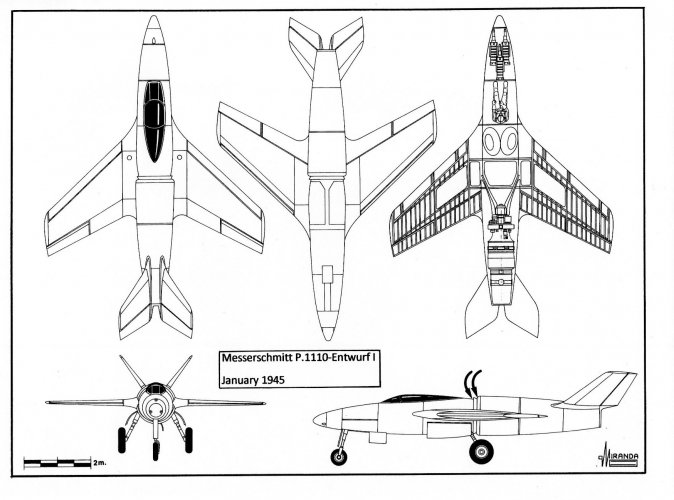
To reduce the drag coefficient at high speeds the designers of the Messerschmitt P.1110 fighter employed two boundary layer suction inlets placed ahead of the lateral air scoops. The turbulent air was sucked by means of a special extractor fan.
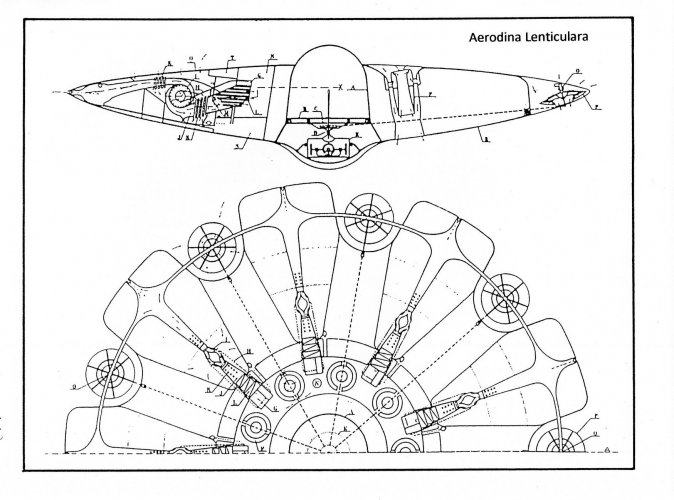
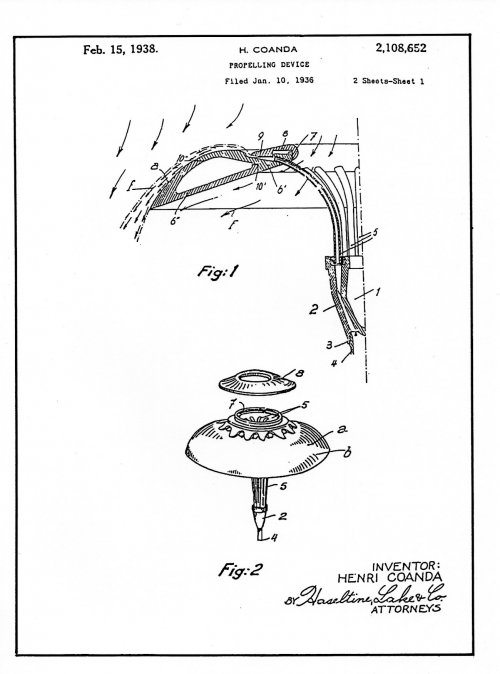
The Germans were extremely interested in the research by Henri M. Coanda, the Romanian aeronautical engineer that discovered the Coanda Effect in 1934 and designed the Aerodina Lenticulara flying saucer in 1935. On February 15 and September 27, 1938, Coanda received two French patents about airflow acceleration over the periphery of a concave disc. On May 9, 1939, Coanda patented a new propelling device to increase the wings lift.
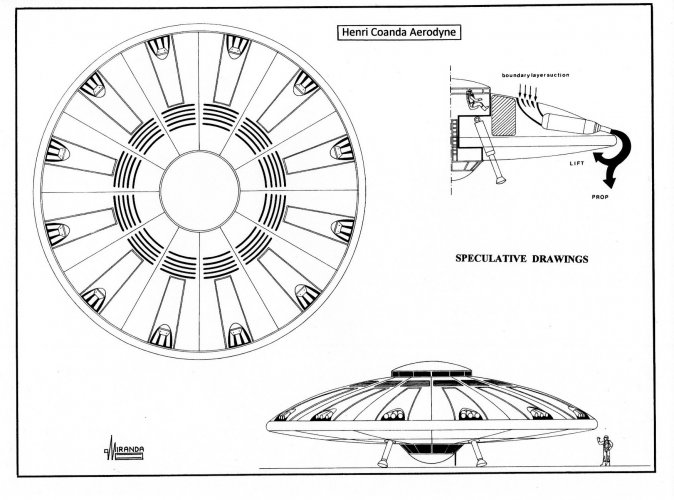
During the German occupation of Paris, Coanda was forced to design a 20 m of diameter aerodyne powered by twelve Jumo 004 jet engines mounted in a radial pattern with the exhaust pipes directed towards the external ring, where the Coanda Effect produced six tons of lifting power per square yard. The air sucked through sixty slots (Lüftungs) installed around the cockpit crating a lifting power derived from vacuum effect on the disc upper surface. The air passed through a toroidal plenum chamber (Zentraltur-Binenanlage) from where it was sucked by the turbojets and expelled towards the thick peripheral ring. Control was achieved by differential acceleration of the engines.
In 1937, several scientists and engineers from the AVA-Göttingen research center started experiments with suction inlets installed in the wing of a Junkers AT. 1 light plane. During the flight tests program an efficiency of 22 per cent was obtained with a 20 hp suction device. In 1940 a lift coefficient of 5 was achieved using a 45 hp suction fan mounted in the engine of a Fieseler Storch AT.2.
Between 1941 and 1943 the Messerschmitt Bf 109 V-24 prototype was fitted with blown flaps to improve low-speed handling. By 1944 some tests were conducted at Daimler-Benz/Stuttgart with one Bf 109 G-6 fitted with a Caudron built aile soufflé and one 9,000 rpm suction-fan blower system built by AVA. But the suction at high transonic speed required a considerable amount of power.
In February 1940, the tailless jet fighter project Lippisch P 01-112 was fitted with a suction device powered by one Bramo/BMW 3302 turbojet. In April 1943, the Arado design team proposed to use the Ar 232 A-05 prototype as flying laboratory fitted with a suction boundary layer control system powered by a cold rocket Walter HWK RI-203.
All these suction devices involved cutting slots (Lüftungs) into an aircraft’s wings, but the first attempts to use multiple slots to increase the suction rate did not achieve satisfactory results. The problem of more efficient suction led the German engineers to new research into porous surfaces with small holes.
At the end of 1944, the German foamed-metallurgy conducted experiments with porous Aluminum/Iron/Bronze alloys using the superplastic-deformation/diffusion-bonding technology. The new porous material, named Luftschwamm by the Göttingen scientist, would allow to eliminate the air scoops of the transonic fighters by delaying 1/10 Mach the apparition of compressibility shockwaves. But the work was discontinued without explanation in 1945.
The mystery was finally solved in April 1963 during the Mach 0.77 tests flights performed by the Northrop X-21A, an experimental prototype fitted with a porous breathing wing with thousands of tiny slots with 0.0035-inch width. The results were doubtful practically, because of the obstructions of the slots by insects, dust, rain, and other environmental anomalies.
In November 1944, some ground tests carried out with the Messerschmitt Me 262 W.Nr.130015, showed that the internal drag in the air ducts reduced the turbojet thrust by 45 kp for each meter in long.
The German designers were forced to imagine new aerodynamic solutions to reduce the drag coefficient in the air ducts. Twin booms and tailless configurations with short fuselage avoided the loss of thrust associated with the long tail pipe, and the long air duct used with nose air intakes was avoided by the installation of two lateral intakes with short S-shaped ducts. Unfortunately for the Germans, with this configuration the air scoops were placed in the air turbulent zone generated over the wing upper surface by the Coanda Effect, and the loss of performance was estimated between 4 per cent and 14 per cent.
To reduce the drag coefficient at high speeds the designers of the Messerschmitt P.1110 fighter employed two boundary layer suction inlets placed ahead of the lateral air scoops. The turbulent air was sucked by means of a special extractor fan.
The Germans were extremely interested in the research by Henri M. Coanda, the Romanian aeronautical engineer that discovered the Coanda Effect in 1934 and designed the Aerodina Lenticulara flying saucer in 1935. On February 15 and September 27, 1938, Coanda received two French patents about airflow acceleration over the periphery of a concave disc. On May 9, 1939, Coanda patented a new propelling device to increase the wings lift.
During the German occupation of Paris, Coanda was forced to design a 20 m of diameter aerodyne powered by twelve Jumo 004 jet engines mounted in a radial pattern with the exhaust pipes directed towards the external ring, where the Coanda Effect produced six tons of lifting power per square yard. The air sucked through sixty slots (Lüftungs) installed around the cockpit crating a lifting power derived from vacuum effect on the disc upper surface. The air passed through a toroidal plenum chamber (Zentraltur-Binenanlage) from where it was sucked by the turbojets and expelled towards the thick peripheral ring. Control was achieved by differential acceleration of the engines.
In 1937, several scientists and engineers from the AVA-Göttingen research center started experiments with suction inlets installed in the wing of a Junkers AT. 1 light plane. During the flight tests program an efficiency of 22 per cent was obtained with a 20 hp suction device. In 1940 a lift coefficient of 5 was achieved using a 45 hp suction fan mounted in the engine of a Fieseler Storch AT.2.
Between 1941 and 1943 the Messerschmitt Bf 109 V-24 prototype was fitted with blown flaps to improve low-speed handling. By 1944 some tests were conducted at Daimler-Benz/Stuttgart with one Bf 109 G-6 fitted with a Caudron built aile soufflé and one 9,000 rpm suction-fan blower system built by AVA. But the suction at high transonic speed required a considerable amount of power.
In February 1940, the tailless jet fighter project Lippisch P 01-112 was fitted with a suction device powered by one Bramo/BMW 3302 turbojet. In April 1943, the Arado design team proposed to use the Ar 232 A-05 prototype as flying laboratory fitted with a suction boundary layer control system powered by a cold rocket Walter HWK RI-203.
All these suction devices involved cutting slots (Lüftungs) into an aircraft’s wings, but the first attempts to use multiple slots to increase the suction rate did not achieve satisfactory results. The problem of more efficient suction led the German engineers to new research into porous surfaces with small holes.
At the end of 1944, the German foamed-metallurgy conducted experiments with porous Aluminum/Iron/Bronze alloys using the superplastic-deformation/diffusion-bonding technology. The new porous material, named Luftschwamm by the Göttingen scientist, would allow to eliminate the air scoops of the transonic fighters by delaying 1/10 Mach the apparition of compressibility shockwaves. But the work was discontinued without explanation in 1945.
The mystery was finally solved in April 1963 during the Mach 0.77 tests flights performed by the Northrop X-21A, an experimental prototype fitted with a porous breathing wing with thousands of tiny slots with 0.0035-inch width. The results were doubtful practically, because of the obstructions of the slots by insects, dust, rain, and other environmental anomalies.
Attachments
The Omega files
After the war ended, the Allied powers raced to size aeronautic technology in occupied Germany and the aerodynamic configuration of these German projects was used in the first generation of the Cold War jet fighters North American F-86 Sabre, Mikoyan Gurevich MiG-15, Lavotckin La-15, Dassault MD 450 Ouragan, Dassault MD 452 Mystère, Nord 2200 and Tank IAE 33.
The long air duct between the nose air intake and the turbojet reduced the thrust by 45 kpf for each meter in length. To reduce the drag coefficient in January 1945 Messerschmitt designed the P.1110 fighter fitted with side-mounted air intakes and S-shaped ducts.
This configuration was used by the second generation of the Cold War fighters Hawker Hunter, Grumman F-11 Tiger, Folland Gnat, Supermarine Swift, Dassault Etendard, Dassault Mystère III, Arsenal VG-70, Arsenal VG-90, Sud Est S.E. Baroudeur, Breguet 1001 Taon, Centre NC 1080 and SAAB J-32 Lansen.
The delta wing configuration of the Lippisch DM-1prototype and the Messerschmitt P.1112/S2 project was used in the Convair XF-92, Convair F-102, Nord 1402 Gerfaut, Sud Est S.E. 212 Durandal, Dassault Mirage I, Avro 707, Boulton Paul P.111, Boulton Paul P.120, Handley Page H.P.115, Fairey Delta 1, Fairey Delta 2, BAC 221 and Short SC.1.
The maximum speed of the first prototypes XF-92 and YF-102 was limited to Mach 0.98 due a transonic drag much higher than expected, but the problem was solved in December 1954 using the aerodynamic principle named area rule, patented by Junkers in March, 1944.
Swept wings with two trailing-edge fin and rudder unit configuration from the Arado E.583 and Junkers EF.128 projects were used in the Chance Vought F7U Cutlass naval fighter.
Over time even the most unusual wing configurations developed by the German aerodynamicists during the war ended up being used in experimental planes.
The ‘bat wing’ of the Messerschmitt Me P.1109-01, the Heinkel P.1078 and the Blohm und Voss P.208 projects were used in 1996 in the prototype Boeing Bird of Prey.
The oblique scissors wing of the Messerschmitt Me P.1109-01 and Blohm und Voss P.202 projects was flight tested in 1979 with the NASA Ames AD-1 research airplane.
The forward-swept wing of the German projects Heinkel He 162 D, Blohm und Voss P.209.02, BMW Strahlbomber II and Focke-Wulf P. 03028, was flight tested with the Grumman X-29 research plane in 1984.
The butterfly tailplane of the Heinkel P.1079A and Messerchmitt P.1110 projects were used in 1951 in the Supermarine Type 508 prototype and in the Fouga CM.170 jet trainer in 1952.
The Versuchsflugel II crescent wing of the Arado Ar 234 V16 project was used in the Handley Page H.P.88 research plane in 1951 and in the Handley Page Victor strategic bomber in 1952.
On October 2, 1941, the Messerschmitt Me 163A V4 rocket plane reached a critical number of Mach 0.84 before suffering the compressibility effects. Experts concluded that this was the speed limit for an aircraft fitted with swept wings, because the center of pressure displaced itself rearwards and outwards making the airplane very unstable.
The tailless configuration of the Messerschmitt Me 163 Komet was flight tested in the research planes de Havilland D.H.108 in 1946, Northrop X-4 in 1948, Payen Katy in 1954 and in the Douglas F4D Skyray naval fighter in 1951.
The double-delta configuration of the Henschel P.130 project was used by SAAB in their J35 Draken jet interceptor in 1955.
The jet/rocket mixed propulsion system of the Messerschmitt prototype Me 262 V074 and the Focke-Wulf Projekt VI Flitzer was used in the French interceptor Dassault Mirage IIIC in 1961 and in the British research airplane Saunders-Roe S.R. 177 in 1947.
The variable-geometry wing of the Messerschmitt P.1102-05 was used in the Bell X-5 and Mirage G prototypes, in the Grumman F-14 Tomcat naval fighter, in the MiG-23 fighter-bomber and in the Panavia Tornado bomber.
The annular wing developed by von Zborowski for the Heinkel Wespe VTOL project, was flight tested in 1958 with the French prototype SNECMA Coléoptère.
The radar AWACS rotating antenna of the airborne early warning airplanes Grumman E-2 Hawkeye and the AWACS Boeing E-3 Sentry were developed in 1944 for the Arado Ar 234 C-3, to track a bomber stream up to distances of 45 km using a FuG 244 Bremen 0 radar set with a rotating disc above the fuselage.
The French DEFA and British ADEN 30 mm cannons were developed from the German Mauser MG 213C.
The Mighty Mouse air-to-air unguided rockets fired by the all-weather interceptors Lockheed F-94 Starfire, Northrop F-89 Scorpion and North American F-86 D Sabre Dog during the Cold War, were developed from the Rheinmetall R4M Orkan 55 mm rocket, and their automatic firing radar system probably was a development of the German FuG 222 Pauke S fire control radar with Oberon-Elfe predictor system.
The ramjet propulsion of the German projects Lippisch P.13a, Skoda-Kauba SK P.12, Heinkel P.1080, Focke-Wulf Ta 283 and Messerschmitt P.1101L was flight tested by the North American F-51D 44-63528 in 1946, the Lockheed F-80 Trijet in 1948, and the French prototypes Leduc 021 and Sud Ouest SO 9000 Trident in 1953.
The turboprop configuration of the Focke-Wulf P.0310226-17 project was flight tested in 1953 with the McDonnell XF-88B prototype and in 1955 by the Republic XF-84 H Thunderscreech research plane in 1955.
The canard foreplanes of the Blohm und Voss P.217 and Messerschmitt P.1110 (Feb 12, 1945) projects was used by the Dassault Mirage/Milan in 1969.
Several versions of the Fieseler Fi 103 (V-1) cruise missile were manufactured in USA, as Republic-Ford JB-2 Loon, in France as ARSAERO CT-10 and in the USRR as the Izdeliye 10.
The EMW V-2 ballistic missile was manufactured in the USRR as the R-1 in 1948, in USA as RTV-G-4 Bumper and developed as the PGM Redstone rocket of the Mercury project in 1958.
The Rheinmetall-Borsig Rheintochter surface-to-air missile concept inspired the Soviet SA-2 (1960) and the US Nike Ajax (1954).
The Doblhoff WNF 342 jet propelled rotor concept was used in the Hiller YH-32 Hornet helicopter in 1950, in the American Helicopter XH-26 Jet Jeep in 1952, in the Fairey Rotodyne compound gyroplane in 1957 and in the Fairey Gyrodyne prototype in 1957.
The SNECMA Atar 101 French turbojet was developed of the BMW 003 axial-flow turbojet.
And, what happened during the Cold War with the German projects of flying saucers? An indirect proof of its existence can be found in fifteen designs developed in Canada by the Avro A.V. Roe Company between 1952 and 1961.
In the immediate post-war period, the British aeronautic industry conducted three transonic research projects: The Miles M.52 was a brute force project based on the use of a W.2/700 turbojet with afterburning, the R.A.E. transonic airplane was a streamlined variant of the Focke-Wulf Ta 183 powered by one AJ 65 turbojet, the de Havilland D.H.108 was a modified Vampire jet fighter with swept wings and tailless configuration.
The British had no luck with their tailless experiments: The General Aircraft GAL 56 and GAL 61, Armstrong Withworth A.W.52, Handley Page H.P.75 and Baynes Bat prototypes had resulted in dangerously unstable machines.
In October 1945 John Frost, the project engineer of the D.H. 108, decided to use the German technology of the Messerschmitt Me 163 swept wing fighter with the cooperation of several German technicians. One of them was Dr. Waldemar Voigt, chef designer of Messserschmitt-Oberammergau AG.
Frost also had access to the information on tip jet-driven rotor helicopters, radial flow gas turbines and the Flügelrad propulsion concept that had been captured in Europe by the British Intelligence Objectives Sub-committee (B.I.O.S.). The development of the powerful BMW-Bramo radial-flow turbojet was continued at the British National Gas Turbine establishment.
In 1947 Frost joined A.V. Roe Canada Company, as project designer of the Avro XC-100 all-weather fighter, only ten days before Kenneth Arnold’s UFO encounter.
Fascinated by reports of UFO sightings, Frost concluded that the German technology could be used to build a flying disc. Privately and with a group of friends, he started the design of the tip jet-driven rotor Gyrodyne based in the Feuerball concept and a disc-shaped aircraft powered by an integral pancake radial-flow turbojet based in the Kugelblitz concept.
Researcher Tim Mattews states in the book 'UFO revelation' that in 1951 A.V. Roe employed several German scientists including the chief designer of the Kugelblitz project, Dr. Heinrich Richard Miethe.
Late in 1951 Frost made a proposal for a proof-of-concept saucer-like flying vehicle. Early in 1952 the A.V. Roe Special Projects Group was formed to investigate the Frost ideas.
On February 7, 1952, the Group distributed an internal document titled ‘Description and Thoughts on the Turbo Disc’ (a simple gas turbine halfway between a ram-jet engine and centrifugal engine), Frost also submitted the design to the engineering department of McGill University.
The radial-flow turbojet designed by the Frost team had twenty feet of diameter, 42,000 lbf minimum thrust at low pressure and an outstanding power-to-weight ratio of 1.73 to 1.
The horizontal Pelton-wheel turbine had a large multi-stage centrifugal compressor with the rotor blades mounted on the inner disc ring and stator blades in the outer disc ring. The separate combustion system consisted of several combustion chambers with individual burners and nozzle guide vanes distributed in a radial pattern between the ribs of the vehicle.
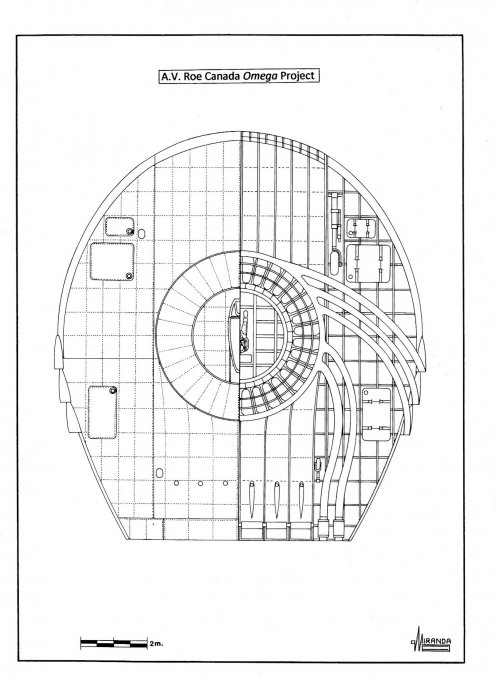
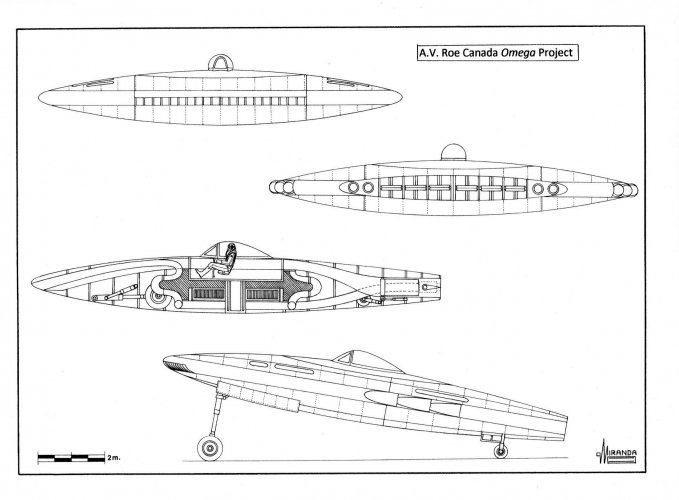
This work led to the first design named Omega project, with elliptical planform, 36 ft wingspan, 40 ft overall length and 1 to 7 aspect ratio. It was proposed to control the vehicle by altering the direction of thrust forces.
The vehicle had twenty air-intake slots mounted in the nose, the new pancake engine was designed as an integral part of the airframe and the jet thrust exited from around the entire rim of the engine.
About three-fifths of the jet exhaust flow through a multiple jet-pipe assembly that directs the flow of gases in a rearward direction from the sides of the airframe for propulsion and the remainder is ejected from the trailing edge through ten deflector vanes comprising elevons and trimmers providing control in yaw, roll and pitch.
In March 1953 Frost met with the wartime German engineer George Klein, who had taken part in the development of the Flügelrad Projekt. The reunion took place at a Canadian Government Facility in West Germany.
On August 23, 1953, Frost patented the Air Cushion Effect and in June 1954 published the report ‘Project Y-2: Flat Vertical Take-off Gyroplane’, a proof-of-concept vehicle named Project P.724.
The Y-2 was a true flying saucer design powered by one radial flow gas turbine which utilizes compressed air as its only means of lubrication.
Their VTOL capability was achieved by ducting engine exhaust to the periphery of the disc and deflecting the air flow downwards by means of the Coanda Effect. For transition to forward flight, the air flow would be gradually redistributed backwards by means of trim flaps.
The proposed Avro Y-2 Project P.724 (Patent April 18, 1955) had 44 ft. (13.4 m) diameter and 5.9 ft. (1.8 m) height. A new proposed version (Patent May 9, 1955) with 49 ft. (14.97 m) of diameter and 6.9 ft. (2 m) height, was powered by eight radially mounted Armstrong-Siddeley ASM Viper 5 axial-flow turbojets with 1,900 lbs. thrust each.
‘Canada’s Flying Saucer’, by Bill Zuk, The Boston Mills Press, 2001.
‘Flying Saucers Avro’s Secrets’, by Bill Rose, Air Pictorial, May 2001.
Air Intelligence Digest, December 1954, Volume 7, Nº12.
‘Man-made Flying Saucers’, Royal Air Force Flying Review Nº1, October 1955.
‘The Project Silver Bug Report: ATIC TR-AC-47, 15 February 1955’, by Roger D. Cook, SD Publications, June 2000.
‘The (almost) Flying Saucer’, by Ernest Ball, Air Enthusiast International/June 1974.
‘The Pentagon Flying Saucer Problem’, by Graham Chandler, Air & Space, April/May 2003.
‘Is this real Flying Saucer?’ by Thomas Turner, Look Magazine, Volume 19, June 1955.
‘Flying Saucers are real’, People Today Magazine, September 1952.
‘The Secret Saucer’, Product Engineering, December 15, 1958.
J.C.M. Frost Patents - 3,024,966 (March 13, 1962), 3,020,002 (February 6, 1962), 3,022,963 (February 27, 1962), 3,018,068 (January 23, 1962), 3,062,482 (November 6, 1962), 3,124,323 (March 10, 1964), 3,051,414 (August 28, 1962).
‘Project Omega’ New York Times, September 17, 1953.
Toronto Daily Star, Mach 13, 1953.
Toronto Daily Star, April 21, 1953.
‘Avro Canada’s Omega’, Aeroplane, January 5, 1954.
London Times, April 22, 1953.
London Times, April 23, 1953.
Ali Nº 12, May 17, 1953.
Ali Nuove, June 1953.
‘Canada Builds Flying Saucers’, Fate magazine, October 1953.
‘How the Flying Saucer Works’, by Willy Ley, Mechanix Illustrated, March 1956.
‘Cold War Tech War’ by Randall Whitcomb, Apogee Books, 2008.
‘The UFO Files: The Canadian Connection Exposed’ by Palmiro Campagna, Toronto: Stoddart Publishing, 1998.
‘Saucer Attack (pop culture in the golden age of flying saucers)’, Eric & Leif Nesheim, General Publishing Knc. CA.1997.
After the war ended, the Allied powers raced to size aeronautic technology in occupied Germany and the aerodynamic configuration of these German projects was used in the first generation of the Cold War jet fighters North American F-86 Sabre, Mikoyan Gurevich MiG-15, Lavotckin La-15, Dassault MD 450 Ouragan, Dassault MD 452 Mystère, Nord 2200 and Tank IAE 33.
The long air duct between the nose air intake and the turbojet reduced the thrust by 45 kpf for each meter in length. To reduce the drag coefficient in January 1945 Messerschmitt designed the P.1110 fighter fitted with side-mounted air intakes and S-shaped ducts.
This configuration was used by the second generation of the Cold War fighters Hawker Hunter, Grumman F-11 Tiger, Folland Gnat, Supermarine Swift, Dassault Etendard, Dassault Mystère III, Arsenal VG-70, Arsenal VG-90, Sud Est S.E. Baroudeur, Breguet 1001 Taon, Centre NC 1080 and SAAB J-32 Lansen.
The delta wing configuration of the Lippisch DM-1prototype and the Messerschmitt P.1112/S2 project was used in the Convair XF-92, Convair F-102, Nord 1402 Gerfaut, Sud Est S.E. 212 Durandal, Dassault Mirage I, Avro 707, Boulton Paul P.111, Boulton Paul P.120, Handley Page H.P.115, Fairey Delta 1, Fairey Delta 2, BAC 221 and Short SC.1.
The maximum speed of the first prototypes XF-92 and YF-102 was limited to Mach 0.98 due a transonic drag much higher than expected, but the problem was solved in December 1954 using the aerodynamic principle named area rule, patented by Junkers in March, 1944.
Swept wings with two trailing-edge fin and rudder unit configuration from the Arado E.583 and Junkers EF.128 projects were used in the Chance Vought F7U Cutlass naval fighter.
Over time even the most unusual wing configurations developed by the German aerodynamicists during the war ended up being used in experimental planes.
The ‘bat wing’ of the Messerschmitt Me P.1109-01, the Heinkel P.1078 and the Blohm und Voss P.208 projects were used in 1996 in the prototype Boeing Bird of Prey.
The oblique scissors wing of the Messerschmitt Me P.1109-01 and Blohm und Voss P.202 projects was flight tested in 1979 with the NASA Ames AD-1 research airplane.
The forward-swept wing of the German projects Heinkel He 162 D, Blohm und Voss P.209.02, BMW Strahlbomber II and Focke-Wulf P. 03028, was flight tested with the Grumman X-29 research plane in 1984.
The butterfly tailplane of the Heinkel P.1079A and Messerchmitt P.1110 projects were used in 1951 in the Supermarine Type 508 prototype and in the Fouga CM.170 jet trainer in 1952.
The Versuchsflugel II crescent wing of the Arado Ar 234 V16 project was used in the Handley Page H.P.88 research plane in 1951 and in the Handley Page Victor strategic bomber in 1952.
On October 2, 1941, the Messerschmitt Me 163A V4 rocket plane reached a critical number of Mach 0.84 before suffering the compressibility effects. Experts concluded that this was the speed limit for an aircraft fitted with swept wings, because the center of pressure displaced itself rearwards and outwards making the airplane very unstable.
The tailless configuration of the Messerschmitt Me 163 Komet was flight tested in the research planes de Havilland D.H.108 in 1946, Northrop X-4 in 1948, Payen Katy in 1954 and in the Douglas F4D Skyray naval fighter in 1951.
The double-delta configuration of the Henschel P.130 project was used by SAAB in their J35 Draken jet interceptor in 1955.
The jet/rocket mixed propulsion system of the Messerschmitt prototype Me 262 V074 and the Focke-Wulf Projekt VI Flitzer was used in the French interceptor Dassault Mirage IIIC in 1961 and in the British research airplane Saunders-Roe S.R. 177 in 1947.
The variable-geometry wing of the Messerschmitt P.1102-05 was used in the Bell X-5 and Mirage G prototypes, in the Grumman F-14 Tomcat naval fighter, in the MiG-23 fighter-bomber and in the Panavia Tornado bomber.
The annular wing developed by von Zborowski for the Heinkel Wespe VTOL project, was flight tested in 1958 with the French prototype SNECMA Coléoptère.
The radar AWACS rotating antenna of the airborne early warning airplanes Grumman E-2 Hawkeye and the AWACS Boeing E-3 Sentry were developed in 1944 for the Arado Ar 234 C-3, to track a bomber stream up to distances of 45 km using a FuG 244 Bremen 0 radar set with a rotating disc above the fuselage.
The French DEFA and British ADEN 30 mm cannons were developed from the German Mauser MG 213C.
The Mighty Mouse air-to-air unguided rockets fired by the all-weather interceptors Lockheed F-94 Starfire, Northrop F-89 Scorpion and North American F-86 D Sabre Dog during the Cold War, were developed from the Rheinmetall R4M Orkan 55 mm rocket, and their automatic firing radar system probably was a development of the German FuG 222 Pauke S fire control radar with Oberon-Elfe predictor system.
The ramjet propulsion of the German projects Lippisch P.13a, Skoda-Kauba SK P.12, Heinkel P.1080, Focke-Wulf Ta 283 and Messerschmitt P.1101L was flight tested by the North American F-51D 44-63528 in 1946, the Lockheed F-80 Trijet in 1948, and the French prototypes Leduc 021 and Sud Ouest SO 9000 Trident in 1953.
The turboprop configuration of the Focke-Wulf P.0310226-17 project was flight tested in 1953 with the McDonnell XF-88B prototype and in 1955 by the Republic XF-84 H Thunderscreech research plane in 1955.
The canard foreplanes of the Blohm und Voss P.217 and Messerschmitt P.1110 (Feb 12, 1945) projects was used by the Dassault Mirage/Milan in 1969.
Several versions of the Fieseler Fi 103 (V-1) cruise missile were manufactured in USA, as Republic-Ford JB-2 Loon, in France as ARSAERO CT-10 and in the USRR as the Izdeliye 10.
The EMW V-2 ballistic missile was manufactured in the USRR as the R-1 in 1948, in USA as RTV-G-4 Bumper and developed as the PGM Redstone rocket of the Mercury project in 1958.
The Rheinmetall-Borsig Rheintochter surface-to-air missile concept inspired the Soviet SA-2 (1960) and the US Nike Ajax (1954).
The Doblhoff WNF 342 jet propelled rotor concept was used in the Hiller YH-32 Hornet helicopter in 1950, in the American Helicopter XH-26 Jet Jeep in 1952, in the Fairey Rotodyne compound gyroplane in 1957 and in the Fairey Gyrodyne prototype in 1957.
The SNECMA Atar 101 French turbojet was developed of the BMW 003 axial-flow turbojet.
And, what happened during the Cold War with the German projects of flying saucers? An indirect proof of its existence can be found in fifteen designs developed in Canada by the Avro A.V. Roe Company between 1952 and 1961.
In the immediate post-war period, the British aeronautic industry conducted three transonic research projects: The Miles M.52 was a brute force project based on the use of a W.2/700 turbojet with afterburning, the R.A.E. transonic airplane was a streamlined variant of the Focke-Wulf Ta 183 powered by one AJ 65 turbojet, the de Havilland D.H.108 was a modified Vampire jet fighter with swept wings and tailless configuration.
The British had no luck with their tailless experiments: The General Aircraft GAL 56 and GAL 61, Armstrong Withworth A.W.52, Handley Page H.P.75 and Baynes Bat prototypes had resulted in dangerously unstable machines.
In October 1945 John Frost, the project engineer of the D.H. 108, decided to use the German technology of the Messerschmitt Me 163 swept wing fighter with the cooperation of several German technicians. One of them was Dr. Waldemar Voigt, chef designer of Messserschmitt-Oberammergau AG.
Frost also had access to the information on tip jet-driven rotor helicopters, radial flow gas turbines and the Flügelrad propulsion concept that had been captured in Europe by the British Intelligence Objectives Sub-committee (B.I.O.S.). The development of the powerful BMW-Bramo radial-flow turbojet was continued at the British National Gas Turbine establishment.
In 1947 Frost joined A.V. Roe Canada Company, as project designer of the Avro XC-100 all-weather fighter, only ten days before Kenneth Arnold’s UFO encounter.
Fascinated by reports of UFO sightings, Frost concluded that the German technology could be used to build a flying disc. Privately and with a group of friends, he started the design of the tip jet-driven rotor Gyrodyne based in the Feuerball concept and a disc-shaped aircraft powered by an integral pancake radial-flow turbojet based in the Kugelblitz concept.
Researcher Tim Mattews states in the book 'UFO revelation' that in 1951 A.V. Roe employed several German scientists including the chief designer of the Kugelblitz project, Dr. Heinrich Richard Miethe.
Late in 1951 Frost made a proposal for a proof-of-concept saucer-like flying vehicle. Early in 1952 the A.V. Roe Special Projects Group was formed to investigate the Frost ideas.
On February 7, 1952, the Group distributed an internal document titled ‘Description and Thoughts on the Turbo Disc’ (a simple gas turbine halfway between a ram-jet engine and centrifugal engine), Frost also submitted the design to the engineering department of McGill University.
The radial-flow turbojet designed by the Frost team had twenty feet of diameter, 42,000 lbf minimum thrust at low pressure and an outstanding power-to-weight ratio of 1.73 to 1.
The horizontal Pelton-wheel turbine had a large multi-stage centrifugal compressor with the rotor blades mounted on the inner disc ring and stator blades in the outer disc ring. The separate combustion system consisted of several combustion chambers with individual burners and nozzle guide vanes distributed in a radial pattern between the ribs of the vehicle.
This work led to the first design named Omega project, with elliptical planform, 36 ft wingspan, 40 ft overall length and 1 to 7 aspect ratio. It was proposed to control the vehicle by altering the direction of thrust forces.
The vehicle had twenty air-intake slots mounted in the nose, the new pancake engine was designed as an integral part of the airframe and the jet thrust exited from around the entire rim of the engine.
About three-fifths of the jet exhaust flow through a multiple jet-pipe assembly that directs the flow of gases in a rearward direction from the sides of the airframe for propulsion and the remainder is ejected from the trailing edge through ten deflector vanes comprising elevons and trimmers providing control in yaw, roll and pitch.
In March 1953 Frost met with the wartime German engineer George Klein, who had taken part in the development of the Flügelrad Projekt. The reunion took place at a Canadian Government Facility in West Germany.
On August 23, 1953, Frost patented the Air Cushion Effect and in June 1954 published the report ‘Project Y-2: Flat Vertical Take-off Gyroplane’, a proof-of-concept vehicle named Project P.724.
The Y-2 was a true flying saucer design powered by one radial flow gas turbine which utilizes compressed air as its only means of lubrication.
Their VTOL capability was achieved by ducting engine exhaust to the periphery of the disc and deflecting the air flow downwards by means of the Coanda Effect. For transition to forward flight, the air flow would be gradually redistributed backwards by means of trim flaps.
The proposed Avro Y-2 Project P.724 (Patent April 18, 1955) had 44 ft. (13.4 m) diameter and 5.9 ft. (1.8 m) height. A new proposed version (Patent May 9, 1955) with 49 ft. (14.97 m) of diameter and 6.9 ft. (2 m) height, was powered by eight radially mounted Armstrong-Siddeley ASM Viper 5 axial-flow turbojets with 1,900 lbs. thrust each.
Canadian Flying Saucers Bibliography
‘Canada’s Flying Saucer’, by Bill Zuk, The Boston Mills Press, 2001.
‘Flying Saucers Avro’s Secrets’, by Bill Rose, Air Pictorial, May 2001.
Air Intelligence Digest, December 1954, Volume 7, Nº12.
‘Man-made Flying Saucers’, Royal Air Force Flying Review Nº1, October 1955.
‘The Project Silver Bug Report: ATIC TR-AC-47, 15 February 1955’, by Roger D. Cook, SD Publications, June 2000.
‘The (almost) Flying Saucer’, by Ernest Ball, Air Enthusiast International/June 1974.
‘The Pentagon Flying Saucer Problem’, by Graham Chandler, Air & Space, April/May 2003.
‘Is this real Flying Saucer?’ by Thomas Turner, Look Magazine, Volume 19, June 1955.
‘Flying Saucers are real’, People Today Magazine, September 1952.
‘The Secret Saucer’, Product Engineering, December 15, 1958.
J.C.M. Frost Patents - 3,024,966 (March 13, 1962), 3,020,002 (February 6, 1962), 3,022,963 (February 27, 1962), 3,018,068 (January 23, 1962), 3,062,482 (November 6, 1962), 3,124,323 (March 10, 1964), 3,051,414 (August 28, 1962).
‘Project Omega’ New York Times, September 17, 1953.
Toronto Daily Star, Mach 13, 1953.
Toronto Daily Star, April 21, 1953.
‘Avro Canada’s Omega’, Aeroplane, January 5, 1954.
London Times, April 22, 1953.
London Times, April 23, 1953.
Ali Nº 12, May 17, 1953.
Ali Nuove, June 1953.
‘Canada Builds Flying Saucers’, Fate magazine, October 1953.
‘How the Flying Saucer Works’, by Willy Ley, Mechanix Illustrated, March 1956.
‘Cold War Tech War’ by Randall Whitcomb, Apogee Books, 2008.
‘The UFO Files: The Canadian Connection Exposed’ by Palmiro Campagna, Toronto: Stoddart Publishing, 1998.
‘Saucer Attack (pop culture in the golden age of flying saucers)’, Eric & Leif Nesheim, General Publishing Knc. CA.1997.
Attachments
martinbayer
ACCESS: Above Top Secret
- Joined
- 6 January 2009
- Messages
- 5,062
- Reaction score
- 6,969
I would *DEARLY* like to get an honest to god/loki/vishnu/bhudda/jehova/zeus/kami/ganesha/shiva (wait - doesn't that vaguely sound like jehova? never mind) assessment of any actual hardware that might be associated with any of those utterly obnoxious rumors.The Omega files
After the war ended, the Allied powers raced to size aeronautic technology in occupied Germany and the aerodynamic configuration of these German projects was used in the first generation of the Cold War jet fighters North American F-86 Sabre, Mikoyan Gurevich MiG-15, Lavotckin La-15, Dassault MD 450 Ouragan, Dassault MD 452 Mystère, Nord 2200 and Tank IAE 33.
The long air duct between the nose air intake and the turbojet reduced the thrust by 45 kpf for each meter in length. To reduce the drag coefficient in January 1945 Messerschmitt designed the P.1110 fighter fitted with side-mounted air intakes and S-shaped ducts.
This configuration was used by the second generation of the Cold War fighters Hawker Hunter, Grumman F-11 Tiger, Folland Gnat, Supermarine Swift, Dassault Etendard, Dassault Mystère III, Arsenal VG-70, Arsenal VG-90, Sud Est S.E. Baroudeur, Breguet 1001 Taon, Centre NC 1080 and SAAB J-32 Lansen.
The delta wing configuration of the Lippisch DM-1prototype and the Messerschmitt P.1112/S2 project was used in the Convair XF-92, Convair F-102, Nord 1402 Gerfaut, Sud Est S.E. 212 Durandal, Dassault Mirage I, Avro 707, Boulton Paul P.111, Boulton Paul P.120, Handley Page H.P.115, Fairey Delta 1, Fairey Delta 2, BAC 221 and Short SC.1.
The maximum speed of the first prototypes XF-92 and YF-102 was limited to Mach 0.98 due a transonic drag much higher than expected, but the problem was solved in December 1954 using the aerodynamic principle named area rule, patented by Junkers in March, 1944.
Swept wings with two trailing-edge fin and rudder unit configuration from the Arado E.583 and Junkers EF.128 projects were used in the Chance Vought F7U Cutlass naval fighter.
Over time even the most unusual wing configurations developed by the German aerodynamicists during the war ended up being used in experimental planes.
The ‘bat wing’ of the Messerschmitt Me P.1109-01, the Heinkel P.1078 and the Blohm und Voss P.208 projects were used in 1996 in the prototype Boeing Bird of Prey.
The oblique scissors wing of the Messerschmitt Me P.1109-01 and Blohm und Voss P.202 projects was flight tested in 1979 with the NASA Ames AD-1 research airplane.
The forward-swept wing of the German projects Heinkel He 162 D, Blohm und Voss P.209.02, BMW Strahlbomber II and Focke-Wulf P. 03028, was flight tested with the Grumman X-29 research plane in 1984.
The butterfly tailplane of the Heinkel P.1079A and Messerchmitt P.1110 projects were used in 1951 in the Supermarine Type 508 prototype and in the Fouga CM.170 jet trainer in 1952.
The Versuchsflugel II crescent wing of the Arado Ar 234 V16 project was used in the Handley Page H.P.88 research plane in 1951 and in the Handley Page Victor strategic bomber in 1952.
On October 2, 1941, the Messerschmitt Me 163A V4 rocket plane reached a critical number of Mach 0.84 before suffering the compressibility effects. Experts concluded that this was the speed limit for an aircraft fitted with swept wings, because the center of pressure displaced itself rearwards and outwards making the airplane very unstable.
The tailless configuration of the Messerschmitt Me 163 Komet was flight tested in the research planes de Havilland D.H.108 in 1946, Northrop X-4 in 1948, Payen Katy in 1954 and in the Douglas F4D Skyray naval fighter in 1951.
The double-delta configuration of the Henschel P.130 project was used by SAAB in their J35 Draken jet interceptor in 1955.
The jet/rocket mixed propulsion system of the Messerschmitt prototype Me 262 V074 and the Focke-Wulf Projekt VI Flitzer was used in the French interceptor Dassault Mirage IIIC in 1961 and in the British research airplane Saunders-Roe S.R. 177 in 1947.
The variable-geometry wing of the Messerschmitt P.1102-05 was used in the Bell X-5 and Mirage G prototypes, in the Grumman F-14 Tomcat naval fighter, in the MiG-23 fighter-bomber and in the Panavia Tornado bomber.
The annular wing developed by von Zborowski for the Heinkel Wespe VTOL project, was flight tested in 1958 with the French prototype SNECMA Coléoptère.
The radar AWACS rotating antenna of the airborne early warning airplanes Grumman E-2 Hawkeye and the AWACS Boeing E-3 Sentry were developed in 1944 for the Arado Ar 234 C-3, to track a bomber stream up to distances of 45 km using a FuG 244 Bremen 0 radar set with a rotating disc above the fuselage.
The French DEFA and British ADEN 30 mm cannons were developed from the German Mauser MG 213C.
The Mighty Mouse air-to-air unguided rockets fired by the all-weather interceptors Lockheed F-94 Starfire, Northrop F-89 Scorpion and North American F-86 D Sabre Dog during the Cold War, were developed from the Rheinmetall R4M Orkan 55 mm rocket, and their automatic firing radar system probably was a development of the German FuG 222 Pauke S fire control radar with Oberon-Elfe predictor system.
The ramjet propulsion of the German projects Lippisch P.13a, Skoda-Kauba SK P.12, Heinkel P.1080, Focke-Wulf Ta 283 and Messerschmitt P.1101L was flight tested by the North American F-51D 44-63528 in 1946, the Lockheed F-80 Trijet in 1948, and the French prototypes Leduc 021 and Sud Ouest SO 9000 Trident in 1953.
The turboprop configuration of the Focke-Wulf P.0310226-17 project was flight tested in 1953 with the McDonnell XF-88B prototype and in 1955 by the Republic XF-84 H Thunderscreech research plane in 1955.
The canard foreplanes of the Blohm und Voss P.217 and Messerschmitt P.1110 (Feb 12, 1945) projects was used by the Dassault Mirage/Milan in 1969.
Several versions of the Fieseler Fi 103 (V-1) cruise missile were manufactured in USA, as Republic-Ford JB-2 Loon, in France as ARSAERO CT-10 and in the USRR as the Izdeliye 10.
The EMW V-2 ballistic missile was manufactured in the USRR as the R-1 in 1948, in USA as RTV-G-4 Bumper and developed as the PGM Redstone rocket of the Mercury project in 1958.
The Rheinmetall-Borsig Rheintochter surface-to-air missile concept inspired the Soviet SA-2 (1960) and the US Nike Ajax (1954).
The Doblhoff WNF 342 jet propelled rotor concept was used in the Hiller YH-32 Hornet helicopter in 1950, in the American Helicopter XH-26 Jet Jeep in 1952, in the Fairey Rotodyne compound gyroplane in 1957 and in the Fairey Gyrodyne prototype in 1957.
The SNECMA Atar 101 French turbojet was developed of the BMW 003 axial-flow turbojet.
And, what happened during the Cold War with the German projects of flying saucers? An indirect proof of its existence can be found in fifteen designs developed in Canada by the Avro A.V. Roe Company between 1952 and 1961.
In the immediate post-war period, the British aeronautic industry conducted three transonic research projects: The Miles M.52 was a brute force project based on the use of a W.2/700 turbojet with afterburning, the R.A.E. transonic airplane was a streamlined variant of the Focke-Wulf Ta 183 powered by one AJ 65 turbojet, the de Havilland D.H.108 was a modified Vampire jet fighter with swept wings and tailless configuration.
The British had no luck with their tailless experiments: The General Aircraft GAL 56 and GAL 61, Armstrong Withworth A.W.52, Handley Page H.P.75 and Baynes Bat prototypes had resulted in dangerously unstable machines.
In October 1945 John Frost, the project engineer of the D.H. 108, decided to use the German technology of the Messerschmitt Me 163 swept wing fighter with the cooperation of several German technicians. One of them was Dr. Waldemar Voigt, chef designer of Messserschmitt-Oberammergau AG.
Frost also had access to the information on tip jet-driven rotor helicopters, radial flow gas turbines and the Flügelrad propulsion concept that had been captured in Europe by the British Intelligence Objectives Sub-committee (B.I.O.S.). The development of the powerful BMW-Bramo radial-flow turbojet was continued at the British National Gas Turbine establishment.
In 1947 Frost joined A.V. Roe Canada Company, as project designer of the Avro XC-100 all-weather fighter, only ten days before Kenneth Arnold’s UFO encounter.
Fascinated by reports of UFO sightings, Frost concluded that the German technology could be used to build a flying disc. Privately and with a group of friends, he started the design of the tip jet-driven rotor Gyrodyne based in the Feuerball concept and a disc-shaped aircraft powered by an integral pancake radial-flow turbojet based in the Kugelblitz concept.
Researcher Tim Mattews states in the book 'UFO revelation' that in 1951 A.V. Roe employed several German scientists including the chief designer of the Kugelblitz project, Dr. Heinrich Richard Miethe.
Late in 1951 Frost made a proposal for a proof-of-concept saucer-like flying vehicle. Early in 1952 the A.V. Roe Special Projects Group was formed to investigate the Frost ideas.
On February 7, 1952, the Group distributed an internal document titled ‘Description and Thoughts on the Turbo Disc’ (a simple gas turbine halfway between a ram-jet engine and centrifugal engine), Frost also submitted the design to the engineering department of McGill University.
The radial-flow turbojet designed by the Frost team had twenty feet of diameter, 42,000 lbf minimum thrust at low pressure and an outstanding power-to-weight ratio of 1.73 to 1.
The horizontal Pelton-wheel turbine had a large multi-stage centrifugal compressor with the rotor blades mounted on the inner disc ring and stator blades in the outer disc ring. The separate combustion system consisted of several combustion chambers with individual burners and nozzle guide vanes distributed in a radial pattern between the ribs of the vehicle.
This work led to the first design named Omega project, with elliptical planform, 36 ft wingspan, 40 ft overall length and 1 to 7 aspect ratio. It was proposed to control the vehicle by altering the direction of thrust forces.
The vehicle had twenty air-intake slots mounted in the nose, the new pancake engine was designed as an integral part of the airframe and the jet thrust exited from around the entire rim of the engine.
About three-fifths of the jet exhaust flow through a multiple jet-pipe assembly that directs the flow of gases in a rearward direction from the sides of the airframe for propulsion and the remainder is ejected from the trailing edge through ten deflector vanes comprising elevons and trimmers providing control in yaw, roll and pitch.
In March 1953 Frost met with the wartime German engineer George Klein, who had taken part in the development of the Flügelrad Projekt. The reunion took place at a Canadian Government Facility in West Germany.
On August 23, 1953, Frost patented the Air Cushion Effect and in June 1954 published the report ‘Project Y-2: Flat Vertical Take-off Gyroplane’, a proof-of-concept vehicle named Project P.724.
The Y-2 was a true flying saucer design powered by one radial flow gas turbine which utilizes compressed air as its only means of lubrication.
Their VTOL capability was achieved by ducting engine exhaust to the periphery of the disc and deflecting the air flow downwards by means of the Coanda Effect. For transition to forward flight, the air flow would be gradually redistributed backwards by means of trim flaps.
The proposed Avro Y-2 Project P.724 (Patent April 18, 1955) had 44 ft. (13.4 m) diameter and 5.9 ft. (1.8 m) height. A new proposed version (Patent May 9, 1955) with 49 ft. (14.97 m) of diameter and 6.9 ft. (2 m) height, was powered by eight radially mounted Armstrong-Siddeley ASM Viper 5 axial-flow turbojets with 1,900 lbs. thrust each.
Canadian Flying Saucers Bibliography
‘Canada’s Flying Saucer’, by Bill Zuk, The Boston Mills Press, 2001.
‘Flying Saucers Avro’s Secrets’, by Bill Rose, Air Pictorial, May 2001.
Air Intelligence Digest, December 1954, Volume 7, Nº12.
‘Man-made Flying Saucers’, Royal Air Force Flying Review Nº1, October 1955.
‘The Project Silver Bug Report: ATIC TR-AC-47, 15 February 1955’, by Roger D. Cook, SD Publications, June 2000.
‘The (almost) Flying Saucer’, by Ernest Ball, Air Enthusiast International/June 1974.
‘The Pentagon Flying Saucer Problem’, by Graham Chandler, Air & Space, April/May 2003.
‘Is this real Flying Saucer?’ by Thomas Turner, Look Magazine, Volume 19, June 1955.
‘Flying Saucers are real’, People Today Magazine, September 1952.
‘The Secret Saucer’, Product Engineering, December 15, 1958.
J.C.M. Frost Patents - 3,024,966 (March 13, 1962), 3,020,002 (February 6, 1962), 3,022,963 (February 27, 1962), 3,018,068 (January 23, 1962), 3,062,482 (November 6, 1962), 3,124,323 (March 10, 1964), 3,051,414 (August 28, 1962).
‘Project Omega’ New York Times, September 17, 1953.
Toronto Daily Star, Mach 13, 1953.
Toronto Daily Star, April 21, 1953.
‘Avro Canada’s Omega’, Aeroplane, January 5, 1954.
London Times, April 22, 1953.
London Times, April 23, 1953.
Ali Nº 12, May 17, 1953.
Ali Nuove, June 1953.
‘Canada Builds Flying Saucers’, Fate magazine, October 1953.
‘How the Flying Saucer Works’, by Willy Ley, Mechanix Illustrated, March 1956.
‘Cold War Tech War’ by Randall Whitcomb, Apogee Books, 2008.
‘The UFO Files: The Canadian Connection Exposed’ by Palmiro Campagna, Toronto: Stoddart Publishing, 1998.
‘Saucer Attack (pop culture in the golden age of flying saucers)’, Eric & Leif Nesheim, General Publishing Knc. CA.1997.

dannydale
ACCESS: Top Secret
- Joined
- 13 May 2007
- Messages
- 1,014
- Reaction score
- 1,633
AGAIN.This is how I imagine the triebflugel or the flak mine to look on take off.
Stretch it a bit to the flugelrad.View: https://youtu.be/JvHqZzrBMDw?

exclaimedleech8
ACCESS: Top Secret
- Joined
- 30 September 2024
- Messages
- 823
- Reaction score
- 999
Did it come equipped with iDrive?
Imagine how much they cost to repair
Imagine how much they cost to repair
Last edited:
antigravite
ACCESS: Top Secret
- Joined
- 25 April 2008
- Messages
- 843
- Reaction score
- 297
I agree with martinbayer. Yes please. Show us actual harware picture.I would *DEARLY* like to get an honest to god/loki/vishnu/bhudda/jehova/zeus/kami/ganesha/shiva (wait - doesn't that vaguely sound like jehova? never mind) assessment of any actual hardware that might be associated with any of those utterly obnoxious rumors.
Best
A.
baerenmarke
ACCESS: Restricted
- Joined
- 14 January 2026
- Messages
- 2
- Reaction score
- 5
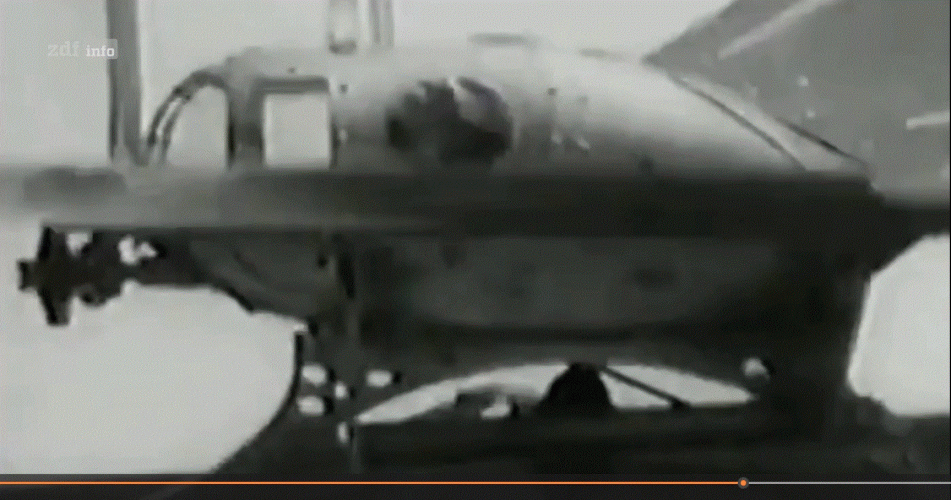
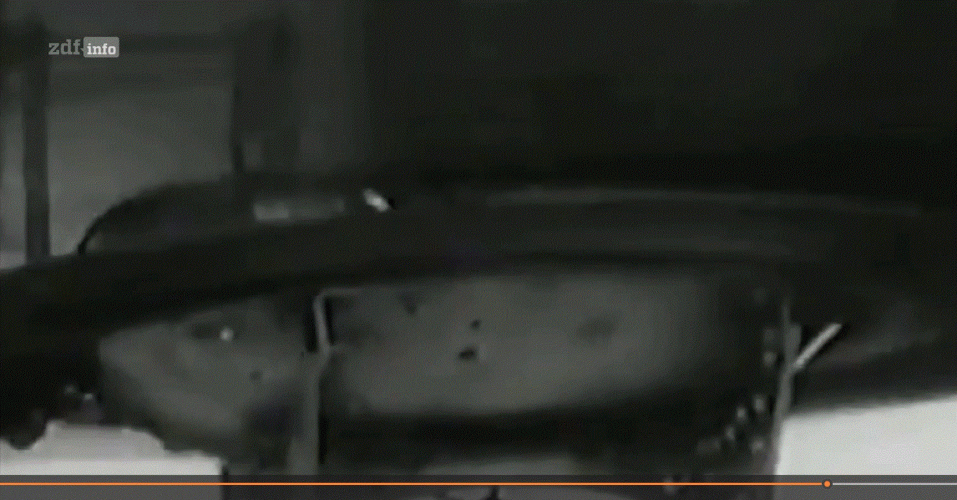
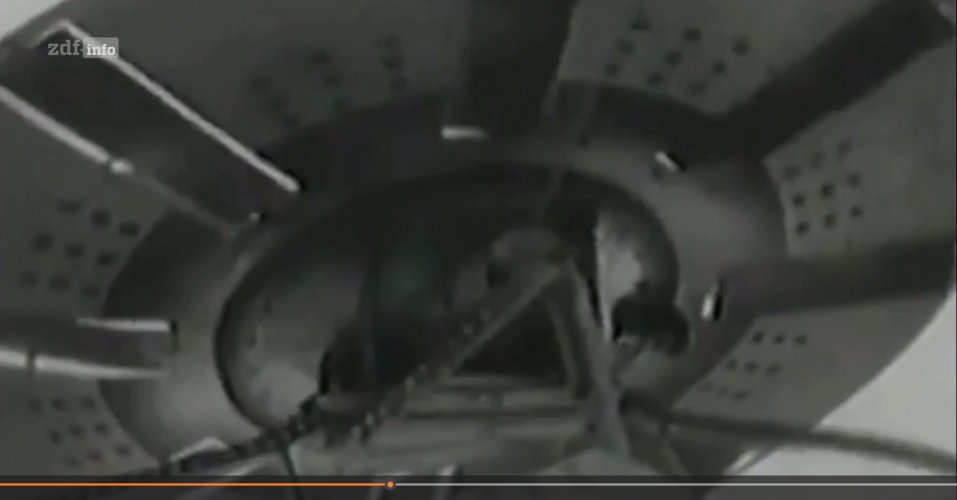
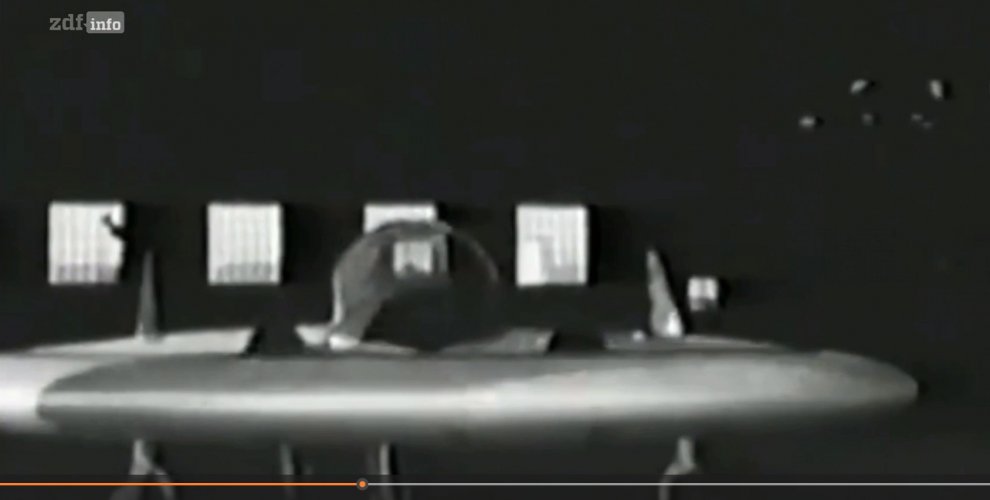
Hello everyone,
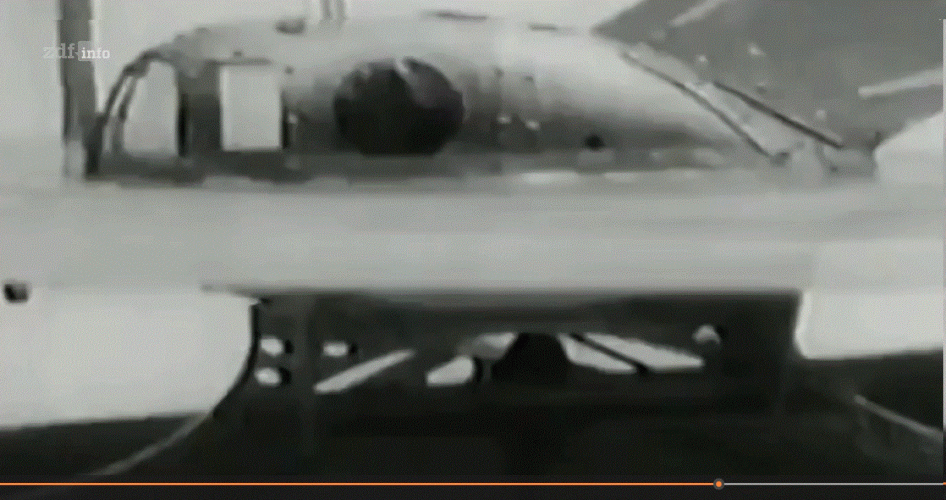
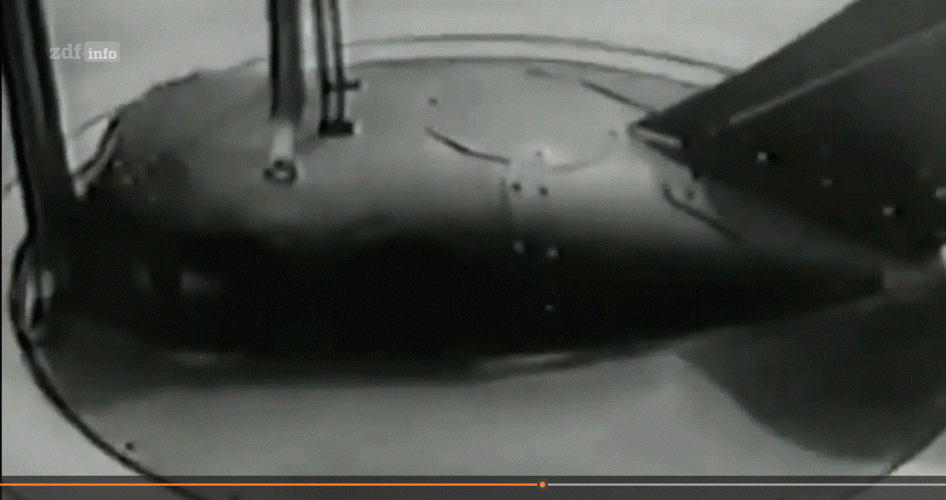
Here’s a very short clip of a flying wheel. I’ve uploaded the video to YouTube so you can have a look.
View: https://youtu.be/S1Uu_ZcyehU
Beforehand some stills from that video
(translated from original post)


Beste Grüße.
Here’s a very short clip of a flying wheel. I’ve uploaded the video to YouTube so you can have a look.
Beforehand some stills from that video
(translated from original post)
Beste Grüße.
Last edited by a moderator:
M53 is simply the fan versione of the Atar9K-50 turbo jet, same core design. It s on wiki too, for what it counts..Mmh... sorry, from Atar 101 to ATAR 09 yes, you can trace origin to Oestrich and Atelier technique aéronautique de Rickenbach (ATAR), with ATAR 09K50 been very last of a long evolution. But the M88 powering Rafale has nothing to do with ATAR apart from being a mil jet engine and being made by the same manufacturer. Same with the M53 powering M2000 and 4000, no connection with ATAR.
Similar threads
-
-
-

-

-
How Could Heinkel-Hirth Compete After the HeS 011 Fell Behind BMW and Jumo?
- Started by hippo2004
- Replies: 16