
You are using an out of date browser. It may not display this or other websites correctly.
You should upgrade or use an alternative browser.
You should upgrade or use an alternative browser.
Bendix « Talos Land System » as possible ICBM interceptor
- Thread starter Sferrin
- Start date
S
sublight
Guest
I've seen that before, it was at White Sands....

- Joined
- 3 June 2011
- Messages
- 20,942
- Reaction score
- 19,176
sublight said:I've seen that before, it was at White Sands....
Yep. Do you know what it was?
S
sublight
Guest
One of the many missile projects my dad worked on.
- Joined
- 3 June 2011
- Messages
- 20,942
- Reaction score
- 19,176
sublight said:One of the many missile projects my dad worked on.
Well that's a safe bet.
 It is the White Sands Missile Range after all. I imagine your dad has all kinds of interesting "war stories". Must be fun to pick his brain.
- Joined
- 3 June 2011
- Messages
- 20,942
- Reaction score
- 19,176

Talos Land System
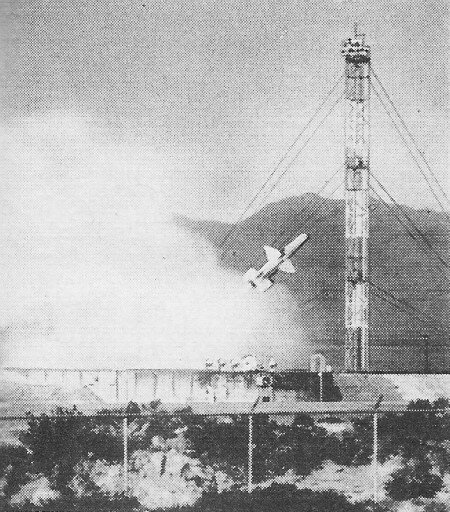
Talos was considered by the Army and Air Force for land defense of targets and the nuclear warhead version was considered as a possible ICBM interceptor.4 In 1955 a "roundhouse" installation was built by the Air Force at White Sands Missile Range, New Mexico, to test the missile as a point defense system for Strategic Air Command air bases. It functioned as a completely automatic system from target designation to intercept and was the most advanced antiaircraft system in existence.
Meanwhile, the Army and Air Force were squabbling over which service should be operating ground based air defense systems. In 1956 the Senate Armed Services Committee ended the bickering by awarding the Army responsibility for land based missiles with a range up to 200 miles. The completed and ready to run Talos Land System was turned over to the Army for evaluation. The Army was developing its own Nike Hercules anti aircraft missile system and had little interest in Talos, even though Talos was operational and Hercules was not. The Army decided to cancel the Talos Land System and disassembled the facility at White Sands."
http://www.okieboat.com/Talos.html
If you like the Talos, this is by far the best source of information I've ever seen. It covers a lot of detail of the ramjet, warhead, operations, performance, history, etc.
pathology_doc
ACCESS: Top Secret
- Joined
- 6 June 2008
- Messages
- 1,896
- Reaction score
- 2,117
Fascinating! I'd imagine that a fully operational land-based system, being entirely free of volume constraints, could accommodate a much greater number of missiles in fully assembled format (possibly even all of them) and more guidance-illuminator sets for a much higher rate of engagement.
Have to admit, though, I'm not sure I like the thought of a nuke-on-nuke engagement using an air-breathing missile as the interceptor vehicle. Was Talos's altitude capability really good enough to lift a powerful enough nuclear warhead high enough to avoid collateral damage? Over the sea it doesn't really matter so much; over sensitive targets, some of which may be civilian, though, it's another story. Possibly the relief from shipboard constraint would have allowed a much bigger rocket booster to be fitted to the ABM version for a better head start, but ultimately it's still an air breather...
Have to admit, though, I'm not sure I like the thought of a nuke-on-nuke engagement using an air-breathing missile as the interceptor vehicle. Was Talos's altitude capability really good enough to lift a powerful enough nuclear warhead high enough to avoid collateral damage? Over the sea it doesn't really matter so much; over sensitive targets, some of which may be civilian, though, it's another story. Possibly the relief from shipboard constraint would have allowed a much bigger rocket booster to be fitted to the ABM version for a better head start, but ultimately it's still an air breather...
- Joined
- 3 June 2011
- Messages
- 20,942
- Reaction score
- 19,176
pathology_doc said:Fascinating! I'd imagine that a fully operational land-based system, being entirely free of volume constraints, could accommodate a much greater number of missiles in fully assembled format (possibly even all of them) and more guidance-illuminator sets for a much higher rate of engagement.
Have to admit, though, I'm not sure I like the thought of a nuke-on-nuke engagement using an air-breathing missile as the interceptor vehicle. Was Talos's altitude capability really good enough to lift a powerful enough nuclear warhead high enough to avoid collateral damage? Over the sea it doesn't really matter so much; over sensitive targets, some of which may be civilian, though, it's another story. Possibly the relief from shipboard constraint would have allowed a much bigger rocket booster to be fitted to the ABM version for a better head start, but ultimately it's still an air breather...
Don't know if you read all the articles at the link but they mention 100,000ft altitude capability. (That's about Sprint altitude. Granted one is going horizontal while the other is passing through 100,000ft headed up.)
pathology_doc
ACCESS: Top Secret
- Joined
- 6 June 2008
- Messages
- 1,896
- Reaction score
- 2,117
And your last sentence basically illuminates my concerns. Talos is built for a flight OUT to a target at high straightline speed on a relatively horizontal flightpath, followed by a brief period of engagement. Some of that last stretch is going to be in coast phase, but the thing is already doing M3.2 or thereabouts at engine burnout and has some energy to spare in thin air. A flight up is another matter - is there going to be enough retained energy for manoeuvre to final engagement if the missile is coasting the last few thousand feet, with practically all the lift needed to be provided by thrust?
Methinks you'd need (as I suggested) a more powerful booster for the first phase, altering the ramjet and tweaking the fuel flow for a later start and a final phase in more rarefied air, possibly changes to the fins which changes the aerodynamic responses and the manoeuvre transfer functions, which requires changes to the electronics, etc. etc. By the time you've finished, is it really still a Talos and would the redesign effort not be better off getting put into a new missile?
I'll give you this: as a stopgap or last resort, it's almost certainly better than nothing.
Methinks you'd need (as I suggested) a more powerful booster for the first phase, altering the ramjet and tweaking the fuel flow for a later start and a final phase in more rarefied air, possibly changes to the fins which changes the aerodynamic responses and the manoeuvre transfer functions, which requires changes to the electronics, etc. etc. By the time you've finished, is it really still a Talos and would the redesign effort not be better off getting put into a new missile?
I'll give you this: as a stopgap or last resort, it's almost certainly better than nothing.

- Joined
- 28 November 2006
- Messages
- 734
- Reaction score
- 867
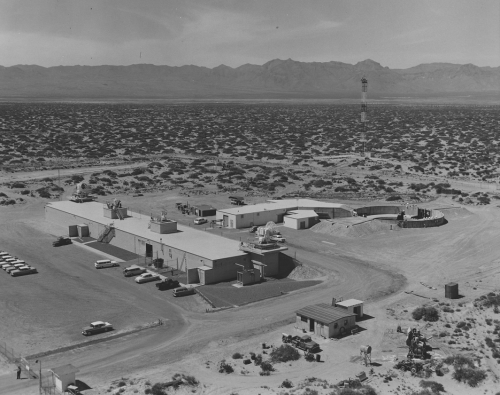
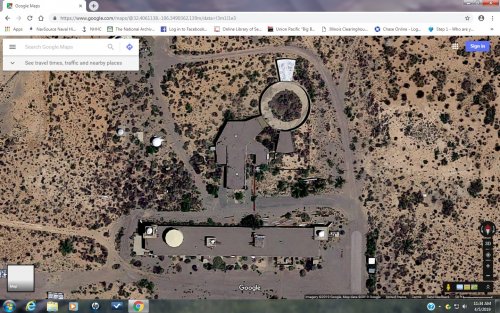
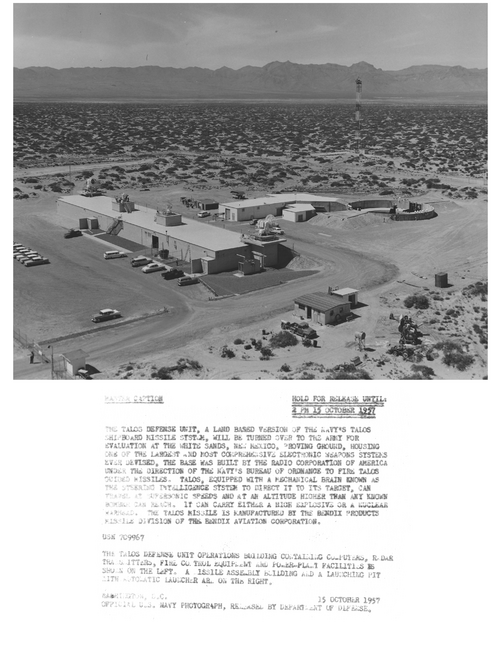
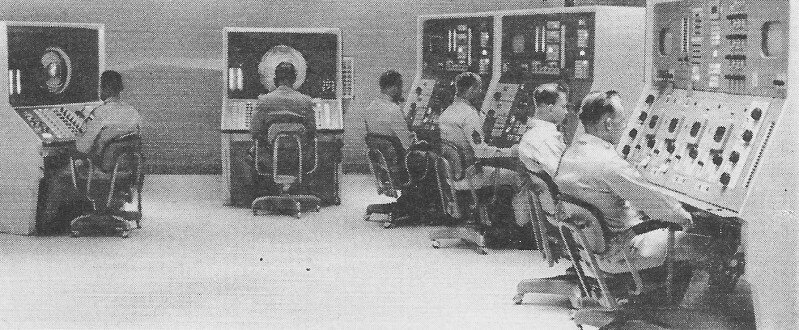
The ground-based Talos system was being referred to as the Talos Defense Unit. It was built at White Sands Proving Ground. Here you have a photo of the TDU with the control center (319 feet long, 80 feet wide, 30 feet high) in the foreground. On its roof there are two target-tracking and illuminating radars and two guidance beam transmitters, which meant that the system could have engaged two targets simultaneously. Behind the radar building the missile firing complex may be seen. It containded a launcher with storage (for six missiles) and reloading facilities.
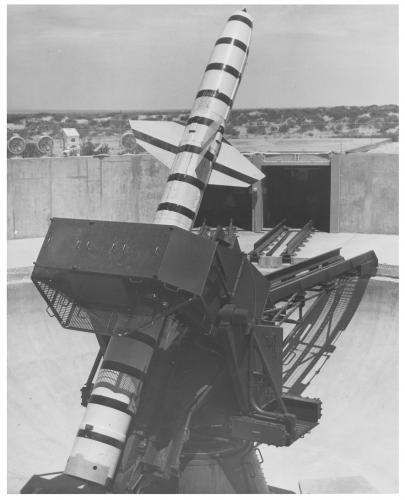
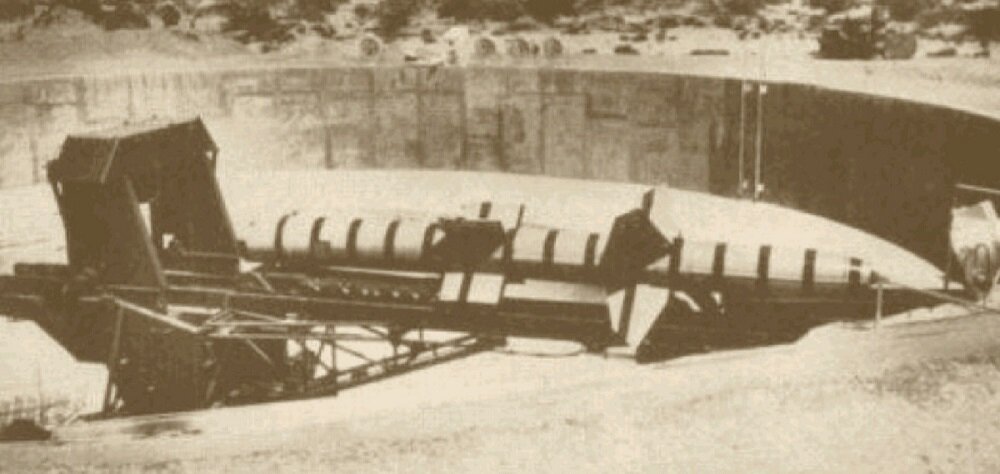
Besides you've got here a photo of a missile on the launcher inside the firing complex.
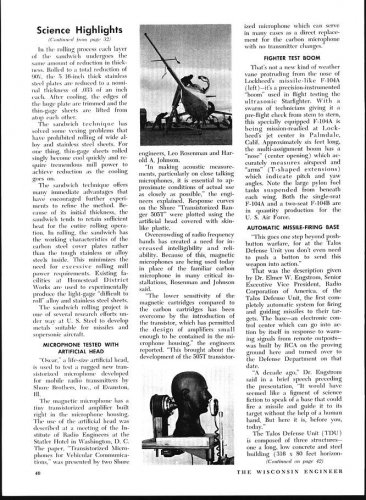
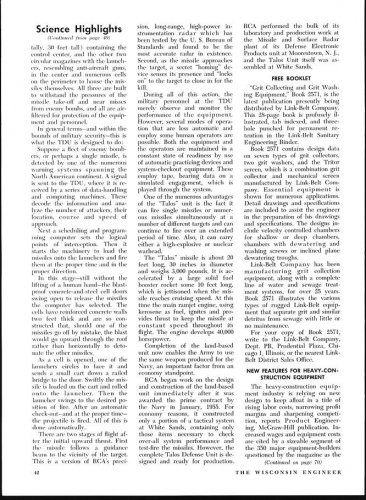
Below you may also find scans of two pages from The Wisconsin engineer Volume 62, Number 5 (February 1958), with a short article on the Talos Defense Unit as well as a chapter on this subject from John Hopkins APL Technical Digest Vol. 3, No. 2, 1982.
Piotr
Besides you've got here a photo of a missile on the launcher inside the firing complex.
Below you may also find scans of two pages from The Wisconsin engineer Volume 62, Number 5 (February 1958), with a short article on the Talos Defense Unit as well as a chapter on this subject from John Hopkins APL Technical Digest Vol. 3, No. 2, 1982.
Piotr
Attachments
pathology_doc
ACCESS: Top Secret
- Joined
- 6 June 2008
- Messages
- 1,896
- Reaction score
- 2,117
Wow, that's a long time between thread posts.
Then again, I've been away for quite a time. Thanks for that info.
Then again, I've been away for quite a time. Thanks for that info.
- Joined
- 28 November 2006
- Messages
- 734
- Reaction score
- 867
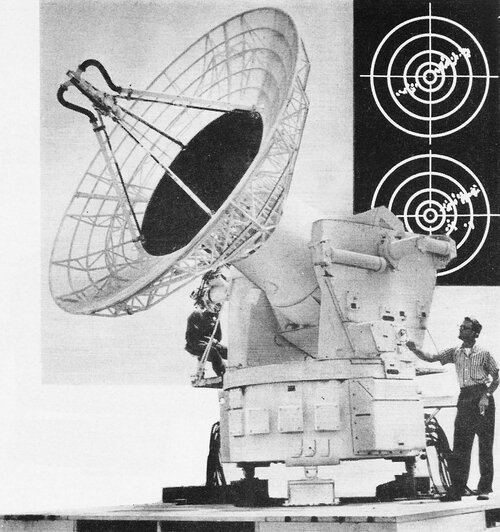
Some photos of the TDU that I've found in my files.
Piotr
Piotr
Attachments

Grey Havoc
ACCESS: USAP
- Joined
- 9 October 2009
- Messages
- 24,500
- Reaction score
- 18,175
Some info on the planned deployment of Land Talos along with NIKE in Western Europe:
In January 1956 West German key officials had been briefed on plans for bolstering American air defenses with NIKE units. In accordance with the Forces convention, the over-all construction program was submitted to the Federal Republic during the following month, and by 17 May 1956 real estate requirements of the NIKE program had been submitted.
By simultaneously confronting the German Federal and Land (State) governments with U.S. real estate requirements, it was hoped that Bonn would apply sufficient pressure to expedite action on the local level. The American Ambassador, however, withheld presentation of requirements to the Bonn Government at this time, pointing out that the Land governments should first be given sufficient time to act on the matter before he approached a high-level government agency. In the event of prolonged delay in acquiring the properties, the Ambassador promised to take action.
Almost immediately the program ran into determined local opposition, especially in the Rhine Palatinate. Resistance to the acquisition of NIKE sites stemmed largely from apprehension over losing agricultural land, from the belief that the presence of the NIKE installation would increase the danger of air attack, and from widespread opposition to rearmament. The problem was further complicated by U.S. Air Force insistence that TALOS missiles be used at four of the sites. When the U.S. Embassy requested the Federal Republic to assist in overcoming state opposition, Bonn drew attention to the constitutional restrictions that greatly limited the Federal Government's coercive power.
By April 1957 only 6 of the 24 NIKE sites had been definitely acquired. Of the 24 sites, 16 were to be located in the Palatinate, 2 in Hesse, 5 in Baden-Wuerttemberg, and 1 (tentative) in the Saarland. Baden-Wuerttemberg first approved all 5 sites, but local political pressures limited final approval to only 2. Hesse steadfastly refused to approve any sites, while by May 1957 the Palatinate had actually given final approval to the acquisition of only 5 and partial approval to 3 of the 16 sites. The German representatives declared that, since opposition to the NIKE program was increasing, they would be unable to make any further commitments in the foreseeable future .
https://usarmygermany.com/Sont.htm?...om/Units/Air Defense/USAREUR_ADA Overview.htmIn November 1956 the Department of Defense decided to withhold funds for NIKE construction pending evidence of coordinated Army-Air Force planning for the use of surface-to-air missiles. To prevent further delay in NIKE construction, US EUCOM suggested concurrent planning for both the NIKE and TALOS missiles. Since TALOS units were not programmed for Europe until FY 1960, and any delay in NIKE construction would leave U.S. forces in Europe exposed to unopposed nuclear air attacks, USAREUR wanted the construction funds to be released without further delay. The TALOS units, when made available, could be integrated into an air defense system in priority areas determined by a joint USAREUR-USAFE air defense planning committee.

Dilandu
I'm dissatisfied, which means, I exist.
The system would be at best semi-mobile, or more likely "transportable". And it would basically be an analogue of already-existing Nike-Hercules (which was already in service and running when Talos was still under testing).It's a pity a mobile Land Talos wasn't developed and deployed to Western Europe.
- Joined
- 5 May 2007
- Messages
- 2,017
- Reaction score
- 4,278
Entirely fixed base, AFAIK.The system would be at best semi-mobile, or more likely "transportable"
I assume the USAF must have seen some advantage to Talos over Nike-Hercules, but I can't think what it was. Beyond being operated by men in blue suits, that is.
Dilandu
I'm dissatisfied, which means, I exist.
Well, I'm not sure; the components were designed for being ship-based, so they are at least theoretically transportable. As much as "Nike", I suppose; "Nike" were considered "mobile", because they could be moved from one prepared position to another in just a few weeks.Entirely fixed base, AFAIK.
Well, the fire control capabilities, I suppose. "Nike-Hercules" was strictly "one-one" weapon, i.e. just one target could be tracked and engaged with just one missile simultaneously (if the missile failed fo do the job, the second could be launched, but not two at once). Those limited capabilities could not be remedied without basically building a second "Nike" battery.I assume the USAF must have seen some advantage to Talos over Nike-Hercules, but I can't think what it was. Beyond being operated by men in blue suits, that is.
"Talos", on the other hand, was designed as capable of engaging two targets with any number of missiles each. While warships were limited by the launchers reloading time, there were no reason why land-based "Talos" can't have all its missiles on individual launchers, fully primed and ready to launch (there were no need to save space on land, so no need for pre-launch fin installation; missiles could be just stored finned). And theoretically, it was possible to increase the number of fire control channels by just adding more radars.
So in terms of fire control, land-based "Talos" was clearly superior; it could engage two targets simultaneously, each with basically any number of missiles.
The disadvantage was, that "Talos" missile was much more complex than "Nike-Hercules" missile. "Talos" dual guidance reuired much more complex - and costly! - electronic, than "Nike-Hercules" command guidance. Also "Talos" warhead were smaller, and it was not capable of carrying massive 30-kt "skyburner" warhead like "Nike-Hercules" could.
Dilandu
I'm dissatisfied, which means, I exist.
To summarise advantages and disadvantages:
Nike-Hercules:
+ was already available by late 1950s;
+ was able to use existing "Ajax" sites with reasonable scale of refit;
+ was cheaper per shot;
+ could carry much heavier warheads;
- could engage just single target with single missile;
- accuracy decreased with distance;
- have priblems with low-altitude interceptions;
Land-based Talos:
+ have far more capable fire control (could engage two targets with any number of missiles each);
+ did not suffer from decreasing accuracy with distance;
+ was able to engage low-altitude targets (at least in theory);
+ potentially have more capacity for improvement;
- was much costlier and required more maintenance per missile;
- could not carry heavy nuclear warheads;
- required entirely new missile bases to be build;
- in late 1950s was still in testing, and may not be ready for service for some time
Nike-Hercules:
+ was already available by late 1950s;
+ was able to use existing "Ajax" sites with reasonable scale of refit;
+ was cheaper per shot;
+ could carry much heavier warheads;
- could engage just single target with single missile;
- accuracy decreased with distance;
- have priblems with low-altitude interceptions;
Land-based Talos:
+ have far more capable fire control (could engage two targets with any number of missiles each);
+ did not suffer from decreasing accuracy with distance;
+ was able to engage low-altitude targets (at least in theory);
+ potentially have more capacity for improvement;
- was much costlier and required more maintenance per missile;
- could not carry heavy nuclear warheads;
- required entirely new missile bases to be build;
- in late 1950s was still in testing, and may not be ready for service for some time
Dilandu
I'm dissatisfied, which means, I exist.
P.S. Just noticed one interesting detail about land "Talos" all missiles on photos lack bow antennas of semi-active homing guidance. It looks like USAF wanted to operate only nuclear-tipped missiles (which does not require semi-active guidance, being purely beam-riders) and therefore opted for much simpler system than naval ones.
It's logical, by the way. The "Nike-Hercules" missiles on American territory were also nuclear-tipped only, with conventional warheads being used only for training shots. So it make sence for USAF to want only nuclear "Talos".
It's logical, by the way. The "Nike-Hercules" missiles on American territory were also nuclear-tipped only, with conventional warheads being used only for training shots. So it make sence for USAF to want only nuclear "Talos".

In a 1950s film on the TDU, a scale model of the land-based Talos system built by RCA displays that the original concept for the site was more elaborate. The original RCA concept model incorporated two launcher pits that shared a common missile assembly/checkout area. Surrounding each launcher pit were 30 Talos missile storage cells, arrayed 360 degrees around the launcher. These numerous launcher cells were incorporated under a common roof that encircled the perimeter of the building, giving the launcher cell amore streamlined plan. Obviously this model was scaled back for the prototype at WSMR, which was based on a single launcher cell and two storage cells each containing two internal bays.
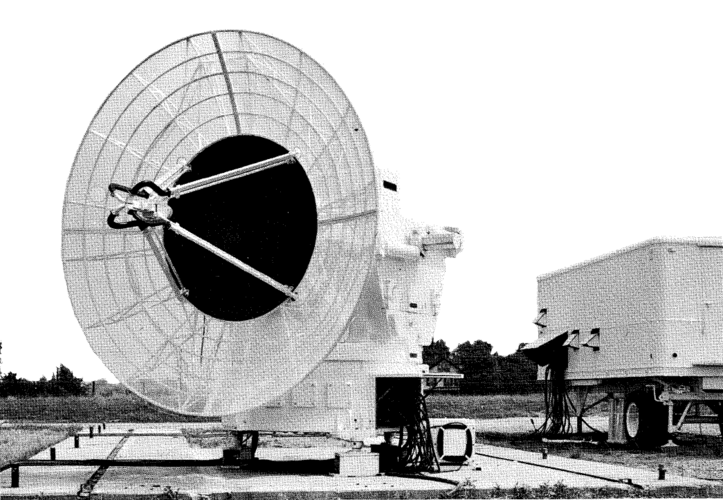
The separate, windowless control building held the computers and support systems for two C-band, monopulse radar units mounted on the roof of the building. These radar units were variants of the AN/FPS-16 radar adapted as target trackers for the TDU under contract NOrd15642 that were designated as the AN/FPQ-4 radar (Mills 1959:2-5). The difference between the AN/FPS-16 and AN/FPQ-4 radars appears to be primarily one of technical nomenclature; most sources identify the TDU radar units as AN/FPS-16s (Brown and Meyer 1982; Phillips 1958). Two additional C-band guidance radars were also centrally located on the roof of the control building. The RCA scale model of the TDU incorporated four of these radars to accommodate the two Talos launchers, but was otherwise consistent with the actual constructed building.
The AN/FPQ-4 radars tracked and illuminated the targets once acquired, while the guidance radars supported mid-course guidance. The system was also capable of multiplexing, where it could guide several missiles simultaneously to multiple targets by switching the radar illumination from target to target during the terminal flight phase of each missile.
The First Tactical Talos W provided the capability to carry a nuclear warhead whichcould destroy large fleets of aircraft, an important tactical advantage over the non-nuclear Nike-Ajax system (Garten and Dean 1982). The land-based Talos was therefore designed around the “W” version of the Talos missile.
Attachments
I assume the USAF must have seen some advantage to Talos over Nike-Hercules, but I can't think what it was. Beyond being operated by men in blue suits, that is.
A lot of it was "Empire building" that became obsolete rather fast due to changing conditions.
The USAF started work on BOMARC in 1949; but the first BOMARC A (250+ mile range) didn't IOC until 1 Sep 1959; with BOMARC B (500+ mile range) IOCing 1 June 1961.
The Air Force needed a "quick deploy" program to show up while they were waiting for BOMARC; to prevent the Army from grabbing the entire ADA mission with NIKE.
That's why Land-Based Talos was started in 1954-1955 by the USAF; because TALOS with it's 100-150 mile range would be ready earlier than BOMARC to grab "second generation ADA" contract dollars and mindspace.
Two things then happened:
Army kept plugging away with NIKE B (Hercules) and started operational deployment on 30 June 1958; having designed the missile to "plug in" wherever possible with existing NIKE I (Ajax) installations.
And more importantly, in 1957, the Army managed to steal away TALOS from the USAF in a turf battle over the definition of "long range" -- it's why NIKE ZEUS A (Winged Zeus) had a very short 75 mile range; since that's the maximum range the Army was allowed.
When the definition of "long range" was changed to anything under 200 miles (roughly) to the Army, and anything over 200 miles to the Air Force, Talos was short ranged enough to go to the Army, while BOMARC A stayed with the Air Force.
By that time in 1957; HERCULES with it's 50 mile range (soon to be extended to 75) was almost ready (one year to deployment); and could be plugged into the (very expensive) AJAX built-out network; whereas TALOS was longer ranged, but would require all new sites to be built.
The only other option available for an Army deployment of TALOS was the ABM mission, performed with a nuclear warhead. The early studies on ABM for TALOS and BOMARC had an outsized influence -- these mission(s) would have been performed with nuclear warheads; and if you look at the public version of the MIRV History:
"The ABM system assumed to be a threat to MINUTEMAN three to four years hence, i.e., for the time period 1965-1968 was still the SA-4. Because of the SA-4 relatively low altitude capability it was expected that [DELETED]
you start to understand where the "jammers+decoys" line for ABM penetration comes from -- they're not meant to get past a purpose built ABM system like ZEUS; but to get past an "augmented" SAM system like TALOS.
ZEUS, with it's much more powerful purpose built radar complex + discrimination computers, could easily defeat decoys; while TALOS struggled; so there was no reason for the Army to pursue an interim TALOS ABM complex, when ZEUS was coming.
Similar threads
-
Talos, the SPG-56 and the SPG-61
- Started by M. A. Rozon
- Replies: 106
-
-

-

-
Common Autonomous Multi-Domain Launcher (U.S. Army, late 2020s)
- Started by Grey Havoc
- Replies: 0