There was an entry in
American Secret Projects: Bombers, Attack and Anti-Submarine Aircraft 1945 to 1974, which does mention this on page 70-71
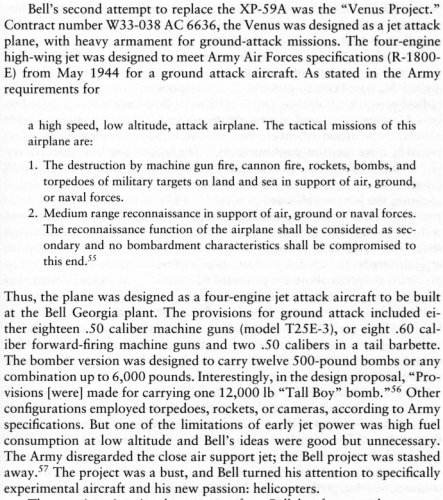
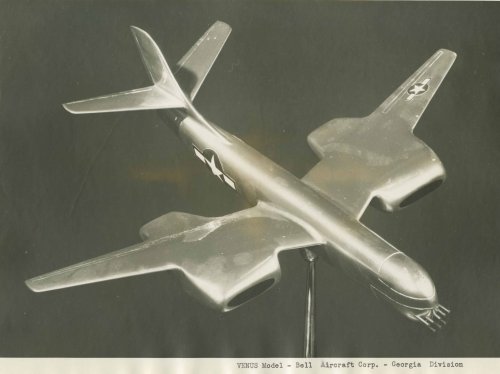
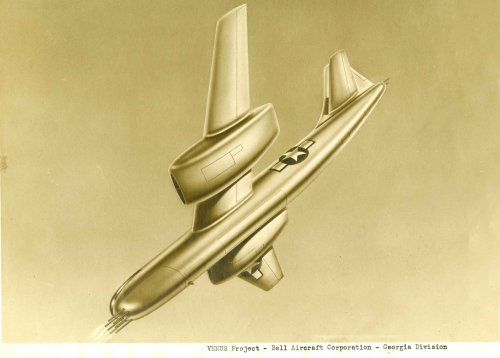
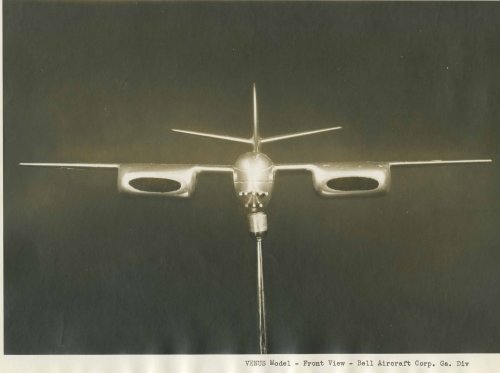
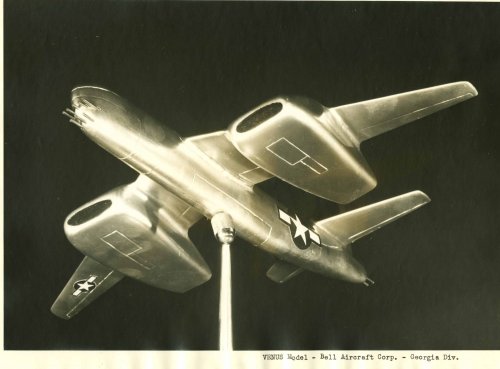
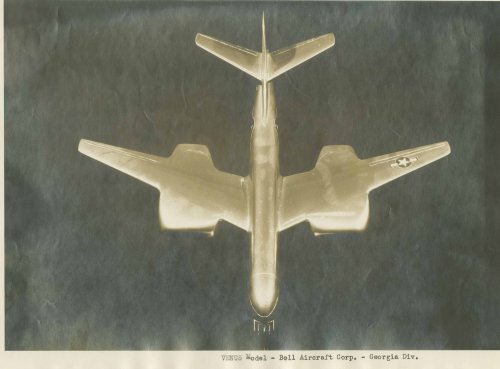
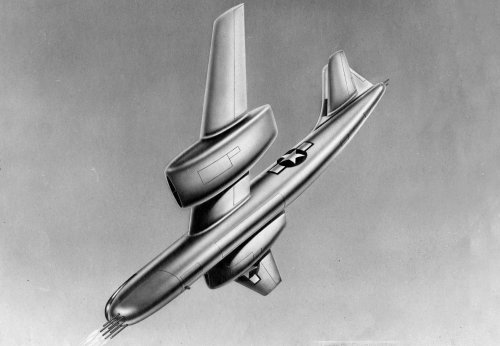
Bell Georgia Division's Venus high-speed, low-altitude, swept-wing attack aircraft was also prepared against the 10 March 1945 Design Directive. This stated both attack and bomber versions, a desired speed of 600 mph (965 km/h) at sea level (500 mph/805 km/h was the minimum acceptable), service ceiling of 30,000 ft (9,144 m) (acceptable minimum 25,000 ft/7,620 m), a defensive turret with two 0.50 in (12.7 mm) machine guns and combinations of bomb loads up to 6,000lb (2,722kg). There was to be an interchangeability between fuel and bombs and provision was also to be made for one 12,000 lb (5,443 kg) Tallboy bomb. The offensive guns were to comprise no fewer than sixteen forward-firing 0.50 in (12.7 mm) machine guns, although other types could be used and in its proposal Bell offered an alternative with eight forward-firing 0.60 in (15.2 mm) guns. The design gross weight figure was to include twelve 500 lb (227 kg) bombs carried internally and the dive speed limit was to be 110% of the maximum Mach number attained in level flight.
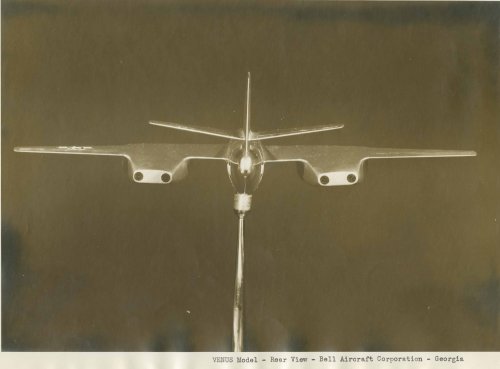
...Bell received a contract to proced with further development of its design in three different forms, two attack types with the different nose gun arrangements and a pure bomber. The 'attacker's' crew would comprise the pilot, co-pilot and tail gunner, while the bomber version would add a bombardier-navigator in the nose. Venus's four TG-180 (J35) jet engines were to be housed in two streamlined nacelles underneath the wing, the attack versions both carried 4,600 gal US (17,413 lit) of fuel for a range of 2,800 miles (4,505 km), and the bomber 3,980 gal (15,066 lit) for a range of 2,400 miles (3,862 km). Gross weight for the 0.50 in (12.7 mm) nose gun version was 66,661 lb (30,237 kg), for the 0.60 in (15.2 mm) gun version 66,386 lb (30,113 kg), and for the bomber 63,029 lb (28,590 kg). It is understood that the Venus's maximum speed was in the 500 mph (805 km/h) range (560 mph/901 km/h with more powerful engines), the ceiling when carrying a full load was 26,520 ft (8,001 m) and there wrere potential problems with controllability when flying at high speed and low level.
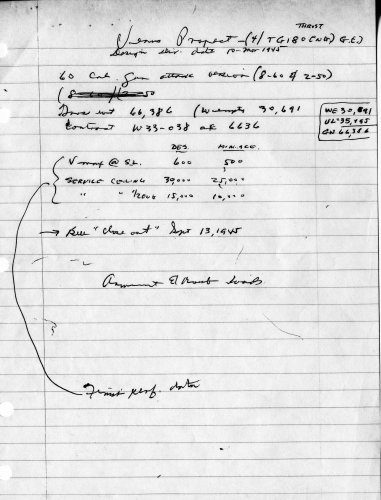
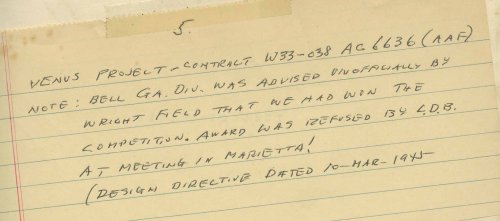
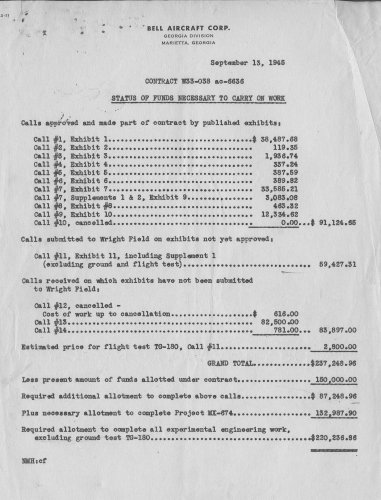
...A handwritten note in the surviving documents (in ballpoint pen, so not written at the time) states that Bell was 'advised unofficially that it had won the competition', but in May 1945 AAF suppport for the project was stopped and the Venus was 'closed out ' on 13 September 1945 (which it is assumed means the data of final abandonment).
This does seem to conform to what
Dynoman has posted in the PDF, though the PDF is more detailed in terms of the variations in gun and bomb-load. It is suprising that the aircraft was only stressed to +3.67/-1.5 g which is actually less than the A-26 (Normal-rated L/F = 4.27g).
The USAAF had adopted ideas for tactical bombing operations from the RAF's experience with the Desert Air Force, whcih called for two basic types of aircraft: A fighter able to gain air-superiority as well as carry out a secondary air-to-ground mission, which could also include variants for photo-reconnaissance, and; a fast-attack bomber.
Both the USAAF and RAF had excellent fighters, but the RAF might very well have had some fast-attack bombers that were either sturdier or more maneuverable than ours. Examples of this would include the Bristol Beaufighter and the De Havilland Mosquito (though I think it appeared fairly late in the campaign) and both were more maneuverable than the A-20's which we used (the Mosquitos had ultimate-rated L/F of 8g at design-weight).
Regardless of whether they were interested in executing dive-attacks or simply level bombing, a higher L/F gives more agility which often helps assist survivability and based on the A-26 and the Mosquito: I'd figure they'd have wanted no less than 4.27g and preferably 5.33 (2/3 the ultimate rated L/F for the Mosquito).
Could it be that Bell Model 31 was in contention with the Curtiss XA-43 which became the Curtiss XF-87?
I'm not sure, but it's possible that the designation was handed over to a project that was cancelled. That did happen with the XA-43/XF-87, and I think the initial XF9F-1 was a night-fighter (if I recall, it looked like an F7F with a double-pod in each wing replacing the R-2800).