Beechcraft biplane fighter designs

lark

ACCESS: Top Secret
Senior Member
Joined
17 February 2006
Messages
1,892
Reaction score
374
I read a long time ago(the memory fails where) that Beech produced
a few fighter aircraft designs ( late 30's ?) using their -Staggerwing - principle.

Is there someone who knows more.(descriptions- drawings?)

Thanks...
 
My dear lark,

a little information may be help you,was Beech UC-43B with
Staggerwing and registration as NC1193V and N1193V.
 
Thanks Hesham,but the UC-43 was known very well and NOT a fighter (P or F) design.
 
My dear lark,

please read this;
 

Attachments

  • untitled.JPG
    untitled.JPG
    49.7 KB · Views: 1,275
Hesham, a UC-43 and a C-45 are two different aircraft. The UC-43 is based on the Beech Staggerwing and the C-45 is based on the Beech 18 twin.
 
PURSUIT17.jpg

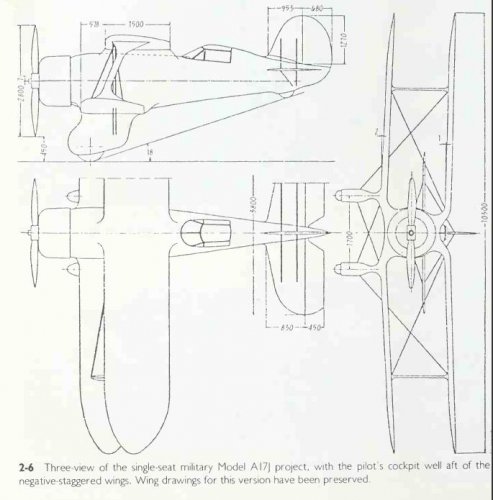
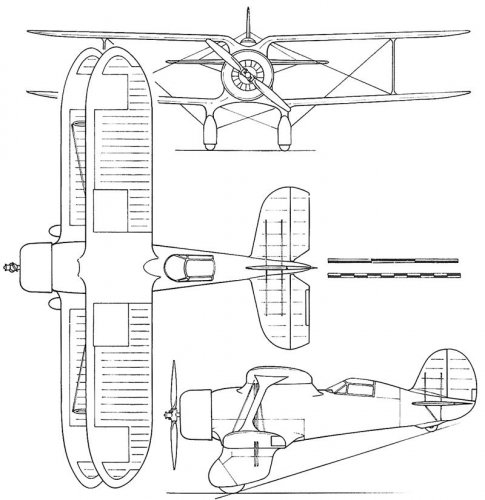
Model 17 based Pursuit circa 1932, drawing from 'Beech Aircraft and Their Predecessors' by Pelletier. The book lists it as the Model 17J, but
based on descriptions in 'The Staggerwing Story' by Phillips it is more likely the A17R, as the 17J was intended to have a two man crew.
A floatplane version was also planned with a single central float and wing mounted stabilizing floats.
Four .30 MG or two .30 and two .50 MG, provision for a 500lb bomb on the centreline of the land-plane.
Wright R-975E3 'Cyclone'.
Span: 34' 4"
Length:26'
Max speed: 220 mph at 2,000'
Ceiling: 22,000'
Empty weight: 2,650 lb
Max weight: 5,100 lb

BEECHPB.jpg

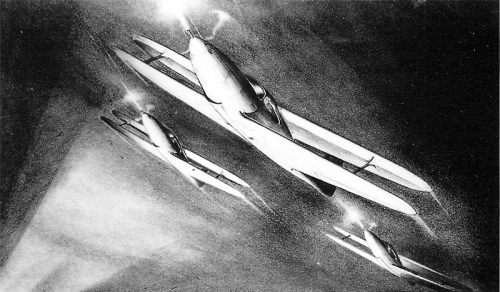
'Beechcraft Pursuit Biplane' designed early in 1940.
One 37mm cannon and one each .30 and .50 MG.
Allison V-1710 of 1,200 hp mounted behind the pilot, as in the P-39.
Span: 32'
Length: 36'
Max speed: 350 mph at 13,200'
Cruise: 318 mph
Max weight: 6,200lb


Cheers, Jon

 
This it is.Great find! I knew it was somewhere...
Thanks Jon...
 
You're welcome Lark.
BTW the wings from the Sword kit in 1/72 or the AMT kit in 1/48th could be used to model the A17R.

I've been thinking about modifying an Airacobra into the BPB.

Cheers, Jon
 
Excellent idea , but the Beech BPB fighter looks very sleek
compared with the P.39 , unless you have seen a side or 3 view
of the PBP to rely on...
 
Seeing as its an artists rendition, I'm not too sure how sleek it would have been. ;)

Check out artist's renderings and advertisements of the P-39 from the war period...it's much sleeker in those ads than it was in reality.

As to other illustrations, that is the only one I've ever seen.

Cheers, Jon
 
joncarrfarrelly said:
PURSUIT17.jpg

Model 17 based Pursuit circa 1932, drawing from 'Beech Aircraft and Their Predecessors' by Pelletier. The book lists it as the Model 17J, but
based on descriptions in 'The Staggerwing Story' by Phillips it is more likely the A17R, as the 17J was intended to have a two man crew.
A floatplane version was also planned with a single central float and wing mounted stabilizing floats.
Four .30 MG or two .30 and two .50 MG, provision for a 500lb bomb on the centreline of the land-plane.
Wright R-975E3 'Cyclone'.
Span: 34' 4"
Length:26'
Max speed: 220 mph at 2,000'
Ceiling: 22,000'
Empty weight: 2,650 lb
Max weight: 5,100 lb

BEECHPB.jpg

'Beechcraft Pursuit Biplane' designed early in 1940.
One 37mm cannon and one each .30 and .50 MG.
Allison V-1710 of 1,200 hp mounted behind the pilot, as in the P-39.
Span: 32'
Length: 36'
Max speed: 350 mph at 13,200'
Cruise: 318 mph
Max weight: 6,200lb


Cheers, Jon

Any chance of reposting those pics?
 
As requested:

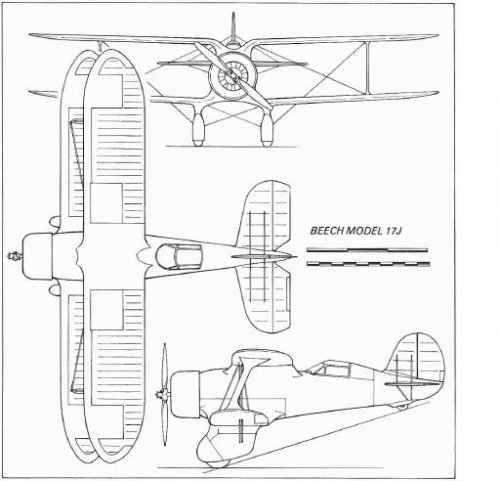
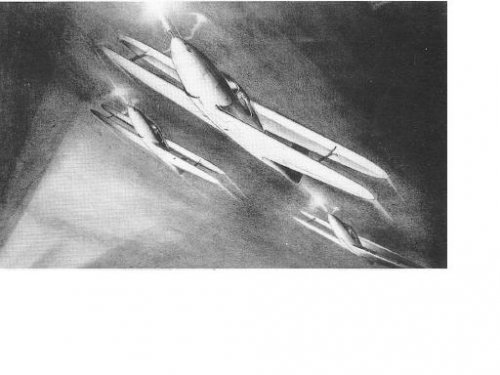
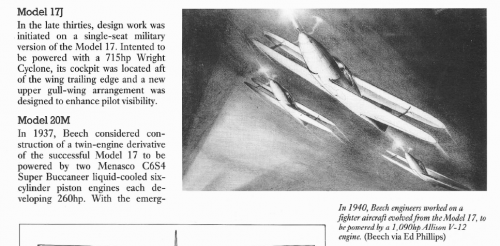
The second picture is with an Allison 1,090 hp V-12 instead of the original 715 hp Wright Cyclone and the cockpit has been moved ahead of the wings
 

Attachments

  • Beech Model 17J 3D Drawing.JPG
    Beech Model 17J 3D Drawing.JPG
    35.5 KB · Views: 310
  • Beech Model 17J.JPG
    Beech Model 17J.JPG
    27.7 KB · Views: 334
Loren said:
The second picture is with an Allison 1,090 hp V-12 instead of the original 715 hp Wright Cyclone and the cockpit has been moved ahead of the wings

Was it intended to be a ground controlled nightfighter?
 
Grey Havoc said:
Was it intended to be a ground controlled nightfighter?

Don't think so, as it's a design from the early '40s, whereas, AFAIK, early warning radar wasn't
fielded (without great enthusiasm !) before the end of 1940. And those radar systems, still had
no means of height measurement, IIRC. So it would have been difficult to guide a fighter at night
to an intruder. Additionally, there probably still was no fear in the US to be attacked from the air.
 
Was it intended to be a ground controlled nightfighter?
Doesn't say. It just says that Beech engineers worked on a 1940 fighter aircraft evolved from the Model 17, no designation with it.
 
Loren said:
As requested:

The second picture is with an Allison 1,090 hp V-12 instead of the original 715 hp Wright Cyclone and the cockpit has been moved ahead of the wings

The whole Info and drawing.
 

Attachments

  • L-1.png
    L-1.png
    365 KB · Views: 598
Greetings All!

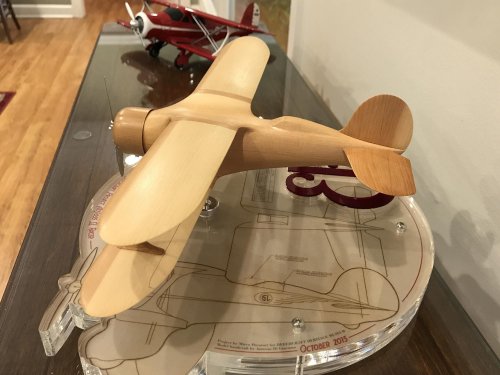
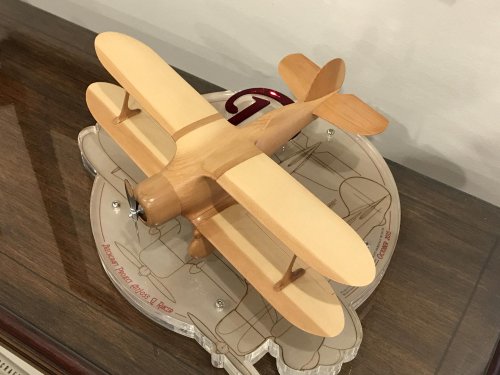
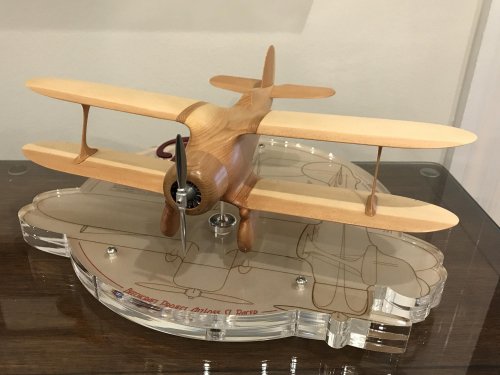
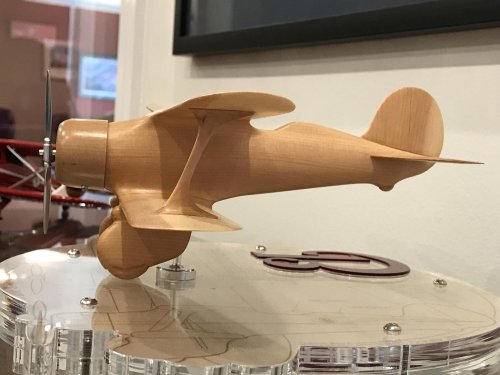
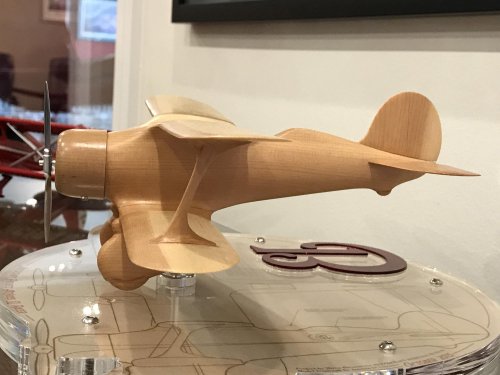
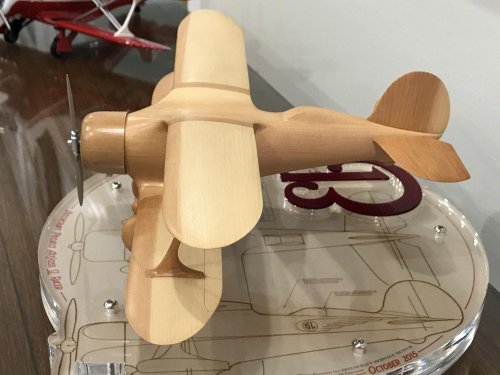
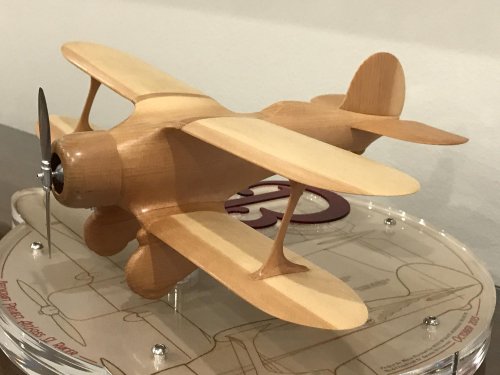
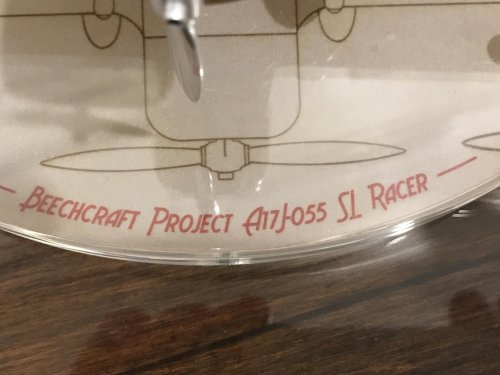
Back in mid-October, I went to the "Beech Party" at the Beechcraft Heritage Museum in Tullahoma, TN. What a great event and what an amazing Museum.

In one of the offices was this fine model of the 17J-55 SL, very similar if not the same as Loren's posting with the 3 view. I took this as being a long distance racer when I saw it and the base seems to confirm that.

A beautiful model.... Mark
 

Attachments

  • zMG_9453.jpg
    zMG_9453.jpg
    251 KB · Views: 94
  • zMG_9456.jpg
    zMG_9456.jpg
    269.6 KB · Views: 82
  • zMG_9455.jpg
    zMG_9455.jpg
    249.6 KB · Views: 83
  • zMG_9465.jpg
    zMG_9465.jpg
    233.1 KB · Views: 79
  • zMG_9464.jpg
    zMG_9464.jpg
    228.1 KB · Views: 76
  • zMG_9468.jpg
    zMG_9468.jpg
    232.4 KB · Views: 324
  • zMG_9460.jpg
    zMG_9460.jpg
    219.4 KB · Views: 355
  • zMG_9463.jpg
    zMG_9463.jpg
    145.1 KB · Views: 378
Model 17 based Pursuit circa 1932, drawing from 'Beech Aircraft and Their Predecessors' by Pelletier. The book lists it as the Model 17J, but
based on descriptions in 'The Staggerwing Story' by Phillips it is more likely the A17R, as the 17J was intended to have a two man crew.
A floatplane version was also planned with a single central float and wing mounted stabilizing floats.
Four .30 MG or two .30 and two .50 MG, provision for a 500lb bomb on the centreline of the land-plane.
Wright R-975E3 'Cyclone'.
Span: 34' 4"
Length:26'
Max speed: 220 mph at 2,000'
Ceiling: 22,000'
Empty weight: 2,650 lb
Max weight: 5,100 lb

'Beechcraft Pursuit Biplane' designed early in 1940.
One 37mm cannon and one each .30 and .50 MG.
Allison V-1710 of 1,200 hp mounted behind the pilot, as in the P-39.
Span: 32'
Length: 36'
Max speed: 350 mph at 13,200'
Cruise: 318 mph
Max weight: 6,200lb

Cheers, Jon
update to post from 2007 with defunct image links
 

Attachments

  • PURSUIT17.jpg
    PURSUIT17.jpg
    78.5 KB · Views: 111
  • BEECH_PURSUIT_01.png
    BEECH_PURSUIT_01.png
    219.1 KB · Views: 126
In November 1936, the Soviet Polikarpov I-16 monoplane fighter entered combat prematurely without being sufficiently tested.

During operations in Spain and China it was shown that their absence of flaps and unreliable undercarriage retraction system were inefficient to operate from poorly equipped airfields that were unprepared for high-speed landings.

The I-16 lacked the automatic starting system of the American fighters, and their engines were to be put into operation using a Hucks starter tuck. The procedure was slow, and in the meantime the airfield was to be defended by I-15 and I-152 biplanes against strafing attacks.

The I-16 was particularly vulnerable in dogfight against monoplanes (Messerschmitt Bf 109 in Spain, Mitsubishi A5M2 in China, Nakajima Ki.27 in Khalkhin Gol and Brewster B-239 in Finland) that used hit-and-run combat tactics.

These battle experiences encouraged a belief in the supposed ability of the Soviet biplanes in close combat against monoplanes. In 1938, Polikarpov design team decided to return to the biplane configuration with the I-153, a new fighter with pneumatic rearward retracting landing gear and 12.4 seconds turning time, an over-development of an obsolete concept that was outdated from its very beginning and just managed to survive the monoplanes combat tactics by using evasive maneuvers.

Why then do the Soviet devotion to the biplanes?

Basically, a biplane fighter had a higher ceiling and climbing speed and better maneuverability than a monoplane equipped with the same engine. It also needs a shorter landing strip for take-off. All these advantages were counterbalanced by the higher speed of the monoplane but, for the Soviet designers, it was not clear if the new French engines with more than 1,000 hp could be manufactured under license by the local industry of 1940.

During the 1930s, some designers began to consider ways of combining the take-off and landing characteristics and maneuverability of biplanes with the high speed of monoplanes and carried studies which retained agility inherent to biplanes while featuring improved performance.

In 1936 the French built the experimental prototype Bleriot-SPAD 710, a biplane fighter equipped with retractable landing gear.

The Americans built several naval fighters equipped with retractable landing gear Curtiss BF2C-1 (1934), Grumman F2F-1 (1935) and F3F-1 (1936).

In 1938 the Canadians built the fighter and attack aircraft Gregor FDB-1 also equipped with retractable landing gear.

Other imaginative designers decided to transform Hawker Hurricane and Republic XP-44 monoplane fighters into biplanes with the installation of an auxiliary upper wing jettisonable to assist short take-off.

In 1939, Soviet designers V. Nikitin and V. Sevchenko built a prototype of variable geometry in which the landing gear was hidden in the lower wing and then this wing folded upwards until it was hidden inside the upper wing, transforming the biplane into a monoplane during flight.

But the time of maneuverable biplane fighters has already passed, the realities of combat prevailed over theories and biplane fighters were relegated to attack missions in which they proved surprisingly useful in the ground support role thanks to its ability to operate from improvised airfields near the front lines.

After the Munich Agreement, the British realized that they were unprepared for the war because London was defended by Hawker Fury biplane fighters.

Alarmed by the rapid development of the new German monoplane fighters, the countries lacking a sufficiently advanced aeronautical industry, encountered many difficulties to get supplies of fighters in the international market.

The demand for modern aircraft shot up and the supply retreated until it disappeared completely when all European countries demanded some kind of protection against the threat of the Luftwaffe bombers.

Then the demand for fighters went to American industry, but it turned out that the production capacity of Curtiss and Boeing was saturated by the enormous orders of planes made by French and British.

During the Battle of France in May 1940 it was shown that the Fairey Battle and Breguet 693 light bombers proved incapable of stopping the advance of the panzers.

This military disaster opened a new market in attack aircraft for American manufacturers.

North American began exporting the NA-69, an attack version of the AT-6 advanced trainer, Brewster built the XA-32 prototype specializing in attack and dive bombing, Northrop was very successful with the export of the Model A-17A and in 1942, North American began manufacturing the A-36A, a dive-bomber/ground attack version of the Mustang.

When the Bell P-39 fighter project was about to be cancelled following the decision to eliminate the turbo-supercharged engine, the Beechcraft company proposed the construction of a single seat attack plane based on the airframe of the Beech Model 17 with the new propulsion system originally developed for the Airacobra and armed with one 37-mm Oldsmobile anti-tank gun firing through the propeller hub and two nose mounted 0.3-in and 0.5-in machine guns.

The light and cheap airframe of the Model 17 was expected to have exceptional STOL characteristics thanks to the power of the Allison V-12 engine.

Beechcraft Pursuit Plane 1940 project technical data

Wingspan: 9.60 m, length: 8.880 m, height: 3.06, Max weight: 2,809 kg, Max speed: 563 km/h, power plant: one Allison V-12 engine rated at 1,090 hp.
 

Attachments

  • 131.jpg
    131.jpg
    799.5 KB · Views: 128
  • 133.jpg
    133.jpg
    840.6 KB · Views: 117
The attached drawings can't be downloaded. Justo, could you please upload again?
Thanks!
 
Beechcraft Pursuit Plane 1940
Nice plans, @Justo Miranda ! And quite obviously a very different design from the 17J.
Although I do not have any proof so far, I'm tempted to think it may have been assigned the number 21.
  • Model 17 was the Staggerwing series
  • Model 18 was the Twin Beech (Voyager, Traveler, Expeditor, Kansan, Navigator) series
  • Model 20 was a Twin Staggerwing project (1937-38)
  • Model 22 was a bomber project
  • Model 23 was a carrier based scout bomber project
  • Model 24 was an unbuilt hi-lift version of Model 17
  • Model 25 was the AT-10 Wichita prototype (and unbuilt 25J observation type)
  • Model 26 was the production AT-10 Wichita
  • Model 27 was a Task Force Freighter biplane project
  • Model 28 was the XA-38 Destroyer/Grizzly attack twin prototype
As you can see, both #19 and #21 are not known in the original model sequence*, but since Beechcraft used to assign the numbers in chronological sequence back then, it makes sense that the 1940 fighter would have come after the Model 20.

* Beechcraft later reassigned numbers #16, #19, #23 and #24 out of sequence to totally different aircraft.
 
Last edited:

Similar threads

Back
Top Bottom