Argus-Junkers Battle Aircraft (EF-126 Pulse Jet)

Desertfox

ACCESS: Top Secret
Joined
25 February 2007
Messages
1,255
Reaction score
1,920
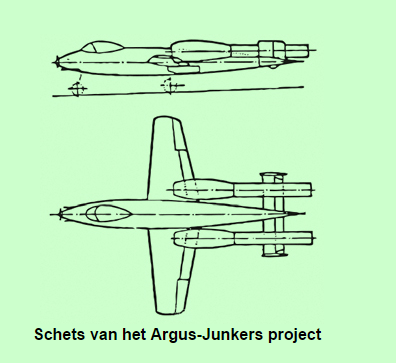
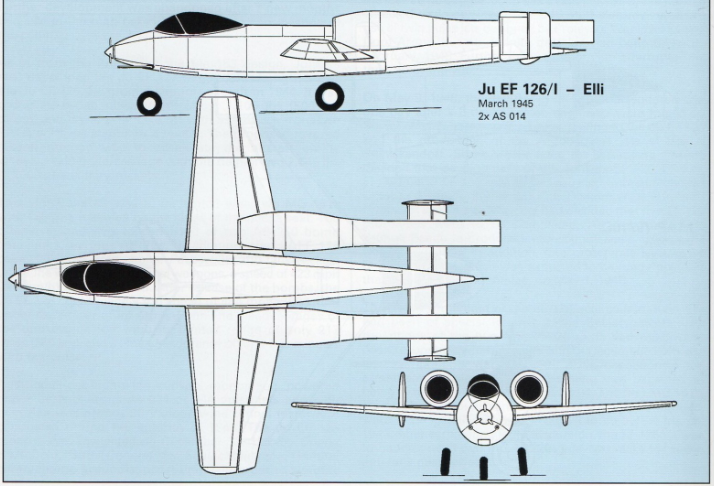
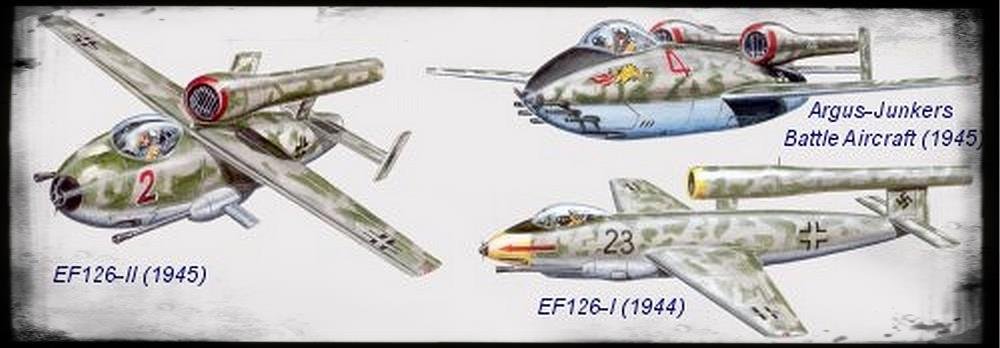
Hi I'm looking for a Luftwaffe Jet. Unfortunately I don't know its name. All I know is that it was a Ground Attack Aircraft powered by a pair of pulse jets and it looked alot like the A-10 Warthog, even to the location of the pulse jets.

Any information is welcomed, Thanks.
 
It's not that one. The one I'm looking for was powered by Pulse Jets and the engines where placed on the rear fuselage just like the A-10.
 
Would you be thinking of the Junkers EF-126? Looked a lot like a manned V-1 with a cockpit forward, two 20mm cannons in the nose and underwing rockets.
 
Its not the EF-126 but it is a development of it. I just found out its called the Argus-Junkers Battle Aircraft.

http://www.geocities.com/hjunkers/ju_ef126_a1.htm
 
Hi Desertfox,


and after 8 years,here is the story of it with drawing to Argus-Junkers Battle Aircraft,it's
new for me;


http://users.telenet.be/denzjos/pulsejets/pulsejets.html


During the last months of the war materials were scarce and time pressures higher to design and build something. Argus and Junkers went together a challenge to design a ground attack aircraft that could easily be created by small firms in the form of building packages. In November 1944 by Professor Heinrich Hertel, who represented the company Junkers, one presented at the Junkers EF 126 ground attack aircraft based on the design EHK (Entwicklungs-HauptKomission). The plane was easy to build, cheap to make, and was powered by two Argus As 014 pulse jets. Consequently, one at a speed of 300 to 350 km / h can take a range of from 40 to 50 minutes. It was decided that the design in practice it would not comply and no aircraft were ordered. With a view to optimizing such type of aircraft was admitted further development of this unit. The new 1945 design was equipped with two Argus As 044 pulse jets that each would develop a thrust of 475kg and the unit at a speed of 810km / h delivery. Further specifications: wing width 6.65m, 7.8m hull length, full length 8.46m, height with landing gear from 1.80m, weight 2980 kg. The unit would be armed with 2x or 1x MK108 MK214 cannon in the nose and 24x R4M or 2 to 4 RZ100 rockets under the wings. The device is not in production.
 

Attachments

  • Argus-Junkers.png
    Argus-Junkers.png
    91.4 KB · Views: 506
The twin pulsejet variant of the EF 126 is also discussed on pages 71-72 of the book Luftwaffe Secret Projects: Ground Attack & Special Purpose Aircraft.
 
It doesn't have a name. I have considerable doubts over the placements of the jets, the wing and tailplane both being in the efflux.

http://www.luft46.com/junkers/jugap.html
The design of the Junkers ground attack aircraft with two Daimler Benz 007 turbofan engines looks like a cross between the A-10 and the Su-25, because it had the same twin rudder empennage design as the A-10 and engines mounted in the wing roots as in the Su-25.
 
Perhaps Dan (newsdeskdan) has more information but afaik this Junkers turbofan ground attack aircraft is pure fake. I have never seen or heard of any original text or drawing.
 
Perhaps Dan (newsdeskdan) has more information but afaik this Junkers turbofan ground attack aircraft is pure fake. I have never seen or heard of any original text or drawing.

No known evidence of it. No mention of it in any reports and no known period drawings of it. Neither is there any contemporary evidence for a twin-pulsejet EF 126. There were mid-wing and high-wing variants, and wheeled or skid undercarriage variants, but nothing on a twin-pulsejet version. Given that the aircraft was meant to use as much of the Fi 103 as possible, I suspect that twin-pulsejet was never an option. However, tests by the FGZ did show that if you stuck two pulsejets right next to each other, the harmful vibrations were cancelled out. So a twin-pulsejet version would have actually worked better than a single one. But there's no known evidence that this was tried.

NB. I've no information whatsoever about what the Soviets might have done with the EF 126. The information on the website mentioned might be true, I don't know.
 
Hi Dan: Thanks for the information concerning the FGZ pulsejet tests. I wonder if vibration-cancelling was the logic behind the Soviets mounting two Chelomey D-3 engines on their 16Kh development of the V-1. I had assumed it was done for increased power, but??
My apologies for straying off-topic.

Regards, Harry
 
Perhaps Dan (newsdeskdan) has more information but afaik this Junkers turbofan ground attack aircraft is pure fake. I have never seen or heard of any original text or drawing.

No known evidence of it. No mention of it in any reports and no known period drawings of it. Neither is there any contemporary evidence for a twin-pulsejet EF 126. There were mid-wing and high-wing variants, and wheeled or skid undercarriage variants, but nothing on a twin-pulsejet version. Given that the aircraft was meant to use as much of the Fi 103 as possible, I suspect that twin-pulsejet was never an option. However, tests by the FGZ did show that if you stuck two pulsejets right next to each other, the harmful vibrations were cancelled out. So a twin-pulsejet version would have actually worked better than a single one. But there's no known evidence that this was tried.

NB. I've no information whatsoever about what the Soviets might have done with the EF 126. The information on the website mentioned might be true, I don't know.
On page 72 of the book Luftwaffe Secret Projects: Ground Attack & Special-Purpose Aircraft there is a drawing of the above-mentioned twin-pulsejet attack aircraft looking like the EF 126, dated April 21, 1945.

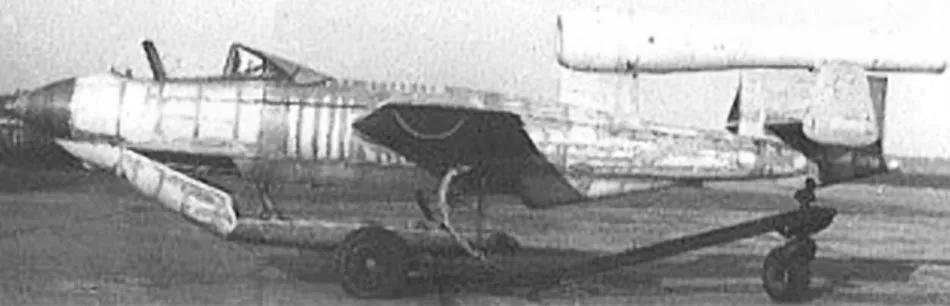
To answer your question of what the Soviets did with the EF 126, development of the EF 126 was continued after the Junkers plant in Dessau was handed over to the Soviets by the Americans in the summer of 1945. Unpowered flight tests of the EF 126 began in the spring of 1946, and later that year several EF 126 prototypes were transported to the USSR by train along with the first EF 131 prototype. Powered flights of the EF 126 began in March 1947, but in June 1948 the Soviet government ordered all development of the EF 126 to be terminated. Details of the EF 126 flight test program are discussed in depth on pages 218 and 219 of the book Soviet X-Planes by Bill Gunston and Yefim Gordon. Photos of the EF 126 prototypes are available at this link:

http://tanks45.tripod.com/Jets45/Histories/JuEF126/EF126.htm
 
Perhaps Dan (newsdeskdan) has more information but afaik this Junkers turbofan ground attack aircraft is pure fake. I have never seen or heard of any original text or drawing.

No known evidence of it. No mention of it in any reports and no known period drawings of it. Neither is there any contemporary evidence for a twin-pulsejet EF 126. There were mid-wing and high-wing variants, and wheeled or skid undercarriage variants, but nothing on a twin-pulsejet version. Given that the aircraft was meant to use as much of the Fi 103 as possible, I suspect that twin-pulsejet was never an option. However, tests by the FGZ did show that if you stuck two pulsejets right next to each other, the harmful vibrations were cancelled out. So a twin-pulsejet version would have actually worked better than a single one. But there's no known evidence that this was tried.

NB. I've no information whatsoever about what the Soviets might have done with the EF 126. The information on the website mentioned might be true, I don't know.
On page 72 of the book Luftwaffe Secret Projects: Ground Attack & Special-Purpose Aircraft there is a drawing of the above-mentioned twin-pulsejet attack aircraft looking like the EF 126, dated April 21, 1945.

To answer your question of what the Soviets did with the EF 126, development of the EF 126 was continued after the Junkers plant in Dessau was handed over to the Soviets by the Americans in the summer of 1945. Unpowered flight tests of the EF 126 began in the spring of 1946, and later that year several EF 126 prototypes were transported to the USSR by train along with the first EF 131 prototype. Powered flights of the EF 126 began in March 1947, but in June 1948 the Soviet government ordered all development of the EF 126 to be terminated. Details of the EF 126 flight test program are discussed in depth on pages 218 and 219 of the book Soviet X-Planes by Bill Gunston and Yefim Gordon. Photos of the EF 126 prototypes are available at this link:

http://tanks45.tripod.com/Jets45/Histories/JuEF126/EF126.htm

I have that book but the drawing does not look contemporary to me. There is no source given. As far as it's possible to tell there is no period evidence for it. It's not impossible that it's 'real' but the evidence is lacking.
 
Need translation,

from, Deutsche Spuren in der Sowjetischen Luftfahrtgeschichte
 

Attachments

  • 1.png
    1.png
    1.8 MB · Views: 183
  • 2.png
    2.png
    1.6 MB · Views: 161
  • 3.png
    3.png
    1.7 MB · Views: 184
Translation :
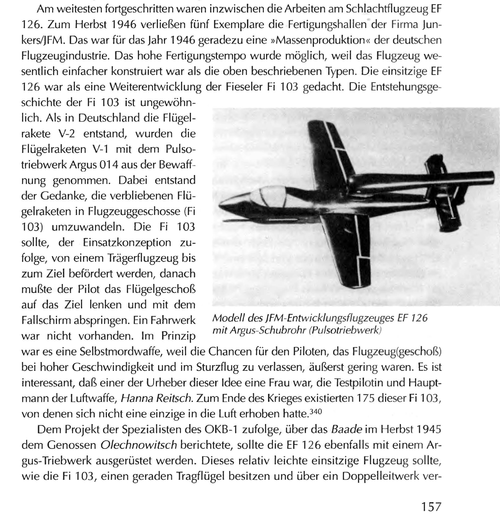
"Most advanced were the construction works on the ground attack aircraft EF 126. During autumn 1946, 5 aircraft
left the factory of Junkers/JFM. For that time, that was really a kind of "mass production" in German aviation
industry ! This speed of production was possible, because the aircraft was much simpler, than the types described
above.The single seat EF 126 was planned as a development of the Fieseler Fi 103, making her development history
unusual. When the <winged rocket> V2 was built, the <winged rocket> V1 was cancelled from further production plans.
That triggered ideas, to modify left over Fi 103. The Fi 103 was intended to be carried to the target area by an
aircraft, where the pilot took over to guide the missile onto the target and eject .
So there was no landing gear. Principally it was a suicide weapon, because chances to leave the aircraft at high speed
in the dive were minimal. It's interesting, that the creator of this idea was a woman, Hanna Reitsch, test pilot and
captain of the Luftwaffe. At the end of the war there were 175 of those Fi 103, not a single one had been flown.
According to the specialist of OKB-1, Baade reported about it to <compeer> (socialist/communist appelation) Olechnowitsch
during atumn 1945, the EF 126 should be powered by an Argus pulse jet. This relatively light, single seat aircraft should
have straight wings, like the Fi 103 and a twin tail, but that already were all similarities. The pilot was seated in the
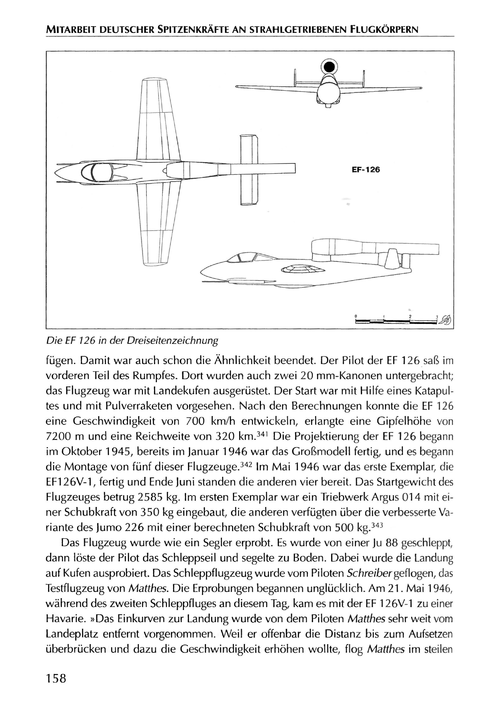
forward part of the fuselage, the two 20 mm guns were mounted there, too. The aircraft was fitted with landing skids
Take-off should be accomplished by catapult and solid fuel rockets. Calculations predicted a speed of up to 700 km/h.
a ceiling of 7200 m and a range of 320 km. Planning for the EF 126 started in October 1945 and already in January 1946,
a full scale model was finished and the production of 5 aircraft began. The first example, EF 126V-1 was finished and at
the end of June the other four were ready. Take-off weight was 2585 kg. The first aircrat got an Argus 014 pulse jet with
a thrust of 350 kg, the other four had the improved Jumo 226 witha predicted thrust of 500 kg.
The aircraft was tested as a glider. Towed by a Ju 88, the pilot released the tow line, gliding back to earth. The towing
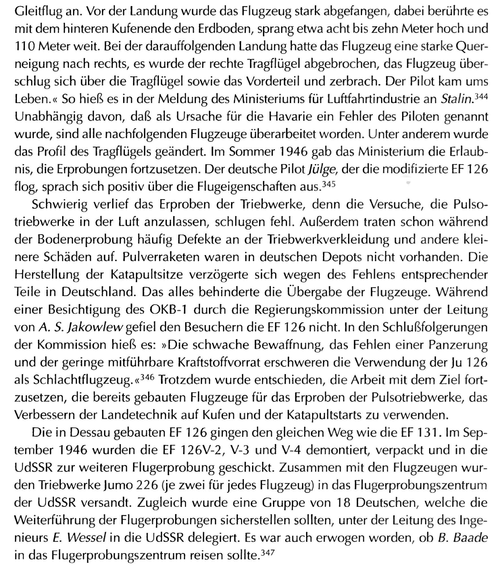
aircraft was flown by Pilot Schreiber, the test aircraft by pilot Matthes. Testing began with a mishap, at 21st of May 1946,
during the second launch. "Matthes had started the return to the airfield quite far away. Probably to gap the distance to
the touch down point, he tried to increase speed by flying in a deep gliding angle. Just prior to touch down, he flared and
the aircraft touched the ground with the after end of the landing skid. It jumped back to a heigt of eight to ten meters for
a distance of about 110 m. During the following landing, the right wing was sheared off, the aircraft somersaulted and broke
into parts, killing the pilot." That was the report from ministry for the aviation industry to Stalin. Though the reason was
stated as pilot's error, all other aircraft were reworked. One change amongst others was the change of the wing profile. In
summer 1946 the ministry allowed further testing and the German pilot Jülge regarded the flight characteristics as good.
Testing the pulse jet engines was difficult, because attempts to start them in the air failed. Additionally, already during
ground testing, there were defects in the engine cowlings and other minor damages. There were no solid fuel rockets in the German
depots, development of the ejection seats was delayed, because of shortage of needed parts in Germany, hindering delivery of
the aircraft. During an inspection of the OKB-1 by a governmental commission, the EF 126 didn't appeal to the visitors. In the
conclusion, the commission said "Weak armament, missing armour and the very limited amount of fuel make the use of this aircraft
as a ground attacker difficult". Nevertheless, work was kept going on , the already finished aircraft should be used for testing
pulse jet engines, landing techniques for aircraft with skids and catapult launch.
The EF 126 built in Dessau took the same way, as the EF 131. In September 1946, the EF 126V-2, V-3 and V-4 were dismantled, packed
up and sent to the Soviet Union. At the same time, a group of 18 Germans, intended to proceed with further testing, were delegated
to the SU, led by Engineer E.Wessel. It was planned, too, that B.Baade should go to the testing center."
 
Thank you my dear Jemiba.

And from, Jet Planes of the Third Reich - The Secret Projects-volume two,

so weird ?!.
 

Attachments

  • 1.png
    1.png
    498.5 KB · Views: 146
  • 2.png
    2.png
    455.4 KB · Views: 134
  • 3.png
    3.png
    198.9 KB · Views: 101
I have a query and a idear to cancel out the vibrations and that's creating a pylon/mounting of sufficient materials to absorb the vibrations they had a fair amount of synthetic rubber and wood to hand so could it of been done I wonder
 
Would, like two similar pendulums, the two pulse jets have fallen into synchronisation ??

Or, more alarming for side-mounts, in opposite phase ? If latter, I suppose they must be stacked on centre line...

IIRC, the guy in ?New Zealand who did a lot of 'recent' pulse-jet development --Tuned pipes, no flap valves, remarkable efficiency & Thrust / Weight ??-- was sorta warned off the subject due possibilities for 'improvised flying bombs'...

Unfortunately, I lost the link to and downloads from his fun site in a PC multi-drive crash, since when he seems to have 'gone dark'...
 
Would, like two similar pendulums, the two pulse jets have fallen into synchronisation ??

Or, more alarming for side-mounts, in opposite phase ? If latter, I suppose they must be stacked on centre line...

IIRC, the guy in ?New Zealand who did a lot of 'recent' pulse-jet development --Tuned pipes, no flap valves, remarkable efficiency & Thrust / Weight ??-- was sorta warned off the subject due possibilities for 'improvised flying bombs'...

Unfortunately, I lost the link to and downloads from his fun site in a PC multi-drive crash, since when he seems to have 'gone dark'...
Wouldn't be surprised he was warned off his pulse jet developments as recent history has shown the technology could end up in the wrong hands and having perfected propulsion systems of the pulsejet type are still quite easy to make tbh more so today if u have a cyclone style hoover and the necessary bits and bobs to go with
 
Would, like two similar pendulums, the two pulse jets have fallen into synchronisation ??

Or, more alarming for side-mounts, in opposite phase ? If latter, I suppose they must be stacked on centre line...

IIRC, the guy in ?New Zealand who did a lot of 'recent' pulse-jet development --Tuned pipes, no flap valves, remarkable efficiency & Thrust / Weight ??-- was sorta warned off the subject due possibilities for 'improvised flying bombs'...

Unfortunately, I lost the link to and downloads from his fun site in a PC multi-drive crash, since when he seems to have 'gone dark'...
Wouldn't be surprised he was warned off his pulse jet developments as recent history has shown the technology could end up in the wrong hands and having perfected propulsion systems of the pulsejet type are still quite easy to make tbh more so today if u have a cyclone style hoover and the necessary bits and bobs to go with

According to Argus, no practical quantity of rubber/wood mountings would be sufficient. When Blohm & Voss informed Argus that it planned to do exactly that with its P 213 design, Argus wrote back to say that in their extensive experience it would not work.
Putting two tubes right next to each other did apparently cancel out the vibrations though. Experiments tried by the FGZ in 1945 evidently proved this. But obviously it was too late by then.
 

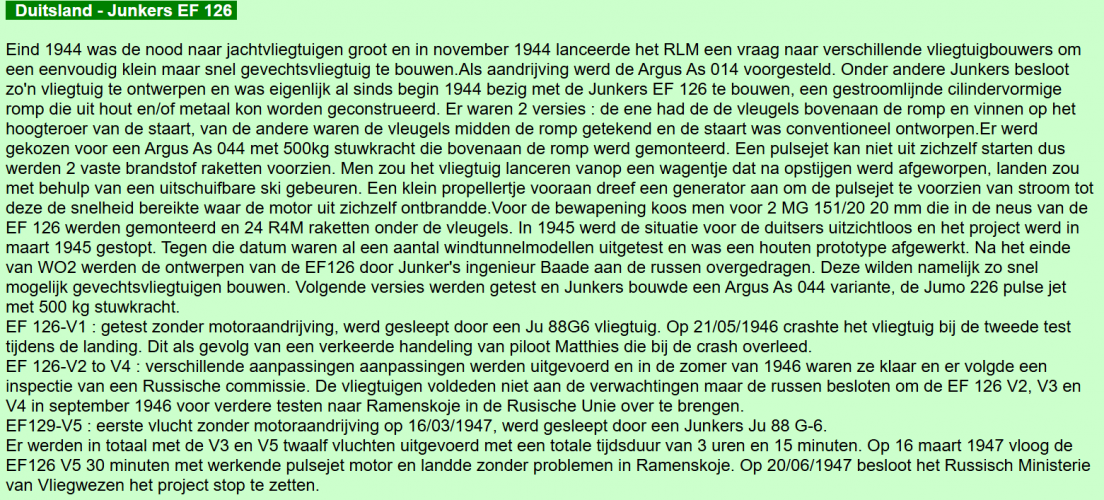
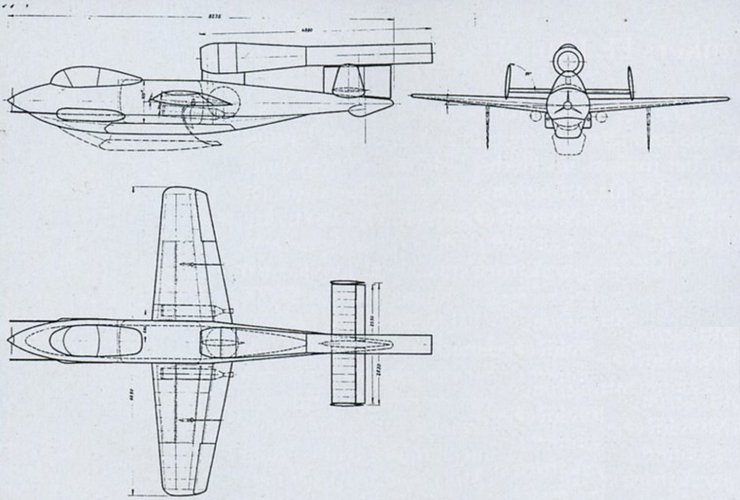
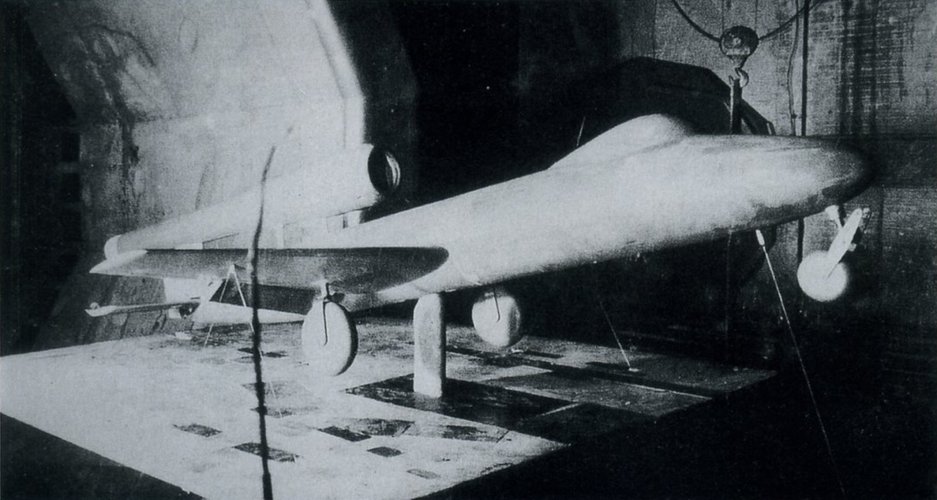
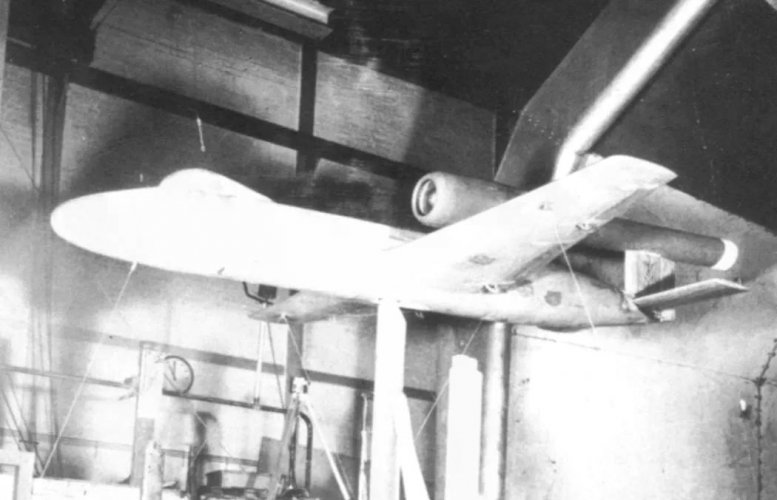
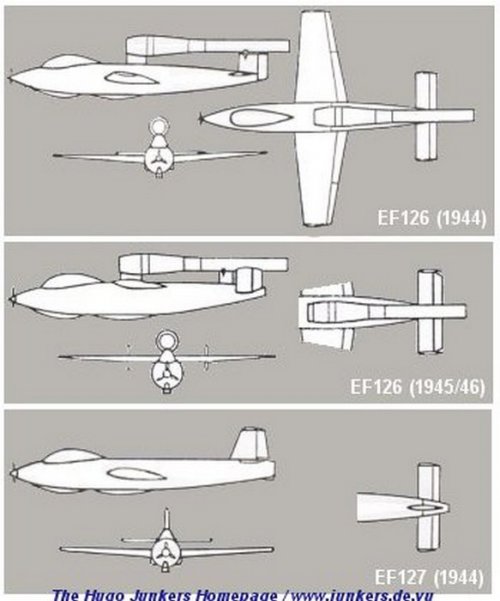
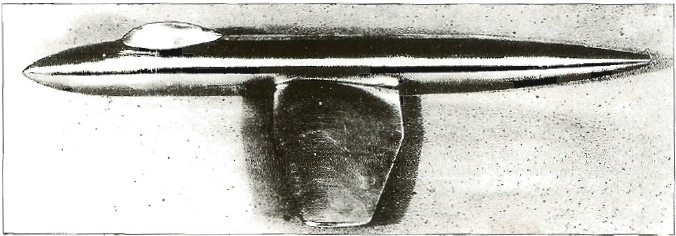
at the end of 1944 the need for fighter planes was great and in November 1944 the RLM issued a request to various aircraft manufacturers to build a simple small but fast fighter plane. The Argus As 014 was proposed as the propulsion. Junkers, among others, decided to design such a plane and had actually been busy since the beginning of 1944 building the Junkers EF 126, a streamlined cylindrical fuselage that could be constructed from wood and/or metal. There were 2 versions: one had the wings at the top of the fuselage and fins on the tail elevator, the other had the wings drawn in the middle of the fuselage and the tail was designed conventionally. An Argus As 044 with 500kg thrust was chosen which was mounted at the top of the fuselage. A pulsejet cannot start by itself so 2 solid fuel rockets were provided. The plane would be launched from a cart that was jettisoned after take-off, landing would be done with the aid of an extendable ski. A small propeller at the front drove a generator to power the pulsejet until it reached the speed where the engine ignited by itself. For the armament, 2 MG 151/20 20 mm were chosen which were mounted in the nose of the EF 126 and 24 R4M rockets under the wings. In 1945, the situation for the Germans became hopeless and the project was stopped in March 1945. By that date, a number of wind tunnel models had already been tested and a wooden prototype had been completed. After the end of WWII, the designs of the EF 126 were transferred to the Russians by Junker's engineer Baade. They wanted to build fighter planes as quickly as possible. Subsequent versions were tested and Junkers built an Argus As 044 variant, the Jumo 226 pulse jet with 500 kg thrust.
EF 126-V1 : tested without engine propulsion, was towed by a Ju 88G6 aircraft. On 21/05/1946 the aircraft crashed during the second test during landing. This was due to an incorrect action by pilot Matthies who died in the crash.
EF 126-V2 to V4 : various modifications were carried out and in the summer of 1946 they were ready and followed by an inspection by a Russian commission. The aircraft did not meet the expectations but the Russians decided to transfer the EF 126 V2, V3 and V4 to Ramenskoye in the Russian Union in September 1946 for further testing.
EF129-V5 : first flight without engine propulsion on 16/03/1947, was towed by a Junkers Ju 88 G-6. In total twelve flights were made with the V3 and V5 with a total duration of 3 hours and 15 minutes. On 16 March 1947 the EF126 V5 flew for 30 minutes with working pulsejet engine and landed without problems in Ramenskoye. On 20/06/1947 the Russian Ministry of Aviation decided to stop the project.
 

Attachments

  • 22.png
    22.png
    203.6 KB · Views: 70
Last edited:

Attachments

  • EF 126.jpg
    EF 126.jpg
    263.5 KB · Views: 49
  • EF126 MODEL.jpg
    EF126 MODEL.jpg
    466.9 KB · Views: 42
  • Blower-model-EF.126-2.jpg
    Blower-model-EF.126-2.jpg
    61.8 KB · Views: 40
  • EF.126V-1-1.jpg
    EF.126V-1-1.jpg
    93.8 KB · Views: 45
  • EF.126V-1-2.jpg
    EF.126V-1-2.jpg
    33.2 KB · Views: 52
Last edited:
http://www.hugojunkers.bplaced.net/junkers-ef126.html
The EF60 was the first design of series of Junkers rocket fighter aircrafts. The design of the EF60 was similar to the V1 design with Argus-engine but it was equipped with a single-seated cockpit. Due to the intensive power loss of the Argus rocket engine in higher altitudes, the original role as fighter aircraft was dropped. Instead, the design was further developed as a combat aircraft under the designator EF126 Elly. A mockup was built until the end of WWII. But as the RLM was not convinced with the Argus engines the EF126 developement stopped.

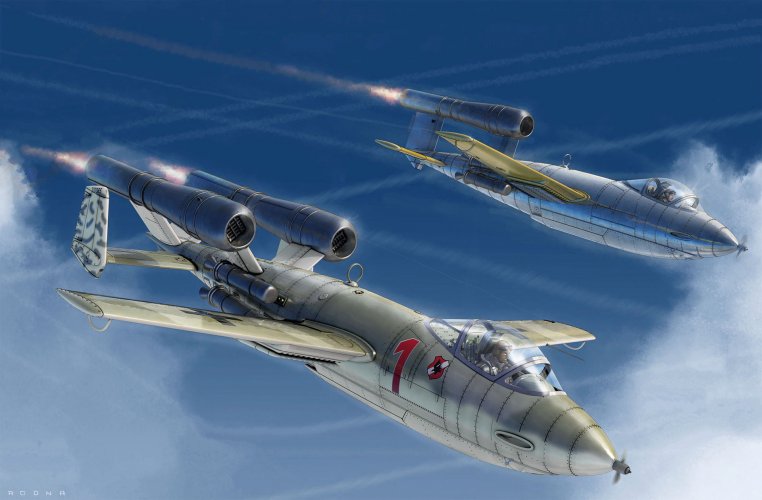
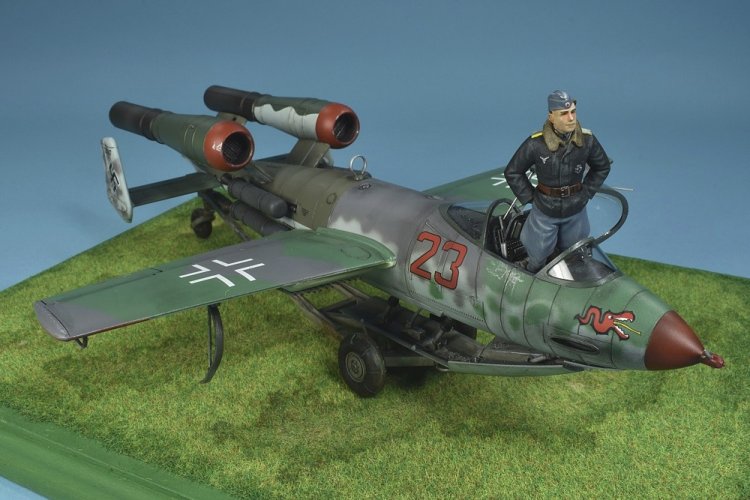
In 1945 Junkers and Argus tried to solve the power loss problems on the EF126 with an improved design with two Argus As-044 Pulso engines. The fuselage was based on the initial center wing and double tail design of the EF126. These rocket engines were mounted at the rear sides of the fuselage. There is no explicit new EF number known for this design. Probably it was developed still as the EF126, but also this can't be proofed by documents today.

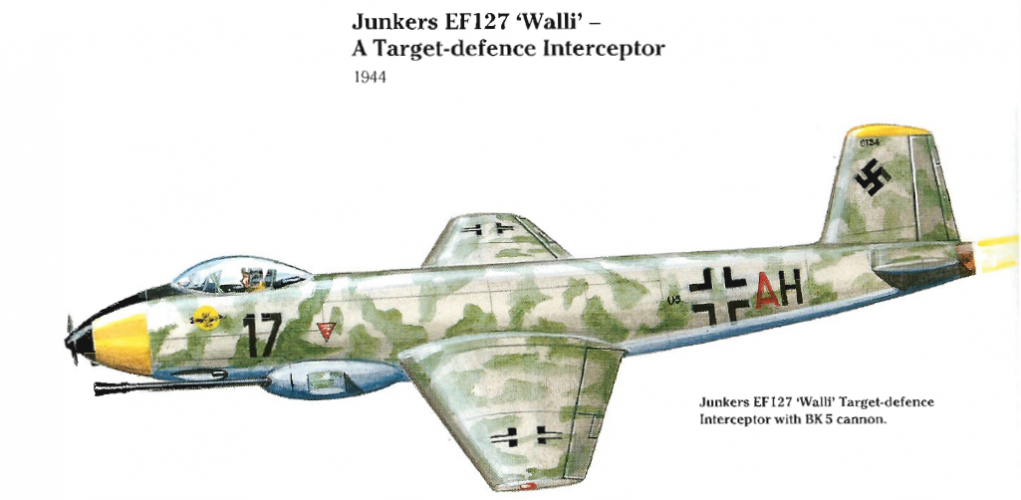
In autumn 1944 the RLM started the "Jager-Notprogramm" with a request for a simple fighter aircraft, which was quick enough during its take-off phase for getting contact to the incoming bomber streams, which now were located very late due to the reduced radar surveillance. The special RLM request therefore asked for a fighter, which was able to take-off with the enemy insight and to intercept him before he reaches his target. This meant the request for a rocket fighter.

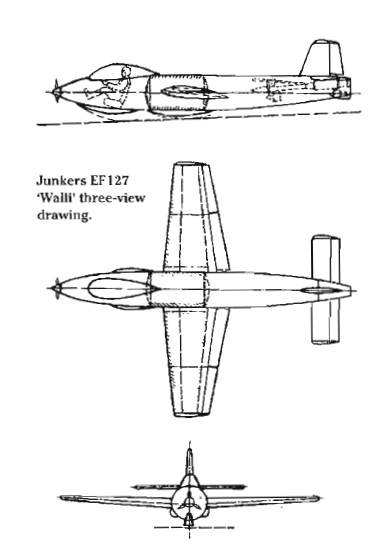
Three companies supplied their designs upon this request. Messerschmitt presented the P.1104 rocket fighter in wooden structure. Heinkel presented the P.1077 Julia and Junkers presented the EF127 Walli. A fourth design was supplied by Bachem with the BP-20 Natter, which finally made the race.

Due to the fact, that the RLM did not like the Argus engines, the EF126 was changed to the Walter HWK engines, which were now integrated into the fuselage. This new design was named EF127 and presented to the RLM according to the "Jager-Notprogramm" aquisition. However until the end of WWII only little further work was performed on that design. Just a mockup was built until the end of WWII.

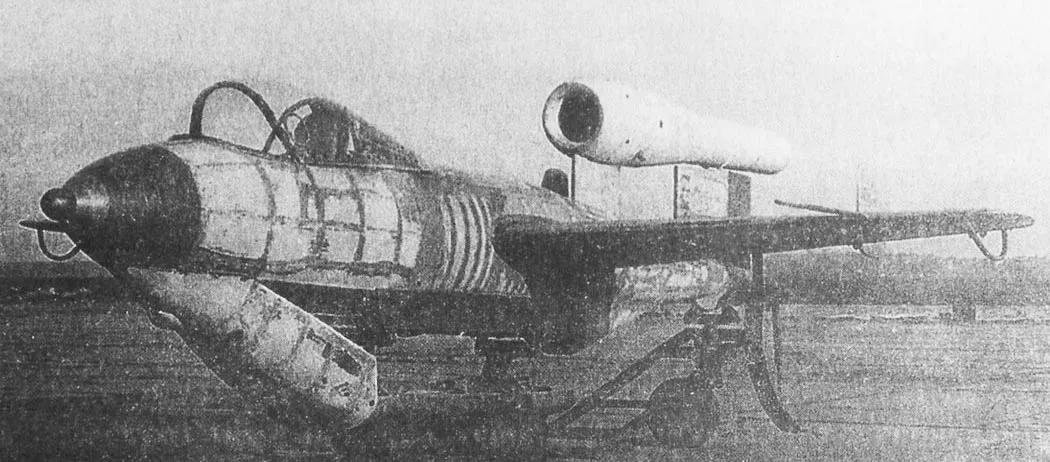
When the Soviets occupied Dessau, they continued the prototype construction of the EF126 since October 1945. In January 1946 a large scale model became available and the Russians advised the Junkers team to built up to five prototypes. In May 1946 the first prototype was completed and in the same month the EF126-V1 was first flown by Heinz Schreiber. As the aircraft was not equipped with an engine at this time, it was towed by a Ju88G6. During the second non-powered test flight on 21.05.1946 the EF126-V1 crashed on landing at Dessau. The Junkers test pilot Matthies was killed during that accident.

Some modifications were introduced at the four other EF126s and in June 1946 the remaining four aircraft were ready to fly. In Summer 1946 the EF126 were inspected by a Russian governmental commission. Due to the small range, the minimum gun fire and the missing armours they were not satisfied with the EF126 design. However at least three EF126 (-v2, -v3 and -v4) were transfered to Russia for further flight trials in September 1946.

The EF126 developement seemed to have been continued in Russia, at least the EF126-V5 was first flown on 16.03.1947, again a non-powered flight towed by a Ju88 as in Dessau. A total of 12 flights with a flight time of totally 3 hours and 15 minutes were performed in 1947 by the -V3 and the -V5 On 20.06.1948 the Russian Aviation Ministry advised the stop of any further developement of the EF126.

Technical Data:

Aircraftyearenginelength
in m
span
in m
wing area
im sqm
net weight
in kg
payload
in kg
seatsspeed
in km/h
range
in km
EF126 Elly
EF127 Walli
.
Argus-Junkers Design
1945
1945
.
1945
1 x Argus As-044 (500kp)
1 x Walter HWK509 C-1 (400kp)
1 x Jumo 226 (1946)
2 x Argus As-044(475kg)
n.a.
7,45
.
8,54
6,30
6,30
.
2,80
8,90
8,90
.
n/a
T/O
1030
n/a
T/O
2800
1930
n/a
2980
1770
1000
n/a
810
n.a.
12 min.
 

Attachments

  • ef126-02.jpg
    ef126-02.jpg
    50.9 KB · Views: 49
  • ef126-03.jpg
    ef126-03.jpg
    65.1 KB · Views: 53
  • Screenshot_2.png
    Screenshot_2.png
    444.1 KB · Views: 49
  • Screenshot_3.png
    Screenshot_3.png
    50.2 KB · Views: 52
  • Screenshot_4.png
    Screenshot_4.png
    303.4 KB · Views: 53
Last edited:
https://www.facebook.com/groups/luft46models/posts/577402984791381/
the EF126 with an improved design with two Argus As-044 Pulso engines. The fuselage was based on the initial center wing and double tail design of the EF126. These pulse engines were mounted at the rear sides of the fuselage. There is no explicit new EF number known for this design.
 

Attachments

  • 500551688_2400842670289806_2661375124439172143_n.jpg
    500551688_2400842670289806_2661375124439172143_n.jpg
    754.9 KB · Views: 58
  • 495155232_10161769746052183_2427451148443363026_n.jpg
    495155232_10161769746052183_2427451148443363026_n.jpg
    201.4 KB · Views: 61
EF 126 Additional Information
- Twin Pulsejet
- Winch launch with BMW 801 engine

[1] December 19, 1944 – December 20, 1944
EHK - Entwicklungshauptkommission
Klein-Flugzeug mit Argusrohr (Presentation Hertel)
a.) Junkers propose a particularly inexpensive and simple single-seat ground-attack aircraft powered by an Argus "V-1" pulsejet.
From the Luftwaffe's perspective, the flight range and duration (450–500 km and 40–50 minutes) are considered so inadequate that the aircraft is deemed militarily unsuitable.
b.) Due to capacity constraints, the development of this aircraft—which is technically highly interesting owing to its low cost—cannot be supported as a purely experimental project with no intention of series production.
Decision:
The design or construction of the proposed aircraft project is out of the question.

[2] December 21, 1944
EF 126
Modifications requested by the General der Schlachtflieger were incorporated into the plans and inspected by him on December 16, 1944. The General der Schlachtflieger has expressed his approval and will submit a formal requirement.

[2] December 21, 1944
Junkers Projekt EF 126
Device with 450 kg of thrust; cannot be operated without take-off rockets.
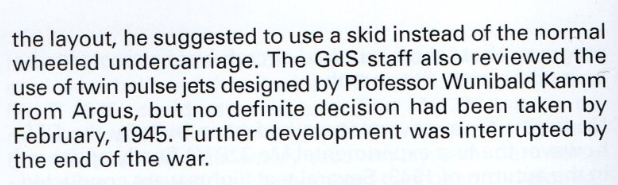
Currently verifying the function of the Kemm'schen twin-tube* and, if applicable, its use for the EF 126.
Failures resulting from engine-related structural damage—such as those that occurred with the V-1 missile—are unacceptable for manned aircraft.
All these questions are currently being re-examined. The EF 126 is only worthwhile if available in certain quantities by the summer of 1945.
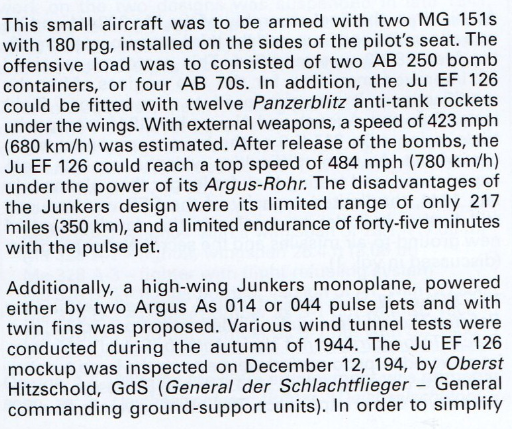
The mock-up was inspected on December 12, 1944, together with Oberst Hitschold, General der Schlachtflieger.
Consideration is being given to switching the project to skids in order to make production even simpler and cheaper. The General der Schlachtflieger intends to announce shortly whether there is interest in this device.

[3] January 15, 1945 – January 21, 1945
"Elli"
Following a renewed demand by the General der Schlachtflieger (after the matter had been halted by the EHK), arrangements were made to have the project figures submitted by Junkers verified by the DVL. A comparison with the Heinkel 162 (two Argus pulsejets) casts doubt on the Junkers' performance. General der Schlachtflieger demands Elli with a skid landing gear and winch launch instead of take-off rockets. Winch for multiple towing, powered by a BMW 801. Apart from a lack of cost-effectiveness, inflexibility and tactical entrapment are considered unacceptable.

[4] March 5, 1945 – March 15, 1945
Elli:
Project also rejected by the General Staff.

Source:
Bundesarchiv
[1] Signatur: R 3/1749; Page: 120-121
[2] Signatur: RL 3/2572; Page 55
[2] Signatur: RL 3/2572; Page:56
[3] Signatur: RL 3/2567; Page: 91
[4] Signatur: RL 3/2567; Page 271
(*Wunibald Kamm - FKFS - Twin-Pulsejet for EF 126)

Direct Link:
R 3/1749
https://invenio.bundesarchiv.de/invenio/direktlink/f51492e8-e362-4942-ac42-e5cc82c29a8e/
RL 3/2567 & RL 3/2572
https://invenio.bundesarchiv.de/invenio/direktlink/ff268edd-8129-450a-b0e4-6a35d48fc287/

 

Similar threads

Back
Top Bottom