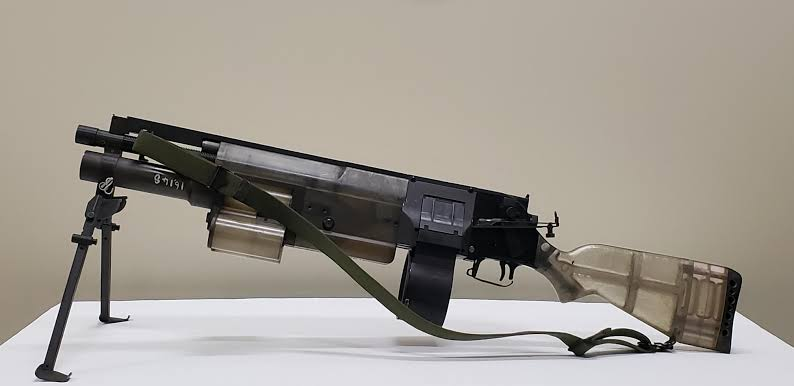
The Army's Advanced Combat Rifle (ACR) competition was over 35 years ago and had some interesting submissions.
The Steyr Arms GmbH ACR was using a 10.4 mm × 45 mm case and a saboted fletchette to throw a 1.6 mm x 41.25 mm and .66 gram carbon steel dart at 4,750 fps all the way back in 1987. It was submitted into the Army's ACR competition that ran 1989-1990. Cartridges weighed 50% less than the 5.56 mm x 45 mm NATO.
AAI Corporation used rounds in the 5.56 mm x 45 mm NATO format with a similar 1.6 mm x 41.27 mm fletchette dart to reach 4,600 fps.
Those flechettes were of
very questionable terminal effectiveness, though. Might tumble, J-hook and rip your heart apart and you drop on the spot, or might put two icepick holes in your lung and you barely even slow down till the lung collapses in 15 minutes.
Heckler & Koch submiited caseless ammunition in several competitions. It came in many flavors but began the first submission as a 4.9 mm projectile. It would go through several sizes through development. It was submitted to NATO as a 4.3 mm in 1977. The UK wanted one in 4.85 mm x 45 mm. But NATO standardized the 5.56 mm x 45 mm round in 1980. They submitted a 4.92 mm x 33 mm in the Army ACR competition. H&K caseless rounds were good for about 55,000 psi to propel rounds at near the 3,000 fps mark.
The G11 was not
terrible until something went wrong and then the armorer needed to fix it. The US Army has a very different model of what the individual soldier is supposed to be able to fix by himself. And frankly, the internals needed John Browning III to simplify them all before it'd have a chance at US adoption. I swear it's like a Swiss Watch in there.
The major operational fault is that the
recoil in hyperburst is enough to knock the soldier off the rifle entirely, like 375H&H magnum recoil levels(!). So the hyperburst wasn't as accurate as advertized, at least in that the shooter could never see their effect on the target.
===========================
Conceptually,
the issue with the ACR program was that the US Army was asking for
an engineering solution to a lack of training problem. Basic grunts were not getting good enough rifle training for operational events instead of annual rifle qualifications/medal shoots. They now spend far, far more time on a pop-up target range, random(ish) pop-ups and distances not known to the shooter from about 10 yards clear out to 300. And that's how the Army got more than a 100% improvement in combat effectiveness without buying every grunt a new rifle.
It makes me wonder if 5,000 fps couldn't be a realistic target if they first agreed to a common ACR dart and designated cartridge weight, ignition methods, and barrel length of the overall competition. Let the engineers come up with ways to generate single, triple, and fully automatic fire rates.
Except for the dart thing,
that's actually what happened with NGSW. Companies were told "launch this 6.8mm,
8-9g projectile at over 900m/s. Rifle
with suppressor mounted cannot be more than Xcm long."
I still think someone should have brought out a Springfield M1A chambered in .270 WSM and/or an M1918 BAR chambered in .270 and entered that into the contest. Just to make a point.