Alternative new rifle cartridges

It is pretty obvious, MihoshiK, that you are not reading the previous thread discussions. If the Army settles on a high pressure round for existing rifles (M855A1 or M855A1+) then there is no need to pivot towards 6.8 x 51 mm, or any other round. You are set that these pressures will liquify rifle parts, which is irrational. The M250 is the same cartridge as M7/XM8 in a light maching gun.
I DID read the previous discussions, and you did NOT answer my point. You didn't even read my post correctly.

I was not talking about rifle parts, but the cartridge case.
At those pressures the case head, if made from regular brass, will flow under the pressure. Which is why the .277 Fury runs with three-piece cartridge cases, with a case head of steel.
Run regular cartridges at those pressures, and you will have an interesting time.

Which is what you claim Big Army is doing with M855A1+ in your posts.

And yes, as SuperShark says, the M7 was redesigned for the higher pressure too.

So, now that we've talked about reading comprehension...
 
The AR reciever isn't pressure bearing! And barrels, bolts, barrel extensions are relatively cheap!
The lower receivers aren't, but I'm really curious what the upper receiver feels about doing direct gas impingement on 80k PSI.

And yes, the barrels and bolts, just the most high-strength and heavy metal components of most weapons, I'm sure that uprating them to handle overpressured ammo will neither significantly increase the cost or weight of the weapon... you know, like it did in the weapon redesigned for overpressured ammo that is the entire centerpiece of this thread.
 
The lower receivers aren't, but I'm really curious what the upper receiver feels about doing direct gas impingement on 80k PSI.

And yes, the barrels and bolts, just the most high-strength and heavy metal components of most weapons, I'm sure that uprating them to handle overpressured ammo will neither significantly increase the cost or weight of the weapon... you know, like it did in the weapon redesigned for overpressured ammo that is the entire centerpiece of this thread.
The AR-15 isn't direct impingement, it uses an internal piston in the bolt. You can compare the bolt/carrier assembly of the Stoner Internal Piston AR-15 to true DI like the Ljungman or Mas 49/56.

As for barrel and bolt performance, the M4/M16 steel spec for them is very mild and almost a century old. Modern materials science hasn't been applied to the problem, which is why SOCOM is spending money to do that.

A million barrels and bolts a year shouldnt even be two thousand tons of steel. Steel alloy prices vary but even tungsten alloy tool steels like M50 are under 10k per ton. So you're looking at maybe 25 million dollars of steel. And that's not even taking into account that nobody autofrettages small arms barrels, which gives significant performance gains in accuracy, durability, wear resistance and pressure tolerance without changing the metal.
 
What better than to bring some of the stupid ideas of the M7 into the realm of 5.56mm carbines? Now we can train people on "weak" 5.56mm cartridges and only give them the high-pressure stuff when they get to the war zone so all the geniuses can be scratching their heads wondering why everyone is shooting so poorly on these rifles they spent all this effort making able to accurately engage targets out to 800+ meters.
 
What better than to bring some of the stupid ideas of the M7 into the realm of 5.56mm carbines? Now we can train people on "weak" 5.56mm cartridges and only give them the high-pressure stuff when they get to the war zone so all the geniuses can be scratching their heads wondering why everyone is shooting so poorly on these rifles they spent all this effort making able to accurately engage targets out to 800+ meters.
What kind of a moron idea is that? Just issue the same ammunition all the time like a normal army!

Also, the point of high pressure 5.56 is that you get flatter shooting in the 0-300/0-500 range band. You don't actually NEED this, but it's a nice to have.
 
The lower receivers aren't, but I'm really curious what the upper receiver feels about doing direct gas impingement on 80k PSI.
The gas tube goes all the way back into the the gas key on the bolt carrier, and gas is routed down into the internal piston to push the bolt forward off the locking lugs and the bolt carrier to the rear.

There's very little pressure remaining when the gas tube comes out of the gas key. IIRC in normal operation that gas pressure is near zero, because the bullet has left the barrel entirely. This gives the case a moment of time to relax before the bolt pulls it out of the chamber.


And yes, the barrels and bolts, just the most high-strength and heavy metal components of most weapons, I'm sure that uprating them to handle overpressured ammo will neither significantly increase the cost or weight of the weapon... you know, like it did in the weapon redesigned for overpressured ammo that is the entire centerpiece of this thread.
The barrel design specs of an AR date to 1962 or so. Steel barrel and extension, chrome lined bore.

There are much stronger barrel specs out there now. Like Faxon pencil barrels. Carbon-fiber wrapped barrels, too.


And that's not even taking into account that nobody autofrettages small arms barrels, which gives significant performance gains in accuracy, durability, wear resistance and pressure tolerance without changing the metal.
Can you autofrettage a tube that small? I have only heard of it being done on cannon sized barrels. This paper makes it sound like you'd have to cut the barrel blank to almost-finished diameters (which happens after cutting the rifling) before pressurizing it to ~120kpsi or something equally absurd.
 
What kind of a moron idea is that? Just issue the same ammunition all the time like a normal army!
The same moron idea with the 6.8x51...


Also, the point of high pressure 5.56 is that you get flatter shooting in the 0-300/0-500 range band. You don't actually NEED this, but it's a nice to have.
I admit, being able to point&click to 500 with basically no adjustments to the sight would be amazing. But 5.56 really is point&click to about 350.
 
Can you autofrettage a tube that small? I have only heard of it being done on cannon sized barrels. This paper makes it sound like you'd have to cut the barrel blank to almost-finished diameters (which happens after cutting the rifling) before pressurizing it to ~120kpsi or something equally absurd.
Yeah I'm pretty sure you can hydro AF it.
 
I admit, being able to point&click to 500 with basically no adjustments to the sight would be amazing. But 5.56 really is point&click to about 350.
Minimal bullet drop is nice. Going to the 5.56 mm diameter I am sure was a bit like that with the huge drop in kick to the average soldier. I am a little broader shoulder and find .223 and .243 to be near zero kick. My grandfather used to love his .308 because it reminded him of his dependable M1, which to me still is a rather light kick. But I still respect a .300 WM for its kick. I can fire turkey load 12 gauge all day but elk loads like .300 WM take their toll. With the average human male closer to 5'7" it makes sense to continue the downward trend in barrel diameters and increase in barrel pressures.

The 7.62 x 51 mm had its day but clearly these hypersonic velocity bullets in small packages are a huge advantage. And I respect large bullet masses over .50 caliber with lower velocities have unique effects well beyond the .300 WM, so they have their usefulness, too. Plenty of impact power to break a motor block without breaking a shoulder. But carrying hundreds of rounds versus maybe 100 rounds is never going to be effective as a main weapon. M855A1-based development has shown that there is still life left in the 5.56 mm. It seems prudent to explore that before any change to a niche 6.8 mm round is needed. Going to a bigger round like 6.8 mm is really a slap in the face to the sciences involved, and makes me suspicious of the merits.
 
Last edited:
What better than to bring some of the stupid ideas of the M7 into the realm of 5.56mm carbines? Now we can train people on "weak" 5.56mm cartridges and only give them the high-pressure stuff when they get to the war zone so all the geniuses can be scratching their heads wondering why everyone is shooting so poorly on these rifles they spent all this effort making able to accurately engage targets out to 800+ meters.
That would be the current HICAR program.
 
It seems prudent to explore that before any change to a niche 6.8 mm round is needed. Going to a bigger round like 6.8 mm is really a slap in the face to the sciences involved, and makes me suspicious of the merits.
The problem isn’t going to larger diameter rounds. The problem was going to an AR-10 pattern round length which caused massive weight increases. 5.56 MAX, 6mm ARC, .264 are the future. Especially when paired with emerging metallurgy like NAS3 cases allowing much more powder load.

People are pushing 2550fps out of 8 inch 300 blackouts and hitting submoa at 500 yards. Small arms are evolving very fast contrary to what naysayers are talking about
 
The problem isn’t going to larger diameter rounds. The problem was going to an AR-10 pattern round length which caused massive weight increases. 5.56 MAX, 6mm ARC, .264 are the future. Especially when paired with emerging metallurgy like NAS3 cases allowing much more powder load.
If a medium rifle that was good at its job but lacked 40% of the current rounds carried, then they hit their target audience. But for fast position movers that churn ammunition, it is probably not the right choice.
 
If a medium rifle that was good at its job but lacked 40% of the current rounds carried, then they hit their target audience. But for fast position movers that churn ammunition, it is probably not the right choice.
The 6.8SPC, 6.5 Grendel, or 6mmARC all carry about 25 rounds in a STANAG 30rd body. Or ~17 rounds in a 20rd body.

Which is half the loss of ammunition capacity that going back to a 7.62-sized rifle causes.
 
The 6.8SPC, 6.5 Grendel, or 6mmARC all carry about 25 rounds in a STANAG 30rd body. Or ~17 rounds in a 20rd body.

Which is half the loss of ammunition capacity that going back to a 7.62-sized rifle causes.
It's a mix of that, the vampiric mass of the magazine itself (think the tsiolkovsky rocket math), and the cartridge weight vs 5.56.

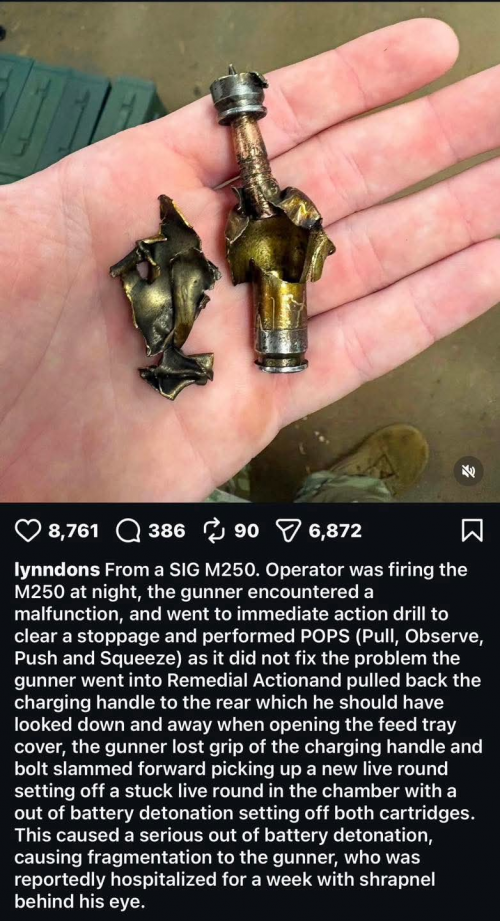
Also saw this today. Seems the M250 and the Sig case have problems. I really don't love how the bullet is speared through the primer.

1781813814228.png
 
Also saw this today. Seems the M250 and the Sig case have problems. I really don't love how the bullet is speared through the primer.
Can happen to any repeater that has a stuck case and someone drops the bolt.

I suspect that this was aided by the heavier springs in the M250 and what looks like a steel penetrator in the case being shoved through.
 
Some thoughts I missed the first time around.

The lower receivers aren't, but I'm really curious what the upper receiver feels about doing direct gas impingement on 80k PSI.
As I mentioned before, the upper isn't under any significant gas pressure. Also, the pressure at the gas port should be a lot lower than chamber pressure.

Remember the problems with M16-no-suffixes? OrdBu changed the powder to a ball type. With basically no QA on it before loading into the cases. Per an interview with Jim Sullivan, ball powder destined for M14s was tested three times before loading into cases, and thus wasn't beating the crap out of the M14 op-rods (while modern .30-06 will beat up the op-rods on Garands due to high pressures at the gas port). This un-QAed ball powder was more than 10,000psi higher than specified at the gas port, which did pretty intense things to the cyclic rate. IIRC drove the cyclic rate from ~750rpm to over 900, which the AR does NOT like. Beats up the back of the upper and the buffer tube from stopping the bolt carrier.
 
Seems like straight cartridges without necks or tapers would help capacity but create issues with loading and extraction as rounds cycle through, hence they tend to be for simpler mechanisms. Nickel steel cases sound like progress although plastic cases seem to be a plausible path when it comes to production scales, too. This is why my instinct feels a thicker base will drive thin bullets without necked shells in the future. If they can stick to a 5.56 mm with a straight cartridge we already know there is a significant boost in cartridges carried. But if it was that simple it would already have happened.

The drop of a .204 (approx. 5.2 mm) at 39 grains is something ridiculous in around two feet at 500 yards and a bit over 15 inches of wind drift. The .204 unfortunately is nearly the same size as a 5.56 mm case. I think they can push the diameter of the cartridge closer to the bullet down to match a similar performance as the original cartridge using steel cases but we run into new problems which impact rate of fire. So far they've only been pushing the .17 (4.5 mm) to 4200 fps using brass cartridges. Would love to see it pushed even harder with nickel steel technologies.

Should be around the size of a .38 Special for a 4.5 mm bullet to get enough powder for over 4,000 fps with a 30 grain bullet using brass. Would still need to figure out if propellants and steel casing can get to that .204 level reliably. My other concern is costs to manufacture. Maybe they can make the bullet telescope internally off a secondary plastic subcase using a steel head. No exposed plastic, just sleeves for powder to keep the bullet aligned with a inexpensive plug in the front. The bullet could be held in place by a crimped cap that allows the bullet to escape through. It has to be stupid simple for mass production. Most of all it hss to work reliably with no drop in rate of fire from what it replaces. Seems like a tall order when competing with M855A1+. Same cartridge shape and minor mods to existing guns for a big boost in velocity. Not 4500 fps velocity, but close enough.
 
Seems like straight cartridges without necks or tapers would help capacity but create issues with loading and extraction as rounds cycle through, hence they tend to be for simpler mechanisms. Nickel steel cases sound like progress although plastic cases seem to be a plausible path when it comes to production scales, too. This is why my instinct feels a thicker base will drive thin bullets without necked shells in the future. If they can stick to a 5.56 mm with a straight cartridge we already know there is a significant boost in cartridges carried. But if it was that simple it would already have happened.
Side note is that short-fat rounds like 6.5 Grendel or 300WSM have much better internal ballistics than long-skinny rounds like a .375H&H or .22WMR. Less powder for the same velocity, IIRC caused by the much wider flame front across the powder column. Plus they tend to keep the flames inside the case which means less throat erosion (=longer barrel life)


The drop of a .204 (approx. 5.2 mm) at 39 grains is something ridiculous in around two feet at 500 yards and a bit over 15 inches of wind drift. The .204 unfortunately is nearly the same size as a 5.56 mm case. I think they can push the diameter of the cartridge closer to the bullet down to match a similar performance as the original cartridge using steel cases but we run into new problems which impact rate of fire. So far they've only been pushing the .17 (4.5 mm) to 4200 fps using brass cartridges. Would love to see it pushed even harder with nickel steel technologies.
Well yeah, the .204 is based on the .223 case. (Difference between .223 and 5.56 is 1mm overall length and thicker brass)


Should be around the size of a .38 Special for a 4.5 mm bullet to get enough powder for over 4,000 fps with a 30 grain bullet using brass.
Which is basically the same size as a 5.56 case.
  • .38spl is 9.6mm case diameter, 29.3mm case length;
  • 5.56 is 9.58mm case base diameter tapering to 9mm at the shoulder, and the shoulder is 36.5mm from the case head.
So you're not gaining any more magazine capacity because the cases are the same diameter, and necking the case down to 4.5mm would likely require almost as much extra length as 5.56 does.


Maybe they can make the bullet telescope internally off a secondary plastic subcase using a steel head. No exposed plastic, just sleeves for powder to keep the bullet aligned with a inexpensive plug in the front. The bullet could be held in place by a crimped cap that allows the bullet to escape through.
The plastic sleeve would have to be absolutely concentric with the bore of the case and barrel for that to work. Else you've got a forcing cone at the start of the barrel like in a revolver, and that doesn't work well at rifle velocities.


It has to be stupid simple for mass production. Most of all it hss to work reliably with no drop in rate of fire from what it replaces. Seems like a tall order when competing with M855A1+. Same cartridge shape and minor mods to existing guns for a big boost in velocity. Not 4500 fps velocity, but close enough.
I still need more information on M855A1+. So it's running steel cases and stupid-high chamber pressures, without being overpressure at the gas port?
 
The plastic sleeve would have to be absolutely concentric with the bore of the case and barrel for that to work. Else you've got a forcing cone at the start of the barrel like in a revolver, and that doesn't work well at rifle velocities.
When I said inexpensive plug I was thinking compacted clay to keep all the pressure focused at the bullet base. We use clay for class A fireworks using propellants in the 30-35,000 fps range and it hold up extremely well. I doubt pushing 100,000 fps is beyond its capacity. Something cheap.
 
When I said inexpensive plug I was thinking compacted clay to keep all the pressure focused at the bullet base.
The problem is keeping the bullet in the dead center of the barrel. If it's not starting dead center you're going to have unpredictable accuracy problems.


We use clay for class A fireworks using propellants in the 30-35,000 fps range and it hold up extremely well. I doubt pushing 100,000 fps is beyond its capacity. Something cheap.
But yes, from what I know of high power rocketry compacted clay works well enough as a rocket nozzle as well.
 
Some thoughts I missed the first time around.


As I mentioned before, the upper isn't under any significant gas pressure. Also, the pressure at the gas port should be a lot lower than chamber pressure.

Remember the problems with M16-no-suffixes? OrdBu changed the powder to a ball type. With basically no QA on it before loading into the cases. Per an interview with Jim Sullivan, ball powder destined for M14s was tested three times before loading into cases, and thus wasn't beating the crap out of the M14 op-rods (while modern .30-06 will beat up the op-rods on Garands due to high pressures at the gas port). This un-QAed ball powder was more than 10,000psi higher than specified at the gas port, which did pretty intense things to the cyclic rate. IIRC drove the cyclic rate from ~750rpm to over 900, which the AR does NOT like. Beats up the back of the upper and the buffer tube from stopping the bolt carrier.
I'd also note that (IIRC) the bend in the gas tube heats up (and then fails) faster than the rest of the gun in most situations on an AR-15 design, which is a much lower order issue than other parts going pop.
 
I'd also note that (IIRC) the bend in the gas tube heats up (and then fails) faster than the rest of the gun in most situations on an AR-15 design, which is a much lower order issue than other parts going pop.
That's a deliberate design choice. Gas tube goes pop on an AR, you're left with a straight pull bolt action rifle. The rifle still works, though the T-handle is in a lousy spot to work the bolt repeatedly. Bad ergonomics, you have to break your cheek weld after every shot.

But the rifle will still go bang! You can still fight back. Or at least fight your way to a fully working rifle.
 
I still need more information on M855A1+. So it's running steel cases and stupid-high chamber pressures, without being overpressure at the gas port?
I mean you can tune the gas port if you want, or it should be straightforward to work up an adjustable gas block to allow running a variety of pressures. But, apocryphally, I haven't heard any complaints about over-gassing from people messing around with 80ksi loads in good quality ARs.
 
That's a deliberate design choice. Gas tube goes pop on an AR, you're left with a straight pull bolt action rifle. The rifle still works, though the T-handle is in a lousy spot to work the bolt repeatedly. Bad ergonomics, you have to break your cheek weld after every shot.

But the rifle will still go bang! You can still fight back. Or at least fight your way to a fully working rifle.
For sure, I meant that (IIRC) it was designed like this so that it was a relatively safe point of failure vs burning through or blowing up other parts of the gun.
 
I mean you can tune the gas port if you want, or it should be straightforward to work up an adjustable gas block to allow running a variety of pressures. But, apocryphally, I haven't heard any complaints about over-gassing from people messing around with 80ksi loads in good quality ARs.
I mean, most ARs are overgassed. Not as massively overgassed as AKs, but still overgassed. Best argument for adjustable gas blocks is a 2 or 3 position model: Normal/Suppressed or Dirty/Normal/Suppressed.

Like I said, you want to have a specific pressure (which I don't actually know and don't think I've ever heard or seen published) at the gas port. If the 80kpsi-at-the-chamber rounds are still within the normal AR pressure tolerance at the gas port, the rifle will run just fine without beating the crap out of the receivers.


For sure, I meant that (IIRC) it was designed like this so that it was a relatively safe point of failure vs burning through or blowing up other parts of the gun.
Ah, gotcha!

I keep telling new car folks (whether racers or 4wd) to leave a relatively weak link that is easy to replace and not too expensive as a part in their driveline, even if they overbuild everything else. If/when you overload the system, SOMETHING is going to break. You want that something to be least-damaging to the rest of the vehicle when it does, and it helps if it's not too expensive. I recommend the rear driveshaft U-joint on a car for RWD and 4WD.

This is the same thing. A new gas tube is like $10 and 20min with a barrel wrench and an armorer's jig, then you reconfirm the rifle zero.
 
Seems simpler to integrate a relief valve that tamps pressure within the safe working range.
 
Seems simpler to integrate a relief valve that tamps pressure within the safe working range.
It's actually more parts and more machining on an AR. Plus pieces that can get lost while cleaning since by definition it's a ball bearing, a small spring, and at least one stubby bolt with a hole up the middle that threads into the front of your gas block that all need to be cleaned if they've vented (better to do as a 4 piece set than a 3 piece, you take out the whole 4-piece assembly as a block to clean instead of 3 easily-lost parts).

Those were actually a valued upgrade item for Saiga shotguns, but the gas block was drilled all the way through on Saigas and the front hole threaded for access to clean it all. But shotguns have wildly different ammunition types available at wildly different gas port pressures. So if you wanted your Saiga to run on birdshot for cheap practice or in competitions you needed the Gun Fix'r Gas Plug. 4 assembled parts plus a tiny tube of lock-tite. Remove old gas plug. Thread in new one. Shoot with wimpiest extra-light trap loads you planned on shooting (or at least the cheapest Wal-Mart bulk pack bird shot you can find) and tighten the center bolt (pressure relief adjustment) down till it runs those. Then stop, wait till everything cools off. Now back out the center bolt and count how many turns it takes to come out. Write this down so you don't forget it. Clean the insides. When you go to put the center bolt back in, put the lock-tite on it and tighten it down however many turns you wrote down. From now on, you just unscrew the whole outer gas plug and drop it into solvent to clean, and don't mess with the center bolt ever again. I recommend you witness mark it, too, so you can see if it's moved.
 
Shotguns typically max out at 11, 500 psi whereas we are talking a range about 7.5x that. Are you sure the comparison is a good analogy?
 
Shotguns typically max out at 11, 500 psi whereas we are talking a range about 7.5x that. Are you sure the comparison is a good analogy?
Thing is, those light birdshot loads are at about 7000psi. So we're talking about a range from 100% to 165% of working pressure.

So despite a great increase in the working rifle pressure, we're not talking about going from 55klbs to 90klbs or from 80klbs down to 49k.

Bluntly, "too much pressure" in firearms is usually less than 20% above the max. Yes, a proof load might not blow the barrel apart, but it's not going to do nice things to full auto mag dump proof loads in any firearm. You'll shear locking lugs, bend operating rods, break extractors and ejectors, break springs, blow the firing pin out the back of the bolt, blowtorch the firing pin hole from pierced primers...
 
The Army's Advanced Combat Rifle (ACR) competition was over 35 years ago and had some interesting submissions.

The Steyr Arms GmbH ACR was using a 10.4 mm × 45 mm case and a saboted fletchette to throw a 1.6 mm x 41.25 mm and .66 gram carbon steel dart at 4,750 fps all the way back in 1987. It was submitted into the Army's ACR competition that ran 1989-1990. Cartridges weighed 50% less than the 5.56 mm x 45 mm NATO.

AAI Corporation used rounds in the 5.56 mm x 45 mm NATO format with a similar 1.6 mm x 41.27 mm fletchette dart to reach 4,600 fps.

Heckler & Koch submiited caseless ammunition in several competitions. It came in many flavors but began the first submission as a 4.9 mm projectile. It would go through several sizes through development. It was submitted to NATO as a 4.3 mm in 1977. The UK wanted one in 4.85 mm x 45 mm. But NATO standardized the 5.56 mm x 45 mm round in 1980. They submitted a 4.92 mm x 33 mm in the Army ACR competition. H&K caseless rounds were good for about 55,000 psi to propel rounds at near the 3,000 fps mark.

It makes me wonder if 5,000 fps couldn't be a realistic target if they first agreed to a common ACR dart and designated cartridge weight, ignition methods, and barrel length of the overall competition. Let the engineers come up with ways to generate single, triple, and fully automatic fire rates. Would love to see hollow carbon fiber bolts with copper collars and tungsten penetrator tips as a standard fletchette requirement. Require all gun contestants to submit independently developed rounds. The gun maker competition and round maker competitions may have different winners. May even require common magazine attachment points where the most practical magazine maker may be awarded contracts, too.
 
Last edited:
The Army's Advanced Combat Rifle (ACR) competition was over 35 years ago and had some interesting submissions.

The Steyr Arms GmbH ACR was using a 10.4 mm × 45 mm case and a saboted fletchette to throw a 1.6 mm x 41.25 mm and .66 gram carbon steel dart at 4,750 fps all the way back in 1987. It was submitted into the Army's ACR competition that ran 1989-1990. Cartridges weighed 50% less than the 5.56 mm x 45 mm NATO.

AAI Corporation used rounds in the 5.56 mm x 45 mm NATO format with a similar 1.6 mm x 41.27 mm fletchette dart to reach 4,600 fps.

Heckler & Koch submiited caseless ammunition in several competitions. It came in many flavors but began the first submission as a 4.9 mm projectile. It would go through several sizes through development. It was submitted to NATO as a 4.3 mm in 1977. The UK wanted one in 4.85 mm x 45 mm. But NATO standardized the 5.56 mm x 45 mm round in 1980. They submitted a 4.92 mm x 33 mm in the Army ACR competition. H&K caseless rounds were good for about 55,000 psi to propel rounds at near the 3,000 fps mark.

It makes me wonder if 5,000 fps couldn't be a realistic target if they first agreed to a common ACR dart and designated cartridge weight, ignition methods, and barrel length of the overall competition. Let the engineers come up with ways to generate single, triple, and fully automatic fire rates. Would love to see hollow carbon fiber bolts with copper collars and tungsten penetrator tips as a standard fletchette requirement. Require all gun contestants to submit independently developed rounds. The gun maker competition and round maker competitions may have different winners. May even require common magazine attachment points where the most practical magazine maker may be awarded contracts, too.
Ignoring the manufacturing issues of mass production tungsten tip carbon fiber flechettes, isn't the idea that flechettes J-hook in flesh?
An ultra-lightweight, ultra-stiff flechette seems like a bad idea.

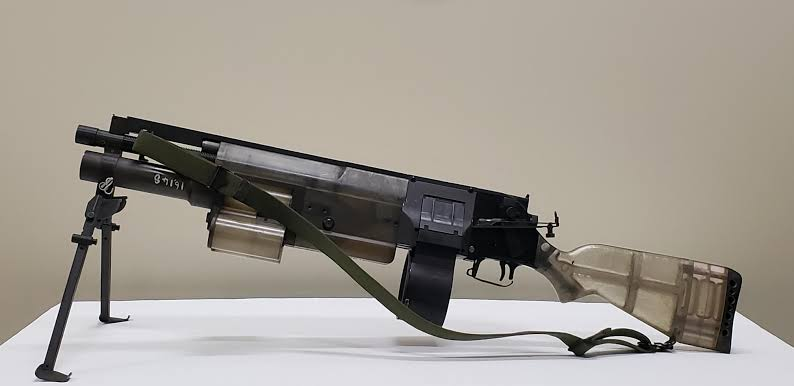
Based on this and prior posts, are you looking at something like Dardick's magnum opus?

1784260704241.png
 
The Army's Advanced Combat Rifle (ACR) competition was over 35 years ago and had some interesting submissions.

The Steyr Arms GmbH ACR was using a 10.4 mm × 45 mm case and a saboted fletchette to throw a 1.6 mm x 41.25 mm and .66 gram carbon steel dart at 4,750 fps all the way back in 1987. It was submitted into the Army's ACR competition that ran 1989-1990. Cartridges weighed 50% less than the 5.56 mm x 45 mm NATO.

AAI Corporation used rounds in the 5.56 mm x 45 mm NATO format with a similar 1.6 mm x 41.27 mm fletchette dart to reach 4,600 fps.
Those flechettes were of very questionable terminal effectiveness, though. Might tumble, J-hook and rip your heart apart and you drop on the spot, or might put two icepick holes in your lung and you barely even slow down till the lung collapses in 15 minutes.


Heckler & Koch submiited caseless ammunition in several competitions. It came in many flavors but began the first submission as a 4.9 mm projectile. It would go through several sizes through development. It was submitted to NATO as a 4.3 mm in 1977. The UK wanted one in 4.85 mm x 45 mm. But NATO standardized the 5.56 mm x 45 mm round in 1980. They submitted a 4.92 mm x 33 mm in the Army ACR competition. H&K caseless rounds were good for about 55,000 psi to propel rounds at near the 3,000 fps mark.
The G11 was not terrible until something went wrong and then the armorer needed to fix it. The US Army has a very different model of what the individual soldier is supposed to be able to fix by himself. And frankly, the internals needed John Browning III to simplify them all before it'd have a chance at US adoption. I swear it's like a Swiss Watch in there.

The major operational fault is that the recoil in hyperburst is enough to knock the soldier off the rifle entirely, like 375H&H magnum recoil levels(!). So the hyperburst wasn't as accurate as advertized, at least in that the shooter could never see their effect on the target.

===========================

Conceptually, the issue with the ACR program was that the US Army was asking for an engineering solution to a lack of training problem. Basic grunts were not getting good enough rifle training for operational events instead of annual rifle qualifications/medal shoots. They now spend far, far more time on a pop-up target range, random(ish) pop-ups and distances not known to the shooter from about 10 yards clear out to 300. And that's how the Army got more than a 100% improvement in combat effectiveness without buying every grunt a new rifle.


It makes me wonder if 5,000 fps couldn't be a realistic target if they first agreed to a common ACR dart and designated cartridge weight, ignition methods, and barrel length of the overall competition. Let the engineers come up with ways to generate single, triple, and fully automatic fire rates.
Except for the dart thing, that's actually what happened with NGSW. Companies were told "launch this 6.8mm, 8-9g projectile at over 900m/s. Rifle with suppressor mounted cannot be more than Xcm long."

I still think someone should have brought out a Springfield M1A chambered in .270 WSM and/or an M1918 BAR chambered in .270 and entered that into the contest. Just to make a point.

 
Those flechettes were of very questionable terminal effectiveness, though. Might tumble, J-hook and rip your heart apart and you drop on the spot, or might put two icepick holes in your lung and you barely even slow down till the lung collapses in 15 minutes.


The G11 was not terrible until something went wrong and then the armorer needed to fix it. The US Army has a very different model of what the individual soldier is supposed to be able to fix by himself. And frankly, the internals needed John Browning III to simplify them all before it'd have a chance at US adoption. I swear it's like a Swiss Watch in there.

The major operational fault is that the recoil in hyperburst is enough to knock the soldier off the rifle entirely, like 375H&H magnum recoil levels(!). So the hyperburst wasn't as accurate as advertized, at least in that the shooter could never see their effect on the target.

===========================

Conceptually, the issue with the ACR program was that the US Army was asking for an engineering solution to a lack of training problem. Basic grunts were not getting good enough rifle training for operational events instead of annual rifle qualifications/medal shoots. They now spend far, far more time on a pop-up target range, random(ish) pop-ups and distances not known to the shooter from about 10 yards clear out to 300. And that's how the Army got more than a 100% improvement in combat effectiveness without buying every grunt a new rifle.


Except for the dart thing, that's actually what happened with NGSW. Companies were told "launch this 6.8mm, 8-9g projectile at over 900m/s. Rifle with suppressor mounted cannot be more than Xcm long."

I still think someone should have brought out a Springfield M1A chambered in .270 WSM and/or an M1918 BAR chambered in .270 and entered that into the contest. Just to make a point.
.276 garand!
 
Based on this and prior posts, are you looking at something like Dardick's magnum opus?
Interesting concept that was truly before its time. It doesn't appear to solve any storage problems with the tround concept. But it is interesting. It kind of reminds me of exotic ideas like cannister disc charges fed separate from the bullet supply. While interesting it doesn't really solve any problems without adding new ones
 
Back
Top Bottom