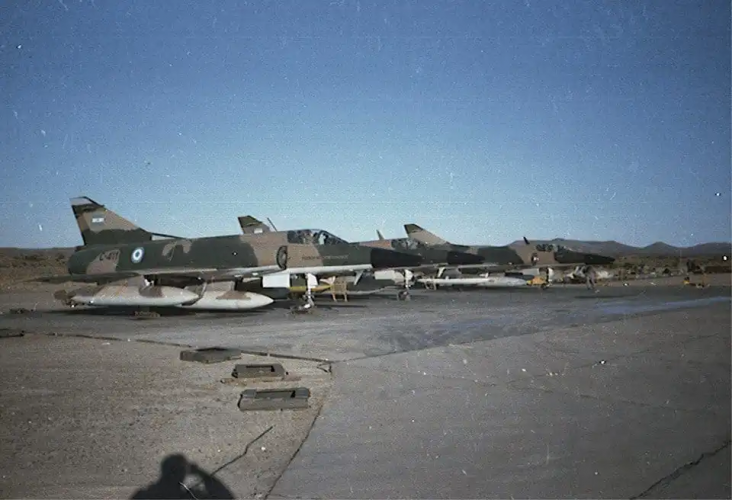
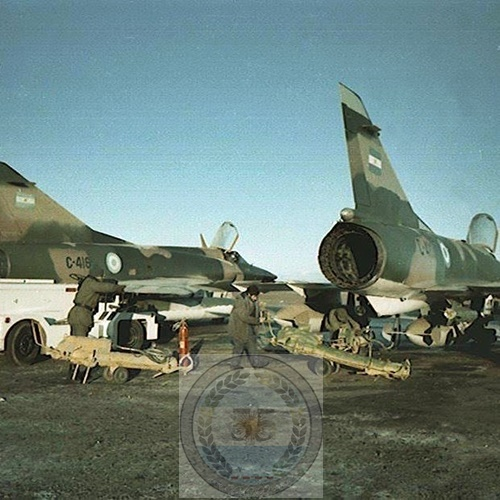
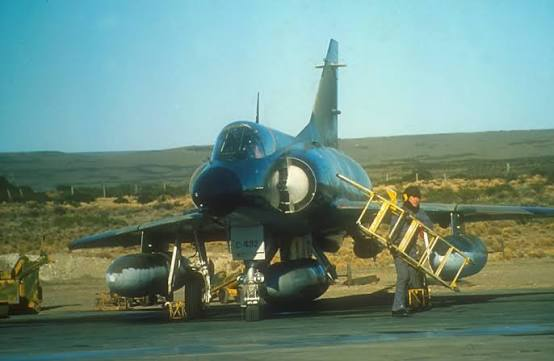
MiG-21MF/bis vs Sea Harriers ?

  • Sea Harriers would have complete air superiority.

  • Sea Harriers would have had some losses.

  • Sea Harriers would have been blasted out of the sky.

  • None of the two aircraft would have gained air superiority.


Results are only viewable after voting.
FWIW tactical aircraft don't fly until they're empty and then refuel from the tanker. The textbook tanker use is to top off the tanks of aircraft before they reach 'bingo' point so they can turn back if the refueling fails, which it does often enough.
More precisely, at least in US usage, the tactical aircraft are constantly topping off so they always have enough fuel to reach a divert field.


Perhaps if Argentina had undertaken significant planning in the years leading up to the war
All 26 pages of this thread, summed up right here.

Argentina failed to plan, so they planned to fail.
 
Argentina failed to plan, so they planned to fail.

That used to be the slogan for financial services ad when I was a teenager.

The thing is planning doesn't cost much if anything at all, it's the sort of thing militaries do all the time, or should do anyway. It's amazing that plans didn't exist for the entire gamut of Falklands invasion and defence, scenarios, perhaps drawn up during officer promotion courses.
 
The thing is planning doesn't cost much if anything at all, it's the sort of thing militaries do all the time, or should do anyway. It's amazing that plans didn't exist for the entire gamut of Falklands invasion and defence, scenarios, perhaps drawn up during officer promotion courses.
The question is "at what level do you have your officers draw up plans?"

For example, the USAF actually requires Lieutenants to do the full wing-scale mission ops planning at Red Flag. Pilots that have just gotten to be flight leaders are exposed to wing commander level planning. So that if all the Majors and LtColonels and even full bird Colonels in the unit are killed, the unit can still fight if they can get birds in the air.

But the RusAF has not done that, the officers getting exposed to wing-scale mission planning are very senior flight leaders, Majors or higher.

And I've noticed a cultural thing among Hispanic forces that tends to not let junior officers do the planning. So at best something like a Malvinas retake would be staff officer training for Majors and higher. Maybe even a LtCol or Colonel training thing.
 
Bear in mind the logistics that would likely be involved not only in doing something like "lengthening" an airstrip but also what would likely be entailed in supporting any additional aircraft, aircrew, support personnel, support equipment, and other general support issues that would likely be required.
The solution to the logistics conundrum would be to use Port Stanley airfield for shuttle operations from the mainland, instead of basing fighters there.

This would involve 2 operational concepts: first 2-6 CAP fighters could take off each morning from the mainland. They would refuel and switch pilots at Port Stanley over the course of the day before returning to base at the end of each day for maintenance. They would be tasked with disrupting the Sea Harriers CAP orbits and attack missions. The logistical support would involve fuel and spare air to air missiles.

Later (once antiship missions start), strike aircraft from the mainland could also land for a quick fuel stop prior to returning to base. This would allow them to carry more bombs and use more fuel on their strike legs to fly less predictable flight paths. No weapons replenishment would be done at Port Stanley, which would simplify the logistics burden.

This would require apron space and fuel mostly, not a lot of maintenance support at Port Stanley. The planes would all be fairly lightly loaded which helps reduce take off and landing distances. The runway would still be too short for Mirages and Daggers but it would work for Skyhawks (especially if brake parachutes were added for wet conditions). Not perfect but likely the most workable concept. Also with better fighter support it’s likely that more transport flights could continue to fly in instead of enduring virtual siege conditions, so that’s how logistics could be sustained.
 
Last edited:
The solution to the logistics conundrum would be to use Port Stanley airfield for shuttle operations from the mainland, instead of basing fighters there.

This would involve 2 operational concepts: first 2-6 CAP fighters could take off each morning from the mainland. They would refuel and switch pilots at Port Stanley over the course of the day before returning to base at the end of each day for maintenance. They would be tasked with disrupting the Sea Harriers CAP orbits and attack missions. The logistical support would involve fuel and spare air to air missiles.

Later (once antiship missions start), strike aircraft from the mainland could also land for a quick fuel stop prior to returning to base. This would allow them to carry more bombs and use more fuel on their strike legs to fly less predictable flight paths. No weapons replenishment would be done at Port Stanley, which would simplify the logistics burden.

This would require apron space and fuel mostly, not a lot of maintenance support at Port Stanley. The planes would all be fairly lightly loaded which helps reduce take off and landing distances. The runway would still be too short for Mirages and Daggers but it would work for Skyhawks (especially if brake parachutes were added for wet conditions). Not perfect but likely the most workable concept. Also with better fighter support it’s likely that more transport flights could continue to fly in instead of enduring virtual siege conditions, so that’s how logistics could be sustained.

The RN Sea Harrier's CAP missions consisted of 25 minutes take-off and transit to station over San Carlos, 20 minutes on CAP station, 25 minutes transit back to the carrier.

When Sid's Strip became available the Sea Harrier's CAP mission became 25 minutes take-off and transit to station over San Carlos, 40 minutes on CAP station, 5 minutes to land at Sid's Strip for 15-20 minute 'hot turnaround', 5 minutes take-off, 40 minutes on CAP station, 25 minutes transit back to the carrier. Vastly more 'productive'.

IIUC the typical Mirage mission was ~55 minutes take-off and transit to CAP station over Port Stanley, ~10 minutes on CAP station, ~55 minutes transit back to the mainland base.

What I think would happen if Port Stanley was extended enough for limited use the typical Mirage mission would be ~55 minutes take-off and transit to CAP station over Port Stanley, ~55 minutes on CAP station, ~10 minutes to land a Port Stanley for 15-30 minute 'hot turnaround' for only 1/2 fuel, ~55 minutes transit back to the mainland base. Vastly more productive, but I don't think the runway would be long enough to allow take-offs with full fuel to allowed a 2nd ~55 minute CAP from Port Stanley, which I think would need a 6,000' runway like the British built postwar.
 
I don't think the runway would be long enough to allow take-offs with full fuel to allowed a 2nd ~55 minute CAP from Port Stanley, which I think would need a 6,000' runway like the British built postwar.
With proper planning Argentina should have gotten its hands on JATO rockets (plentiful supply available) for Mirage operations from Port Stanley.

I bet a pair of JATOs could easily be jury rigged without reinforcement… nothing like the Swiss Mirage IIIRS setup (8 JATOs with 1,000lbf thrust each for 300m take off runs!), but good enough for some additional safety margin for full fuel takeoffs.
 
With proper planning Argentina should have gotten its hands on JATO rockets (plentiful supply available) for Mirage operations from Port Stanley.

I bet a pair of JATOs could easily be jury rigged without reinforcement… nothing like the Swiss Mirage IIIRS setup (8 JATOs with 1,000lbf thrust each for 300m take off runs!), but good enough for some additional safety margin for full fuel takeoffs.

Sure, but I think it would be a pretty big job for a 2nd or 3rd tier Air Force with a very small fleet or Mirage III and Daggers. A country like Australia or Israel could probably do it for their fleets but I think it would be a stretch for Argentina.

In a wider sense has JATO ever been used as the routine method of allowing jets to operate from strips otherwise too short for them? Chu Li in Vietnam comes to mind, but I think that was very short term. Or are they like 'drop' tanks, actually auxiliary tanks that can be dropped in an extreme emergency; JATO rocket might be used every now and then in very difficult circumstances, but not for most or all sorties?
 
Sure, but I think it would be a pretty big job for a 2nd or 3rd tier Air Force with a very small fleet or Mirage III and Daggers. A country like Australia or Israel could probably do it for their fleets but I think it would be a stretch for Argentina.
A stretch, yes, but not a reach too far.

Solid planning should have come up with the possibility. Roll a C130 full of JATO bottles onto the strip early on and it'd be an easy option, but you'd have to train your ground crews to install them and pilots to fly them well ahead of time.


In a wider sense has JATO ever been used as the routine method of allowing jets to operate from strips otherwise too short for them?
IIRC B-47s normally took off with JATO assistance. And I think the P6M was designed for that as well. There's certainly many photos of them doing JATO takeoffs.


Or are [JATO] like 'drop' tanks, actually auxiliary tanks that can be dropped in an extreme emergency; JATO rocket might be used every now and then in very difficult circumstances, but not for most or all sorties?
Depends on the design.

B-47s had internal storage tubes for JATO rockets. C-130s had external mounts for them.
 
Here’s an interesting video on JATO procedures on Swiss Mirage IIIs. Shows how the JATO bottles are tested, loaded and armed, as well as various take offs with different numbers of JATO rockets compared to take offs without JATO.


It should be possible to use the Aussie Mirage IIIO performance manual figures to estimate take off lengths with/without JATO and landing lengths with/without parachutes.
https://onedrive.live.com/?viewid=0...- Community/Other_non_DCS/Dassault Mirage III
 
AIUI the Swiss Mirage III S/RS were a unique version built to meet Swiss requirements. That included strengthening of the airframe and undercarriage to allow them to hoisted within Swiss underground shelters AND to withstand the extra forces imposed on the airframe from JATO take offs. This is noted on the Wiki page and referenced back to the now very old Profile publication

"The Mirage IIIS was with considerably strengthened wings, airframe, and undercarriage as the Swiss Air Force had required robustness comparable to that of carrier-based planes.[38] The reinforced airframes enabled aircraft to be moved by lifting them with a crane (hence the airframes also being fitted with four lifting points, retractable nosecones and lengthened nosewheel legs), as the aircraft caverns in the mountains that Swiss Air Force uses as bunkers offer very little space to maneuver parked aircraft. Another benefit of the strengthened frames was the enabling of JATO-assisted takeoffs, giving the type a short takeoff and landing (STOL) capability.[38]"

Brindley, John (1971). Aircraft Profile 230: Dassault Mirage Variants. Profile Publications. Windsor, Berkshire, UK: Profile Publications Ltd.

This is a link to a copy of the relevant page.
https://boxartden.com/reference/gal...age-Variants/Dassault-Mirage-230-_Page_19-960
 
AIUI the Swiss Mirage III S/RS were a unique version built to meet Swiss requirements. That included strengthening of the airframe and undercarriage to allow them to hoisted within Swiss underground shelters AND to withstand the extra forces imposed on the airframe from JATO take offs.
I’m aware and it’s not surprising that the Swiss Mirages needed local strengthening as each JATO pylon was fitted with 4 bottles delivering 1,800kgp of thrust! That’s had a lot of kick… the 3,600kgp of total thrust almost doubled the aircraft’s net thrust.

What we’re talking about here would be a quarter of that, a single JATO bottle on each side (or even a single JATO bottle fitted to the back of the underfuselage strake which used to house the SEPR rocket booster).
 
OK looking at the Mirage III performance data more closely:
  • Take off weight ~23,000lbs with 2x AIM-9, gun and 2x 600L tanks (~6,500lbs internal fuel)
  • Unstick speed: 172 knots
  • Take-off distance with afterburner in cool temperatures (5-10 degrees C): ~3,000ft (900 meters)
  • Acceleration / net thrust: ~0.44g / 10,000lbf
Each JATO bottle (1,000lbf thrust) will increase acceleration by ~10% and reduce take-off distance by ~10%. Likewise a 10kt headwind component will also reduce take-off distance by ~10%. Typical wind conditions were stable 15 knot westerly winds at Port Stanley.

So Mirage IIIs in standard conditions, air-to-air configuration with full fuel and standard tanks, should be able to take-off in ~750-900m (with/without a single JATO bottle), leaving room to spare on Port Stanley's 1,250m long runway.

I suspect landing was the bigger constraint, especially braking in wet conditions… though a brake parachute would help a lot. Will have to try to estimate that.
 
Last edited:
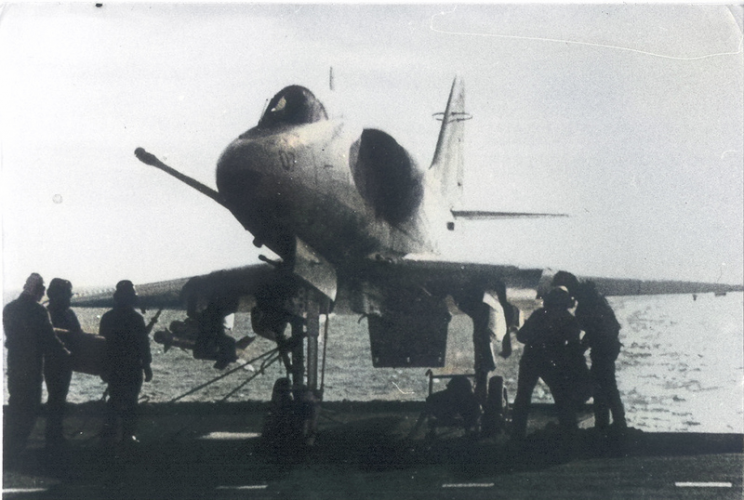
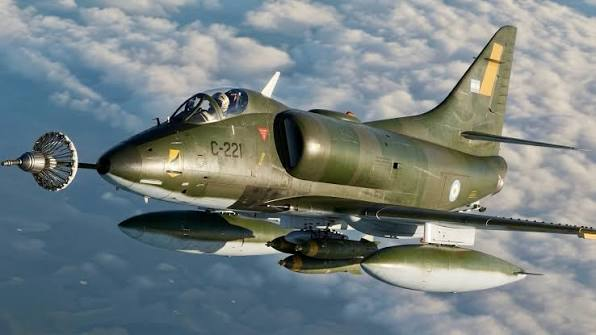
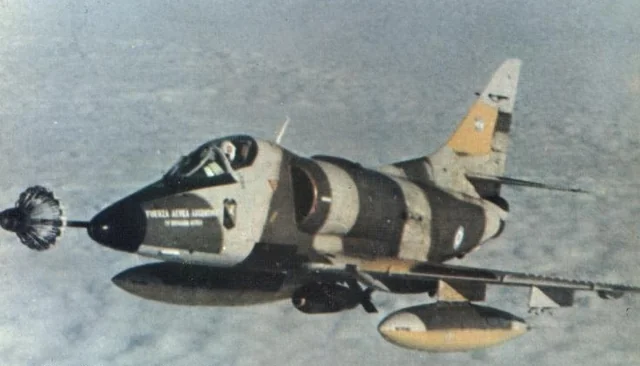
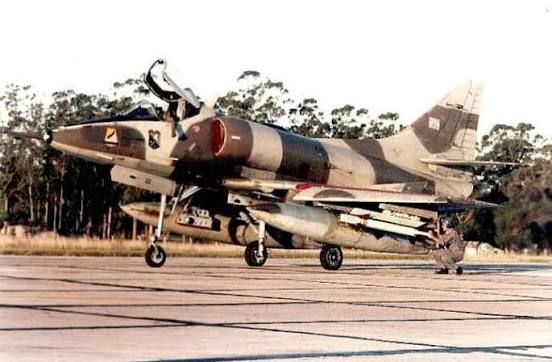
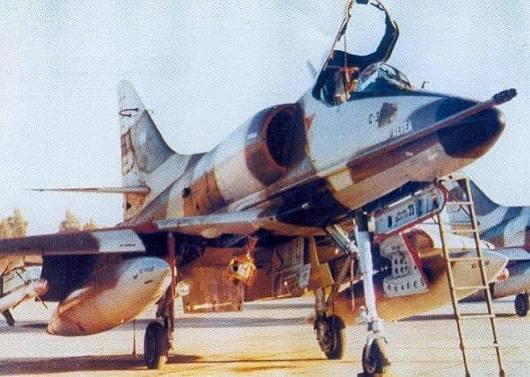
The A-4 specifically could do a very special and usefull trick.
View: https://www.youtube.com/watch?v=JtfHxnJz78E


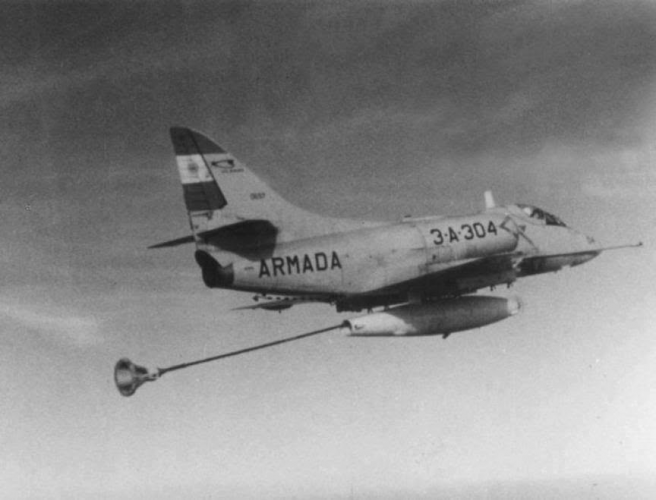
If the argentinians would have taken care to obtain in advance the buddy stores, some "tanker" A-4 could have operated from the mainland in order to support the forward deployed A-4. These tankers would have been almost imposible to be intercepted by the british Harriers.

The A-4 had also sufficient performance in the air-to-air role to fight the british Harriers on decent terms, if armed with decent missiles.
Judging by the Mirages/Daggers performance on the 1st May I doubt the Skyhawks would be a threat

They fired R-530 missiles without solid lock they fired R-530 radar guided missiles in a look down/shoot down situation, with a Mirage 3 that isn't capable to do so. They also fired R-550s (a rear aspect missile) from a frontal aspect. None of their missiles they fired on 1st May guided, they all went ballistic. In their only deciding engagement with Sea Harriers they were flying a very unfavorable welded-wing formation, while the SHAR were flying a combat spread. It cost them both aircraft.
 
Last edited:
While that could have made the Falklands conflict more difficult, Harrier GR3's, coming in "under the radar" and popping up at the last minute to attack the airfield at night, was just the sort of thing that they had trained for in Germany against a far denser anti-aircraft environment.

The Argentines had just a few weeks, under frequent bombardment from Harriers and naval gunfire, before their disgraceful early surrender. It wasn't on the cards.
 
FWIW tactical aircraft don't fly until they're empty and then refuel from the tanker. The textbook tanker use is to top off the tanks of aircraft before they reach 'bingo' point so they can turn back if the refueling fails, which it does often enough.

A buddy equipped A4 could realistically have topped off 2 lightly loaded A4s, which at best only slightly increases the weight of an attack. A KC130 could service 6-8 A4s with larger payloads, which provides a decent sized attack wave.

Perhaps if Argentina had undertaken significant planning in the years leading up to the war the best use of the buddy pods might have been by their Canberras, as they carry more fuel than the A4 and might also be equipped with a long-range fuel tank in the bomb bay. A Canberra might be able to service 2 A4s with large bomb-loads and 3 with smaller loads, and 2 Canberra could support a reasonable attack.
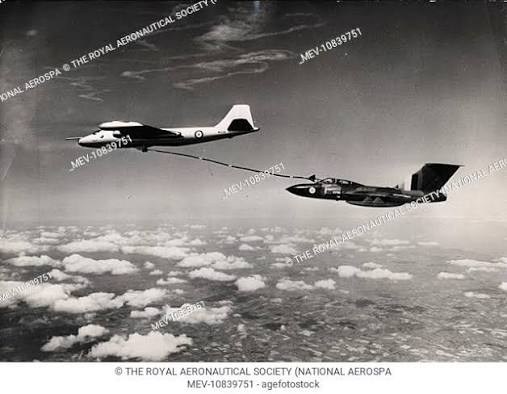
Wasn't the Canberra tested as an aerial tanker at some point ? with a refueling kit in the bomb bay ?
 
While that could have made the Falklands conflict more difficult, Harrier GR3's, coming in "under the radar" and popping up at the last minute to attack the airfield at night, was just the sort of thing that they had trained for in Germany against a far denser anti-aircraft environment.

The Argentines had just a few weeks, under frequent bombardment from Harriers and naval gunfire, before their disgraceful early surrender. It wasn't on the cards.
That was tried and achieved almost nothing.

The low level toss bombing attacks against Port Stanley airport either missed their targets or achieved superficial damage, at very high risk due to the effective Roland SAM defenses. The RN’s gun bombardments would have been too dangerous if Argentina had more Exocets or aircraft shuttling in with AS-30s.
 
OK looking at the Mirage III performance data more closely:
  • Take off weight ~23,000lbs with 2x AIM-9, gun and 2x 600L tanks (~6,500lbs internal fuel)
  • Unstick speed: 172 knots
  • Take-off distance with afterburner in cool temperatures (5-10 degrees C): ~3,000ft (900 meters)
  • Acceleration / net thrust: ~0.44g / 10,000lbf
Each JATO bottle (1,000lbf thrust) will increase acceleration by ~10% and reduce take-off distance by ~10%. Likewise a 10kt headwind component will also reduce take-off distance by ~10%. Typical wind conditions were stable 15 knot westerly winds at Port Stanley.

So Mirage IIIs in standard conditions, air-to-air configuration with full fuel and standard tanks, should be able to take-off in ~750-900m (with/without a single JATO bottle), leaving room to spare on Port Stanley's 1,250m long runway.

I suspect landing was the bigger constraint, especially braking in wet conditions… though a brake parachute would help a lot. Will have to try to estimate that.
What are the drag effects for air combat of carrying the dead weight of the empty JATO bottles. From that video they don't appear to able to be jettisoned.
 
OK looking at the Mirage III performance data more closely:
  • Take off weight ~23,000lbs with 2x AIM-9, gun and 2x 600L tanks (~6,500lbs internal fuel)
  • Unstick speed: 172 knots
  • Take-off distance with afterburner in cool temperatures (5-10 degrees C): ~3,000ft (900 meters)
  • Acceleration / net thrust: ~0.44g / 10,000lbf
Each JATO bottle (1,000lbf thrust) will increase acceleration by ~10% and reduce take-off distance by ~10%. Likewise a 10kt headwind component will also reduce take-off distance by ~10%. Typical wind conditions were stable 15 knot westerly winds at Port Stanley.

So Mirage IIIs in standard conditions, air-to-air configuration with full fuel and standard tanks, should be able to take-off in ~750-900m (with/without a single JATO bottle), leaving room to spare on Port Stanley's 1,250m long runway.

I suspect landing was the bigger constraint, especially braking in wet conditions… though a brake parachute would help a lot. Will have to try to estimate that.

Argentine Mirages operating from the mainland didn't use the supersonic wing tanks, 500l mounted on a very short pylon, a very low drag and light setup. They used the big 1,700l ferry tanks mounted on a long pylon, far more drag and weight. Supersonic tanks and JATO would basically mean Mirages would be based at Port Stanley rather than shuttle operations from the mainland.
 
Wasn't the Canberra tested as an aerial tanker at some point ? with a refueling kit in the bomb bay ?

I don't know about that, but RAAF Canberra B20s in the 1953 London to Christchurch air race had bomb bay fuel tanks holding an extra 6,100 litres of fuel in addition to the 6,200 litres of internal fuselage fuel. The standard 1,100l wingtip tanks were removed to reduce drag for the race. RAAF Canberras were later retro-fitted with a 'wet wing' that added 4,000 litres of internal fuel, an a wing pylon for a bomb.

Argentina's Canberras were ex-RAF B2s without the RAAF's wet wing, so carried about 8,500l in the fuselage and external wingtip tanks. By my reckoning if the bomb bay was fitted with the air race fuel tank and one wingtip tank was replaced by a buddy refueling store an Argentine Canberra could have ~13,400 litres of fuel and maybe offload 1/2-2/3 of that if kept on a short leash.
 
Judging by the Mirages/Daggers performance on the 1st May I doubt the Skyhawks would be a threat

They fired R-530 missiles without solid lock they fired R-530 radar guided missiles in a look down/shoot down situation, with a Mirage 3 that isn't capable to do so. They also fired R-550s (a rear aspect missile) from a frontal aspect. None of their missiles they fired on 1st May guided, they all went ballistic. In their only deciding engagement with Sea Harriers they were flying a very unfavorable welded-wing formation, while the SHAR were flying a combat spread. It cost them both aircraft.
I would not dismiss the A-4 as a threat in air to air mode. It is a very maneuvrable dogfigther, let`s not forget that the americans used it as a disimilar air combat threat at Top Gun, against the best Navy fighters, right at the period of the Falkland conflict. And it constantly made kills.
https://nationalinterest.org/blog/buzz/heres-why-a-4-skyhawk-made-such-good-enemy-plane-hk-122625

It has comparable speed performance, while beeing lighter and with a bigger wing area as the Harrier. It has an excellent instantaneous turn rate. This makes the A-4 a very dangerous close range gunfighter. The difference in the air combat win rate over Falkland resulted mainly because the pilot training, not the machines.
 
I would not dismiss the A-4 as a threat in air to air mode. It is a very maneuvrable dogfigther, let`s not forget that the americans used it as a disimilar air combat threat at Top Gun, against the best Navy fighters, right at the period of the Falkland conflict. And it constantly made kills.
https://nationalinterest.org/blog/buzz/heres-why-a-4-skyhawk-made-such-good-enemy-plane-hk-122625

It has comparable speed performance, while beeing lighter and with a bigger wing area as the Harrier. It has an excellent instantaneous turn rate. This makes the A-4 a very dangerous close range gunfighter. The difference in the air combat win rate over Falkland resulted mainly because the pilot training, not the machines.

IIUC Argentine A4s at best had the Aim9B, a very limited AAM. If A4s had turned to face the attacking Sea Harriers they'd have no choice but to land at Port Stanley, which makes them very vulnerable to attack on the ground from Harriers and naval guns.
 
I don't know about that, but RAAF Canberra B20s in the 1953 London to Christchurch air race had bomb bay fuel tanks holding an extra 6,100 litres of fuel in addition to the 6,200 litres of internal fuselage fuel. The standard 1,100l wingtip tanks were removed to reduce drag for the race. RAAF Canberras were later retro-fitted with a 'wet wing' that added 4,000 litres of internal fuel, an a wing pylon for a bomb.

Argentina's Canberras were ex-RAF B2s without the RAAF's wet wing, so carried about 8,500l in the fuselage and external wingtip tanks. By my reckoning if the bomb bay was fitted with the air race fuel tank and one wingtip tank was replaced by a buddy refueling store an Argentine Canberra could have ~13,400 litres of fuel and maybe offload 1/2-2/3 of that if kept on a short leash.
IIRC the Argentinian AF attempted a long range two Canberra sortie against RN ships involved in retaking South Georgia. For that they had an additional bomb bay fuel tank with weapons limited to two 1,000lb bombs on underling hardpoints. Mission aborted due to weather.
 
IIRC the Argentinian AF attempted a long range two Canberra sortie against RN ships involved in retaking South Georgia. For that they had an additional bomb bay fuel tank with weapons limited to two 1,000lb bombs on underling hardpoints. Mission aborted due to weather.

There you go, all the ingredients are there for Canberra buddy tankers if someone had thought of it.

How would good planning, without extra funds and geopolitical circumstances to buy much if any equipment, have covered the drastic lack of Maritime Patrol aircraft?
 
IIUC Argentine A4s at best had the Aim9B, a very limited AAM. If A4s had turned to face the attacking Sea Harriers they'd have no choice but to land at Port Stanley, which makes them very vulnerable to attack on the ground from Harriers and naval guns.
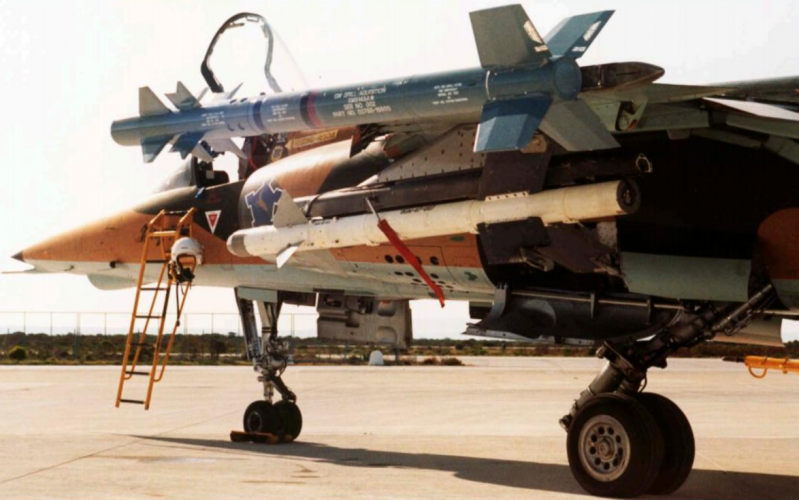
The Navy A-4Q could carry the AIM-9B on the outboard wing pylons. A-4Q had 5 hardpoints. Under fuselage pylon for weapons. In board wing pylons for drop tanks. AIM-9B was fitted for air defence missions from the 25th De Mayo. Argentina received 16 of these but only 10 or so were available in 1982.

The Air Force A-4B/C only had 3 pylons. Under fuselage for weapons and wing pylons needed for drop tanks.
 
The Navy A-4Q could carry the AIM-9B on the outboard wing pylons. A-4Q had 5 hardpoints. Under fuselage pylon for weapons. In board wing pylons for drop tanks. AIM-9B was fitted for air defence missions from the 25th De Mayo. Argentina received 16 of these but only 10 or so were available in 1982.

The Air Force A-4B/C only had 3 pylons. Under fuselage for weapons and wing pylons needed for drop tanks.
Wrong
Hi Ewens
This are the pylons configuration
A-4B 3 pylons , like the A-4Q
The C 5 pylons

A-4Q
1785964360906.png
a-4B
1785964467947.png

a-4c
1785964524110.png

Post war test
1785964679688.png

1785964721939.png
 
What are the drag effects for air combat of carrying the dead weight of the empty JATO bottles. From that video they don't appear to able to be jettisoned.
Drag would certainly be significant with the full 8 bottles. However, the entire JATO pylon could be jettisoned before combat, otherwise aircraft would return with the pylon and attached bottles.

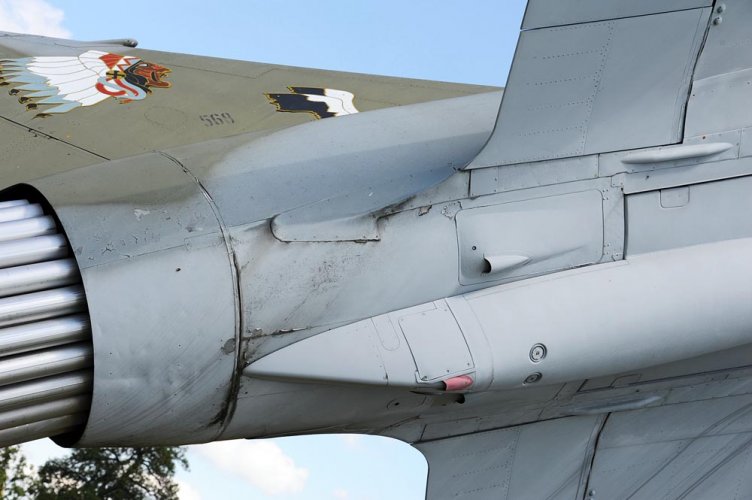
IMHO for Port Stanley a single JATO bottle rigged on the back of the tail strake containing the rocket bay tank would add a nice enough boost (+10% take off thrust), with installation being simplified as that is the same location where the SEPR rocket booster was fitted... see pic attached of the tail fairing.

Argentine Mirages operating from the mainland didn't use the supersonic wing tanks, 500l mounted on a very short pylon, a very low drag and light setup. They used the big 1,700l ferry tanks mounted on a long pylon, far more drag and weight. Supersonic tanks and JATO would basically mean Mirages would be based at Port Stanley rather than shuttle operations from the mainland.
You wouldn't need 1,700L tanks for a 1-way flight from the mainland to Port Stanley. Based on pilot's manual fuel consumption figures, a Mirage III with 2x AIM-9s and 2x 500L tanks (~3,725L total fuel) could fly the 430nm from Rio Gallegos to Port Stanley and arrive overhead with ~1,900L remaining. Land at Port Stanley, quick turnaround to fill the tanks, then start combat operations.

If weather was bad, there would be enough fuel for 1 landing attempt at Port Stanley, bingo fuel at 1,800L, and then max economy climb and cruise back to Rio Grande (slightly closer at 380nm) arriving with ~600L overhead.
 

Attachments

  • Mirage III rocket bay tank.jpg
    Mirage III rocket bay tank.jpg
    102 KB · Views: 5
Drag would certainly be significant with the full 8 bottles. However, the entire JATO pylon could be jettisoned before combat, otherwise aircraft would return with the pylon and attached bottles.

IMHO for Port Stanley a single JATO bottle rigged on the back of the tail strake containing the rocket bay tank would add a nice enough boost (+10% take off thrust), with installation being simplified as that is the same location where the SEPR rocket booster was fitted... see pic attached of the tail fairing.


You wouldn't need 1,700L tanks for a 1-way flight from the mainland to Port Stanley. Based on pilot's manual fuel consumption figures, a Mirage III with 2x AIM-9s and 2x 500L tanks (~3,725L total fuel) could fly the 430nm from Rio Gallegos to Port Stanley and arrive overhead with ~1,900L remaining. Land at Port Stanley, quick turnaround to fill the tanks, then start combat operations.

If weather was bad, there would be enough fuel for 1 landing attempt at Port Stanley, bingo fuel at 1,800L, and then max economy climb and cruise back to Rio Grande (slightly closer at 380nm) arriving with ~600L overhead.
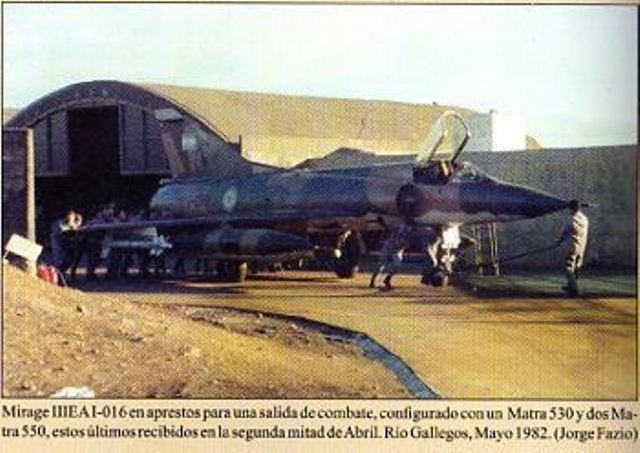
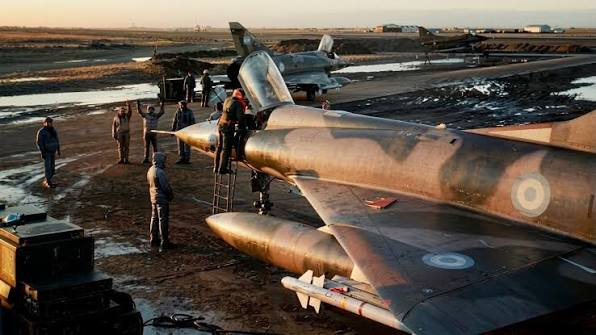
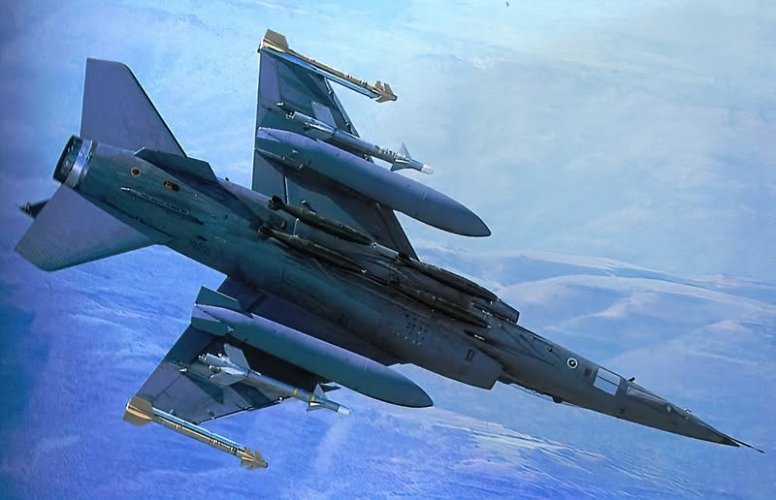
Mirage III for a sortie on the war
1785966084032.png
1 Marta 530
2 Marta 550
2 1700lts drops tank
You can provably asume, that perhaps the 530, later was remove
1785966859716.png


Dagger
attack rol
configuration

1785966217930.png
3 x 1500lts drop tank
2 bombs
1785966256285.png

1785966310370.png
Air to air
1785966655139.png
 
Last edited:
Agree with Canberra like this
1785966992659.png
But we need a fighter jet that can use that, to try to dispute the Air over the Islands, and attack the ships, apart of A-4
No dagger
Equal number of F-1AZ
From Wiki

Mirage F1A​

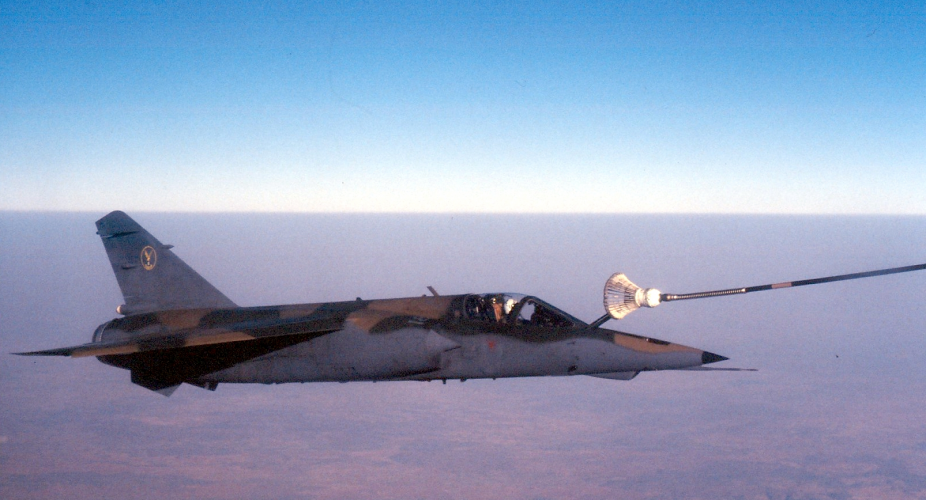
Single-seat ground-attack fighter aircraft, with limited daylight-only air-to-air capability. Fitted with lightweight EMD AIDA 2 ranging radar instead of Cyrano IV of other variants, with laser rangefinder under nose, retractible refuelling probe and more fuel.[113][114]
  • Mirage F1AZ : F1A for South Africa. 32 delivered 1975–1976


1785968154902.png
1785968088834.png
4 550 an the drops tanks and refueling from Canberra
1785968252962.png
 
Last edited:
So, buddy stores existed in ArgMil system. They had bay tanks for Canberra. Did ArgAF have buddy tanks as wel as ArgNavy? Because if ArgAF had enough buddy tanks, that's a really spectacular failure to plan.

How much fuel could a Canberra with bay tank, tip tanks, and 2x buddy stores carry to the Malvinas and still safely get home?
(Note: I'm actually on the UK side of this discussion, everyone on the islands speaks English not Argentine Spanish, but I'm trying to write as a Field-Grade officer on Argentine side for practice.)
 
So, buddy stores existed in ArgMil system. They had bay tanks for Canberra. Did ArgAF have buddy tanks as wel as ArgNavy? Because if ArgAF had enough buddy tanks, that's a really spectacular failure to plan.

How much fuel could a Canberra with bay tank, tip tanks, and 2x buddy stores carry to the Malvinas and still safely get home?
(Note: I'm actually on the UK side of this discussion, everyone on the islands speaks English not Argentine Spanish, but I'm trying to write as a Field-Grade officer on Argentine side for practice.)
The Canberra there was a test
I dont know the numbers
Not buddy tank, but IFR. so you can refueling with another Canberra.
No idea how many arrives to the country.
1785978323343.png
But remeber the a-4q were 8 in total.
I prefer converted the Canberra.
But again, we need planes that can refuling, so in and out of the Islands to attack the forces from diferents routes. apart of the A-4
An a fighter to at least try to dispute the air.
My favorite
1785978528502.png
1785978592545.png
Bought before the embargo
 
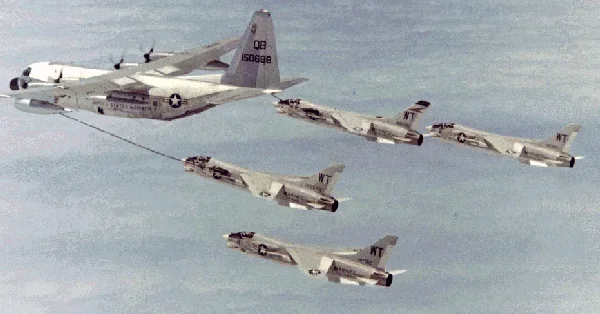
I thought I remembered the ArgAF having KC-130 tankers on them!

Getting another couple of KC-130 hose reels would really help out. And like I'm trying to figure out, it may be better to hang the KC-130 hose reels on the Canberra. Depends on which bird can transfer more fuel.

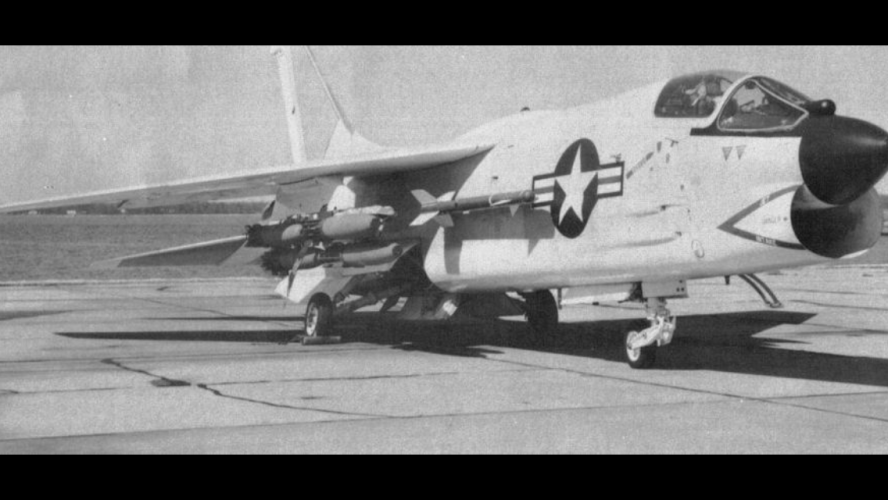
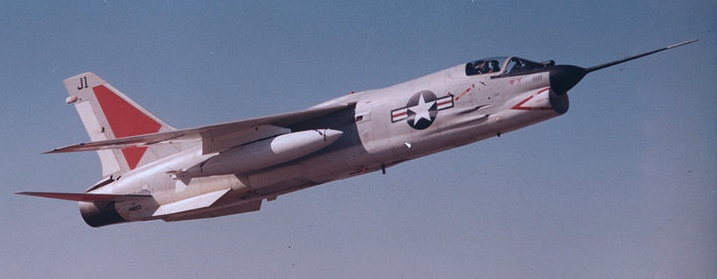
If the Argentine military could buy some F-8s in the 1960s or 70s, that would absolutely ruin the Brits' day. Because I think the Ferry Range spec for the F-8 is with full cannon ammo and at least 2 Sidewinders. So that's an easy combat radius with external tanks of around 500nmi assuming heavy combat and fuel use, up to 750nmi for an out-and-back with no fighting.
 
Did ArgAF have buddy tanks as wel as ArgNavy?

I doubt it since they had the 2 KC130s which ostensibly cover the IFR requirement.

How much fuel could a Canberra with bay tank, tip tanks, and 2x buddy stores carry to the Malvinas and still safely get home?

A Canberra isn't big enough to make 2 buddy pods worthwhile, the receiver aircraft would be too close together and risk a collision. Additionally the buddy store would displace one of the external tanks, unless the HDU was integrated into the bomb bay tank like the photo above.

The tanker doesn't need to make it to the Falklands, rather it needs to make it out to maybe 200 miles from the coast to top p the A4 tanks.

Getting another couple of KC-130 hose reels would really help out. And like I'm trying to figure out, it may be better to hang the KC-130 hose reels on the Canberra. Depends on which bird can transfer more fuel.

The KC-130 tanker configuration carries a removable 3,600 US gallon stainless steel fuselage tank inside its cargo compartment for dedicated transfer fuel, plus whatever can be spared from the internal and wing tanks.
 
You wouldn't need 1,700L tanks for a 1-way flight from the mainland to Port Stanley. Based on pilot's manual fuel consumption figures, a Mirage III with 2x AIM-9s and 2x 500L tanks (~3,725L total fuel) could fly the 430nm from Rio Gallegos to Port Stanley and arrive overhead with ~1,900L remaining. Land at Port Stanley, quick turnaround to fill the tanks, then start combat operations.

If weather was bad, there would be enough fuel for 1 landing attempt at Port Stanley, bingo fuel at 1,800L, and then max economy climb and cruise back to Rio Grande (slightly closer at 380nm) arriving with ~600L overhead.

IIUC you're thinking of a pair of short CAPs, maybe ~20 minutes each, plus the mainland transit flights.

I'm thinking a single long CAP and making the transit back to the mainland purely a ferry flight.
 
IIUC you're thinking of a pair of short CAPs, maybe ~20 minutes each, plus the mainland transit flights.

I'm thinking a single long CAP and making the transit back to the mainland purely a ferry flight.
Not quite. What I'm thinking is the first flight each day is just a shuttle flight from the mainland to Port Stanley. Followed by 2-3 normal ~1hr CAP missions from the forward air base.

The fighters would fly in from Rio Gallegos, land at Port Stanley, refuel, and take-off again for their first CAP. They would land again, refuel, stand alert at the runway threshold until their next CAP slot, then fly again, return, refuel and so on. Switching out pilots over the course of the day and shuttling back to the mainland directly after their 2nd or 3rd CAP. Ideally things would be arranged so that there's always a CAP in the air and an alert pair on the ground from sunrise to sunset (~9 hour days). With double CAPs at dawn and anytime radar reports significant enemy activity. Perhaps one pair would stay overnight for night time intercepts (Black Buck raids) and to cover the first pre-dawn launch.

10-12 CAPs per day x 2 aircraft = 20-24 CAP sorties per day plus the shuttle flights in and out. You'd need to allocate 8 operational fighters at Rio Gallegos each morning to sustain this, though in practice weather constraints would probably reduce the number of CAP sorties actually scheduled or flown, and only on good weather days would all fighters shuttle to Port Stanley.
 
I doubt it since they had the 2 KC130s which ostensibly cover the IFR requirement.


A Canberra isn't big enough to make 2 buddy pods worthwhile, the receiver aircraft would be too close together and risk a collision. Additionally the buddy store would displace one of the external tanks, unless the HDU was integrated into the bomb bay tank like the photo above.

The tanker doesn't need to make it to the Falklands, rather it needs to make it out to maybe 200 miles from the coast to top p the A4 tanks.


The KC-130 tanker configuration carries a removable 3,600 US gallon stainless steel fuselage tank inside its cargo compartment for dedicated transfer fuel, plus whatever can be spared from the internal and wing tanks.
Rule
The best opition
by far
a couple of Kc-130 more
H o F, dosent matter
 
I thought I remembered the ArgAF having KC-130 tankers on them!

Getting another couple of KC-130 hose reels would really help out. And like I'm trying to figure out, it may be better to hang the KC-130 hose reels on the Canberra. Depends on which bird can transfer more fuel.

If the Argentine military could buy some F-8s in the 1960s or 70s, that would absolutely ruin the Brits' day. Because I think the Ferry Range spec for the F-8 is with full cannon ammo and at least 2 Sidewinders. So that's an easy combat radius with external tanks of around 500nmi assuming heavy combat and fuel use, up to 750nmi for an out-and-back with no fighting.
Drop tank was test but never usues on F-8
1786051125659.png

from here
https://thanlont.blogspot.com/2013/03/a-brief-history-of-f8u-crusader-armament.html
 
Not quite. What I'm thinking is the first flight each day is just a shuttle flight from the mainland to Port Stanley. Followed by 2-3 normal ~1hr CAP missions from the forward air base.

The fighters would fly in from Rio Gallegos, land at Port Stanley, refuel, and take-off again for their first CAP. They would land again, refuel, stand alert at the runway threshold until their next CAP slot, then fly again, return, refuel and so on. Switching out pilots over the course of the day and shuttling back to the mainland directly after their 2nd or 3rd CAP. Ideally things would be arranged so that there's always a CAP in the air and an alert pair on the ground from sunrise to sunset (~9 hour days). With double CAPs at dawn and anytime radar reports significant enemy activity. Perhaps one pair would stay overnight for night time intercepts (Black Buck raids) and to cover the first pre-dawn launch.

10-12 CAPs per day x 2 aircraft = 20-24 CAP sorties per day plus the shuttle flights in and out. You'd need to allocate 8 operational fighters at Rio Gallegos each morning to sustain this, though in practice weather constraints would probably reduce the number of CAP sorties actually scheduled or flown, and only on good weather days would all fighters shuttle to Port Stanley.

I'm catching what you're throwing. The next questions are could the Argentines physically mount such an effort if the facilities were available, and what facilities are required and could the Argentine provide them.

In terms of Mirage III effort IIUC 1 May was the busiest day, with 4 x 2 ship Mirage missions and 4 x 2 ship and a single ship Dagger mission. This was with the 11 ship Mirage III and 32 ship Dagger fleet, the idea being to give the impression of continuous coverage. It resulted in 2 Mirage and 3 Dagger being shot down. Overall the Argentine combat jet fleet, on the days they did fly, generally flew 1 mission per day per plane or less and had a high rate of mechanical aborts.

While I wouldn't consider your ConOps to be equivalent to say 3 missions per plane per day, I'd put it at well over one an perhaps the equivalent of two, which is a far higher level of effort than the Argentines were able to achieve historically.

As for the facilities, I'd think it could be done in terms of what the Argetines could provide in terms of runway and an arrestor wire in a short time period, they could probably stretch Port Stanley out to ~5,000' with what the materials and time they had available. Where I think they'd struggle is providing runway access, hardstand with protective revetments for up to 8 irreplaceable fighters, turning loops to enable the launch of fighters in CAP pairs. Mirages sitting on the ground at alert 5 would be prime targets for attack on the ground.

The Falklands is tricky from every angle you look at it, especially for such a short, limited war.
 
Last edited:
@Rule of cool Yes the crux is that Argentina didn’t prepare for the conflict. They lacked the training and ability to sustain sorties to properly use what they already had… all of that would have to be addressed with funding and proper planning. Only then would it make sense to fix some of the equipment gaps.

As for Port Stanley you wouldn’t need anywhere like that much infrastructure with only 4 fighters on the ground at any time. Just metal matting for a pair of alert spots at the runway threshold, some matting at the runway end to help aircraft temporarily clear the runway after landing, and a hardstand area with 2 spots for quick turnaround (refuel & a few AIM-9 missile containers nearby). With so few sorties, pairs of fighters could taxi on the runway without blocking it for very long.

Protective revetments would be a nice to have, but not absolutely necessary. Given the low effectiveness of Harrier strikes and the presence of at most 2 widely dispersed pairs of fighters, it’s unlikely more than 1 or 2 could be hit. And that would be an acceptable risk considering the alternative which is to not have fighters at all, wasting the Mirages’ potential.

I think the infrastructure requirements do increase if you want the ability to simultaneously refuel strike aircraft, as even small numbers of strike aircraft (2-6 at a time) would eat up runway and hardstand availability as well as increasing fuel logistical requirements.
 
Back
Top Bottom